Seabed prospectors
pp. 67-69 · Read in the full issue

Tradewinds
Seabed prospectors waiting for Law of the Sea nod
Sowr/z Pacific Island countries will probably have to wait a long time before a share of the wealth from mineral rich no dules on the bed of the Pacific Ocean comes their way, reports Robert Keith-Reid from Suva.
The big trouble, say University of Hawaii scientist Dr James Andrews is that the richest no dule fields are in the northeast Pacific, well outside the 200-mile economic zones which most island nations should have in force this wear.
Test mining of the nodules began in 5500 m of water 1800 km southeast of Hawaii in March last year. But it was soon broken off, not because of lack of success, but because of inter national political wrangling which may ultimately lead to an indirect windfall from the nodules for the islands.
Ocean Management Inc, a US-West German-Canadian-
Japanese consortium operating
the experimental sea mining
ship Sedco 445, said it was suspending work ‘because of the uncertain outlook for nickel and copper markets, and
the uncertainty of the legal and
fiscal regimes under which
Jeep-sea mining would oper
ite’.
More simply. Ocean Man igement and other consor iums are scared to start mining )n a commercial scale in case
hey find their costly, complex
hips being seized by an inter
lational authority which 77
leveloping countries say hould have almost absolute ontrol over seabed mining in ntemational waters.
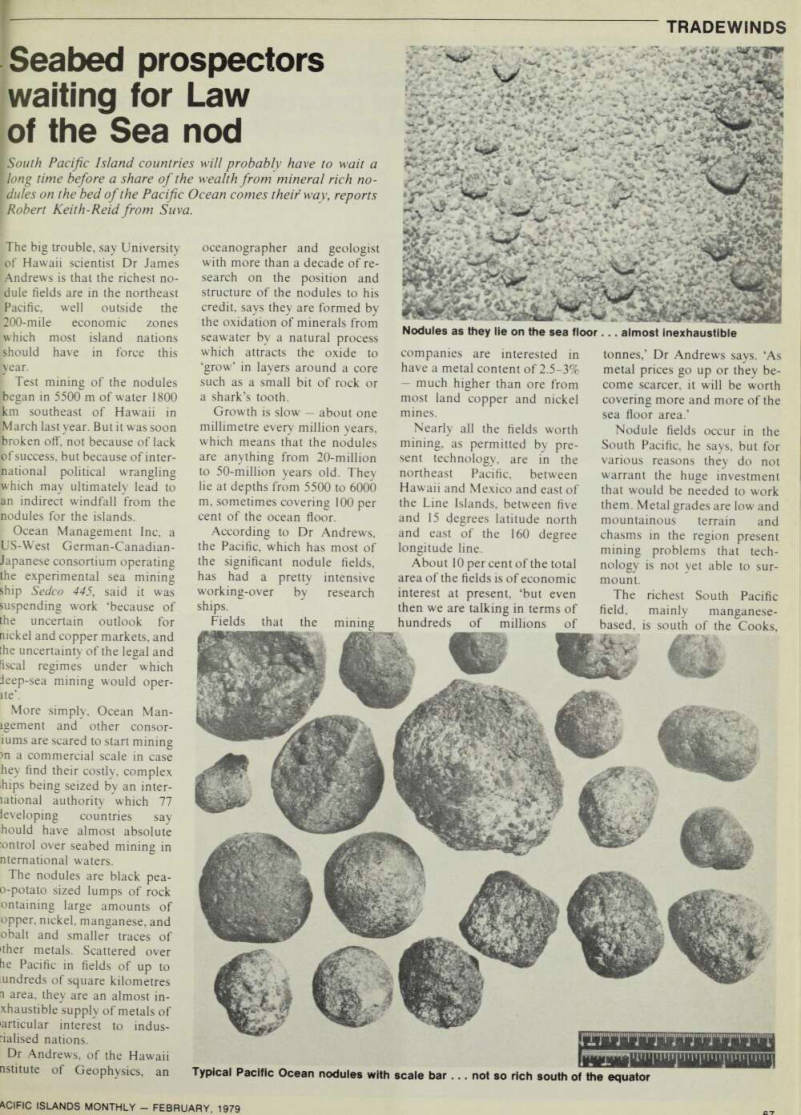
The nodules are black pea o-potato sized lumps of rock
ontaining large amounts of
upper, nickel, manganese, and obalt and smaller traces of •ther metals. Scattered over tie Pacific in fields of up to undreds of square kilometres n area, they are an almost in xhaustible supply of metals of articular interest to indus "ialised nations.
Dr Andrews, of the Hawaii
nstitute of Geophysics, an
oceanographer and geologist
with more than a decade of re search on the position and structure of the nodules to his credit, says they are formed by the oxidation of minerals from seawater by a natural process which attracts the oxide to ‘grow’ in layers around a core such as a small bit of rock or a shark’s tooth.
Growth is slow about one millimetre every million years, which means that the nodules are anything from 20-million to 50-million years old. They lie at depths from 5500 to 6000 m, sometimes covering 100 per cent of the ocean floor.
According to Dr Andrews, the Pacific, which has most of the significant nodule fields, has had a pretty intensive
working-over by research
ships.
Fields that the mining
companies are interested in have a metal content of 2.5-3% much higher than ore from most land copper and nickel mines.
Nearly all the fields worth mining, as permitted by pre sent technology, are in the northeast Pacific, between Hawaii and Mexico and east of the Line Islands, between five and 15 degrees latitude north and east of the 160 degree
longitude line.
About 10 per cent of the total area of the fields is of economic interest at present, ‘but even then we are talking in terms of hundreds of millions of
tonnes,’ Dr Andrews says. ‘As metal prices go up or they be come scarcer, it will be worth covering more and more of the sea floor area.’
Nodule fields occur in the South Pacific, he says, but for various reasons they do not warrant the huge investment that would be needed to work them. Metal grades are low and mountainous terrain and chasms in the region present
mining problems that tech
nology is not yet able to sur mount.
The richest South Pacific field, mainly manganese based, is south of the Cooks,
Typical Pacific Ocean nodules with scale bar . . . not so rich south of the equator
Nodules as they lie on the sea floor. . . almost inexhaustible
with nodules having only 0.4% ‘ nickel and 0.3% copper - far I too low to make them viable at
I present.
f ‘As metal prices rise and ■ mining techniques improve, fields like the Cooks may be [come feasible,’ Dr Andrews says, ‘but it could take 50
[years.”
Six American companies have alone spent at least SUSISO million on sea mining so far. Kennecott, the US cop per giant, estimates that by 1980 total world investment will have climbed to $2BOO million.
At least four international mining consortiums have been formed by various combi nations of US, British, Ger man, Japanese, Dutch, Belgian, Canadian and Aus tralian companies.
Sedco 445 owned by a partnership of Inco Ltd of Canada, Sedco Inc of the USA,
Domco, a 23-company Japan
ese consortium led by Sumi tomo, and the West German
companies Preussag, Metall
gesellschaft, Salzgitter and
Rheinische Braunkohelnwerke is the first ship to attempt the large scale nodule recovery.
The 20,000-tonne converted oil-driller, on its second trip,
successfully dropped a sledge
type collector device which scooped up the nodules into a pipe which sucked them up into the ship’s holds.
Dr Andrews hailed the tests as ‘very significant’. He said: ‘lt’s the first recovery that I know of from the deep oceans by one of these systems. This is good news. It means that the technology has been demon strated.’
But when Sedco 445 got back to port last year the consortium announced the suspension of the trials due to the ‘uncertain outlook’ for the copper and nickel markets and the poten tial international political headache that might be caused in mining them.
What the consortium was concerned about was the sev enth session of the United Nations Law of the Sea Con ference which was opening in Geneva, Switzerland.
Under present international law the nodule fields are there for anyone to mine. But the UN conference has over the years come up with a general, but not yet formalised, agree ment that the nodules should be a resource owned and ex ploited for the benefit of man kind in general. It also advocates that sea mining in in ternational areas should be entrusted to the control of an
international authority. (Fiji is
offering to be headquarters for such a body.) However, major indus-
trialised countries, led by America, are digging their heels in at suggestions by the ‘group of 77’ that the authority should have almost absolute control over mining, and that within 25 years practically all wealth derived from such mining should be directed to financing Third World
development.
The Americans especially don’t like the rather democratic proposal that decisions of the seabed authority should be made on the basis of ‘one nation, one vote’. This would mean that all international ocean areas would be governed by decisions of an organisation in which, by their numbers, dozens of small countries would hold sway. This, predic
tably, the Americans won’t accept. They also want more liberal arrangements to allow capital to get cracking with seabed mining with the assur ance that they will be earning a secure return.
Geneva observers believed the Law of the Sea Conference would break up, unable to agree. They were right. It ad
journed inconclusively. Hence,
the nodule-seekers remain in something of a limbo.
Unless a convention is achieved that will split earnings from seabed mining to the satisfaction of all, it seems that Pacific Island countries will get little or nothing from the min erals in the ocean around them.
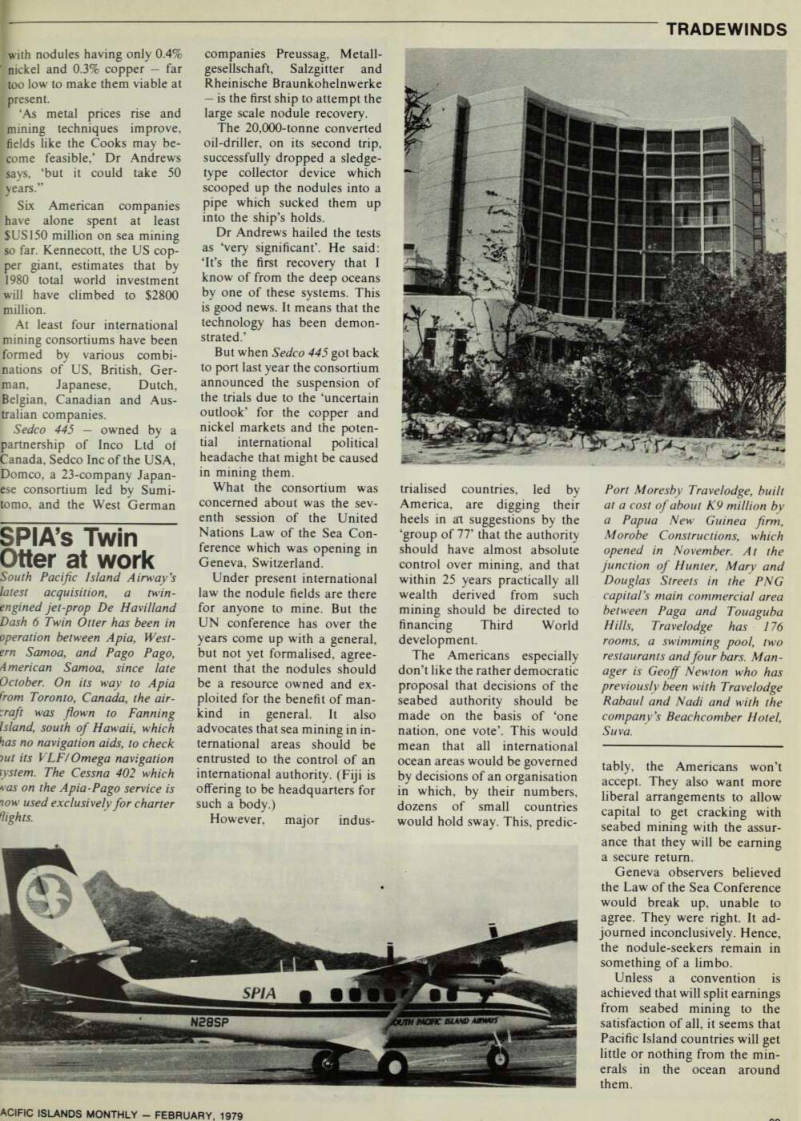
Port Moresby Travelodge, built
at a cost of about K9 million by a Papua New Guinea firm, Morobe Constructions, which opened in November. At the junction of Hunter, Mary and Douglas Streets in the PNG capital's main commercial area
between Paga and Touaguba
Hills, Travelodge has 176 rooms, a swimming pool, two restaurants and four bars. Man ager is Geoff Newton who has
previously been with Travelodge
Rabaul and Nadi and with the company's Beachcomber Hotel, Suva.