Lament From
p. 59 · Read in the full issue
Norfolk’S
Painful Past
K A vivid, first-person account of I the Pacific islands’ most
I infamous prison colony, which
I festered on lovely Norfolk Island from 1825 until the mid-1850s, has at last been published. It is The Exile's [ Lamentations, a manuscript by [ convict Thomas Cook which has been lying almost un [ known in the Mitchell Li brary’s Sydney archives for the past 50 years.
Historians who have tried to recreate Norfolk’s shameful I ‘second settlement’ era have been able to draw on quite a I reasonable body of official re ports and commentaries by men in positions of some auth ority. But prison life looks rather different from the con victs’ point of view, and convict writings from the transpor
tation days scarcely exist.
Three letters from Norfolk
prisoners were appended to
James Backhouse’s Narrative of a Visit to the Australian Colon ies in 1835 but those letters were permitted to be sent only on the understanding that they were to be unsealed for reading by the authorities. Not unna turally, they have written in tones of pious repentance;
something less than straight
reporting.
Marcus Clarke’s For the Term of His Natural Life has moved generations of readers with its tale of Rufus Dawes, an
imaginary prisoner on Norfolk.
But Clarke didn’t arrive in this part of the world until seven years after the prison had been shut down and Norfolk had been handed over to the Pit cairn people as a new home land.
Thomas Mortlock’s Experi ences of a Convict has been the best substantial account from a prisoner’s viewpoint. It has two
touching chapters dealing with
his 1844-46 term on Norfolk.
The publication of Thomas Cook’s Lamentations is thus a powerful addition to a scant literature.
Cook got into trouble with
the law for helping to compose an anonymous threatening let ter designed to scare and worry a cranky older resident in the little town of Whitchurch, England. Eighteen at the time, he was sentenced to 14 years transportation to New South Wales.
He was promptly subjected
to savage treatment and con ditions as a member of road gangs working west of Sydney.
Believing that his punishment
was far out of proportion to his crime, he rebelled and escaped.
He was quickly caught and sent to Norfolk Island where sec ond offenders were shipped to be broken in 1836.
He spent five years on the island, mostly as a convict clerk and overseer. His record was good and he was returned to New South Wales in 1841. He
disappeared shortly afterward
- perhaps escaping to England
or France forever.
At Norfolk he had found spare hours (as well as paper and ink) with which to record his story in a fine Spencerian hand. The first 30 pages or so of his newly-published account tell of his trial, imprisonment and convict experiences in New South Wales. Most of the rest of the slim volume is about
the brutality, prison politick
ing, attempted escapes and
social psychology of the ‘ocean hell’ the Colonial Office had ordered set up on Norfolk.
Cook has a great deal to say in praise of the famous prison reformist, Alexander Maconochie, who was in charge at Norfolk from 1840 to 1844. When Cook left the island he left his manuscript with Maconochie who appar ently took it back to England with him in 1844. In 1929 the Mitchell Library bought it in London for £250.
Cook was convinced that Maconochie’s rewarding of good conduct did far more to rehabilitate prisoners than did punishment. ‘The bare con templation of the lash may act
as a check to the commission of many offences with men who have never received it,’ he wrote, ‘whereas the more fre quently it is inflicted, the more hardened grows its victim in in
iquity, and ultimately braves
the utmost severity it is in the power of a summary court to inflict upon him. I have known men who never having received corporal punishment would almost prefer death to the infliction of 100 lashes upon them previous to their re moval to Norfolk Island, and I have afterwards frequently seen them under its infliction by the most powerful men at the settlement, with apparent unconcern. In fact this was quite fashionable with almost
every lacerated object during
my stay there.’
He catalogues the punish ments dealt out to six prisoners, whom he names, to illustrate the pre-Maconochie methods.
For one Michael Burns he tal lies 21 punishments in two years. Samples: TOO lashes singing a song’; TOO lashes refusing to work being unable from debility’; ‘5O lashes not being able to work and to be kept on bread and water till fit’.
Soon after arriving at Nor folk Cook began to hear the story of the great mutiny of 1834. He hands on this hearsay account in a convincing way.
From there onward he tells
about Norfolk as he saw it him self.
In an introduction. Professor A. G. L. Shaw of Monash University says Cook’s Lamen tations paints ‘a picture of almost unrelieved horror, but
one cannot help wondering
how much more credible this is than the very different im pression that one derives from the official despatches ... One would like to be able to cross examine him carefully’.
Yes, and no doubt Thomas Cook, Michael Burns and their fellow-prisoners would like to be able to cross-examine, in their own way, the authors of the official despatches.
The publishers have pro duced only 1,000 copies of the book, expecting a restricted market. Price-for-size it will strike browsers as 100 expens ive, but anyone with a serious interest in transportation or in
the fairy-tale-like history of
Norfolk Island will have to have it.
The end-papers are almost worth the full price for Norfolk
devotees. They reproduce a
map of the island, drawn around 1840, which is as little known as Cook’s manuscript itself. It includes several dozen place-names, many still in use but many long forgotten. Ed Howard.
The Exile’s Lamentations by Thomas Cook.
Library of Australian History, North Sydney. 120 pp. $l5.
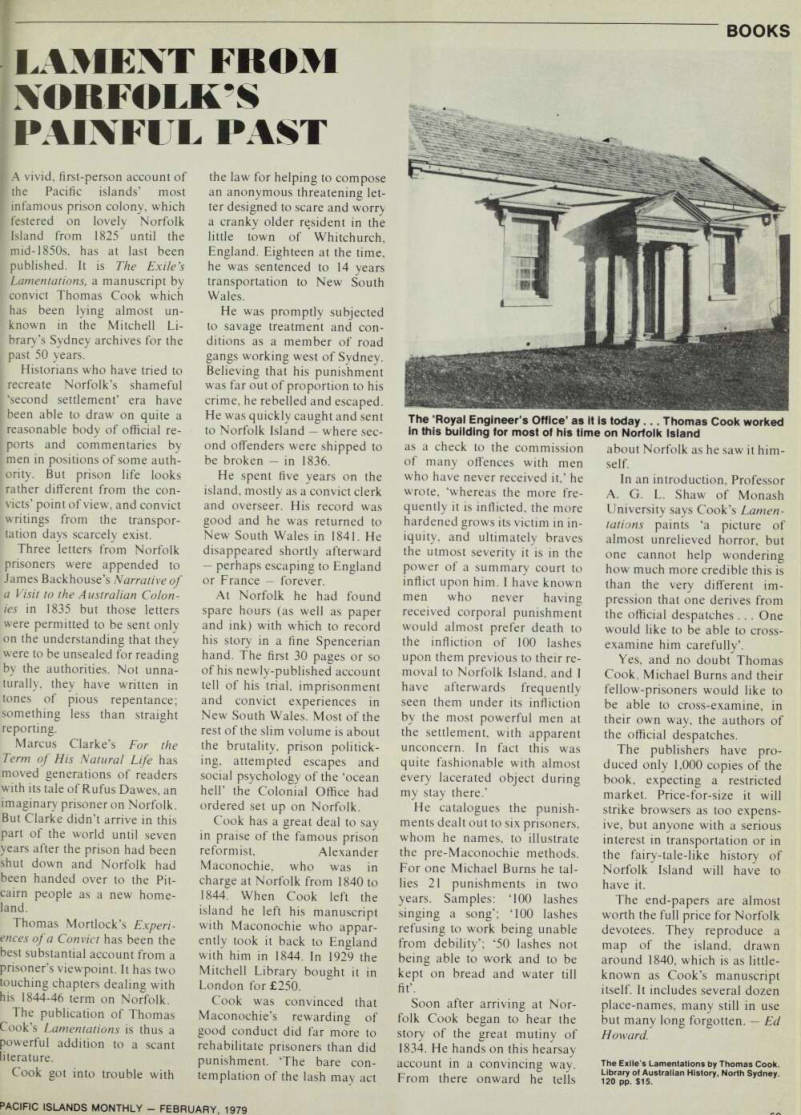
The 'Royal Engineer’s Office’ as It is today . . . Thomas Cook worked in this building for most of his time on Norfolk Island