the Norfolk
pp. 39-43 · Read in the full issue


What’s in the Norfolk Island Bill
The Australian Government plans to hand many of its legis lative powers over Norfolk Island to an elected Norfolk Island Legislative Assembly . this year. The proposed nine man assembly will replace the present eight-man advisory council. This will happen in July if the legislation for it, the Norfolk Island Bill 1978, is passed through the Australian
Parliament during its sittings
beginning in February.
The bill was tabled in the Australian Parliament in November but passage has been withheld to give Norfolk Islanders the opportunity to discuss it and suggest amend ments.
The bill was prepared after detailed discussions between members of the Norfolk Island I Council and officers of the Australian Government. It is not like any other bill that has been tabled in the Australian Parliament. This one proposes a legislature that is a mixture of colonial practice and con ditions to meet the special needs of Norfolk Islanders.
Broadly, the legislation fol
lows the Westminster model of government but virtually it en ables the Australian Govern ment and the Norfolk Island Assembly to operate two separ ate administrations if they wish. The plan behind the bill is that only one administration will be operated - a unified one under the control of Nor folk Islanders.
Clearly, though, there would
have to be a trial period while bureaucrats and islanders learned to work together.
At present the Australian Government holds all legislat ive and executive power. The Norfolk Island Council is ad visory only. Control is vested in the Australian Minister for Home Affairs, Bob Ellicott, through an Administrator, D.
V. O’Leary.
Under the bill, Norfolk re
mains an Australian territory
and there would still be an ad ministrator. Mr Ellicott has
promised that the government intends to increase the pro
posed assembly’s legislative
powers within five years of its
incorporation.
He says: ‘The government is prepared over a period to move towards a substantial measure of self-government for the island and is also of the view that, although Norfolk Island is part of Australia and will re main so, this does not require Norfolk Island to be regulated by the same laws as regulate other parts of Australia . . . ‘The government would see if the island can develop an ap propriate form of government involving its elected represen tatives under which the rev enue necessary to sustain that government will be raised in ternally under its own system of law.’
Under the bill, members of the new Norfolk Island As
sembly will serve a three-year term and will elect a ‘president’ who is akin to a parliamentary speaker. The assembly will nominate some of its members to hold portfolios, as with a ministerial system of govern ment, and they will constitute an executive council.
One of the executive council members will be designated ‘chief minister’, or equivalent. (The bill does not state what these portfolios are to be, the number of them, the titles to be given to the persons holding them, or to the ‘chief minister’ or the ‘president’ of the as sembly. All these are a matter for the assembly.) The administrator will in some ways resemble a gover nor with the important excep tion that he will personally administer those responsi bilities retained by the Aus-
tralian Government on Norfolk Island.
Only he will be able to call a meeting of the executive council, and he will preside over the meetings he attends, which any member of the as sembly can also attend, not just executive members.
Although members of the as sembly will nominate members to the executive council, the ad ministiator may terminate an appointment in ‘exceptional circumstances’. Public servants can be elected to the assembly but can’t be appointed to the executive council.
The bill transfers present legislative and executive auth ority to the assembly, but not on all matters. There will be three categories of power: • Powers of the assembly di rectly (listed on Schedule 2 of the bill) which include the kind of authority you would find at municipal government level in Australia but also embracing the raising of revenue, tourism, radio, television, telephone and postal services and regis tration of companies. • The powers on Schedule 3 which are subject to veto by the Australian Government (fish ing, customs control - but not duties immigration and edu cation). The assembly can in itiate legislation on these matters but they can become law only if Canberra agrees.
Under the powers, the as sembly cannot refuse money supply to the administrator. • Powers enabling the Aus tralian Government to make laws directly for Norfolk Island without reference to the as sembly. However, the bill clearly intends laws to be made through the assembly in the absence of extraordinary cir cumstances. The law-making powers of the assembly are in fact limited only by prohibition against its acquiring property
on unjust terms, maintaining
military forces or coining
money. Otherwise any law on any matter concerning Norfolk may be made through the as
sembly.
The Australian Government
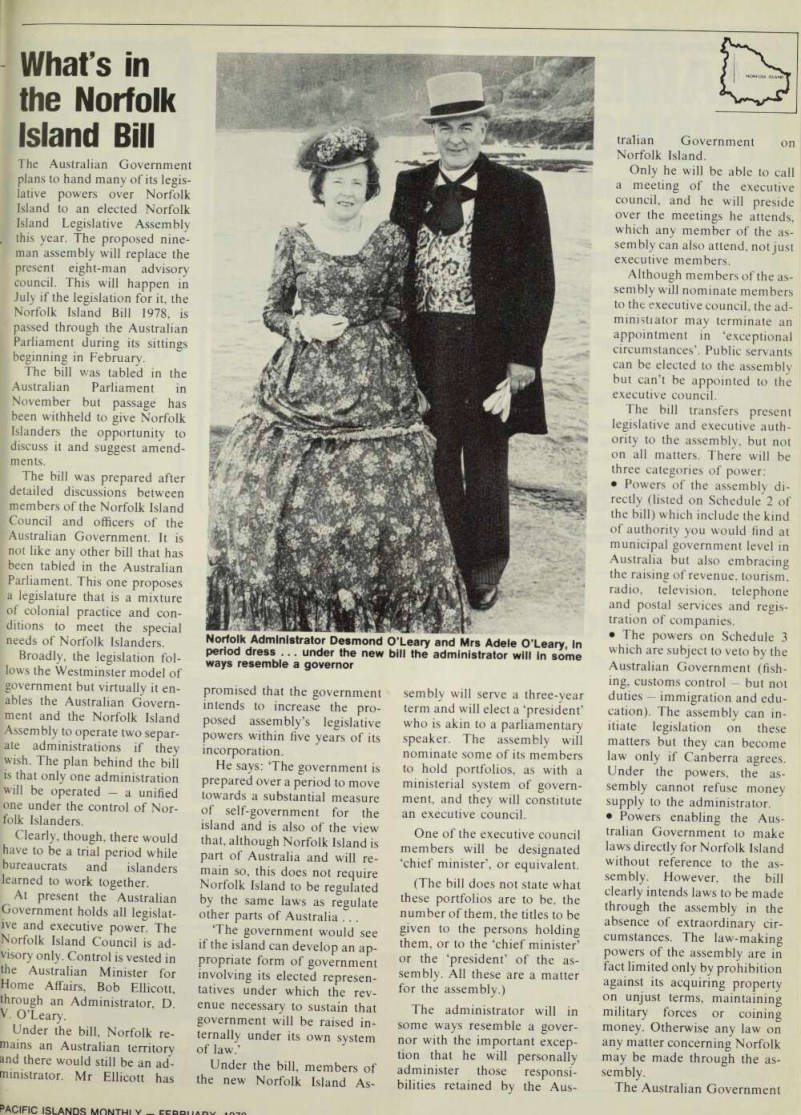
Norfolk Administrator Desmond O’Leary and Mrs Adele O’Leary In period dress ... under the new bill the administrator will In some ways resemble a governor
effectively retains control by its power to withhold the assent necessary to complete the law making process in respect of veto matters and its own powers. The administrator can not quash legislation over which the assembly has full power (Schedule 2). The Aus tralian governor-general can do it, within six months of a law being passed, but he must give the assembly the reasons why any ordinance or part of an ordinance is disallowed.
All matters, whether the re sponsibility of the assembly or
of the Australian Government, are to be financed locally, as at present. It is uncertain what the future is of the Australian annual grant (currently $A 126,000 out of a total annual budget of $2 million).
Commenting on the new bill, particularly on the possi bility that the bill could allow establishment of two separate administrations, Councillor Duncan Mclntyre, who was one of those who took part in the discussions on the bill, and who is a practising solicitor on Norfolk, told PIM; ‘All the dis-
cussions between the minister and the council have very defi nitely envisaged a unified ad ministration. Its achievements will depend on reasonable co operation between the as sembly and the administrator, especially in the raising of rev enue and the voting of
supply.
‘Certainly all the reserve powers of the bill favour the administrator in the event of serious differences, but since it will all be island money in dis pute, to be spent for the island’s benefit, the solutions are likely to be political rather than
legal.
‘The record of the present advisory council suggests that a unified administration is poss ible, though it will be interest ing to see the development of the island’s politics when real responsibility comes and Can berra is no longer there to take all the blame.’
Mr Mclntyre said the main powers missing from the list of functions to be controlled by the assembly and which con cern the daily life of the island
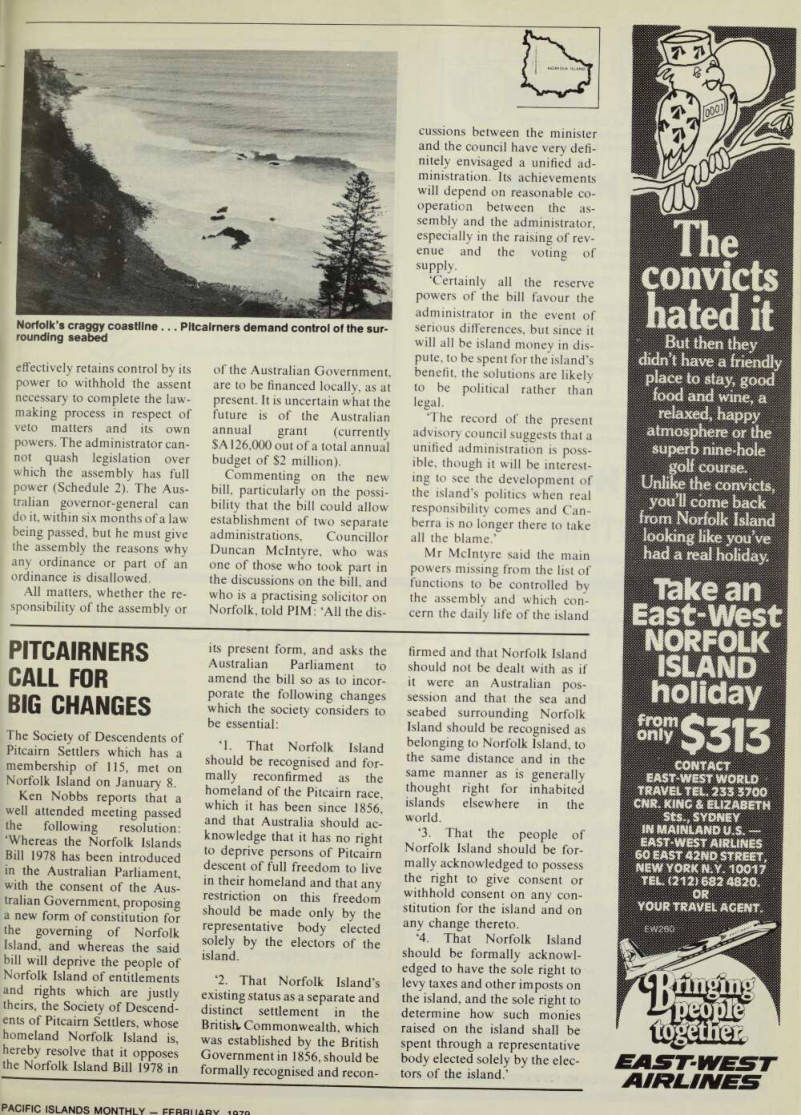
Norfolk’s craggy coastline ... Pitcairners demand control of the sur rounding seabed
are those involving health, wel fare, police and land. ‘The government has prom ised periodic review with a view towards the growth of powers, and in any such review health and welfare should be passed to the assembly at an early date,’ said Mr Mclntyre. ‘With those items in assembly hands there would be little impediment to making the as sembly responsible for all rev enue raising. The bill makes it possible to increase the as
sembly’s powers by adding to
Schedules 2 and 3 by regu lation, so one doesn’t have to go through the full parliamen tary process.’
Councillor Mclntyre said control of air traffic was not likely to be handed over as it
was political, and, in any case, it was paid for by Canberra. He added; ‘ln vehemently oppos ing the Nimmo Report, the islanders sought to obtain guarantees against Australian integration. The present bill is not an unconditional guaran tee; it reserves more power to Australia than many islanders would like. It can be changed by any subsequent Australian parliament, and there is nothing in it to stop a later government bent on inte gration, regardless of the politi cal consequences. ‘But, remembering the promise of further growth of the assembly’s powers, the bill represents a real opportunity for Norfolk Island to establish its political identity in a most forceable way. A good political performance by the assembly would therefore seem to be the best guarantee for the future that the island could have.’
President of Committees of the Norfolk Island Council, Bill Blucher, said in Sydney last
month that he would like to have assurances from the Aus tralian Government that it intends to grant self-govern ment to Norfolk Island.
Mr Blucher said he had no doubts about the intentions of the new Norfolk Island Bill and of the Australian Govern ment but these needed to be spelled out to make it clear to everybody that the bill would lead to a transfer of powers. He wants to see powers transferred within five years.
Mr Blucher believes amend ments to the bill are required, but not its rejection. ‘The coun cil wants what the people want,’ he said.
Exactly what Norfolk Islanders felt about the bill was not clear in early January.
Controversy was developing
but no clear picture had emerged. Mr Blucher read out a precis of the bill at a council meeting on December 13 but there was no discussion. Coun
cillors apparently were waiting
to get more public reaction be fore debating it.
The Norfolk Island News, a
monthly newspaper edited by
Ed Howard, came out in its
December/January issue
against the bill, describing it as ‘Australia’s plan to keep Nor folk a colony’. Mr Howard said it was ‘nothing but a rehashed version of the same colonial rule that has caused anguish and protest on Norfolk gener ation after generation, ever since self-government on the island was crushed in 1896’. He demanded that Australia give clear reasons why it thought the bill benefited the island.
Bill Blucher . . . wants to see power transferred in five years