Condom Caper Is
p. 30 · Read in the full issue
Taking Birth
Control Too Far
Papua New Guinea has always had population control. In pre contact times it was brought about in part by the high rate of infant mortality, in part by traditional customs and taboos relating to sex, and in part, possibly, by the use of traditional herbal contraceptives. I say ‘possibly’ because as far as I know the effectiveness or otherwise of these preparations has not been established by research.
In the first quarter of this century colonial administrators in Papua were worried, not by over-population but by depopu lation. and they adopted several measures to combat this threat. First, they established infant welfare clinics, though, due to lack of money and staff, not on a large enough scale to be really effective. Second, they restricted, and in some cases banned altogether, recruitment of plantation labour from areas in which there was evidence of depopulation. And finally, they established a system of incentives to encourage parents to have more children and to keep them alive. These comprised head tax rebates for the fathers of medium-sized families and cash bonuses to the mothers of really large ones.
The compilation and updating of village censuses, the collection of head tax from those liable to pay it and the pay ment of family bonuses to those eligible to receive them was, for district administration officers, an annual chore calling for considerable physical stamina and a high degree of mental alertness. Differences in ways of describing relationships made it possible to deceive without actually telling lies. ‘ls this your child?’ ‘Yes,’ says Mum, not untruthfully, for in her language her sister’s children are also hers.
It is ironic to think that 50 years ago in Papua, people were
being paid to have big families.
Now, 50 years on, we’re worrying about our ‘population ex plosion'. Traditional ‘family planning’ through custom and taboo is increasingly ignored, and maternal and child health clinics have been highly successful in bringing down the infant mortality rate. So we have a ‘Family Planning Unit’ in the PNG Public Health Department, and a non-governmental ‘Family Planning Association,’ dedicated to the task of per suading people not to have too many children and of explain ing to them how it’s done.
On the whole, the efforts of these enthusiasts have been well received. Of course they have found some opponents. There are those who, comparing our population with that of our Southeast Asian neighbours, claim that Papua New Guinea can support a much bigger population than it has at present.
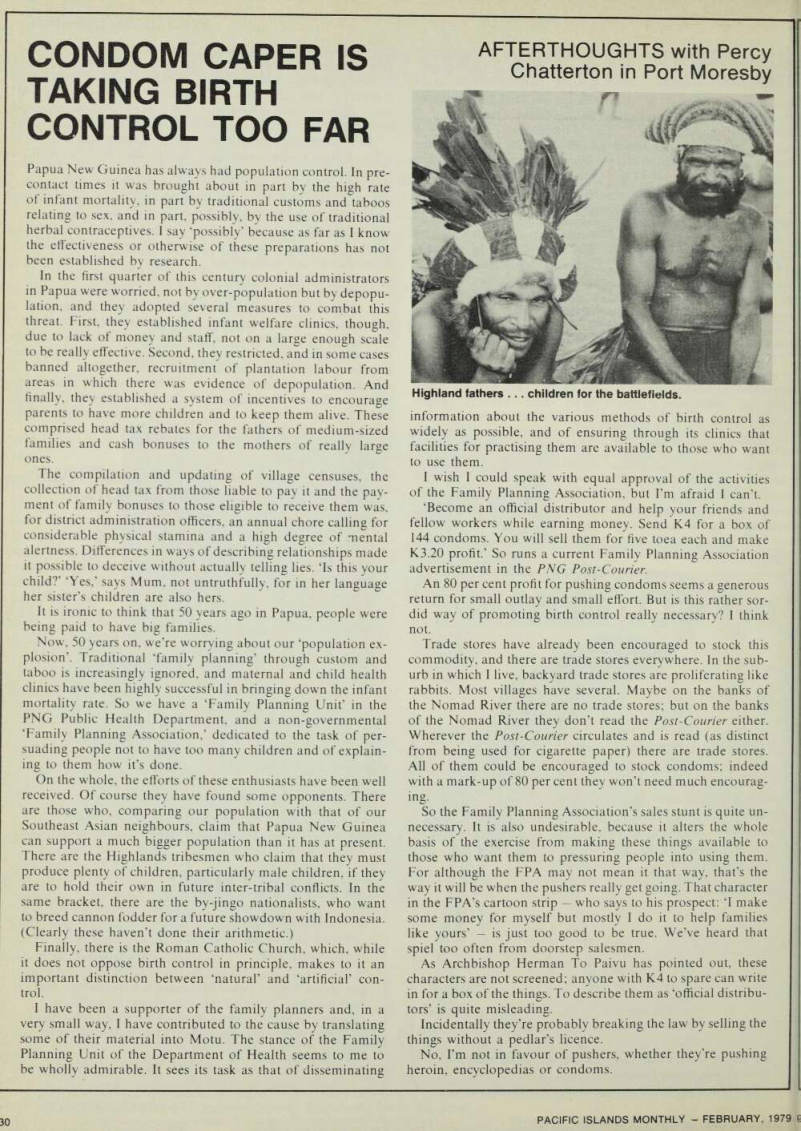
There are the Highlands tribesmen who claim that they must produce plenty of children, particularly male children, if they are to hold their own in future inter-tribal conflicts. In the same bracket, there are the by-jingo nationalists, who want to breed cannon fodder for a future showdown with Indonesia. (Clearly these haven’t done their arithmetic.) Finally, there is the Roman Catholic Church, which, while it does not oppose birth control in principle, makes to it an important distinction between ‘natural’ and ‘artificial’ con trol.
I have been a supporter of the family planners and, in a very small way, I have contributed to the cause by translating some of their material into Motu. The stance of the Family Planning Unit of the Department of Health seems to me to be wholly admirable. It sees its task as that of disseminating
AFTERTHOUGHTS with Percy Chatterton in Port Moresby
information about the various methods of birth control as widely as possible, and of ensuring through its clinics that facilities for practising them are available to those who want to use them.
I wish I could speak with equal approval of the activities of the Family Planning Association, but I’m afraid I can’t. ‘Become an official distributor and help your friends and fellow workers while earning money. Send K 4 for a box of 144 condoms. You will sell them for five toea each and make K 3.20 profit.’ So runs a current Family Planning Association advertisement in the PNG Post-Courier.
An 80 per cent profit for pushing condoms seems a generous return for small outlay and small effort. But is this rather sor did way of promoting birth control really necessary? I think not.
Trade stores have already been encouraged to stock this commodity, and there are trade stores everywhere. In the sub urb in which I live, backyard trade stores are proliferating like rabbits. Most villages have several. Maybe on the banks of the Nomad River there are no trade stores; but on the banks of the Nomad River they don’t read the Post-Courier either.
Wherever the Post-Courier circulates and is read (as distinct from being used for cigarette paper) there are trade stores.
All of them could be encouraged to stock condoms; indeed with a mark-up of 80 per cent they won’t need much encourag
ing.
So the Family Planning Association’s sales stunt is quite un necessary. It is also undesirable, because it alters the whole basis of the exercise from making these things available to those who want them to pressuring people into using them.
For although the FPA may not mean it that way, that’s the way it will be when the pushers really get going. That character in the FPA’s cartoon strip who says to his prospect: T make some money for myself but mostly I do it to help families like yours’ is just too good to be true. We’ve heard that spiel too often from doorstep salesmen.
As Archbishop Herman To Paivu has pointed out, these characters are not screened; anyone with K 4 to spare can write in for a box of the things. To describe them as ‘official distribu
tors’ is quite misleading.
Incidentally they’re probably breaking the law by selling the things without a pedlar’s licence.
No, I’m not in favour of pushers, whether they’re pushing heroin, encyclopedias or condoms.
Highland fathers ... children for the battlefields.