Survivor
pp. 15-16 · Read in the full issue
Papua New Guinea
Somare - The
Great
Survivor
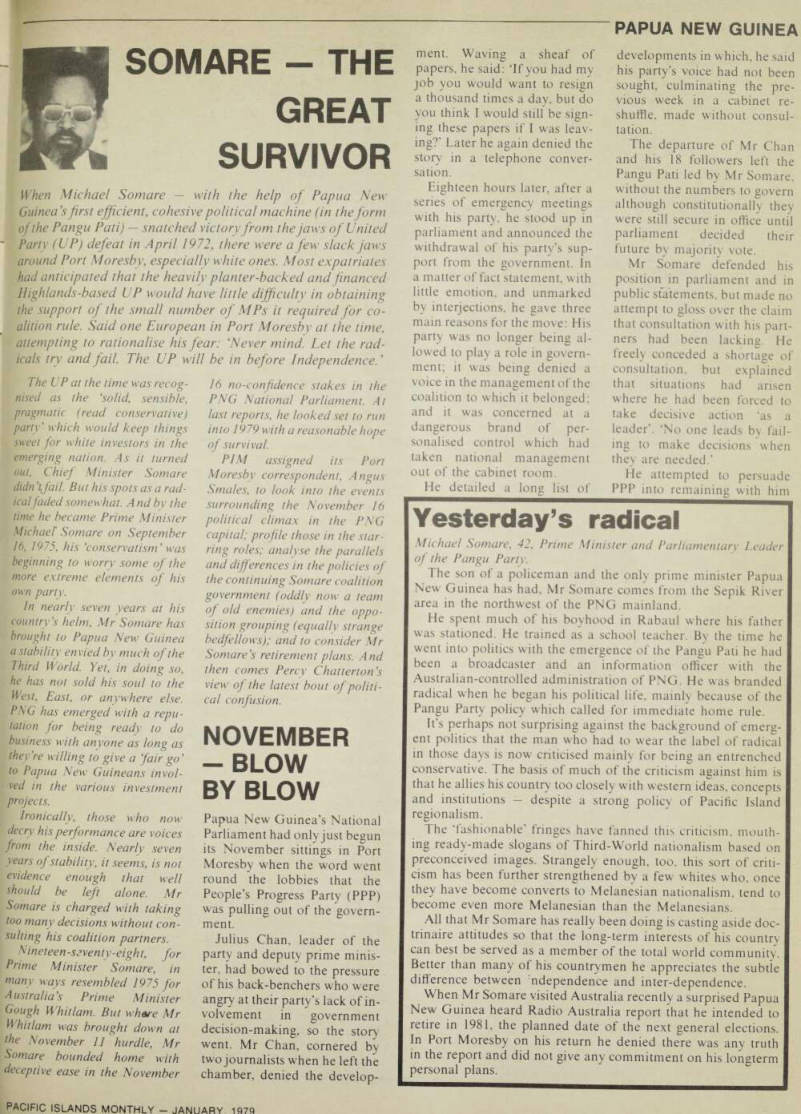
When Michael Somare with the help of Papua New Guinea’s first efficient, cohesive political machine (in the form of the Pangu Pati) snatched victory from the jaws of United Party (UP) defeat in April 1972, there were a few slack jaws around Port Moresby, especially white ones. Most expatriates had anticipated that the heavily planter-backed and financed Highlands-based UP would have little difficulty in obtaining the support of the small number of MPs it required for co alition rule. Said one European in Port Moresby at the time, attempting to rationalise his fear: ‘Never mind. Let the rad icals try and fail. The UP will be in before Independence. ’
The UP at the time was recog nised as the 'solid, sensible, pragmatic (read conservative) party' which would keep things sweet for white investors in the emerging nation. As it turned out, Chief Minister Somare didn ’tjail. But his spots as a rad icalfaded somewhat. And by the time he became Prime Minister Michael Somare on September 16, 1975, his ‘conservatism' was beginning to worry some of the more extreme elements of his own party.
In nearly seven years at his country's helm, Mr Somare has brought to Papua New Guinea a stability envied by much of the Third World. Yet, in doing so, he has not sold his soul to the West, East, or anywhere else.
PNG has emerged with a repu
tation for being ready to do
business with anyone as long as they're willing to give a fair go' to Papua New Guineans invol ved in the various investment projects.
Ironically, those who now decry his performance are voices from the inside. Nearly seven years of stability, it seems, is not evidence enough that well should be left alone. Mr Somare is charged with taking too many decisions without con sulting his coalition partners.
Nineteen-seventy-eight, for
Prime Minister Somare, in many ways resembled 1975 for Australia's Prime Minister Gough Whitlam. But where Mr Whitlam was brought down at the November 11 hurdle, Mr Somare bounded home with deceptive ease in the November
16 no-confidence stakes in the PNG National Parliament. At last reports, he looked set to run into 1979 with a reasonable hope of survival.
PIM assigned its Port Moresby correspondent, Angus Smales, to look into the events surrounding the November 16 political climax in the PNG capital; profile those in the star ring roles; analyse the parallels and differences in the policies of the continuing Somare coalition government (oddly now a team of old enemies) and the oppo sition grouping (equally strange bedfellows); and to consider Mr Somare's retirement plans. And then comes Percy Chatterton's view of the latest bout of politi cal confusion.
November
-Blow
By Blow
Papua New Guinea’s National Parliament had only just begun its November sittings in Port Moresby when the word went round the lobbies that the
People’s Progress Party (PPP)
was pulling out of the govern ment.
Julius Chan, leader of the party and deputy prime minis ter, had bowed to the pressure of his back-benchers who were angry at their party’s lack of in volvement in government decision-making, so the story went. Mr Chan, cornered by two journalists when he left the chamber, denied the develop
ment. Waving a sheaf of papers, he said: ‘lf you had my job you would want to resign a thousand times a day, but do you think I would still be sign ing these papers if I was leav ing?’ Later he again denied the story' in a telephone conver sation.
Eighteen hours later, after a series of emergency meetings with his party, he stood up in parliament and announced the withdrawal of his party’s sup port from the government. In a matter of fact statement, with little emotion, and unmarked by interjections, he gave three main reasons for the move: His party was no longer being al lowed to play a role in govern ment; it was being denied a voice in the management of the coalition to which it belonged; and it was concerned at a dangerous brand of per sonalised control which had taken national management out of the cabinet room.
He detailed a long list of
developments in which, he said his party’s voice had not been
sought, culminating the pre
vious week in a cabinet re shuffle, made without consul tation.
The departure of Mr Chan and his 18 followers left the Pangu Pati led by Mr Somare, without the numbers to govern
although constitutionally they
were still secure in office until parliament decided their
future by majority vote,
Mr Somare defended his position in parliament and in public statements, but made no attempt to gloss over the claim that consultation with his part ners had been lacking. He freely conceded a shortage of consultation, but explained that situations had arisen where he had been forced to take decisive action ‘as a leader’. ‘No one leads by fail ing to make decisions when they are needed.’
He attempted to persuade PPP into remaining with him
but by noon the following day
talks had petered out. ‘l’m on my way back to the office to pack up,’ Mr Chan told news men waiting outside the cabi net room. Four hours later Mr Somare was able to announce he had accepted an offer from the United Party leader,
Raphael Doa. to join him. giv
ing him roughly the same strength in numbers as he had before the PPP defection. The UP had laid down no con ditions, he said, and had been given six ministries in 25.
An offer from Opposition Leader Okuk had been turned down because he had laid down conditions, said Mr Somare. One of the conditions is believed to have been that Mr Okuk should become deputy prime minister, a pos ition now held by one of Mr
Somare’s Pangu supporters,
Ebia Olewale.
The new coalition partners, the UP, came to Mr Somare as i faction from within the op oosition. Once it had been the opposition in its own right and
the biggest single party in par
iament. Obviously still smart ng from earlier events which tad whittled away its strength md influence, it decided it was ime to cross the floor and Mr >omare had little choice but to :mbrace it.
About the time that Mr
Jomare was announcing his
lew coalition, Mr Okuk was innouncing that Mr Chan’s *PP had joined his ranks. The
ipposition took advantage of
he disruptive events in parlia
ment to move a vote of no confidence in the government - the second in three months.
This is a constitutional remedy which can overthrow an ailing government without the need for an election, but an essential ingredient is that the new prime minister be named.
Mr Okuk was duly named in the motion which then had to wait seven days under consti tutional requirements. A bitter
lobbying fight for support
broke out during the waiting period, marked by individual
changes of heart one way or the other, and including the defec tion of Mr Somare’s housing minister, Thomas Kavali.
The galleries couldn’t hold the crowds which came to see the vote. All 109 members attended, including cabinet member Father John Momis who came from hospital, and
opposition Papua Besena
leader Josephine Abaijah who returned from a visit to Syd ney.
Mr Okuk, no doubt impres sed by the calibre of some of
his new supporters, tried tot amend the motion so that ML Chan could be prime ministers But the amendment was deal feated.
The Somare government des feated the no-confidenceo motion 63-45. Sir John Guises; 64. did not vote, but ther speaker, Kingsford Dibelac did.
Sir John, former governors general and veteran politiciann who became deputy leader during a reshuffle! earlier in the year, was the onlyl member of the 109-seat House? who abstained from voting.
His deliberate walkout each: time a division was calico; (there were three divisions ini the debate) was obviously s Guise-type curtain raiser foie the planned announcement which he made immediately! after the debate.
His announcement, com-r plete with photo-copies pf a> formal letter to the oppositions leader, Mr Okuk, was that hoi was resigning as deputy leader.!
His official reason was that*
membership of the opposition!
had changed so greatly that thoi front benches needed reor-i ganising. Sir John felt hesi should give more time to hisfi electorate and allow the oppo-( sition to reorganise its ranks..?
Tm plain John Guise whco wants to devote all his time too representing the people whoo elected him,’ he said.
Despite the reason given, it's?’ hard to avoid the conclusionn that Sir John felt put out by thes almost unconscious way he hadb been left aside following thes arrival of Mr Chan on the op--( position scene. After all, he was?i supposed to be deputy leaden; of the opposition, but thes choice for prime minister-i designate was between leaden; and newcomer not leaden; and deputy leader.
Parliament has now sorted b itself out for the time being but Ji echoes of the disruption re- main. In real terms forT instance, as distinct from num- bers, Mr Somare is probably in n a weaker position than he was ? before. A few members are agi- tating for a general election, p and Opposition Leader lam- bakey Okuk is talking about Ji forming a new party based on n
Highlands electorates.