The South
pp. 13-14 · Read in the full issue
Aviation
New Wings Over
Pacific
Aviation initiatives late last year add up to a bright new ray of hope for the Islands’ ailing tourist industries . A PIM avi ation writer looks at the consequences of the United States’ antipodean excursion to negotiate rights for Continental Air lines and at a new idea being cooked up in Port Moresby which could realise the dreams of advocates of a regional air line system.
When America catches a cold, the old story goes, the whole world sneezes. Well, when President Jimmy Carter de cided to deregulate the airline business, sooner or later it had to reach the Pacific.
The chosen vehicle is to be Continental Airlines, no stranger to the central Pacific area where it is the main force in Air Micronesia and where, under its own flag, it is carrying through from Guam to Taipei.
Now, after a series of well publicised jousts. Continental is set to fly into Australia and New Zealand from May 1 and hopefully the airline’s DC 10s will once again be bringing tourists and business visitors on island-hopping routes that the other Pacific carriers forgot about several years ago.
Continental is in fact making a virtue of necessity. The Los Angeles carrier operates the shorter-ranged DC 10-10 s, which are the same size as the DC 10-30, as operated by Air New Zealand among others.
But they are of a lower all-up weight and carry less fuel. Con
sequently they can’t overfly
languishing ports like Pago
Pago in American Samoa, and Nadi in Fiji and must land there.
Continental is set to run four flights a week into Sydney from Los Angeles. Two flights a week (Mondays and Thurs days) will leave Los Angeles at 10 am (a common departure time for all Pacific flights) and travel via Nadi to Sydney. On
Wednesdays and Saturdays,
the flights will go via Pago
Pago. On Sundays, Tuesdays
and Fridays, Auckland will be the destination.
In all cases, the aircraft will overnight at destination and leave on Wednesdays and Saturdays for Nadi, Honolulu and Los Angeles and on Mon days and Fridays for the Pago
Pago route. Auckland flights
will depart Tuesdays, Thurs
days and Sundays.
So far. fares are still up in the air. During the Canberra nego tiations the US chief nego tiator, Mr Robert A. Brown, from the State Department, focused on landing rights for Continental as the main issue and pressed the US case for clearing away all rules and
regulations seen by the
Americans as hampering inter national civil aviation. Aus tralia’s Transport Minister Peter Nixon, who has spoken loud and long on low air fares, with particular reference to routes between Australia and Europe, tied a lower fare pack age to the Continental ap
proval.
The lowest fare in his ‘indicative’ package was a
45-day advance booking one
that would cost $450 return for Australia-West Coast. Con tinental weighed in with a less
complicated but slightly more
costly fare proposal, and at time of writing final decision had yet to be made.
Continental, which regards simplicity of fare structures as being as desirable as low costs, was dismayed by the Nixon
proposals under which roughly
one-third of the year is divided between high, shoulder and low seasons, with two periods in each category, making a total of six fare-basing seasons each way each year. It’s not im possible. But, Continental be lieves, it would be difficult to market. One proposal the Americans were floating is that the Australian fares be charged into and out of Australia, while US fares were tried on the American market.
The Australian fares flow, in part, from the Australian dis like of the budget ‘cheapies’ which Pan American went for and which Air New Zealand
also espoused. These provide
for about 2% of total capacity to be available at extra cheap rates, with a limit of 15% on any one flight. Passengers book in advance for a particular
week and are told when during that week they can fly. Even with these restrictive . con ditions, the fares have been popular and are booked out months in advance.
Nixon believes the budget fares are too discriminatory and has pushed for a regime of lower fares to be available to all comers at the expense of a certain inconvenience in forward-booking periods. Con tinental, on the other hand, has gone for one-way point-to
point fares which theoretically
could take the island-hopper to several destinations before
reaching the journey’s end
point.
Negotiations will still be re quired to see which concept
prevails.
From the Islands’ point of view. Continental’s must be the favoured approach. The US
carrier is deliberately setting
out to provide tourist services from the hinterland in the southwest and west into the Pa cific, taking the traffic which it now generates as far as Hawaii,
and luring it beyond
Honolulu.
This can only be good news for places like Fiji, which have been upset at the overflight tendency for years, and for Pago Pago, which is incensed at losing its previous Pan Am con nections. In the Samoas, Con
tinental is evidently planning
to make a feature of Western Samoa. It considers Apia’s pos sibilities as most attractive and looks on the existing network of regional services out of Fiji and Samoa as stepping stones to other islands.
At present the tourist flow across the Pacific is most un balanced. Australians and New Zealanders headed east greatly outnumber Americans going the other way. There is obvious room to squeeze up the gap.
The eventual pattern of routes and flows has still to take shape. The American
deregulatory offensive, led by
Bob Brown, began in Honolulu with a fast negotiation with Papua New Guinea. Air
Niugini has long sought a route
east to Honolulu to tap the US tourist flow pattern. They asked for this and got it almost
immediately. Air Niugini also
got Guam and charter rights
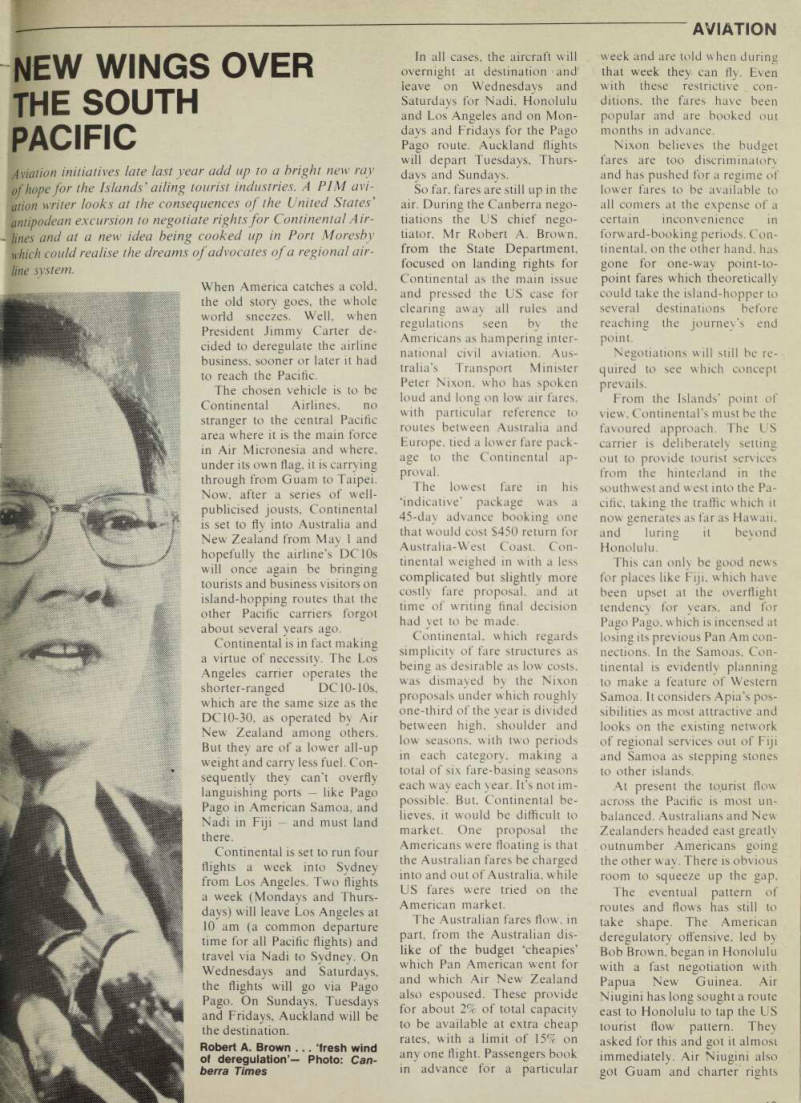
Robert A. Brown ... ‘fresh wind of deregulation’ —Photo: Can berra Times
from PNG to these places as well. On the eve of the opening of the new Travelodge in Port Moresby, this must have been music to the ears of local tour ism entrepeneurs.
Mr Brown’s next port of call was Fiji. And from all accounts, Fiji did even better.
This prompted second thoughts from PNG which in late November hied up to Manilla to see the Americans again, this time with a proposal that they be allowed to service the US mainland. The Americans were disposed at time of writing to offer them Oakland, the under-utilised terminal across the Bay from San Francisco Airport.
After Fiji came New Zealand. Heie there was little standing in the way of offering Continental rights. But there was a serious problem of a national election underway with no one around to sign a permit. Prime Minister Mul doon suggested it be put to the first cabinet meeting after the elections and the Americans agreed.
In Australia. Mr Brown met much stiffer opposition. He caught Mr Nixon and his departmental officials off guard with an airport press conference where he made it clear that unless Australia con ceded what the Americans saw as the bilateral treaty right for a second designated US carrier to arrive, the Americans would >tart lopping off Qantas ser vices at the rate of one a month.
It’s the Italian kidnap victim
syndrome.' one negotiator
explained. ‘First month vou cut aff one flight a week say a inger then next an arm. And
io it goes.’
Although the issue hadn’t aeen fully resolved, it seemed hat the lightly veiled threat
vas eventually unnecessarv.
\ustralia tabled its low-fare proposals and at time of vriting was reported to be >reparing an agreement.
But Continental, of course, is mly the first stage. In the long un the charter flights, opera ed by Island and American :arriers, may prove to be the )ig generator of tourst traffic
hroughout the region.
If lasting prosperity is to ome. however, there will have
to be significant reforms. Much of the accommodation industry and other tourist plant will have to be reorganised, and the airlines themselves wilfhave to re-examine equipment plans.
Air Niugini’s general man ager. Bryan Grey, got in under the fence just "before PNG’s November political upheaval and got executive council per mission to import two more F2Bs that will come into service this year. But to take advantage of his rights, he will need another 707 or its equivalent and this may be harder to arrange in the present cli mate.
Air Pacific, embroiled in rights fights with Australia and New Zealand, must also start
looking at new equipment.
The quandary of both re gional carriers lends some enchantment to a new idea, being cooked up in Port Moresby of an association of smaller airlines under which each maintains its sovereignty and national personality but which come together to operate special flights such as the pro posed charters and American services when necessary.
Such a move would also allow small carriers like Air Niugini and Air Pacific to con sider modern wide-bodied
equipment, which they must
eventually have to combat fuel price rises and other operating problems. ‘At first you think of two fleas getting together to buy a dog,’ a manufacturer’s representative said. “But the more you look at the idea, the more attractive it gets. The key must be to maintain individual national identities and oppor tunities.’
Places like Fiji and Papua New Guinea have been subser vient to the airline ambitions of the bigger powers for so long that it is only in the past couple of years they have started look ing at their own geographical locations on the globe. Both are ideally suited to handle ser vices on a new South Pacific route from Honolulu through to Southeast Asia. Both can also launch north-south flights to the new nodal point of Guam and on to Tokyo and other places, as Air Niugini is
already doing.