Headaches Galore
pp. 73-75 · Read in the full issue
Tradewinds
Nsolomon
Slands Transport
Vith the euphoria of indepen
dence passed, Solomon Islands
? now taking stock of the ormidable problems it faces in ashing forward the country's conomic development. Here , a
*IM correspondent , Irene Haw
ins, reports from Honiara on a
:ey aspect of the problems
ransport of goods by land and
ea.
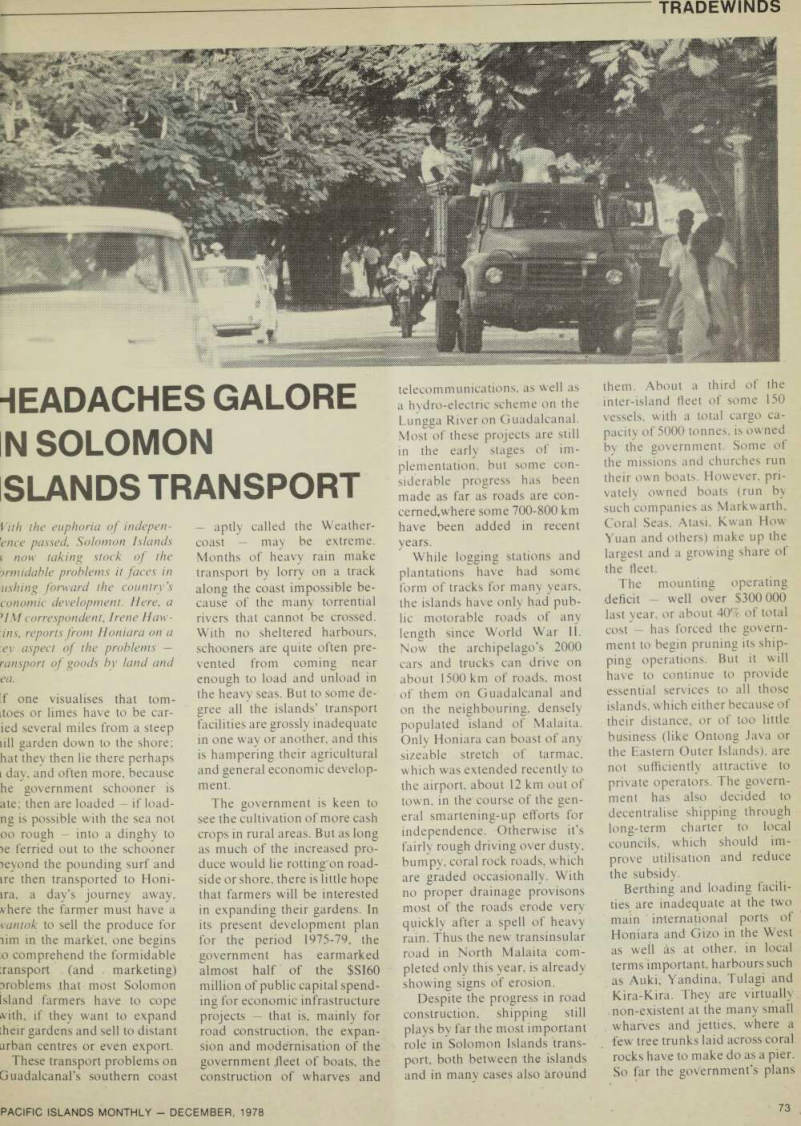
T one visualises that tom itoes or limes have to be car ied several miles from a steep fill garden down to the shore; hat they then lie there perhaps i day, and often more, because he government schooner is ate; then are loaded if load ng is possible with the sea not oo rough into a dinghy to )e ferried out to the schooner )eyond the pounding surf and ire then transported to Honi
ira, a day’s journey away,
vhere the farmer must have a xantok to sell the produce for lim in the market, one begins
;o comprehend the formidable
transport (and marketing)
Droblems that most Solomon Island farmers have to cope
with, if they want to expand
their gardens and sell to distant urban centres or even export.
These transport problems on Guadalcanal’s southern coast
telecommunications, as well as a hydro-electric scheme on the Lungga River on Guadalcanal.
Most of these projects are still in the early stages of im plementation, but some con siderable progress has been made as far as roads are con cemedtwhere some 700-800 km have been added in recent years.
While logging stations and plantations have had some form of tracks for many years, the islands have only had pub lic motorable roads of any length since World War 11.
Now the archipelago’s 2000 cars and trucks can drive on about 1500 km of roads, most of them on Guadalcanal and
on the neighbouring, densely
populated island of Malaita.
Only Honiara can boast of any sizeable stretch of tarmac, which was extended recently to the airport, about 12 km out of town, in the course of the gen eral smartening-up efforts for independence. Otherwise it’s fairly rough driving over dusty, bumpy, coral rock roads, which
are graded occasionally. With
no proper drainage provisons
most of the roads erode very quickly after a spell of heavy rain. Thus the new transinsular road in North Malaita com
pleted only this year, is already
showing signs of erosion.
Despite the progress in road construction, shipping still
plays by far the most important
role in Solomon Islands trans port, both between the islands and in many cases also around
them. About a third of the inter-island fleet of some 150 vessels, with a total cargo ca pacity of 5000 tonnes, is owned by the government. Some of the missions and churches run their own boats. However, pri vately owned boats (run by such companies as Markwarth, Coral Seas, Atasi, Kwan How Yuan and others) make up the largest and a growing share of the fleet.
The mounting operating
deficit well over $3OO 000 last year, or about 40% of total cost - has forced the govern ment to begin pruning its ship ping operations. But it will have to continue to provide essential services to all those islands, which either because of their distance, or of too little business (like Ontong Java or the Eastern Outer Islands), are not sufficiently attractive to private operators. The govern ment has also decided to
decentralise shipping through
long-term charter to local councils, which should im prove utilisation and reduce
the subsidy.
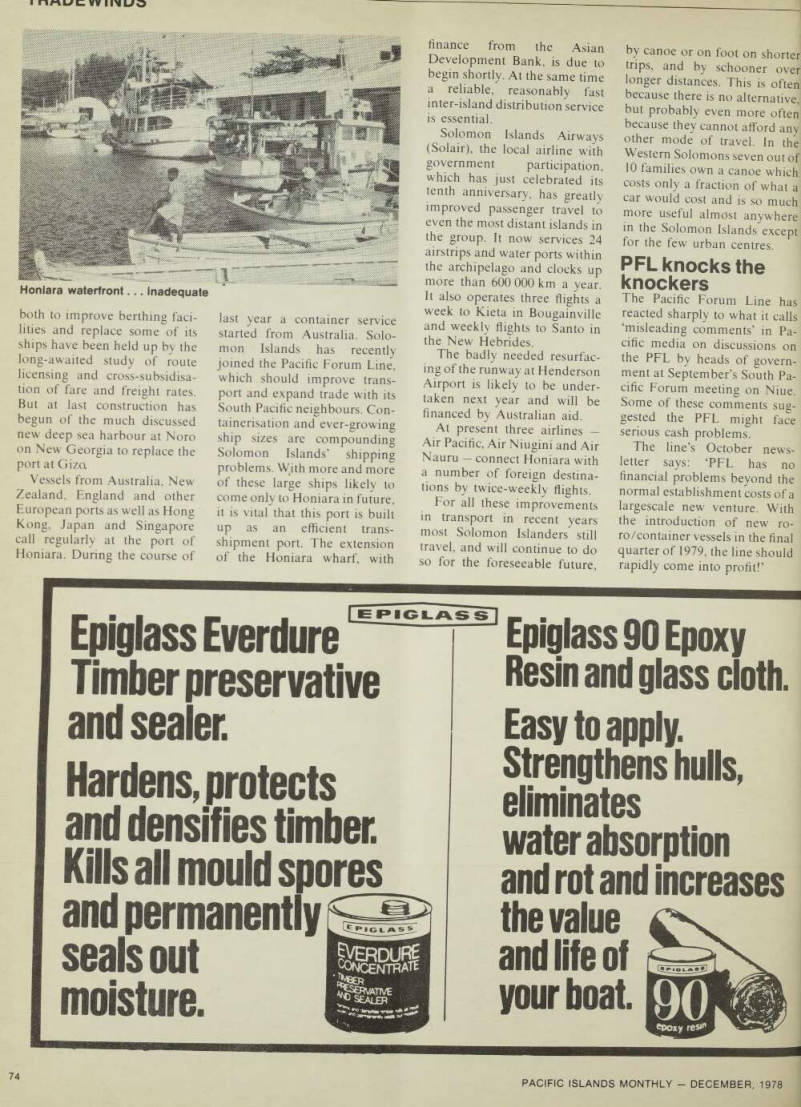
Berthing and loading facili ties are inadequate at the two main in-temational ports of Honiara and Gizo in the West as well as at other, in local terms important, harbours such as Auki, Yandina, Tulagi and Kira-Kira. They are virtually non-existent at the many small wharves and jetties, where a few tree trunks laid across coral rocks have to make do as a pier.
So far the government’s plans
- aptly called the Weather coast - may be extreme.
Months of heavy rain make transport by lorry on a track along the coast impossible be cause of the many torrential rivers that cannot be crossed.
With no sheltered harbours, schooners are quite often pre vented from coming near enough to load and unload in the heavy seas. But to some de gree all the islands’ transport
facilities are grossly inadequate
in one way or another, and this
is hampering their agricultural
and general economic develop
ment.
The government is keen to see the cultivation of more cash crops in rural areas. But as long as much of the increased pro duce would lie rotting”on road side or shore, there is little hope that farmers will be interested in expanding their gardens. In its present development plan for the period 1975-79, the government has earmarked almost half of the SSI6O
million of public capital spend
ing for economic infrastructure projects that is, mainly for road construction, the expan sion and modernisation of the government fleet of boats, the construction of wharves and
both to improve berthing faci lities and replace some of its ships have been held up by the
long-awaited study of route
licensing and cross-subsidisa tion of fare and freight rates.
But at last construction has begun of the much discussed new deep sea harbour at Noro on New Georgia to replace the port at Giza Vessels from Australia, New Zealand, England and other European ports as well as Hong
Kong, Japan and Singapore
call regularly at the port of Honiara. During the course of
last year a container service started from Australia. Solo mon Islands has recently joined the Pacific Forum Line, which should improve trans port and expand trade with its South Pacific neighbours. Con tainerisation and ever-growing
ship sizes are compounding
Solomon Islands’ shipping problems. With more and more
of these large ships likely to
come only to Honiara in future, it is vital that this port is built up as an efficient trans shipment port. The extension of the Honiara wharf, with
finance from the Asian Development Bank, is due to begin shortly. At the same time a reliable, reasonably fast inter-island distribution service is essential.
Solomon Islands Airways (Solair), the local airline with
government participation,
which has just celebrated its
tenth anniversary, has greatly
improved passenger travel to even the most distant islands in the group. It now services 24 airstrips and water ports within the archipelago and clocks up more than 600 000 km a year.
It also operates three flights a week to Kieta in Bougainville and weekly flights to Santo in the New Hebrides.
The badly needed resurfac ing of the runway at Henderson Airport is likely to be under taken next year and will be financed by Australian aid.
At present three airlines Air Pacific, Air Niugini and Air Nauru - connect Honiara with a number of foreign destina
tions by twice-weekly flights.
For all these improvements in transport in recent years most Solomon Islanders still travel, and will continue to do so for the foreseeable future,
by canoe or on foot on shorter trips, and by schooner over longer distances. This is often because there is no alternative, but probably even more often because they cannot afford any other mode of travel. In the Western Solomons seven out of 10 families own a canoe which costs only a fraction of what a car would cost and is so much more useful almost anywhere in the Solomon Islands except for the few urban centres.
PFL knocks the
knockers
The Pacific Forum Line has reacted sharply to what it calls ‘misleading comments’ in Pa cific media on discussions on the PFL by heads of govern ment at September’s South Pa cific Forum meeting on Niue.
Some of these comments sug gested the PFL might face serious cash problems.
The line’s October news letter says; ‘PFL has no financial problems beyond the normal establishment costs of a largescale new venture. With the introduction of new ro ro/container vessels in the final quarter of 1979, the line should rapidly come into profit!’
Honiara waterfront. .. inadequate
After thanking exporters and mporters for their support, ,nd describing this as ‘substan ive proof that PFL was iceded’, the newsletter ends on t ‘gung-ho’ note: ‘The staff in lead office, Apia, are in good ieart and confidently look for ward to being more over worked in 1979 than this ear.’
>NG chases the
talm oil market
apua New Guinea is making determined bid to increase its lice of the world palm oil mar et, according to PNG Govem icnt information officer, daclaren Hiari. Although Malaysia and Indonesia still ominate the palm oil scene, •NG is out to double pro motion by 1988, when the world’s largest oil palm scheme
t Higatura, near Popondetta
i the Northern Province, hould be in full production.
Costing K 45 million in all, tie venture is being jointly de eloped by the PNG Govern lent and the United
kingdom’s Commonwealth
)evelopment Corporation,
"he total expenditure also in ludes a K 9.1 million World
Bank loan. The Higatura scheme envisages development of a 4 000 ha nucleus estate by Higatura Oil Palm Ltd, which is jointly owned by the PNG Government and the CDC. In addition, 1 400 smallholders will be settled on 5 600 ha under oil palm surrounding the nucleus estate. A factory capable of processing 60 tonnes of oil palm per hour is being built at a cost of Kl 6 850 000 to provide smallholders and the nucleus estate with process ing and marketing facilities.
Land has been made avail able for the construction of shipping facilities at Oro Bay for the export of palm oil and palm kernels, and a storage tank capable of holding 16 500 tonnes of palm oil will be built at Oro Bay.
W. Samoans tops
in ‘overstaying’
Western Samoans are the big gest single group of overstayers in New Zealand, according to computer records passed by the New Zealand Government to the Western Samoan Govern ment.
They totalled 1093 as of July
26 out of the 4989 overstayers in New Zealand.
Immigration Minister Frank Gill told parliament that the computer read-outs were pro vided at the request of the act ing secretary of the West Samoan Government.
Drink water from
space spin-off
Nineteen seventy-nine will see the launching throughout the Pacific of a revolutionary new water-purifying device to be distributed by Burns Philp’s
new Enviro Systems depart
ment.
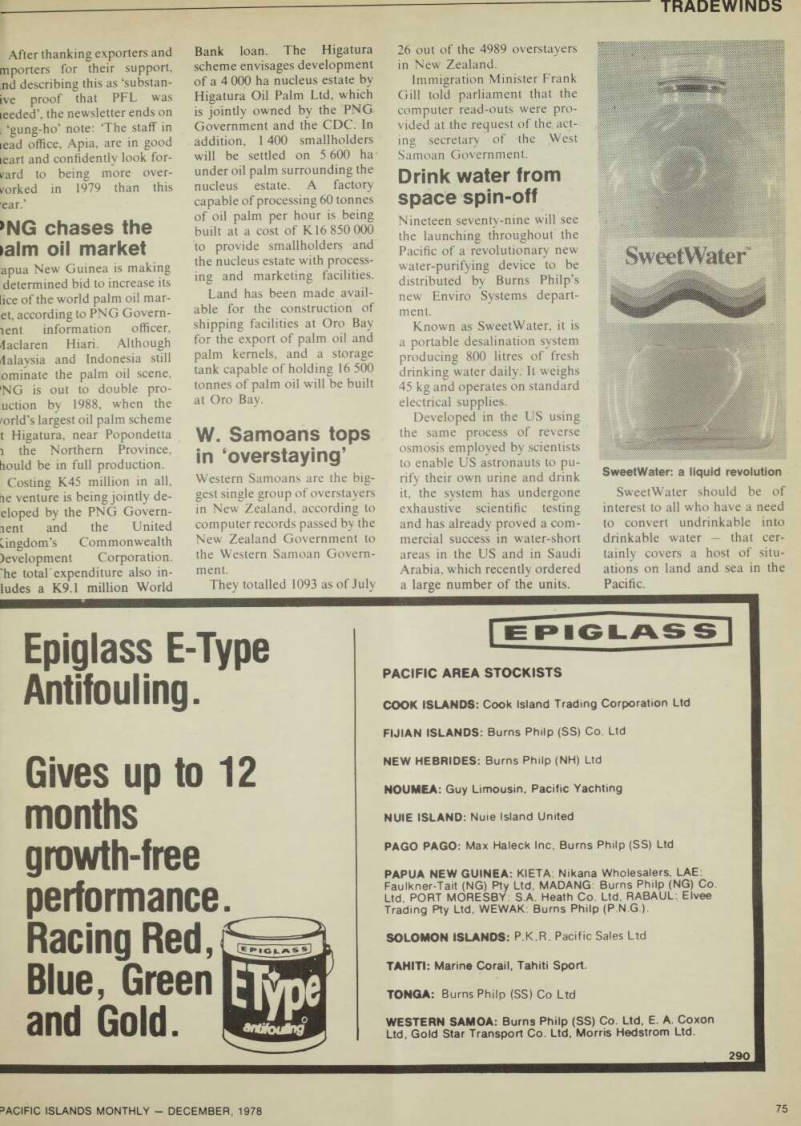
Known as Sweet Water, it is a portable desalination system producing 800 litres of fresh
drinking water daily. It weighs
45 kg and operates on standard
electrical supplies.
Developed in the US using the same process of reverse
osmosis employed by scientists
to enable US astronauts to pu rify their own urine and drink it, the system has undergone exhaustive scientific testing and has already proved a com mercial success in water-short areas in the US and in Saudi Arabia, which recently ordered a large number of the units.
Sweet Water should be of interest to all who have a need to convert undrinkable into drinkable water that cer tainly covers a host of situ ations on land and sea in the Pacific.
Sweet Water: a liquid revolution