Ng Missionaries
pp. 63-67 · Read in the full issue


Yesterday
Wings Of Gold
Enter The
Aviation Arena
When the aeroplane came to New Guinea, among the first organisations to see the advantages of this new transport were the Christian Missions. The Roman Catholics and the Lutherans soon bought their own planes. But in those days of pioneering aviation nearly 50 years ago, the entry of the Missions into the aviation field brought its own dramas, as the following story shows. It is condensed from James Sinclair's new book. Wings of Gold: How the Aeroplane Developed New Guinea, just published by Pacific Publi cations.
Both the Roman Catholics and the Lutherans had quickly realised that the greatest single problem they faced in the establishment and main tenance of their new Highlands stations was the basic matter of
keeping them supplied.
The entire Highlands region was isolated and mountain locked, and was to remain so until as late as the mid-19605,
when the Highlands Highway,
linking the region to the coast at Lae, was finally completed.
In the thirties there *were only two ways of supplying estab lishments mission, adminis tration or private enterprise in the Highlands; by land, employing expensive, inef ficient and slow carrier lines, or
by aeroplane. From a practical
viewpoint, the use of air trans port, expensive though it was, was the only logical choice.
The first into the aviation field was the Neuendettelsau Lutheran Mission. As early as May 1927 Johannes Flierl, founder of the Neuendettelsau Mission, wrote to Rev Ruf on the question of the extension of the work of the mission into the
interior: ‘We shall have to fly into the far inland, like pigeons to their dovecotes. We are
experimenting now with flights
in the goldfields, with very good results’. And wherever possible the mission con structed landing grounds at the major stations, often of barely sufficient standard for safe op erations. The bulk of Lutheran Mission aerial freight was car ried by Guinea Airways, and
mission negotiators invariably
drove a hard bargain over
freight rates.
The board of the Lutheran Mission in Neuendettelsau, Bavaria, approved in 1934 the purchase of a suitable machine.
Director Eppelstein ap proached the Junkers factory at Dessau. Junkers aeroplanes had amply proved their suit ability for New Guinea con ditions in the hands of the
Guinea Airways pilots, and
Eppelstein was offered a second-hand Junkers F/13Ke, fully overhauled and in perfect condition, for 80 000 marks, a considerable reduction on the price of a new aeroplane.
The church council loaned
the mission 3 500 marks; a similar amount was gathered by missionaries in New Guinea, and the Lutheran native evangelists in the newly established Highlands stations voted the sum of 500 shillings from their 1934 allowance. In this way, using small amounts of cash from a great many sources, the purchase price of the F/13 was finally raised.
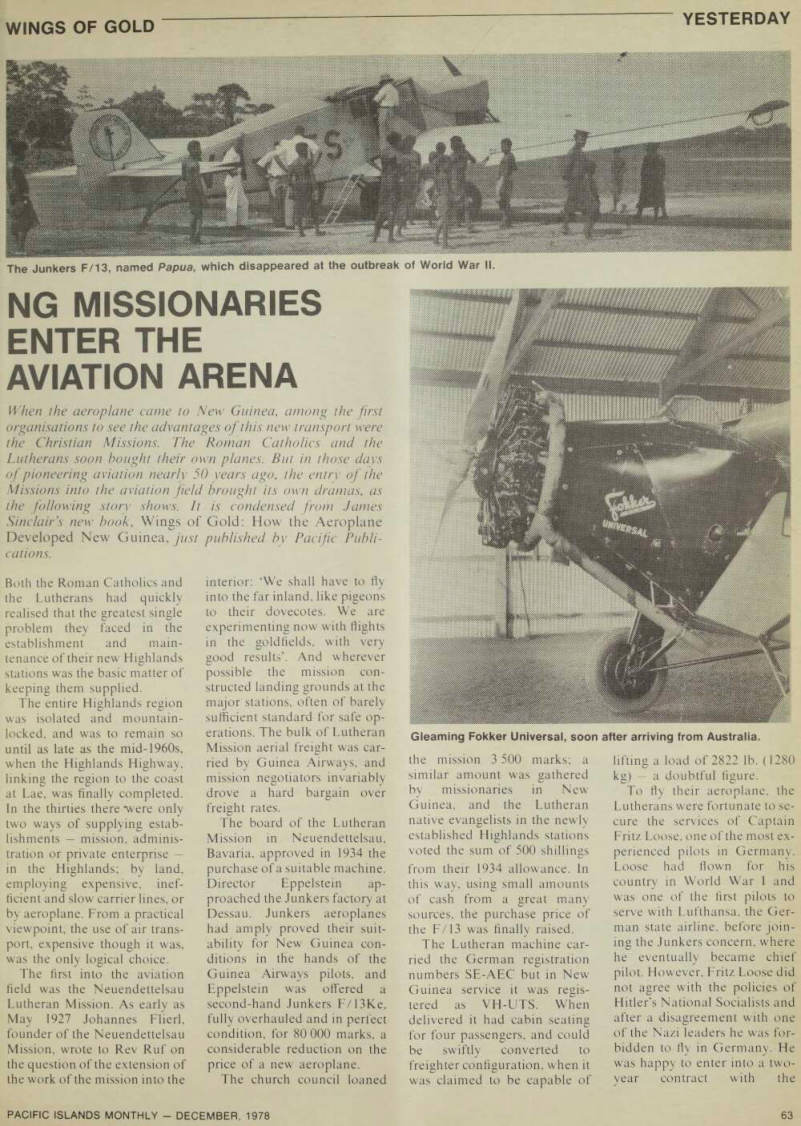
The Lutheran machine carried the German registration numbers SE-AEC but in New Guinea service it was registered as VH-UTS. When delivered it had cabin seating for four passengers, and could be swiftly converted to
freighter configuration, when it
was claimed to be capable of
lifting a load of 2822 lb. (1280
kg) a doubtful figure.
To fly their aeroplane, the Lutherans were fortunate to se cure the services of Captain Fritz Loose, one of the most ex
perienced pilots in Germany.
Loose had flown for his country in World War I and was one of the first pilots to serve with Lufthansa, the Ger man state airline, before join ing the Junkers concern, where he eventually became chief pilot. However, Fritz Loose did not agree with the policies of Hitler’s National Socialists and after a disagreement with one of the Nazi leaders he was for bidden to fly in Germany. He was happy to enter into a two year contract with the
The Junkers F/13, named Papua, which disappeared at the outbreak of World War II.
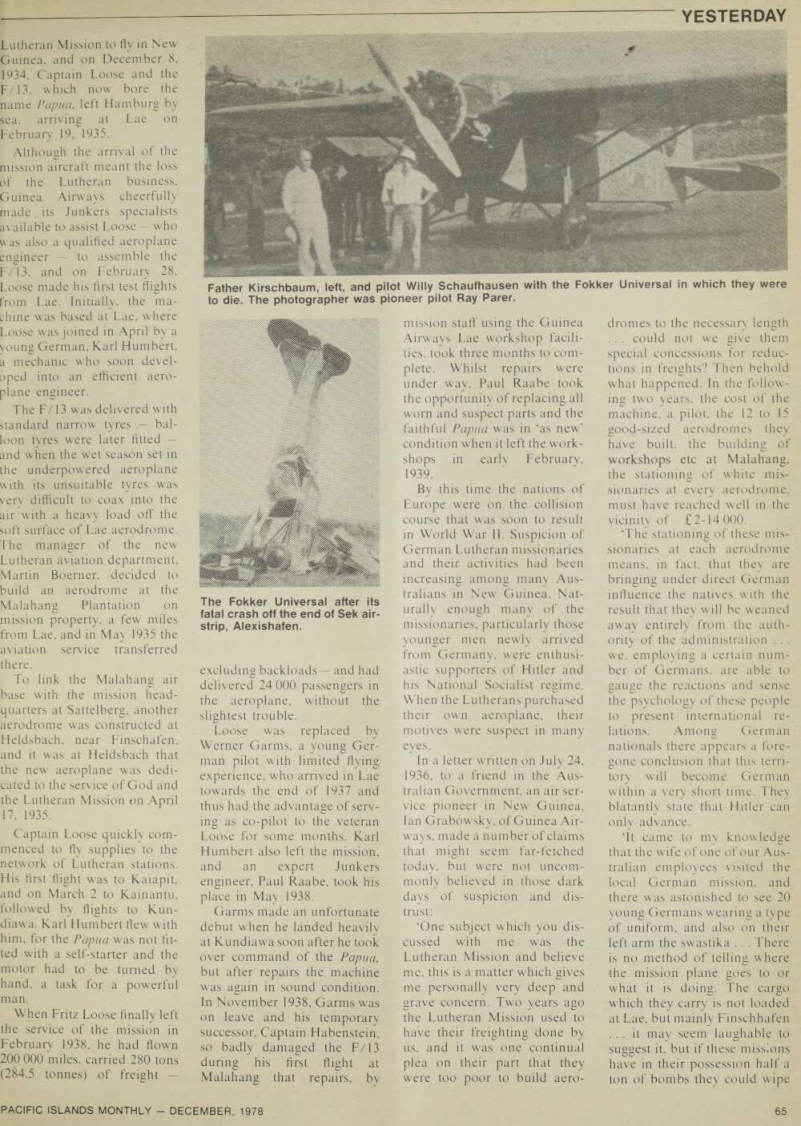
Gleaming Fokker Universal, soon after arriving from Australia.
Lutheran Mission to fly in New Guinea, and on December 8. 1934. Captain Loose and the F/13, which now bore the name Papua, left Hamburg by sea. arriving at Lae on February 19. 1935.
Although the arrival of the mission aircraft meant the loss of the Lutheran business, Guinea Airways cheerfully
made its Junkers specialists
available to assist Loose who was also a qualified aeroplane engineer to assemble the F/13, and on February 28.
Loose made his first test flights from Lae. Initially, the ma chine was based at Lae. where Loose was joined in April by a young German. Karl Humbert, a mechanic who soon devel oped into an efficient aero
plane engineer.
The F/13 was delivered with standard narrow tyres bal loon tyres were later fitted and when the wet season set in
the underpowered aeroplane
with its unsuitable tyres was very difficult to coax into the air with a heavy load off the soft surface of Lae aerodrome.
The manager of the new Lutheran aviation department.
Martin Boerner. decided to build an aerodrome at the Malahang Plantation on mission property, a few miles from Lae. and in May 1935 the aviation service transferred there.
To link the Malahang air base with the mission head quarters at Sattelberg, another aerodrome was constructed at Heldsbach. near Finschafen. and it was at Heldsbach that the new aeroplane was dedi cated to the service of God and the Lutheran Mission on April 17. 1935.
Captain Loose quickly com
menced to fly supplies to the network of Lutheran stations.
His first flight was to Kaiapit, and on March 2 to Kainantu. followed by flights to Kun diawa. Karl Humbert flew with him, for the Papua was not fit ted with a self-starter and the motor had to be turned by hand, a task for a powerful man.
When Fritz Loose finally left the service of the mission in February 1938, he had flown 200 000 miles, carried 280 tons (284.5 tonnes) of freight -
excluding backloads and had delivered 24 000 passengers in the aeroplane, without the
slightest trouble.
Loose was replaced by
Werner Garms, a young Ger man pilot with limited flying experience, who arrived in Lae towards the end of 1937 and thus had the advantage of serv ing as co-pilot to the veteran Loose for some months. Karl Humbert also left the mission, and an expert Junkers engineer, Paul Raabe, took his
place in May 1938.
Garms made an unfortunate debut when he landed heavily at Kundiawa soon after he took over command of the Papua, but after repairs the machine was again in sound condition.
In November 1938, Garms was on leave and his temporary successor. Captain Habenstein, so badly damaged the F/13 during his first flight at
Malahang that repairs, by
mission staff using the Guinea
Airways Lae workshop facili
ties, took three months to com plete. Whilst repairs were under way, Paul Raabe took the opportunity of replacing all worn and suspect parts and the faithful Papua was in ‘as new’ condition when it left the work
shops in early February,
1939.
By this time the nations of Europe were on the collision course that was soon to result in World War 11. Suspicion of German Lutheran missionaries and their activities had been increasing among many Aus tralians in New Guinea. Nat urally enough many of the missionaries, particularly those younger men newly arrived from Germany, were enthusi astic supporters of Hitler and his National Socialist regime.
When the Lutherans purchased their own aeroplane, their motives were suspect in many eyes.
In a letter written on July 24, 1936, to a friend in the Aus tralian Government, an air ser vice pioneer in New Guinea, lan Grabowsky, of Guinea Air ways, made a number of claims that might seem far-fetched today, but were not uncom monly believed in those dark days of suspicion and dis trust; ‘One subject which you dis cussed with me was the Lutheran Mission and believe me. this is a matter which gives me personally very deep and grave concern. Two years ago the Lutheran Mission used to have their freighting done by us, and it was one continual plea on their part that they were too poor to build aero
dromes to the necessary length ... could not we give them special concessions for reduc tions in freights? Then behold what happened. In the follow ing two years, the cost of the machine, a pilot, the 12 to 15
good-sized aerodromes they
have built, the building of
workshops etc at Malahang,
the stationing of white mis sionaries at every aerodrome, must have reached well in the vicinity of £2-14 000.
The stationing of these mis sionaries at each aerodrome means, in fact, that they are bringing under direct German influence the natives with the result that they will be weaned away entirely from the auth ority of the administration . . . we. employing a certain num ber of Germans, are able to gauge the reactions and sense the psychology of these people to present international re lations. Among German nationals there appears a fore gone conclusion that this terri tory will become German within a very short time. They blatantly state that Hitler can
only advance.
‘lt came to my knowledge that the wife of one of our Aus tralian employees visited the local German mission, and there was astonished to see 20 young Germans wearing a type of uniform, and also on their left arm the swastika . . . There is no method of telling where the mission plane goes to or what it is doing. The cargo which they carry is not loaded at Lae, but mainly Finschhafen ... it may seem laughable to suggest it, but if these missions have in their possession half a ton of bombs they could wipe
The Fokker Universal after its fatal crash off the end of Sek air strip, Alexishafen.
Father Kirschbaum, left, and pilot Willy Schaufhausen with the Fokker Universal in which they were to die. The photographer was pioneer pilot Ray Parer.
)ut all our aircraft in half an lour and the whole of our istablishment. ..’
Grabowsky went on to admit hat his fears could well attract /ery adverse criticism but that le would be failing in his duty o Australia if he did not ex cess his views.
There is no doubt that the
Papua was employed purely on
he religious business of the Mission, but the leroplane vanished from the Mew Guinea scene in a mys erious, and curious, way. As he month of August 1939 drew 0 a close war in Europe ippeared inevitable, and in 'act it was to come within days, Werner Garms and Paul Raabe loaded the Papua with
:argo for Ogelbeng. the
Lutheran station near Mt.
Hagen and flew away from Vlalahang never to return.
While they were in the Highl ands war was declared and LJarms and Raabe decided on
1 bold move: they would fly
he aeroplane out of the Man dated Territory of New Guinea md endeavour to escape to
Europe. They flew to Kaiapit
md refuelled from mission >tocks there and on takeoff the lunkers was seen to turn away from Lae, to the south-west.
Later, it was found that they bad reached Merauke, in Dutch New Guinea.
There was indignation in New Guinea when the news of the escape of Garms and Raabe became known, and the authorities were blamed for failing to arrest the Junkers. ‘An executive officer of one
aviation company sought per
mission from the administra tion to send a machine out to seize the foreign and its crew,’ ran a report in Pacific
Islands Monthly. ‘Authority
was not obtained, and the Ger man machine disappeared from the Territory.’
The ultimate fate of the Papua is unknown. Garms and Raabe made their way by steamer to Japan and travelled
via the Trans-Siberia Railway
through Russia into Germany
where both of these brave men joined the Luftwaffe. Garms died in his blazing warplane over the Crimean front when the Germans invaded Russia.
The German Catholic
Mission of the Holy Ghost. So ciety of the Divine Word. East ern New Guinea, was established in 1896 and in 1909 the principal station of the mission was developed at Sek.
Alexishafen. 10 miles (16 km) north of Madang.
When the Catholic faith was extended to the Highlands, church authorities were as quick as the Lutherans to move to acquire their own aero planes. An aerodrome was con structed. 2.5 miles (4 km) from
with their Junkers Papua were making a greater success of their aerial operations than were the Catholics and the mission agreed to purchase a more suitable aeroplane. Suit able machines available in Australia were inspected, and
the aeroplane finally chosen
was a Fokker Universal, an
American-designed high-wing
monoplane built by Atlantic
Aircraft Corporation, a sub sidiary of the Fokker Aircraft Corporation of America.
Sek. equipped with hangar and workshops, and on August 5, 1935. the mission purchased its first aeroplane, a German Klemm L2sd-2 Swallow low
wing monoplane.
The pretty little Klemm. a two-seater, was christened Paulus and was soon flying supplies to the main mission
outstations. The pilot, Willy
Schaufhausen. was skilful and dedicated to the service of the mission and although the Klemm was hardly a freighter, it proved to be so valuable to the Eastern New Guinea mission that another was acquired in April 1937. This machine was given the name Petrus; a young priest. Father John Glover with less than 100
hours flying experience, com
menced piloting the little Klemm in 1938 and rapidly im proved his skill.
But the two Klemms. useful
as they were, were really only
sports machines; the Lutherans
The Fokker Universal had been flying in Australia since January 1929. A bulky ma chine. with a wing span of just under 48 feet (14.7 m) the Universal could carry two crew and four passengers at a maxi mum speed of 118 mph (190 km/h) and it was decid edly a better aeroplane for the work of the mission than were the Klemms.
In May 1939. the mission’s
chief pilot, Willy
Schaufhausen, took delivery of the Fokker in Adelaide. With him was veteran New Guinea pilot Ray Parer. Schaufhausen lacked experience of heavy air craft and long distance flying and wisely the mission engaged Parer to pilot the aeroplane back to Alexishafen.
Willy Schaufhausen was a
good pilot. During his years of
flying in the little Klemm monoplanes he had four times
experienced flying accidents;
on one occasion after an engine
failure he kept his machine in the for half an hour and suc ceeded in reaching an aero drome: on another he was caught in a steep mountain valley by a powerful down draught. and the aeroplane lost 2000 feet (520 m) of altitude in seconds before Schaufhausen regained control after the Klemm passed over a huge grass fire which provided his light machine with vital lift. No pilot cound have survived five years of New Guinea flying if he was incompetent.
It is, however, a fact that the
pilot of an aeroplane is legally
in command and bears the
final responsibility of ensuring
that the machine is in air
worthy condition, properly
loaded, before he takes off.
The terrible accident that de stroyed the Fokker. its crew and passengers the worst disaster in New Guinea avi ation history to that time must therefore be blamed upon
the pilot.
On August 6, 1939.
Schaufhausen prepared for a flight to Salamaua. The Fokker was loaded with a quantity of
freight and three missionary
priests the renowned Fr Franz Joseph Kirschbaum. Fr Superior Jakob Weyer, vicar to Bishop Wolf at Alexishafen. and Fr Otto Bader took their seats in the aeroplane, together with a native mission worker.
When Schaufhausen com menced his takeoff run from Sek aerodrome at 8.30 am the Fokker was overloaded by some 50%. Two hundred yards
beyond the aerodrome, just
after becoming airborne, the Fokker plunged into a grove of coconut palms killing all occupants.
There is no doubt that the Fokker had been overloaded; aircraft inspector P. L. Taylor, who was on the scene the same day. established this conclus
ively.
The bodies were recovered but terribly mangled, and all five were buried in a common grave that evening. Of the vic tims, the best known was Fr Kirschbaum. A priest of the Central New Guinea mission.
Fr Kirschbaum had lived in the Mandated Territory for over 25 years, most of which he spent on the mighty Sepik River.
Captain Fritz Loose, left, with German associates and the Junkers F/13.