ego-tripping
p. 61 · Read in the full issue
Island victim of British ego-tripping
An accomplishment of James Cook which isn’t readily remembered is that, on his sec ond voyage, he took back Omai of Huahine (in the Society Islands), who became the first South Seas islander to visit England and return safely to his home.
E. H. McCormick has writ ten a lengthy and sometimes belaboured account of Omai (or Mai as some called him) who impressed and charmed British society. Exhaustively researched, no one could hope to learn more then McCormick shares with us. not only about Omai. but also of Cook, the Pa cific. and the times of the voy ages. He goes far beyond mere
life description and travelogue
to make commentary on the science and philosophy of the times which motivated Cook and others to collect people from new lands.
Some people have an idea that early European Pacific ex
plorers meandered through the
vast expanse: stopping oc
casionally at islands: chatting
trading and sometimes fight
ing with the people: reprovisioning and then sailing forth to other emerald lagoons and white sand beaches.
Such was not the case. Most voyages were carefully planned (even if the captains were not too sure of where they were going) and much involvement was fostered among the Island peoples. Rousseau’s notions of the ‘noble savage’ promoted great interest and curiosity of Islanders on the part of the
Europeans.
Omai was about 21 when he arrived in England on July 14. 1774. He was given under the charge of Joseph Banks, an entrepreneur and financier of ships’ voyages (and a veteran of Cook’s first trip), who, together with his friends, ‘launched him on a meteoric social career’. At once he was popular in Lon don. ‘The newspapers ... vied
w ith one another to follow his every movement . . .’
Oftentimes his English lessons and other instructions had to be cancelled because of other engagements. If Omai was a noble savage when he arrived. McCormick’s account leaves very Ifttle doubt that he was, if not dissipated at least
appropriately bewildered by
the time he departed.
With all the bedazzlement the young Tahitian had. it is still not clear in McCormick’s account how much he learned and especially how he really felt about his experiences. And perhaps it would never have been possible to tell. One ob server wrote: ‘As we are totally unacquainted with his country, connections and affairs, our conversation was necessarily very much confined . . .’
Captain Cook returned Omai to his home islands in 1777 and there set him up with a European-style house, live stock. gardens, and a number of other w estern accoutrements largely useless on Huahine.
Their purpose was to demon strate an enduring influence through a native who had been
Europeanized.
But these intentions were realised in limited ways. Cap tain William Bligh who visited Tahiti on the Bounty 12 years later to gather breadfruit seed lings, learnt that Omai had died of natural causes some 30 months after his home-coming.
His house had been torn to
pieces and stolen, and the story of the rest of his English-given possessions was one of almost ‘unrelieved loss or neglect'.
Bligh’s informant related that Omai had often gone horse-back riding ‘in boots', a detail seen by Bligh as encouraging proof that ‘he did not immediately after our leav
ing him. lay aside the English
man'. It appears, however that such evidence of westernisa tion is more bemused fancy than serious acculturation. In the end the practice of people
collecting in general and
Omai’s sojourn in point was more of a British national ego trip than an effective exper iment in behaviour modification.
E. H. McCormick intended to write a definitive account.
He did. Scholars of the Pacific who want to know about Omai.
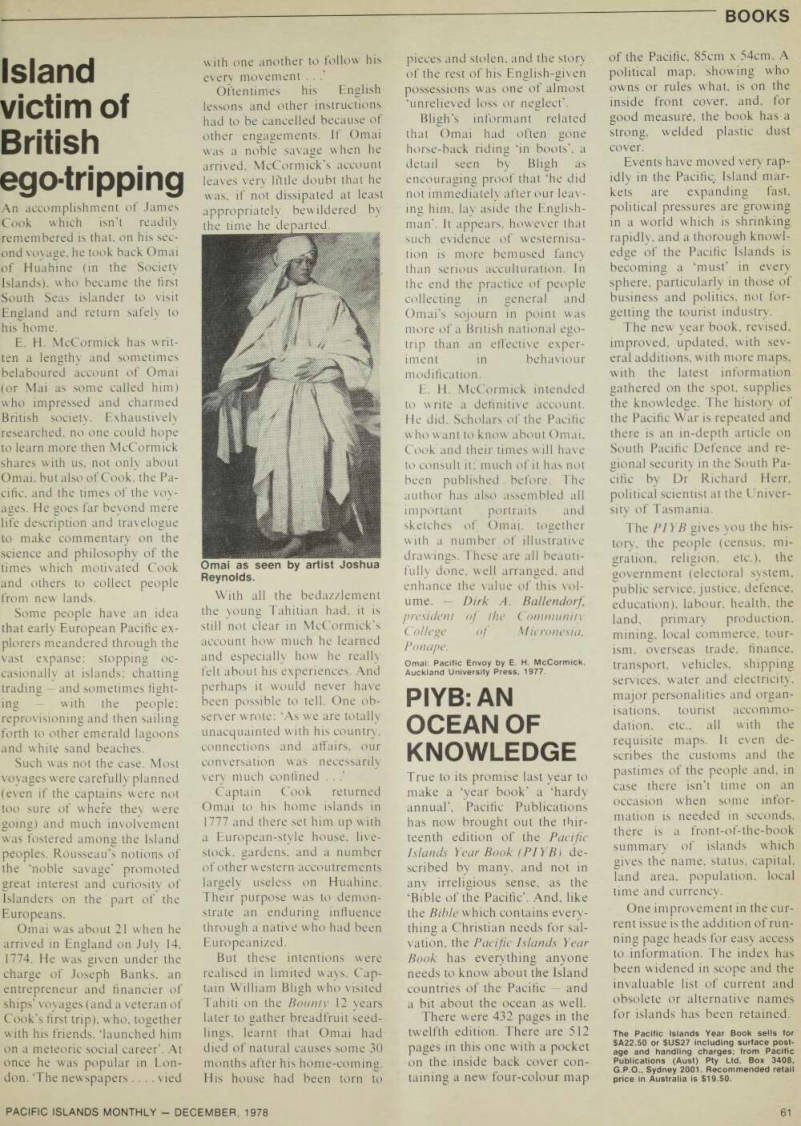
Cook and their times will have to consult it; much of it has not been published before. The author has also assembled all important portraits and sketches of Omai. together with a number of illustrative drawings. These are all beauti fully done, well arranged, and enhance the value of this vol ume. Dirk A. Ballendorfi president of the Community
College of Micronesia ,
Ponape.
Omai: Pacific Envoy by E. H. McCormick, Auckland University Press, 1977.
Omai as seen by artist Joshua Reynolds.