Landrover Too?
pp. 59-60 · Read in the full issue
Books
Can You Have
Your Kava And
Landrover Too?
Ahat do people who want elec ricity, modern medicines, or wen metal fishhooks, have todo 0 obtain these things? A new iind of sugar and The social md economic impact of tourism n Pacific communities seek to )ffer one answer to this mod ern dilemma of Oceanic (and nher) populations in the Third World.
The problem is particularly
icute for those places which ire small in size, limited in narketable resources, with an
ncreasing local population,
fhat description fits most Pa :ific countries and territories. ‘A new kind of sugar’ is a
)hrase used by Hawaiian
dergyman Rev Abraham \kaka, to represent tourism as 1 replacement for the sugar worn in earlier days. The nevitability of tourism was iccepted by the East-West renter workshop, in Honolulu n 1974; little has changed. ;ince what the conferences vanted to sort out was how the ncome from this service indus ry could be planned to pro vide. ‘maximum net economic ;ocial and cultural benefits for he island populations’.
And that is the nettle which
nust be grasped, as the highly
:ritical pieces by Sarny and LeFevre on tourism in Fiji ;trongly demonstrate. Tourism ihould not be just to benefit overseas investors or a local elite, but be spread to all sec ;ors of the society. Claude Robineau. in his tersely written piece on Tahitian tourism,
notes how 'semi-family style
Polynesian hotel forms’ might bring Islanders more into the
benefits accruing from travel
lers and their money. But. he warns, such a development is incompatible with mass tour ism, where the real money lies today.
While the provision of hotel
‘ooms occupies Tahati’s
entrepreneurs, Papua New guinea’s fledgling industry worries about how to supply
visitors with quality artifacts.
Ronald May’s detailed piece on the marketing of tradition does not realise. I think, that indigenous art performs a function, for the user and for the eventual recipient. In the case of tourist or airport art. cash money replaces the pres tige the artisan used to receive.
Similarly, the art artisan de signs his work for his audience, we must not be alarmed if the
artifact produced only vaguely
resembles the traditional one. which might have been employed in a sacred context.
We must be prepared for the
day of the mud mask salt cellar or the already existing kava bowl ash tray.
And. if such objets d'art do appear, we should not be sur prised, for what is being thrown at us is our own Euro- American taste.
But, the whale’s share of Sugar is devoted to Hawaii, which occupies 86 of the vol ume’s 262 pages. The steel guitar, floral shirts, and post card aloha cannot obscure that the Hawaiian situation is very different from what pertains on other islands. Ethnic Hawaiians occupy but a small proportion of the modern
population, having been long
ago swamped by Europeans
and other outsiders. On Hawaii, one cannot talk about the preservation of cultural tra ditions but their resuscitation.
So, tourism is nof every Islander’s cup of kava. The ‘controlled tourism’ of the governments of Papua New Guinea, Western Samoa and the Cook Islands hopes to cope with the influx of the hoped for (and. it seems feared) visitors.
Now, just in case you’re not convinced that tourism should be controlled, the University of California Center for South Pacific Studies, held another conference on the subject in 1975, the proceedings of which comprise The social unci econ omic impact of tourism on Pa cific communities. Instead of
planners and anthropological
pundits, who wrote about Sugar , the second volume involves the heterogeneously concerned people who either run tourist facilities or are com mitted to the people who work in them.
The 38 short papers tell how airline officials, taxi drivers, Maori dancers, and govern ment representatives, amongst others, feel about tourism.
Local involvement, its desir ability or necessity, comes up frequently in the various papers. How deep down through the class structure this local involvement will pene trate is the source of some de bate.
Symbolically, the seven photographs breaking up the seven sections of the 141 page volume show mainly hotels.
Only two show people. For New Zealand’s Hotel Waitomo there are a few Europeans lounging on deck chairs, while the Fijian Hotel shows a mini
saronged maiden extending
her hand to a grateful tourist, floating on an inflated pool raft. These cold photographs contrast with the warm concern of most of the conference par
ticipants.
A valuable and appreciated feature of Impact is that at the end of each section we are treated to some transcripts of the debates at the conference.
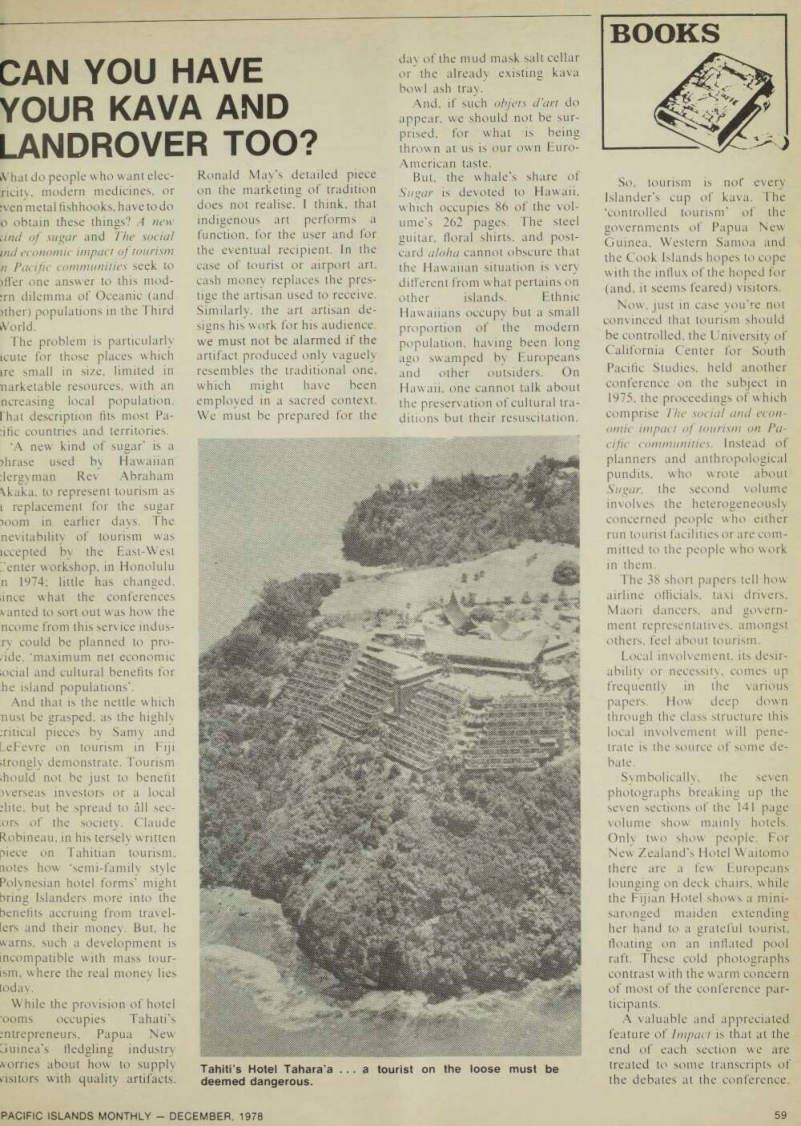
Tahiti’s Hotel Tahara’a ... a tourist on the loose must be deemed dangerous.
Here the conferees question one another, clarify points of view, and discuss what I feel are their honest differences.
Perhaps tourism is a num bers problem, for if a territory seeks to rely upon such a ser vice orientation for its income, it will have to attract large scale package tours. And. once it manages to attract those plane or shiploads, it will have to houSe and Teed them: and give them something to do. When you get a number of people far in thought and distance from their homes, there are bound to be consequences, some regret table. If tourism is primarily for escapism, as some of the conference participants write, then like all escapees, a tourist on the loose must be deemed dangerous, until proven other wise.
Sugar and Impact contain warnings and insights of value to anyone interested in tourism ... or to any interested tour ists.
Idi Amin once remarked that the ideal form of tourism for Uganda would be to have collectors greet arriving air craft, relieve visitors of their cash and send them packing on a return flight. No Pacific terri tory is contemplating such an extreme form of ‘controlled tourism’, however unlikely the proposal seems. But people in the islands are clearly worried about current developments and while tourism, in the form
of religious pilgrimages, has
been around for millenia, there does seem to be something dif ferent, threatening, about the modern experience.
Perhaps the anguish experi
enced by tourist-dominated populations today is not so much the impact of foreigners, but the extent of control, even domination, these same out siders have over today’s Pacificans.
Can Pacific Islanders have their imported goods without also importing the pain that seems to arrive on the same
ship or plane?
Grant
McCall.
A new kind of sugar. Tourism in the Pacific.
Edited by Ben R. Finney & Karen Ann Wat son. Published by the East-West Center, Honolulu, Hawaii, and Center for South Pa cific Studies, Santa Cruz, California. 1977.
SUSS.7S. The social and economic impact of tourism on Pacific communities. Edited by Bryan H. Farrell. Published by Center for South Pacific Studies, University of Califor oia, Santa Cruz, California. 1977.