Towards A South
pp. 66-70 · Read in the full issue
Tradewinds
Pacific Master
Market Plan?
Two-hundred mile resources zone euphoria, apparent after last year’s Port Moresby South Pacific Forum, has palled a bit in the months since. Those instant riches weren’t forth coming and perhaps are even further away after this year's Niue Forum in September. But while the euphoria of 1977 was an over-reaction, so was the de pressed mood of some dele gations after the Niue get-together, writes Bob Hawkins who was in Alofi dur ing the talks.
At least a fisheries organis ation will be set up; an associ ation is to be established among regional airlines; there is enough goodwill to push the
newly-established Pacific
Forum Line on through its dif ficult teething stage; but, much more importantly, the ground work has been laid in a vital area which could, in the not too-distant future, become the Forum’s greatest single achievement.
Before the Niue meeting was a document, compiled rather presumptuously ‘by a team of experts’, entitled Industrial Development and Trade Re lations in the South Pacific. It is a significant report and gives the reader a feeling it may prove to be the first step along the road to the formation of a South Pacific economic com munity. The report was com missioned by the Commonwealth Secretariat and the experts called upon to compile it were assisted by the South Pacific Bureau for Econ omic Co-operation (SPEC).
Australia obviously appreci ated the impact the document would have on Forum mem bers and indicated its willing ness to offer assistance to Island members along lines recommended.
The industrialisation side of the report in itself makes interesting if not too optimis tic reading, but it is the trade
relations portion which pro vides possibly the best ap praisal yet of the various forces at work in the region and then goes on to suggest ways in which Island states can im prove their performance.
It looks at trade with devel oped nations (noting that while more can be sold to Europe and other developed areas Islanders should not rely too heavily in that direction), and trade with developing nations (particularly Association of South-east Asian Nations - ASEAN countries). But its main focus is on improving Island performance vis-a-vis Australia and New Zealand.
The going will not be easy but, with the goodwill of Aus tralia and New Zealand, the re port suggests two ways in which the lot of Island nations could be enhanced. Each, the reports stesses, depends on how forth coming Australia and New Zealand prove to be on the question of access to their markets.
The existing trade agree ment between Australia and its former territory, Papua New Guinea, provides the basis for the first approach. The report suggests an extension of the Australia Papua New Guinea Agreement on Trade and Com mercial Relations (PATCRA) by the accession of the Pacific Island countries and New Zealand.
The report observes that while cast in the form of an agreement establishing a ‘free trade area’. PATCRA is ‘un usual because of the way in which it protects the somewhat different interests of its
developing and developed
members. In brief the agree ment is designed so that PNG gives no tariff concessions to Australia . . . PNG benefits from free access to Australia for most goods whilst Aus tralian interests are protected by the provision of a finely graded range of safeguards’. In other words, PNG has far from open slather but it is a relation ship which other Island groups would like with both Australia and New Zealand.
PATCRA also has articles dealing with the promotion of investment, industrial, tech nical and administrative co operation, trade and technical assistance. And, interestingly.
the agreement provides that the member states may agree to the association of any other] state with the agreement sub-1 ject to the negotiation of ac ceptable terms.
The report says the chief advantages, of an approach i through PATCRA are; that an agreement already exists with provision for accessions and that the process of extension
depends primarily on unilat
eral action by Australia and New Zealand; and that the concessions Australia makes to PNG would provide a yard stick against which Pacific j Islands would measure Aus tralian concessions to other countries and New Zealand concessions to all regional countries.
The report states: ‘Leaving aside the central question of the extent of substantive con cessions by Australia and New Zealand the main problems ... arise primarily from attempt ing to build an agreement, which essentially formalises existing trade relations be tween two countries, out into a full fledged international agreement.’
The second course suggested is for the creation of a new re gional agreement in which Australia and New Zealand would grant preferential or
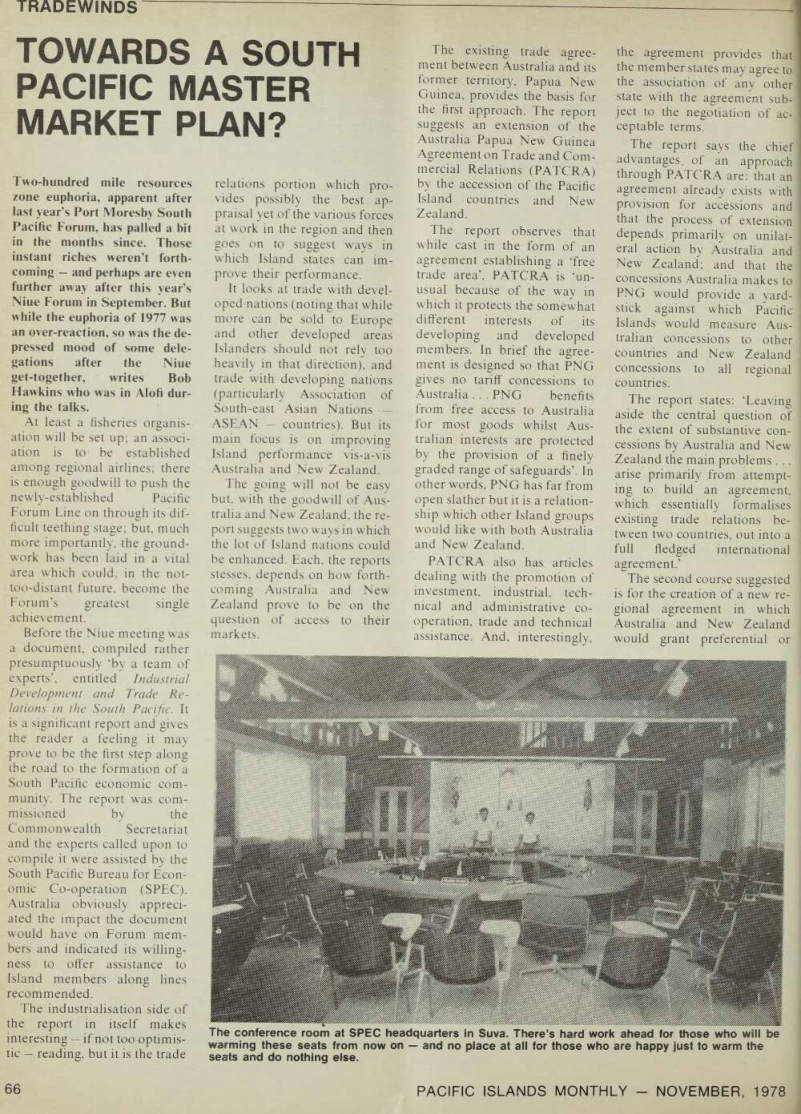
The conference room at SPEC headquarters In Suva. There’s hard work ahead for those who will be warming these seats from now on-and no place at all for those who are happy just to warm the seats and do nothing else.
duty-free access to goods from Island countries on a non reciprocal basis. The main dif ference, it says, from PATCRA ‘would flow from an essentially tactical judgement that it would be possible to avoid un necessary international diplo matic activity by building a new agreement, rather than extending an old one’.
This would require the Forum to call for a review of trade between member coun tries with a view to assisting developing member countries.
Australia and New Zealand would then have to review their current practices and come up with changes they would be prepared to grant to their fel low Forum members. Provided the A-NZ offer looked good enough, ‘the Forum could then ... welcome ... the offers ... and initiate proceedings to gain
international acceptance’.
While a new regional agree ment would give some flexi bility over an extension of PATCRA, the report notes that the ‘gain is ... slight and would need to be weighed against the danger that Australia and New Zealand might ... make less substantive concessions Australia has long argued for non-discrimination in inter national trade relations and has
recently argued that PATCRA
does not offend against the principle of non discrimination. Experience in GATT (General Agreement on Tariffs and Trade) has shown that this position is not fully accepted by some other coun tries and Australia would prob ably find it easier to argue the case for a new agreement rather than an extension . . .’
The Forum’s reaction to the report was to ask SPEC to get senior trade officials of mem ber countries together to exam ine it in detail and to prepare recommendations ‘on a non reciprocal trade agreement be tween Australia and New Zealand on the one hand and the Forum Island countries on the other’.
Other Forum directives on the same report were to instruct SPEC to look to measures to encourage the rationalisation and development of industries in the Islands, to promote
greater market access in Aus tralia and New Zealand and other countries outside the re gion as well as looking to ways in which to improve inter island trade.
Australia’s response to the report was to offer to fund for five years a trade commission in Australia which will pro mote Island exports.
SPEC has the footslogging
ahead of it but if Australia is to put its goodwill where its mouth is and prove that there’s some substance in its sometimes hollow assertions that it is not protectionist there’s no reason to believe sonething substantial in terms of a South Pacific-wide trade agreement can’t be on the table in time for next year’s Forum in Honiara.
Bank Line
changes course
The Bank Line, at the end of November, will launch a
monthly regular and direct
container/unitised cargo ser vice from Hull to Suva and Lautoka, in response to a de mand for a direct service. The new service is part of a restruc turing of the line’s overall South Pacific trade.
Fast, modern, composite cargo liners of the Cedarbank class will be used, offering break bulk containers, bulk liquids, reefer space and heavy lifts up to 50 tonnes. The main destinations are Papeete, Suva,
Lautoka, Noumea, Port Moresby, Lae, Rabaul, Kieta, and Honiara, with occasional calls at Madang, Yandina and Tarawa. Trans-shipment car goes will be accepted for other ports.
The UK loading brokers for the new services to Fiji will be Eastern Liner Services, which already handles Bank Line South Pacific services, with offices in London, Liverpool, Glasgow and Hull. Burns Philp (SS) Co Ltd are the agents in Suva and Lautoka. Details of services may also be obtained from the Bank Line in Syd ney.
At the same time the Bank
Line has announced it is ter minating its services from Fiji, Tonga and Western Samoa to the UK and the Continent.
Legal setback
for Nauruans
An application by Nauru Pa cific Line and Nauru Local Government Council for an
injunction against the Aus
tralian Shipping Officers’
Accociation (ASOA) restrain ing the association from im posing a black ban on the line’s chartered motorship Fentress was dismissed in the Federal Court in Melbourne in Sep tember.
The ruling by Mr Justice Northrop was a double blow to the Nauruans, for the judge, as well as refusing the injunction, said the line was operating il legally in Victoria because it had deliberately refrained from registering in Victoria as a foreign company.
The ASOA had slapped a ban on the Fentress now becalmed in Melbourne be cause of alleged breaches of the shipping officers’ award by its Melbourne travel department.
The Nauru Co-operative So ciety has taken over the travel department’s functions and then notified the ship’s officers that they would be employed under the less favourable con ditions of the Clerks’ Determi nation Award for Victoria.
Harder on ‘expats’
in Solomons
New laws aimed at increasing
employment opportunities for
local people and protecting
customs and culture have been enacted in the Solomons.
There will also be tighter con trol of vessels, including yachts, entering the country.
People wishing to work in the Solomons for more than 14 days will need a clearance from the Commissioner of Labour.
Expatriates looking for work
will not be considered unless the immigration authorities issue a permit. Expatriate wives and husbands of Solomon Islanders, unless they are citi zens of the Solomons, will have to have a permit to enter and
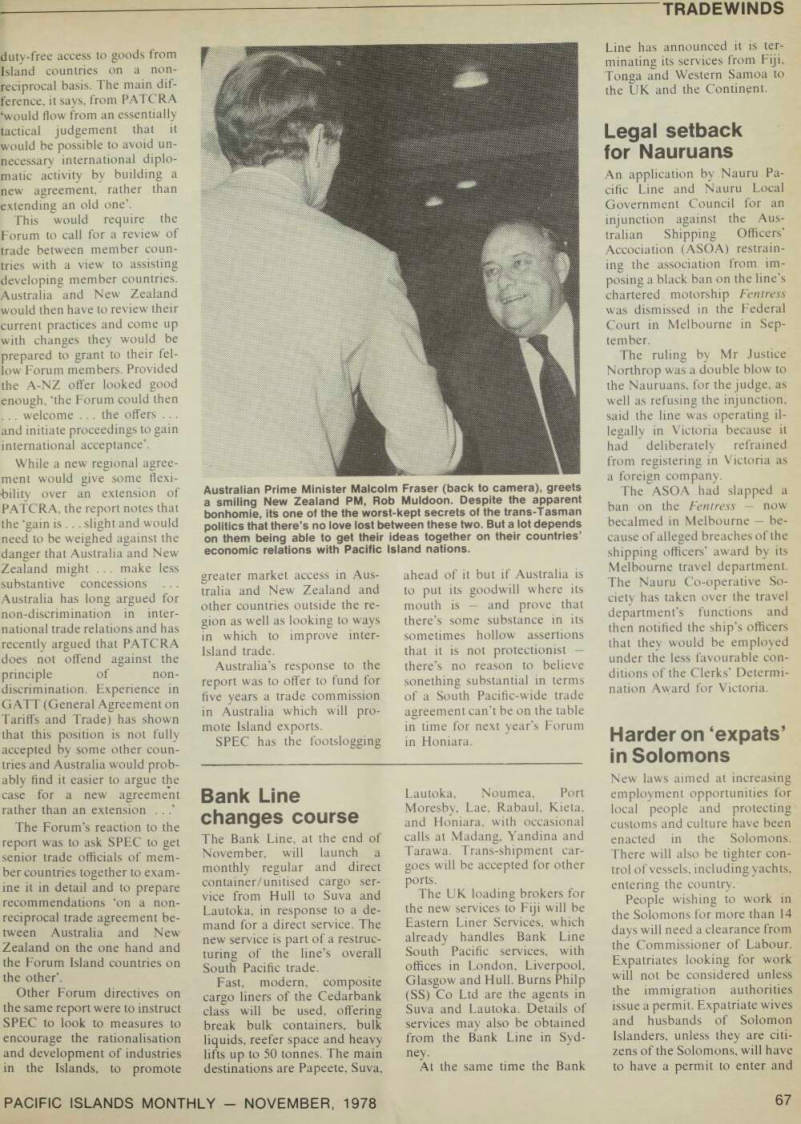
Australian Prime Minister Malcolm Fraser (back to camera), greets a smiling New Zealand PM, Rob Muldoon. Despite the apparent bonhomie, its one of the the worst-kept secrets of the trans-Tasman politics that there’s no love lost between these two. But a lot depends on them being able to get their ideas together on their countries’ economic relations with Pacific Island nations.
ive in the country, and will not >e allowed to work, unless they
lave a permit.
Employment of expatriates
vill only be allowed when con idered necessary, and will be ;übject to the localisation pol cy. The new laws protect the :ountry from having to under ake the financial burden of
:aring for destitute expatriates
md returning them to their >wn countries.
During the debate on the en ibling bills, there were com
jlainls about yachts
‘trespassing”, and pleas for the jovernment to make efforts to ratch intruders.
ndonesia-PNG
alk aid, trade
ndonesia will give technical issistance to Papua New Guinea in small scale indus ries, and the two countries will vork toward establishment of
lirect trading relations. These
igreements were reached dur ng a two-week visit to ndonesia in September by the S NG Minister for Commerce, Mr Pita Lus.
Agreement on technical as ;istance came after a request by Vlr Lus to the Indonesian Minister for Trade and Co operatives, Mr Radius Prawiro. [t will cover the hand loom and
veaving industry, wooden
landicrafts, the use of leather, oamboo and rattan and rooftile
making.
Training in these fields will
;oe conducted either by sending
PNG trainees to Indonesia or Indonesian technical instruc tors to PNG. Further details of the scheme will be worked out through an exchange of letters, expected to be drawn up soon.
Mr Lus and Mr Prawiro agreed that a direct and more
substantial trading relationship
should be brought about
through an increase in visits of government officials, chamber of commerce and industry and
private businessmen.
Trade between Indonesia and PNG is meagre, with an annual value of about $A200,000. The balance of trade, heavily in PNG’s favour, mainly involves re-export of
finished goods through PNG to Irian Jaya.
EEC ‘dumps’
sugar in PNG
A new front was opened up in September in the continuing warfare between the Aus tralian Government and the European Economic Com munity. As well as fighting the EEC over access of Australian primary products and steel to the EEC, the Australian Government now plans to take the EEC to task for its alleged ‘dumping’ of sugar on the Papua New Guinea market.
Australia’s Minister for Trade and Resources, Mr Anthony, said in Parliament that Australia sold about 20 000 tonnes of sugar annually to PNG, but that the EEC had
recently been penetrating this
market with heavily subsidised sugar.
The subsidy content of the EEC sugar amounted to about $350 a tonne, which was about three times the world price for sugar.
Mr Anthony said that pre
vious complaints by Australia
to the EEC about its export practices had not yet had any major impact on the communi
ty’s trading policies.
He added; Tn view of the seriousness of the situation for Australia’s exports to PNG, I have instructed officials of my department to consult with officials of the Australian sugar industry to prepare formal no tification to the General Agree ment on Tariffs and Trade (GATT) challenging the EEC on its behaviour in respect of Article 16 of the GATT to see whether we cannot take some positive action to stop this
dumping.’
Article 16 of the GATT effectively demands the elim ination of export subsidies.
PNG love affair
with Star-Kist?
The Papua New Guinea Government in September sent an eight-man delegation to the United States to complete negotiations with Star-Kist
Company unveils
<uirvpillance nod
surveillance puu Pacific Island governments brooding over the formidable problems of surveillance of
newly proclaimed resources
zones could well look with interest at a technical develop-
ment recently fathered by
Hawkerde Havilland Australia
Pty Ltd.
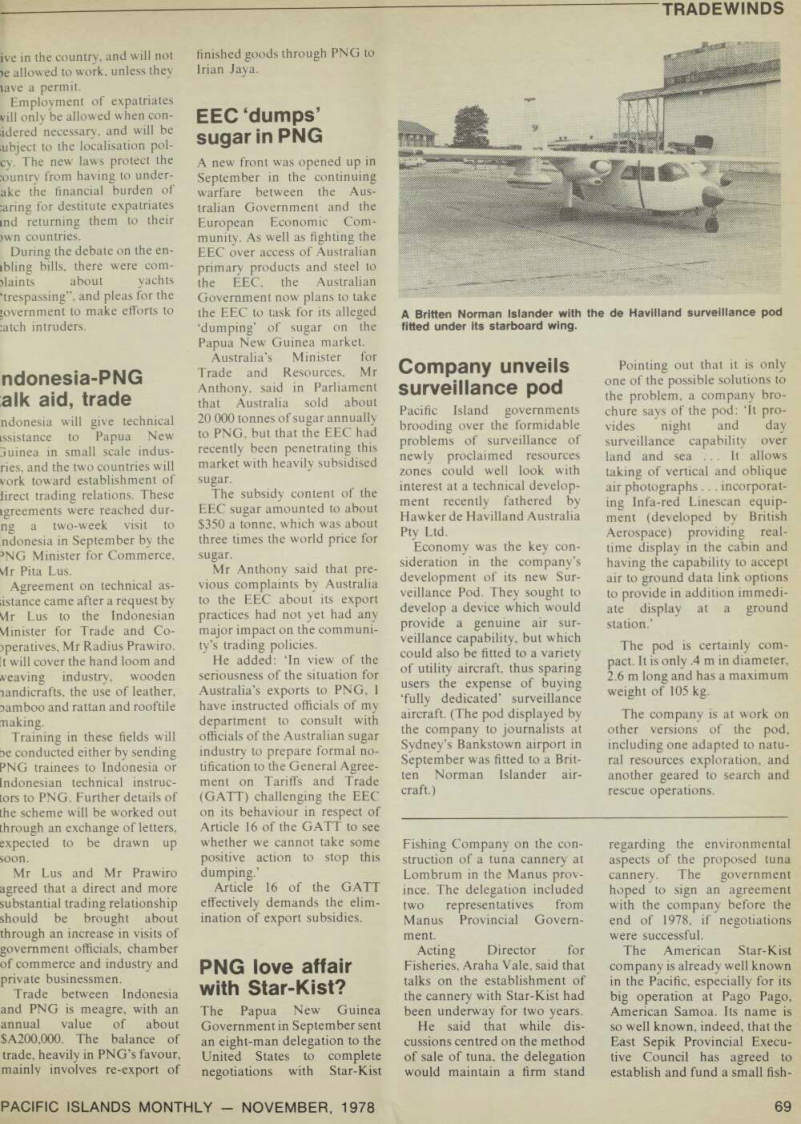
Economy was the key consideration in the company’s development of its new Surveillance Pod. They sought to develop a device which would provide a genuine air surveillance capability, but which , u r /’ • . could also be fitted to a variety r . 1W e . .. ■ J of utility aircraft, thus sparing vr u • users the expense of buying ‘fully dedicated’ surveillance
aircraft. (The pod displayed by
the company to journalists at
Sydney’s Bankstown airport in
September was fitted to a Britten Norman Islander aircraft.)
Pointing out that it is only one ofthe P ossible solutions to the problem, a company bro chure says of the pod: it pro
vides night and day
surveillance capability over land and sea ... It allows taking of vertical and oblique
air photographs . .. incorporat
ing Infa-red Linescan equip
ment (developed by British
Aerospace) providing real time display in the cabin and having the capability to accept air to ground data link options to provide in addition immedi ate display at a ground station.’ ... ■ , The pod is certainly com- T • . , ■ ,• , pact. It is only .4 m in diameter, *; , , J 2.6 m long and has a maximum . . jP in .. wei & ° The company is at work on other versions of the pod, including one adapted to natu ral resources exploration, and another geared to search and
rescue operations.
Fishing Company on the con struction of a tuna cannery at Lombrum in the Manus prov ince. The delegation included two representatives from Manus Provincial Govern ment.
Acting Director for Fisheries, Araha Vale, said that talks on the establishment of the cannery with Star-Kist had been underway for two years.
He said that while dis cussions centred on the method of sale of tuna, the delegation would maintain a firm stand
regarding the environmental aspects of the proposed tuna cannery. The government hoped to sign an agreement with the company before the end of 1978, if negotiations were successful.
The American Star-Kist company is already well known in the Pacific, especially for its
big operation at Pago Pago,
American Samoa. Its name is so well known, indeed, that the East Sepik Provincial Execu tive Council has agreed to establish and fund a small fish
A Britten Norman Islander with the de Havilland surveillance pod fitted under its starboard wing.
ing company in Wewak to be known as Star-Kist Fishing.
The company, which will be 100% PNG-owned, has been initiated by a local business man and two expatriates who have come to an agreement with the East Sepik Provincial Government.
Currency cramp
condominium
One of the weirder aspects of the New Hebrides con dominium’s rule is the dual currency system, writes a Vila correspondent. Both Aus tralian dollars and New Hebrides francs are legal ten der and in the days of parity, before the Australian devalu ation of November 1976, this point was of little significance.
But today, with the generally accepted rate of 80 francs to the dollar, it makes a great dif ference, especially to the larger trading companies (Burns Philp, CFNH) which, coupled with cheap labour and lack of taxation, enhances their
already healthy profits.
The actual franc to dollar rate varies daily at each of Vila’s seven trading banks.
There are also the usually stable condominium and chamber of commerce rates to assist businessmen and retailers. The local banks work their NH franc rates directly from the French franc which has been steadily improving for most of this year.
This all seems reasonable enough until one realises that
pricing is almost universally
done in New Hebrides francs and many people, especially those in the outer islands, are paid in dollars. The large retailers are notorious for their lightning changes in rates with out notice. Any stock already on the shelves or in warehouses obviously was bought at a more favourable rate. But the writer has yet to see any compensat ing price reductions. If every
thing was imported and paid
for in French francs one could see their point, but of course this is not the case.
Both Chief Minister George Kalsakau and Vanuaaku Party leader Walter Lini agree the country needs just one cur-
rency, but nothing positive has been done. The question then would be whether Australian dollars or N.H. francs should be retained. Surely the most rational solution would be the introduction of a new cur rency.
Solomon Islands had their new currency in circulation well before independence so the ball is obviously now in the court of the New Hebrides Government.
Tuvalu service by
Auckland airline?
The Auckland-based airline Sea Bee Air is expected to form an amphibious airline to serve Tuvalu.
Managing director, Murray Pope, said the airline would need to buy Goose amphibian aircraft for the service. ‘We have been looking around and we don’t anticipate any prob lems in getting the aircraft.’ he said.
Sea Bee Air was formed two years ago and operates an am phibious service to the Hauraki Gulf islands.
This is Mr Gordon McKenzie, who is likely to become a fam iliar figure in the South Pacific Islands. He’s heading the newly established office of Nelson & Roberston in Auckland. With a record of more than 80 years of service to the Islands, Nelson & Robertson plans through their new branch to provide NZ manufacturers with ‘on-the
spot’ representation throughout
Papua New Guinea and Fiji. Mr McKenzie, who has 13 years ex perience of exporting to the Islands, will assist clients and manufacturers with any and every query.