Solo man Willy seeks
pp. 59-60 · Read in the full issue
his world ‘first’
If you’ve ever felt that the age of discovery and exploration is over, and that all a poor yachts man can do nowadays is to fol low the beaten track around the world, take heart, write Marie-Therese and Bengt Damielsson from Papeete. Liv ing proof that it is still possible to chalk up a geographical ‘first’ is Dutch solo navigator Willy de Roos - he is circum
vavigating America!
Willy slipped almost un
noticed into Papeete in August.
Admittedly this latter-day Fly
ing Dutchman has not yet com pleted this circuit which has never before been attempted.
But there’s no doubt he will succeed since the most difficult stretch, the Northwest passage, is already behind him. This ex
plains his leisurely approach to
the second half of the voyage: from Cape Horn up the east
coast of the two Americas. He has deliberately postponed it in order to circumnavigate, as an extra dish, the Antarctic con tinent.
Willy was 50 before he gave up a successful business career to make his first voyage round the world under sail, between 1972 and 1975.
Still unsatisfied, and anxious for new challenges, Willy sud denly had the idea that he could achieve his ambition for a world ‘first’ by sailing right around America provided, of course, he managed to get
through the icy Northwest
passage. For the discoverer, the Norwegian Roald Amundsen, it had taken four long years. 1903-07. The hardships he and his five companions endured were almost incredible. Since that time only half a dozen naval vessels, some super
colossal tankers, and the atomic submarine Nautilus have repeated the achieve ment.
Willy de Roos had at his dis posal only a 12 m saving boat named Williwaw (after a tur bulent wind that blows in Patagonia). But he crammed it full of the most modern equip ment: radar, automatic pilot, sounding devices, and so on.
Plus a heating system. For shore excursions he took a one man sledge, to be pulled by himself.
Leaving the coast of Greenland in June 1977, Willy bravely entered the first of an endless succession of narrow and winding channels which constitute the intricate maze called the Northwest passage.
In open water, a constant 24-hour watch had to be kept in order to avoid collisions with the countless icebergs, the size of buildings many storeys high.
When the sea was frozen, the pack ice often threatened to
crush the yacht. All the time.
Willy had to make snap de cisions as to which course or channel to follow. If the de cision proved wrong and there was no exit, it was impossible to turn back. His only recourse was to wait and hope that a new channel would open up in the
right direction. During this
tricky navigation, the compass
was of no use at all. due to the
proximity of the magnetic
pole.
i was certainly scared all the time.’ Willy told us. ‘But that constant fear was a good thing, for it acted like an alarm clock when I dozed off. The only trouble was I did not get enough sleep. On several occasions, I was seriously tempted to follow Amundsen's example and hibernate. To sleep the whole winter seemed to me, at this stage, to be the highest form of human happi ness.’
Fortunately, Willy kept his
eyes open, continued to make
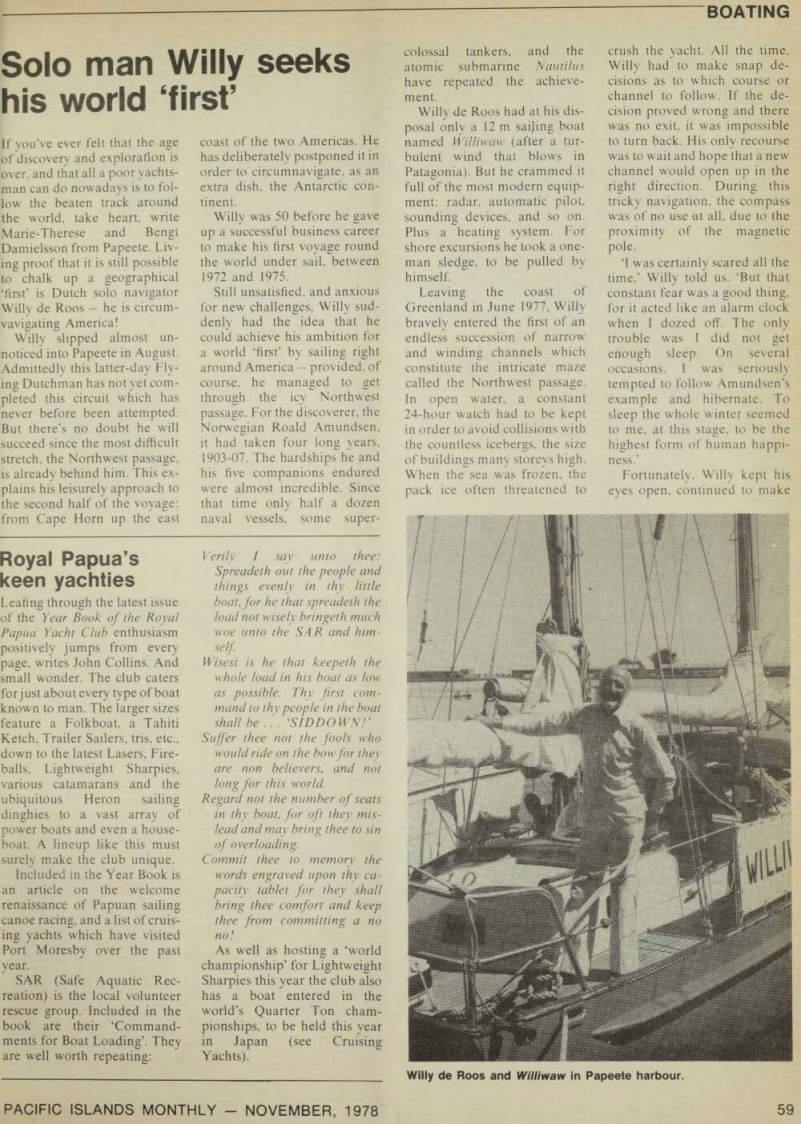
Willy de Roos and Williwaw in Papeete harbour.
the right decisions and also to have lots of plain good luck.
He was deservedly given a hero’s welcome in Vancouver, BC, at the end of October, 1977. But fame is a fickle lady, and nobody paid the least attention here to the red painted yacht with the strange name tied up at the wharf in Papeete for a little more than two weeks. Even more aston ishing, the movie of this extra
ordinary voyage screened by
Willy at the House of Culture attracted an audience of only about 150. practically all fellow sailors from the other yachts in the harbour. Should we con clude that the world’s greatest navigators, the Polynesians, have now become so thoroughly Westernised that they have turned their backs on the sea? And who was on the Papeete waterfront to bid this daring and courageous navi gator goodbye, when he left on his Antarctic cruise? Only a local radio ham and the present writers.
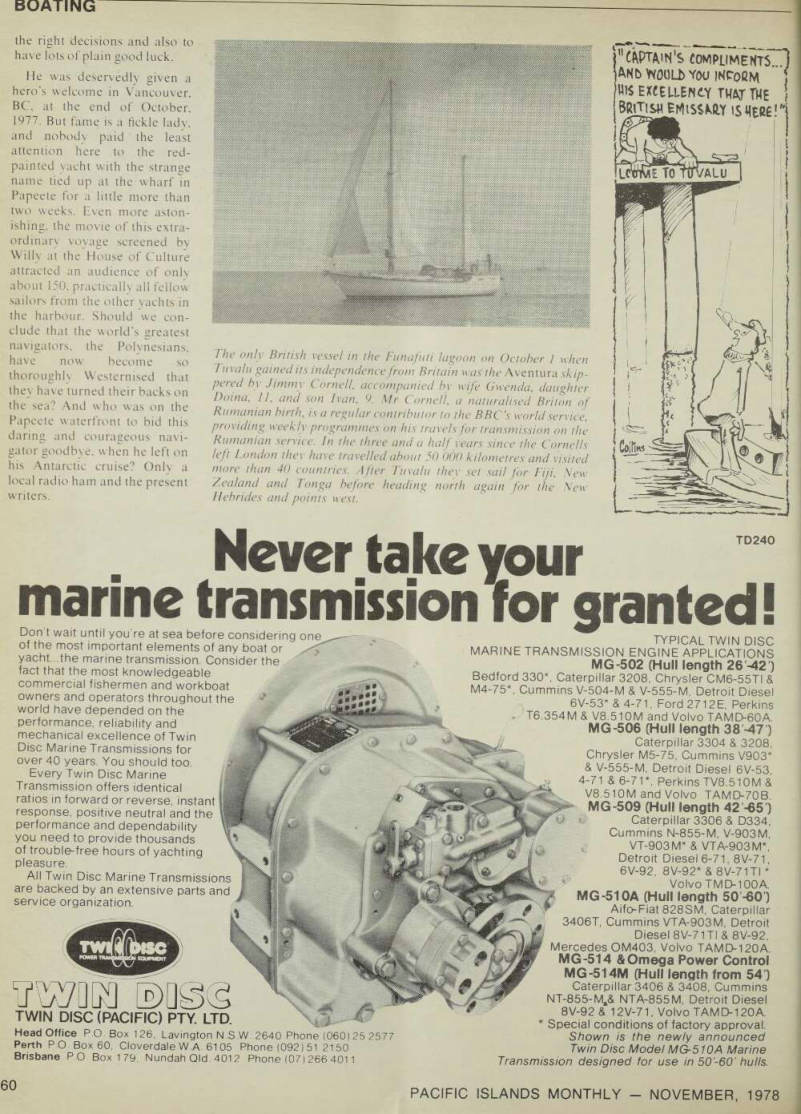
The only British vessel in the Funafuti lagoon on October I when Tuvalu gained its independence from Britain was the Aventura skip pered by Jimmy Cornell, accompanied by wife Gwenda, daughter Doina, 11, and son Ivan, 9. Mr Cornell, a naturalised Briton of Rumanian birth, is a regular contributor to the BBC's world service, providing weekly programmes on his travels for transmission on the Rumanian service. In the three and a half years since the Cornells left London they have travelled about 50 000 kilometres and visited more than 40 countries. After Tuvalu they set sail for Fiji, New Zealand and Tonga before heading north again for the New Hebrides and points west.