Niue hotter than
p. 19 · Read in the full issue
some may think
•mall but hot. That’s how 'liueans like to think of them elves and their island nation, lut their 250 square kilometre oral outcrop home might be lotter than they think. It’s not
lews that radio-activity levels
•n Niue are the highest in the louth Pacific at least among
dands where the radio-activity
> regarded as being of natural
•rigin.
What is news is that mining iterests are now putting down sntative feelers to find out if t is uranium. ‘Who knows /hat is down there,’ said the Jiue Government’s resident conomist Ron Layton. ‘There > a radio-active anomaly. It aust have been caused by □mething. It is virtually cer ain that radio-activity of that was caused by uranium. It light be gone now. It is on that ind of basis, plus a few geo igical theories, that we are
nding out.’
The government has been airly cautious in its approach d uncovering the secret of their •land but not cautious enough s far as New Zealand, with /horn Niue has a special re ationship, is concerned. The uestion was discussed exten ively in both the Niue cabinet nd assembly and it was de
ided last year to push through
mining act to cover all contin encies before allowing in the liners.
Three individuals appear to
lake up the investigating
;am. John Barrie, who is
k.vian Mining; John Rowntree,
Canadian geologist who is ustral Syndicate; and Frank elly, whose company, F. A.
elly Ltd, is doing the drilling.
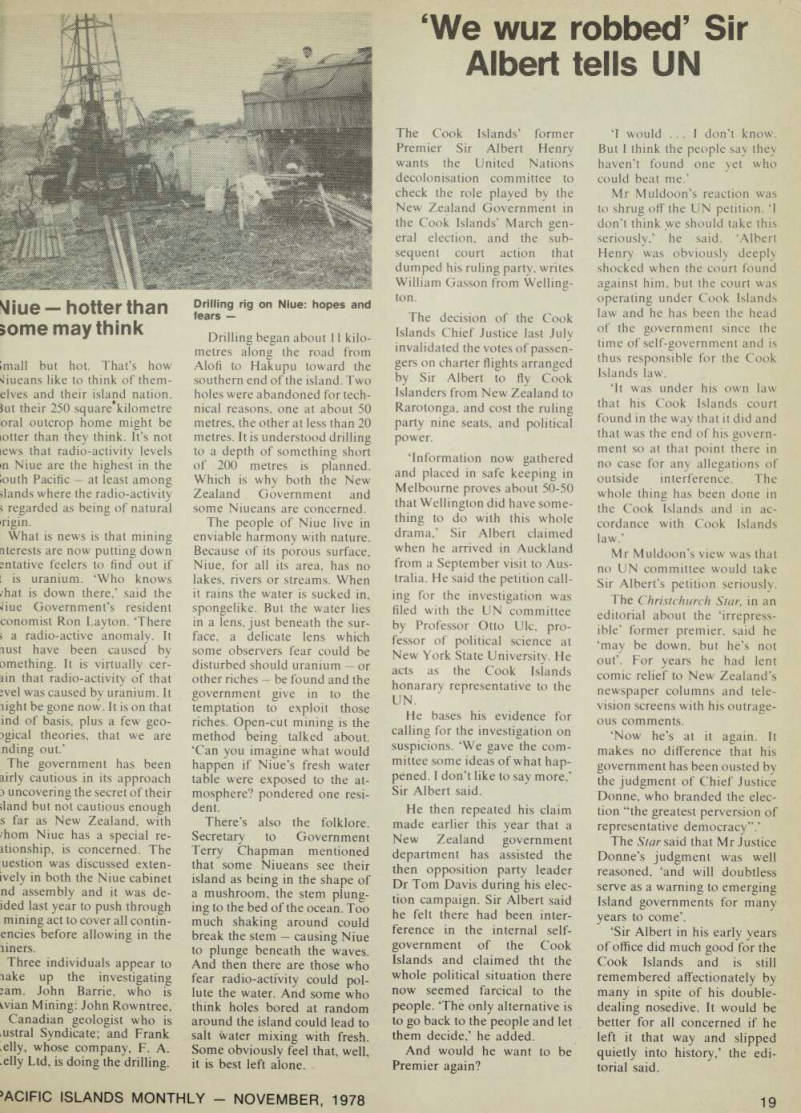
Drilling rig on Niue: hopes and fears Drilling began about 11 kilo metres along the road from Alofi to Hakupu toward the southern end of the island. Two holes were abandoned for tech nical reasons, one at about 50 metres, the other at less than 20 metres. It is understood drilling to a depth of something short of 200 metres is planned.
Which is why both the New Zealand Government and some Niueans are concerned.
The people of Niue live in enviable harmony with nature.
Because of its porous surface, Niue, for all its area, has no lakes, rivers or streams. When it rains the water is sucked in, spongelike. But the water lies in a lens, just beneath the sur face, a delicate lens which some observers fear could be disturbed should uranium or other riches be found and the government give in to the
temptation to exploit those
riches. Open-cut mining is the method being talked about. ‘Can you imagine what would happen if Niue’s fresh water table were exposed to the at
mosphere? pondered one resi
dent.
There’s also the folklore.
Secretary to Government
Terry Chapman mentioned
that some Niueans see their island as being in the shape of a mushroom, the stem plung ing to the bed of the ocean. Too much shaking around could break the stem causing Niue to plunge beneath the waves.
And then there are those who fear radio-activity could pol lute the water. And some who think holes bored at random around the island could lead to salt water mixing with fresh.
Some obviously feel that, well, it is best left alone.