Regionalism To
pp. 17-18 · Read in the full issue
The Niue Forum:
Sub-Regionalism?
PIM editor. Bob Hawkins, was in Niue in September for the meeting of the South Pacific Forum. He found the ‘Pacific Wav' under some strain as conflicting interests among
member countries emerged, and
the shadow of new, sub-regional groupings took on more sub stance than has been known be fore.
fhoughts of a sub-regional
grouping have been exercising
Polynesian minds for some ime, particularly in the eastern
3 acific. Wrangles, unaccept
ible decisions and deteriorat ng personal relationships at he South Pacific Forum meet ng in Alofi, Niue, in Sep ember, have served to leighten speculation that an
:ast Polynesian sub-regional
grouping, involving initially
Vestern Samoa and American lamoa, Niue and Cook slands, will soon be formed.
But the east Polynesians are tot alone in their thoughts. r iji’s Prime Minister Ratu Sir Camisese Mara, less than a /eek after the Niue Forum nded, said in Suva that there /as pressure at the other end f the Pacific for another sub
egional grouping. ‘We may
3in with Papua New Guinea nd Solomon Islands,’ he aid.
What then are the confor the Forum? In
ae short term, probably
othing serious. What it will lean is that problems peculiar ) one or the other end of the acific will be worked out
trough the coming sub-
Jgional groupings. Only prob
;ms of a common nature, of ital interest to all members nd on which there is reason ble hope of acceptable con msus, are likely to find their ay onto a Forum agenda.
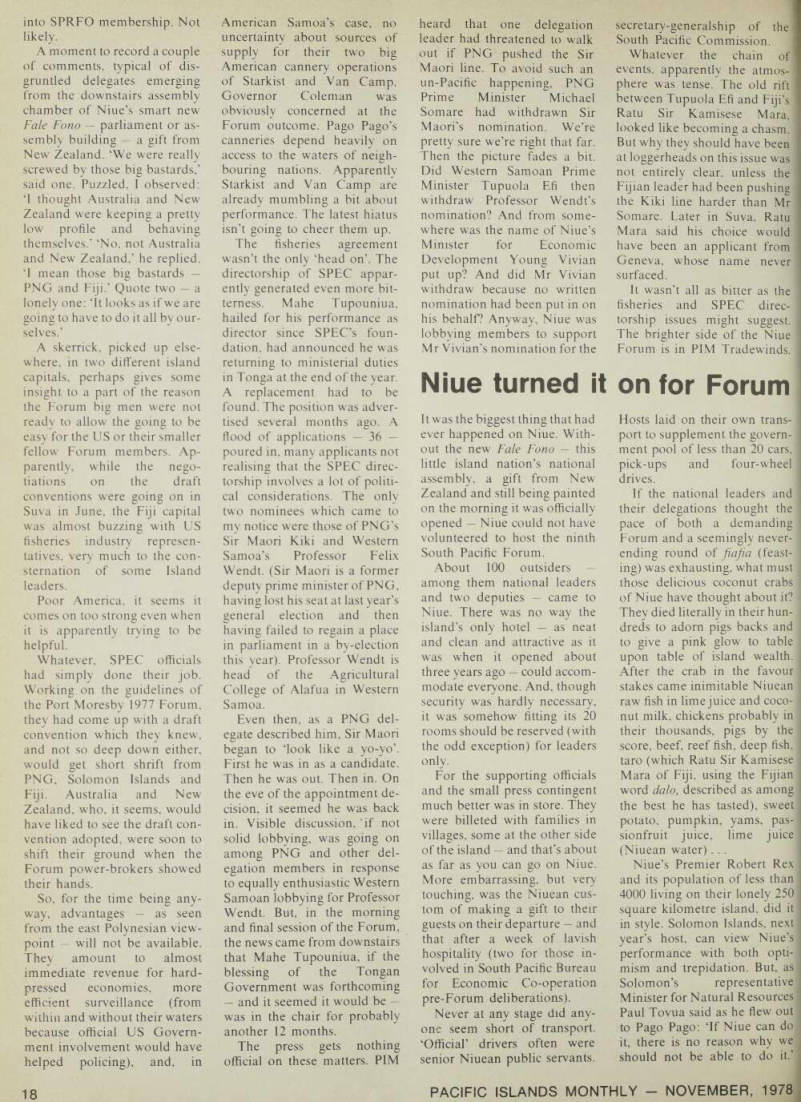
This year’s Niue Forum was ke none before. Ratu Mara as quite openly shocked at le lobbying which went on at lofi, both on the fisheries con trition issue and on the ques on of a successor for Mahe upouniua who was supposed
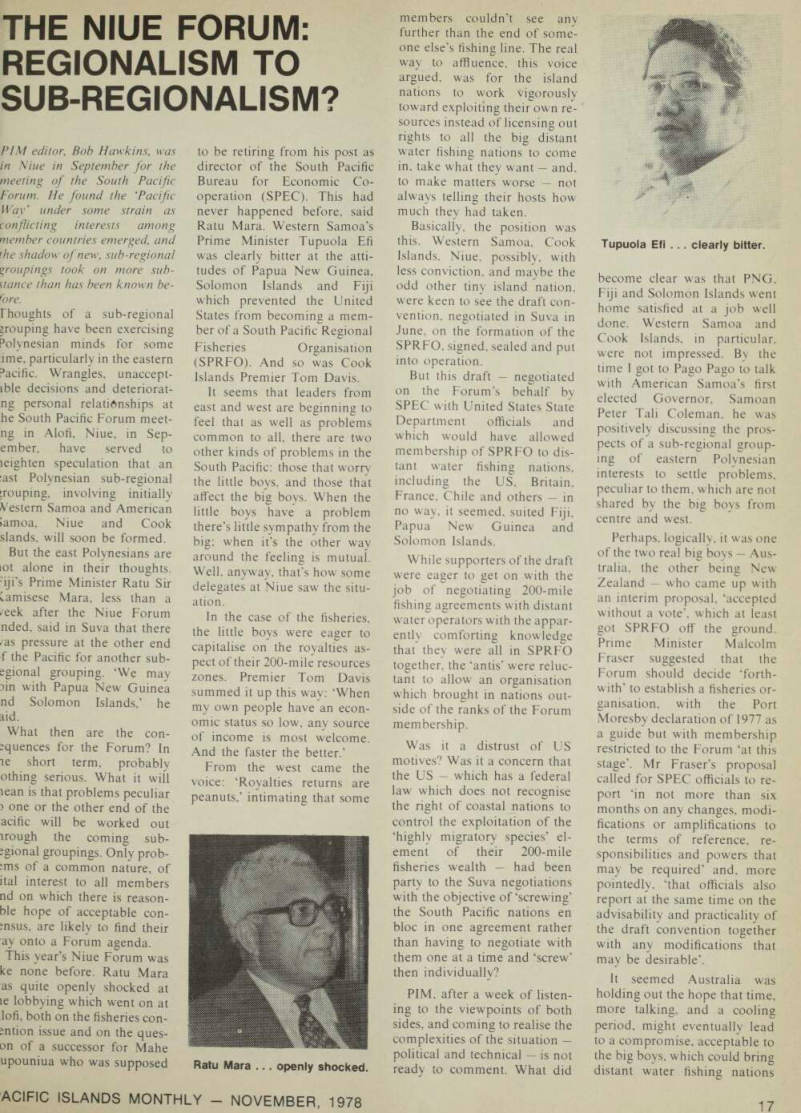
to be retiring from his post as director of the South Pacific Bureau for Economic Co operation (SPEC). This had never happened before, said Ratu Mara. Western Samoa’s Prime Minister Tupuola Efi was clearly bitter at the atti tudes of Papua New Guinea, Solomon Islands and Fiji which prevented the United States from becoming a mem ber of a South Pacific Regional
Fisheries Organisation
(SPRFO). And so was Cook Islands Premier Tom Davis.
It seems that leaders from east and west are beginning to feel that as well as problems common to all, there are two other kinds of problems in the South Pacific: those that worry the little boys, and those that affect the big boys. When the little boys have a problem there’s little sympathy from the big; when it’s the other way around the feeling is mutual.
Well, anyway, that’s how some delegates at Niue saw the situ ation.
In the case of the fisheries, the little boys were eager to capitalise on the royalties as pect of their 200-mile resources zones. Premier Tom Davis summed it up this way: ‘When my own people have an econ omic status so low, any source of income is most welcome.
And the faster the better.’
From the west came the voice: ‘Royalties returns are peanuts,’ intimating that some
members couldn’t see any further than the end of some one else’s fishing line. The real way to affluence, this voice argued, was for the island nations to work vigorously toward exploiting their own re sources instead of licensing out rights to all the big distant water fishing nations to come in, take what they want and. to make matters worse not always telling their hosts how much they had taken.
Basically, the position was
this. Western Samoa. Cook Islands, Niue, possibly, with less conviction, and maybe the odd other tiny island nation, were keen to see the draft con vention, negotiated in Suva in June, on the formation of the SPRFO. signed, sealed and put into operation.
But this draft negotiated on the Forum’s behalf by SPEC with United States State Department officials and which would have allowed membership of SPRFO to dis tant water fishing nations, including the US, Britain, France, Chile and others in no way, it seemed, suited Fiji, Papua New Guinea and Solomon Islands.
While supporters of the draft were eager to get on with the
job of negotiating 200-mile
fishing agreements with distant water operators with the appar
ently comforting knowledge
that they were all in SPRFO together, the ‘antis’ were reluc tant to allow an organisation which brought in nations out side of the ranks of the Forum
membership.
Was it a distrust of US motives? Was it a concern that the US which has a federal law which does not recognise the right of coastal nations to control the exploitation of the
‘highly migratory species’ el
ement of their 200-mile fisheries wealth had been party to the Suva negotiations
with the objective of‘screwing’
the South Pacific nations en bloc in one agreement rather than having to negotiate with them one at a time and ‘screw’
then individually?
PIM, after a week of listen ing to the viewpoints of both sides, and coming to realise the complexities of the situation political and technical is not ready to comment. What did
become clear was that PNG.
Fiji and Solomon Islands went home satisfied at a job well done. Western Samoa and Cook Islands, in particular, were not impressed. By the time I got to Pago Pago to talk with American Samoa’s first elected Governor, Samoan Peter Tali Coleman, he was
positively discussing the pros
pects of a sub-regional group
ing of eastern Polynesian
interests to settle problems, peculiar to them, which are not
shared by the big boys from
centre and west.
Perhaps, logically, it was one of the two real big boys Aus tralia, the other being New Zealand who came up with
an interim proposal, ‘accepted
without a vote’, which at least got SPRFO off the ground.
Prime Minister Malcolm Fraser suggested that the Forum should decide ‘forth with’ to establish a fisheries or ganisation. with the Port Moresby declaration of 1977 as a guide but with membership restricted to the Forum ‘at this stage’. Mr Fraser’s proposal called for SPEC officials to re port ‘in not more than six months on any changes, modi fications or amplifications to the terms of reference, re sponsibilities and powers that may be required’ and, more pointedly, ‘that officials also report at the same time on the
advisability and practicality of
the draft convention together with any modifications that may be desirable’.
It seemed Australia was holding out the hope that time, more talking, and a cooling
period, might eventually lead
to a compromise, acceptable to
the big boys, which could bring
distant water fishing nations
Ratu Mara .. . openly shocked.
Tupuola Efi . . . clearly bitter.
into SPRFO membership. Not likely.
A moment to record a couple of comments, typical of dis
gruntled delegates emerging
from the downstairs assembly chamber of Niue’s smart new Fale Fono parliament or as
sembly building a gift from
New Zealand. ‘We were really screwed by those big bastards,’ said one. Puzzled. I observed: ‘I thought Australia and New Zealand were keeping a pretty
low profile and behaving
themselves.’ ‘No, not Australia and New Zealand,’ he replied.
T mean those big bastards - PNG and Fiji.' Quote two a lonely one: ‘lt looks as if we are going to have to do it all by our selves.’
A skerrick. picked up else where, in two different island
capitals, perhaps gives some
insight to a part of the reason the Forum big men were not ready to allow the going to be easy for the US or their smaller fellow Forum members. Ap parently, while the nego tiations on the draft conventions were going on in Suva in June, the Fiji capital was almost buzzing with US fisheries industry represen tatives, very much to the con sternation of some Island leaders.
Poor America, it seems it comes on too strong even when it is apparently trying to be
helpful.
Whatever, SPEC officials had simply done their job.
Working on the guidelines of the Port Moresby 1977 Forum, they had come up with a draft convention which they knew, and not so deep down either, would get short shrift from PNG, Solomon Islands and Fiji. Australia and New Zealand, who, it seems, would have liked to see the draft con vention adopted, were soon to shift their ground when the Forum power-brokers showed their hands.
So, for the time being any way, advantages as seen from the east Polynesian view point will not be available.
They amount to almost immediate revenue for hard pressed economies, more efficient surveillance (from within and without their waters because official US Govern ment involvement would have
helped policing), and, in
American Samoa’s case, no uncertainty about sources of supply for their two big American cannery operations of Starkist and Van Camp.
Governor Coleman was obviously concerned at the Forum outcome. Pago Pago’s
canneries depend heavily on
access to the waters of neigh
bouring nations. Apparently
Starkist and Van Camp are already mumbling a bit about performance. The latest hiatus isn’t going to cheer them up.
The fisheries agreement wasn’t the only ‘head on’. The directorship of SPEC appar ently generated even more bit terness. Mahe Tupouniua, hailed for his performance as director since SPEC’s foun dation, had announced he was returning to ministerial duties in Tonga at the end of the year.
A replacement had to be found. The position was adver tised several months ago. A flood of applications 36 poured in, many applicants not realising that the SPEC direc torship involves a lot of politi cal considerations. The only two nominees which came to my notice were those of PNG’s Sir Maori Kiki and Western Samoa’s Professor Felix Wendt. (Sir Maori is a former deputy prime minister of PNG, having lost his seat at last year’s general election and then
having failed to regain a place
in parliament in a by-election this year). Professor Wendt is head of the Agricultural College of Alafua in Western Samoa.
Even then, as a PNG del egate described him. Sir Maori began to ‘look like a yo-yo’.
First he was in as a candidate.
Then he was out. Then in. On the eve of the appointment de cision, it seemed he was back in. Visible discussion,'if not solid lobbying, was going on among PNG and other del egation members in response to equally enthusiastic Western Samoan lobbying for Professor Wendt. But, in the morning and final session of the Forum, the news came from downstairs that Mahe Tupouniua, if the blessing of the Tongan Government was forthcoming and it seemed it would be was in the chair for probably another 12 months.
The press gets nothing official on these matters. PIM
heard that one delegation leader had threatened to walk out if PNG pushed the Sir Maori line. To avoid such an un-Pacific happening, PNG Prime Minister Michael Somare had withdrawn Sir Maori’s nomination. We’re pretty sure we’re right that far.
Then the picture fades a bit.
Did Western Samoan Prime Minister Tupuola Efi then withdraw Professor Wendt’s nomination? And from some where was the name of Niue’s Minister for Economic Development Young Vivian put up? And did Mr Vivian withdraw because no written nomination had been put in on his behalf? Anyway, Niue was lobbying members to support Mr Vivian’s nomination for the
secretary-generalship of the South Pacific Commission.
Whatever the chain of events, apparently the atmos phere was tense. The old rift between Tupuola Efi and Fiji’s Ratu Sir Kamisese Mara, looked like becoming a chasm.
But why they should have been at loggerheads on this issue was not entirely clear, unless the Fijian leader had been pushing the Kiki line harder than Mr Somare. Later in Suva. Ratu Mara said his choice would have been an applicant from Geneva, whose name never surfaced.
It wasn’t all as bitter as the fisheries and SPEC direc torship issues might suggest.
The brighter side of the Niue Forum is in PIM Tradewinds.