Letters
pp. 12-13 · Read in the full issue
A Miniature
Bouquet
1 spent 40 years in all the South Pacific Islands. Your articles are wonderful.
Charles S. Deuben
(US Navy retired) Santa Maria California
And A
Bigger One
Earlier this year I wrote you a letter criticising your Pacific Islands Monthly. You so kindly responded, and 1 cannot rest until I send my wholehearted CONGRATS! Every issue is a
delight, photos, all supremely
lovely, contents informative, timely and an inspiration. My admiration goes to every mem ber of your staff, as teamwork I’m sure is a must. i have the impression the subject matter is most unbiased and that, in a turbulent world, is top achievement.
Again, my sincere congratu lations on a magnificent publi cation. May success always be yours.
I look forward to every scrap of information re Pitcairn Island. The world cares, I feel.
Ellyn Greywitt
Ohio.
Usa
How Old
The Ladies?
Mrs Alice Brewster, widow of
Adolph Brewster (formerly
Joske) who was district com missioner, Colo, Fiji, and author of The Hill Tribes of Fiji, had her 107th birthday in England on September 16. She is believed to be the second
oldest person in Britain (the eldest being 108). It would be interesting to know from your readers if her age is known to have been exceeded by (a) any indigenous persons in the Pa cific (b) any Europeans who have lived in the Pacific.
Her husband’s post was one that I held about half a century later.
A predecessor of mine as dis trict commissioner of the Lau Group in Fiji, also about 50 years earlier, was Sir Basil Thomson who arranged the 1900 Treaty of Friendship with Tonga. He had no sons and his only daughter, Mrs Enid Wise, who was given the Tongan name, Anaseini Veihola Tupou. has recently died in England aged 87. She acted at times as secretary for her father who was the son of an Arch bishop of York and, after leav ing the Pacific, became governor of several English prisons and interrogated, as head of British intelligence, German spies in the First War.
He became head of the Crimi
nal Investigation Department
at Scotland Yard, London, and managed to find time to write several books, many of them classic works on the Pacific.
Philip A. Snow
Angmering
Sussex
England
Whither The
White Horse?
I read with interest in May PIM Harald A. Rehder’s letter about the ‘Coral Route’. Mr Rehder said he was unable to locate The White Horse Inn, one of the lodging spots in Western Samoa for Coral Route passengers. Whilst I do not have the full facts, perhaps I can shed some light on the
subject.
I have been told that-it was around 1964 that The White Horse Inn last housed guests, the closure of the lodgings per haps having been caused in part by the fact that a further guest house on the Apia water front, not far from ‘Aggies’, had opened its doors.
However, The White Horse Inn continued to be available
for special specific functions up until about 1970, when it finally closed its doors. The building was converted into four self-contained flats. That’s how it is today.
It may be of interest to some of your readers to learn of the fate of the inn’s main bar.
Having been a resident of Apia from 1967 until 1973, it was in late 1971, whilst driving past The White Horse Inn during its transition stage to flats, I noticed the main bar resting on the disused tennis court. (Both the bar and tennis court were in a bad state of repair.) The princely sum of $lO purchased the bar, complete with its ‘cash’ drawer. The bar was then put on the tray of a large truck and reinstalled in the very large lounge of the old colonial Ger man house that I, a fellow-New Zealander and an Australian
were sharing.
Finally, two points that I share with some other PIM readers in New Zealand: one, we would like to see the feature ‘Twenty Years Ago this Month’ reintroduced it was not only of great interest but often
amusing and topical; second,
the present index, in terms of reference to content country by country, is very poor compared to the index in the previous smaller size editions of PIM.
Randal J. Lockie
Auckland New Zealand (*Twenty Years Ago’ we are con
sidering. Hope you approved the
new indexing introduced in Sep tember Editor.)
Thevenin:
A Reply
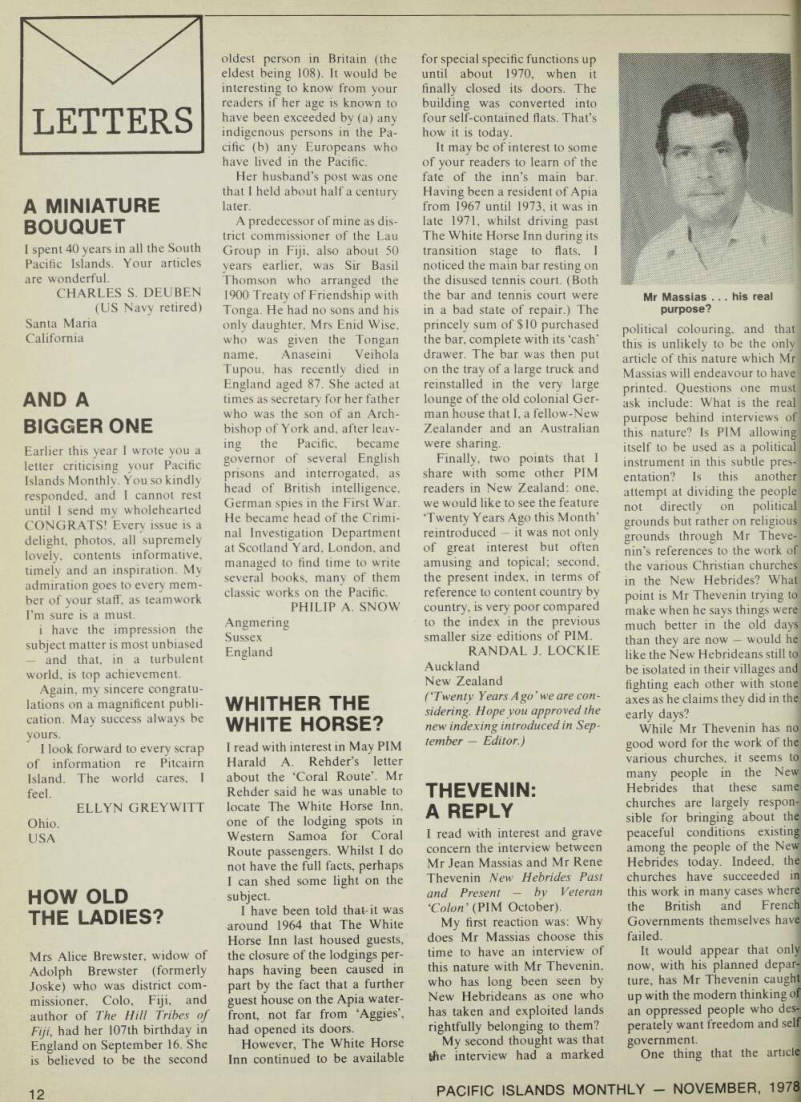
I read with interest and grave concern the interview between Mr Jean Massias and Mr Rene Thevenin New Hebrides Past and Present by Veteran ‘Colon’ {PlM October).
My first reaction was: Why does Mr Massias choose this time to have an interview of this nature with Mr Thevenin, who has long been seen by New Hebrideans as one who has taken and exploited lands rightfully belonging to them?
My second thought was that the interview had a marked
political colouring, and that j
this is unlikely to be the only! article of this nature which Mr] Massias will endeavour to have]
printed. Questions one mustj
ask include: What is the real purpose behind interviews of] this nature? Is PIM allowing] itself to be used as a political] instrument in this subtle pres-i entation? Is this another] attempt at dividing the people
not directly on political
grounds but rather on religious
grounds through Mr Theve
nin’s references to the work of the various Christian churches in the New Hebrides? What point is Mr Thevenin trying to make when he says things were much better in the old days than they are now would he like the New Hebrideans still to be isolated in their villages andj fighting each other with stone axes as he claims they did in the]
early days?
While Mr Thevenin has no good word for the work of the] various churches, it seems to many people in the New Hebrides that these same]
churches are largely respon-l
sible for bringing about the
peaceful conditions existing
among the people of the New Hebrides today. Indeed, the churches have succeeded in this work in many cases where the British and French Governments themselves have failed.
It would appear that only now, with his planned depar-j ture, has Mr Thevenin caught up with the modem thinking of an oppressed people who des perately want freedom and self government.
One thing that the article
Mr Massias ... his real purpose?
makes clear it that Mr Fhevenin, who has often :laimed to be a ‘New Hebri dean’, is a Frenchman after all.
It was interesting to read his re marks about coming back to ;he New Hebrides in the 'uture. Will he come back be fore or after independence to :heck on his vast properties, or vill he be glad to sell now and brget all about investments ind the New Hebrides?
This interview is a dangerous me because others can build m what has been stated in it ,nd thus produce serious div
sions, damaging the present
conomic climate individual Anglicans could react about /hat Mr Thevenin said of their
hurch, or Presbyterians could
eel hurt: Both would be quite jstified in their reactions, 'hose of the Catholic faith ould take exception to what he aid of their church; some ould take up and support his laim that that church should ave been more influential as le national church of the Tench in New Hebrides. On le other side of the con ominium coin, it could never e claimed that the Anglican hurch has been influential to le point that it has dictated olicy to the British Govern tent. It should not be forgot n that most British resident ammissioners have been
[embers of the Anglican
hurch. It would therefore ave been difficult during the mod of which Mr Thevenin >eaks for leaders of that lurch to criticise the leader of e British administration.
For the record, alongside the ackground of Mr Thevenin, a w questions should be asked aout that of Mr Massias. Was - one of the Frenchmen )liged to leave Algeria after at country gained indepen mce? Does he still hold a nior position in the infor ation service in the New ebrides? Is he still political Iviser to the French Resi mcy in the New Hebrides?
Let us hope that future tides of this kind in PIM are
danced by a reply from the
her side. Otherwise they will oduce nothing but tension in situation which already has i overdose of heat in it, and
the French land-owners, who are extremely powerful, will re sist moves by the French Government to return land to its rightful owners, the New Hebrideans.
(Rev) R. F. Wootton
Secretary Commission of Justice & Human
Development Uniting Church
in Australia Commission for World Mission Melbourne Australia
Mistaken
Identity
In view of the grim expression on my face which you kindly reproduced on page 27 of your September issue, I hasten to write to say that it was not David Barwick but
Yours sincerely
P. T. N. Donegan Qc
Attorney-General Honiara Solomon Islands
In Search
Of Loane
In PIM, March 1977, p 57, your report of the tragedy of the Ravakai in which loane Dean was drowned interested me, and I wondered if you could let me know more about the ident
ity of this person. At about the end of World War 11, I knew the Hoille family from Lae, the son being ‘Jim’ and the daugh ters loane, and the other bear ing a second classic Greek name that I cannot recall. I may have the spelling of loane wrong but it was pronounced eye-own-ee. The other sister’s name was pronounced nar-ee or nar-eed-a I think. The family was well known, especially from the Eadie Creek gold
mining days.
Although your article men tions that ‘one man was lost, I thought this could perhaps be a misprint, as there are surely not many loanes about. I would appreciate it if you could give me some indication of whether it could have been the Hoille girl.
I did hear that ‘Jim’ was drowned or killed somehow.
His initials were A. R. W.
Hoille. If you know anything about him, I would be glad to hear. If he is in fact still living I would like to make contact with him.
Normally I would consult the Papua New Guinea tele phone book, but they aren’t too common here at Tewantin.
Just about every time I read through a copy of your maga zine I come across some event involving a person I knew, or
a yacht or ship which I had something to do with. ‘Cruising Yachts’ is always of great interest (to a frustrated yachtie who never ever really made it).
Dennis Gittoes
Tewantin Qld Australia (PIM has replied to Mr Gittoes to the best of its ability, but prob ably not to his entire satisfac tion. Can other readers help him? Editor).
Which Is
Biggest?
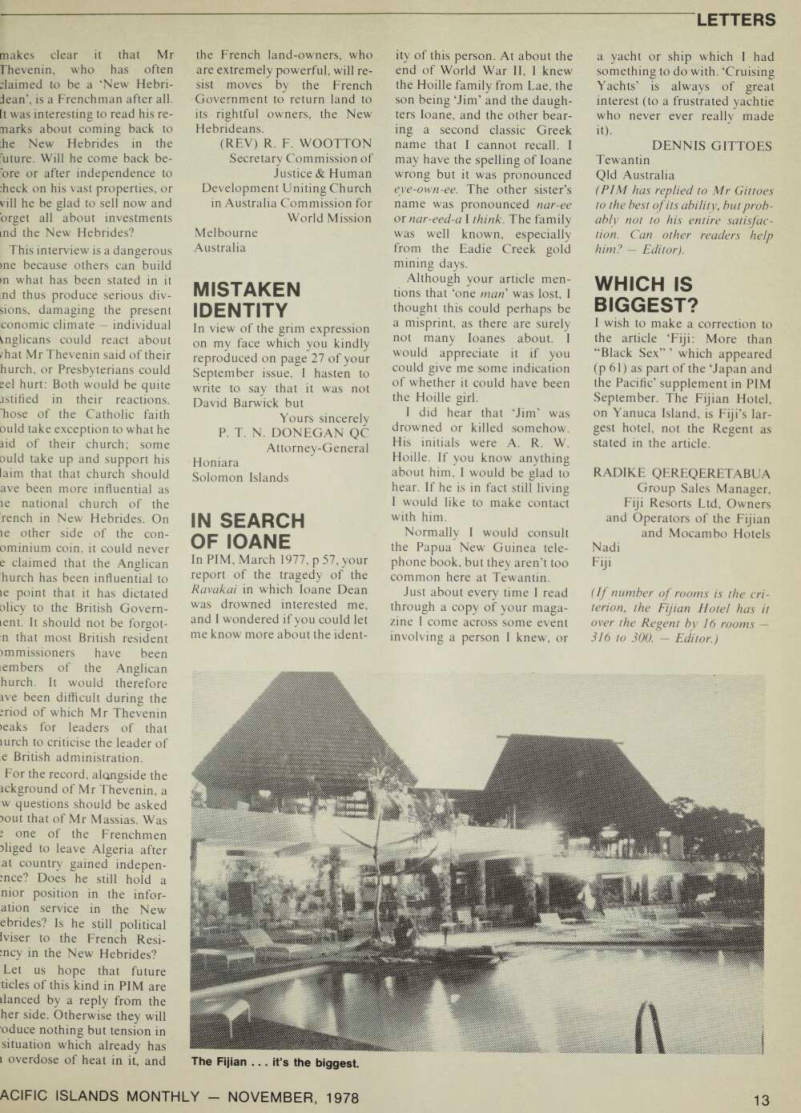
I wish to make a correction to the article ‘Fiji: More than “Black Sex” ’ which appeared (p 61) as part of the ‘Japan and the Pacific’ supplement in PIM
September. The Fijian Hotel,
on Yanuca Island, is Fiji’s lar gest hotel, not the Regent as stated in the article.
Radike Qereqeretabua
Group Sales Manager,
Fiji Resorts Ltd, Owners and Operators of the Fijian and Mocambo Hotels Nadi
Fiji
(If number of rooms is the cri terion, the Fijian Hotel has it over the Regent by 16 rooms 316 to 300. - Editor.)
The Fijian ... it’s the biggest.