Let’S Use
pp. 61-63 · Read in the full issue

[?]'Air
Space
Power’
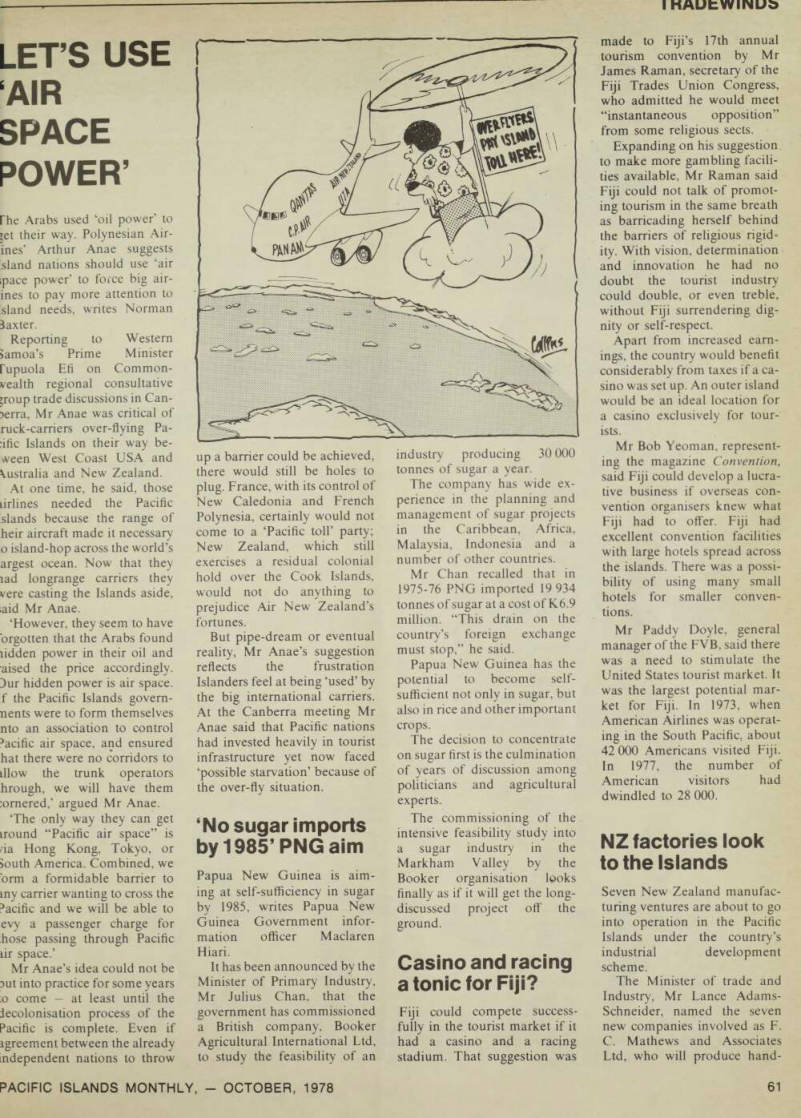
fhe Arabs used ‘oil power’ to jet their way. Polynesian Air ines’ Arthur Anae suggests island nations should use ‘air ipace power’ to force big air ines to pay more attention to island needs, writes Norman Jaxter.
Reporting to Western Samoa’s Prime Minister fupuola Efi on Common
vealth regional consultative
jroup trade discussions in Can berra, Mr Anae was critical of ruck-carriers over-flying Pa cific Islands on their way be ween West Coast USA and Australia and New Zealand.
At one time, he said, those drlines needed the Pacific slands because the range of heir aircraft made it necessary o island-hop across the world’s argest ocean. Now that they
lad longrange carriers they
vere casting the Islands aside, ;aid Mr Anae. ‘However, they seem to have brgotten that the Arabs found ridden power in their oil and
aised the price accordingly.
Dur hidden power is air space, f the Pacific Islands govern nents were to form themselves nto an association to control s acific air space, and ensured hat there were no corridors to illow the trunk operators hrough, we will have them
xbmered,’ argued Mr Anae.
‘The only way they can get iround “Pacific air space” is
n a Hong Kong, Tokyo, or
South America. Combined, we brm a formidable barrier to my carrier wanting to cross the Pacific and we will be able to evy a passenger charge for
hose passing through Pacific
dr space.’
Mr Anae’s idea could not be but into practice for some years ;o come at least until the decolonisation process of the Pacific is complete. Even if
igreement between the already
independent nations to throw
up a barrier could be achieved, there would still be holes to plug. France, with its control of New Caledonia and French
Polynesia, certainly would not
come to a ‘Pacific toll’ party; New Zealand, which still exercises a residual colonial hold over the Cook Islands, would not do anything to prejudice Air New Zealand’s fortunes.
But pipe-dream or eventual
reality, Mr Anae’s suggestion
reflects the frustration Islanders feel at being ‘used’ by the big international carriers.
At the Canberra meeting Mr Anae said that Pacific nations had invested heavily in tourist infrastructure yet now faced ‘possible starvation’ because of the over-fly situation.
‘No sugar imports
by 1985’ PNG aim
Papua New Guinea is aim ing at self-sufficiency in sugar by 1985, writes Papua New Guinea Government infor mation officer Maclaren Hiari.
It has been announced by the Minister of Primary Industry, Mr Julius Chan, that the government has commissioned a British company, Booker Agricultural International Ltd, to study the feasibility of an
industry producing 30 000
tonnes of sugar a year.
The company has wide ex perience in the planning and management of sugar projects in the Caribbean, Africa, Malaysia, Indonesia and a number of other countries.
Mr Chan recalled that in 1975-76 PNG imported 19 934 tonnes of sugar at a cost of K 6.9 million. “This drain on the
country’s foreign exchange
must stop,” he said.
Papua New Guinea has the potential to become self sufficient not only in sugar, but also in rice and other important crops.
The decision to concentrate on sugar first is the culmination of years of discussion among
politicians and agricultural
experts.
The commissioning of the intensive feasibility study into a sugar industry in the
Markham Valley by the
Booker organisation looks finally as if it will get the long discussed project off the
ground.
Casino and racing
a tonic for Fiji?
Fiji could compete success fully in the tourist market if it had a casino and a racing stadium. That suggestion was
made to Fiji’s 17th annual tourism convention by Mr James Raman, secretary of the Fiji Trades Union Congress, who admitted he would meet
“instantaneous opposition”
from some religious sects.
Expanding on his suggestion
to make more gambling facili ties available, Mr Raman said Fiji could not talk of promot ing tourism in the same breath as barricading herself behind the barriers of religious rigid ity. With vision, determination and innovation he had no doubt the tourist industry could double, or even treble,
without Fiji surrendering dig
nity or self-respect.
Apart from increased earn ings, the country would benefit considerably from taxes if a ca sino was set up. An outer island would be an ideal location for a casino exclusively for tour ists.
Mr Bob Yeoman, represent
ing the magazine Convention,
said Fiji could develop a lucra tive business if overseas con vention organisers knew what Fiji had to offer. Fiji had excellent convention facilities with large hotels spread across the islands. There was a possi bility of using many small hotels for smaller conven tions.
Mr Paddy Doyle, general
manager of the FVB, said there was a need to stimulate the United States tourist market. It was the largest potential mar ket for Fiji. In 1973, when American Airlines was operat ing in the South Pacific, about 42 000 Americans visited Fiji.
In 1977, the number of American visitors had dwindled to 28 000.
NZ factories look
to the Islands
Seven New Zealand manufac turing ventures are about to go into operation in the Pacific Islands under the country’s
industrial development
scheme.
The Minister of trade and Industry, Mr Lance Adams- Schneider, named the seven new companies involved as F.
C. Mathews and Associates Ltd, who will produce hand
wn soccer balls in Tonga, >tter Brown Ltd, opening an [hesive manufacturing oper ion in Fiji, Mortco Holdings d, assisting a venture in the X)k Islands that will make rrugated roofing iron and
her metal products, Butland
dustries Ltd, which is form g a joint venture with ilthan International Ltd, in ji, to process ginger, Roth ans Industries Ltd, which will tablish a cigarette industry in estem Samoa, W. F. Tucker id Co Ltd, which will be volved in food processing in ji, and SMI (New Zealand (port Promotions Ltd) which ill operate a dairy foods louring process in Western imoa.
barter for Guam
orkers’ rights
aited States Department of ibor officials and the Inter
itional Union of Operating
igineers have signed a con
)versial training contract
signed to give construction
dustry skills to Guam’s Drkers.
About SUS4SO 000 in federal nds will be used to mount the ng-delayed programme. The ntract signing marked the ilmination of an 11-month in stigation into abuse of immi ation regulations and work les on the island by a group Hawaiian and Asian con actors.
Guam’s construction indus y, which is booming in the ce of millions of dollars of ist-Typhoon Pamela recon
ruction, employs mostly alien
orkers from the Philippines
id Korea. The training pro amme is designed to increase ie number of local workers in instruction and to phase out ie alien labourers.
“The present situation in uam has been an embarrass icnt for the United States rovemment in light of our irrent concern on human ghts,” said Jay Turner, gen ral president of the Inter
ational Union of Operating
ngineers, at the signing cer mony in San Francisco in lay. “It’s difficult to press for uman rights on an inter
national level when some of those very same violations are occurring in our own back
yard.”
Besides the training pro gramme contracts, the US Labor Department has introduced a scheme that hikes construction workers’ wages every six months until Sep tember, 1979. Construction workers on the island now earn a minimum of $4 an hour.
Sea Princess
infer Arcadia
The Sea Princess, the newest ship in the P&O cruise fleet will go into service next Feb ruary. It will take over the pro
gramme previously planned
for the Arcadia which will be laid up temporarily in Hong
Kong.
The Sea Princess can accom modate 840 passengers. Each cabin has a private bathroom,
air-conditioning, a telephone
and two music channels. There are three swimming pools, one indoors. Other facilities in clude sauna baths and massage
services, a gymnasium, golf
driving range, cinema theatre, night club, card room, shop,
boutique, casino, beauty salon,
barber shop, bars, lounges,
children’s playroom and a
wading pool.
Defence role for
trainee pilots
There are still deficiencies in
training Papuan New Guinea
aircraft pilots, the PNG Minis ter for Transport, Bruce,Jeph cott, said in Parliament in reply
to questions by lambakey
Okuk, Leader of the Oppo sition. Mr Jephcott said one of the main problems was the environment in which pilots trained.
The Australian environment was different from that of PNG and PNG pilots who com pleted their course found it hard to adjust to the environ ment of their own country, he said. An approach would be made to the Defence Minister, Mr Louis Mona, about setting up combined Defence Force- Civil Aviation training for
pilots.