Davis: Economic
p. 23 · Read in the full issue
Self-Reliance
Comes First
‘Economic independence is our aim,’ said the new premier of the Cook Islands, Dr Tom Davis, when he visited New Zealand to meet government leaders. ‘l’m not interested in
political independence at this
stage,’ he said, writes William Gasson in Wellington.
Dr Davis, 61, was calling to talk about his island’s econ omic plans. It was his first call since Cooks’ Chief Justice Gaven Donne had ousted the government of Sir Albert Henry.
Dr Davis saw as his main problem, the task of giving his nation, which has no more than 65 square kilometres of arable land, a degree of self-reliance.
T know this is going to take some doing but I think, with the friends we have, we’re going to achieve this,’ he said.
Friends and relatives of the Cook Islands in fact help to
keep the country financially
solvent. With a trade deficit of about SNZI2 million the Cooks rely on New Zealand for more than $6 million in various forms of aid plus a flow of money from the 16,000 Islanders who live and work in New Zealand. ‘How much is this?’ Dr Davis asked. ‘No one really knows but we’re able to support an extremely unfavourable deficit situation mainly from the good relations and goodwill of the people living outside the Cook Islands,’ he said.
While the Cooks must rely on New Zealand’s aid and Dr Davis calculated it would be two years before these contri butions could be reduced he dislikes his people having to accept handouts. ‘Our people
are hard-working and they
have had a taste of handouts.
They’ve had a taste of this for quite some time and I feel that they don’t need any more. I feel they have a feeling of self re liance in themselves.’
What he would like to do is create a favourable climate for investment from any source in
the private sector to develop the islands’ industries and export capacity. And ideally he would like to see the cook Islanders living in New Zealand return home to run those industries. ‘We’re not ready for that yet because our economic pro gramme has not advanced to that stage ... but our greater economic policy is that they can come back and participate in the economy without any difficulty,’ he said.
Looking at the development
of the Pacific region generally.
Dr Davis found a difference between the Melanesian and Polynesian sectors. The Melanesians ( advanced far more rapidly, he said, and the cultural reason for this was that their society was based on selecting peole who were best for the job. The Polynesian so ciety was based on inherited privilege. Dr Davis seems
intent on changing this pattern for his 15 tiny islands.
Asked to what extent he would foster foreign invest ment other than from New Zealand he said he had not yet decided. ‘Obviously any foreign investment that can assist us we will gratefully re ceive and consider. We are not going to restrict this to one area or to one country. I don’t think we need to.’
While the long relationship
with New Zealand had created a situation whereby much of the private and public sectors
were orientated towards New Zealand ‘this shouldn’t stop us from going elsewhere if this would help us to get onto our feet,’ said Dr Davis. But obviously he was not prepared to open wide his country’s doors to just anyone.
What would his response be if a foreign government offered his islands a joint fishing ven ture along with the establish ment of a base? He replied: ‘lf the terms are reasonable my re sponse would be favourable.’
But he qualified that by adding there were countries with which he would not want to have dealings. ‘They have a bad record so far as I’m con cerned and with that record I would not wish to have deal ings with them.’
Dr Davis made it clear that the Cooks philatelic bureau, run by American millionaire Finbar Kenny, would con tinue. It provides the Cook Islands with a major slice of its overseas earnings. The bureau and Mr Kenny were linked with the funds Sir Albert Henry used to finance the charter flights for his voters. At one point during the furore over the source of the charter funds, Mr Kenny threatened to with draw from the bureau and to sever his ties with the Cook Islands.
Asked if he planned to main tain links with Mr Kenny, Dr Davis said that to date he had no reason to find Mr Kenny in any situation that was blame worthy at all. The documents produced in the court hearing showed very clearly that Mr Kenny was not involved, he said. ‘I have no reason to blame him for anything and it would be unreasonable of me to do anything else but to encourage him to continue,’ Dr Davis said.
How long does he plan to stay in politics? ‘I will stay in
office long enough to complete
the job that needs to be done,’ said Dr Davis.
On Sir Albert’s future? ‘Sir Albert is finished in politics.
He quite strongly claims he isn’t but I don’t think he’ll make a comeback now. His future lies in the hands of the police and the courts,’ Dr Davis’s observation referred to
the continuing police investi
gation into use of public funds in the Cook Islands.
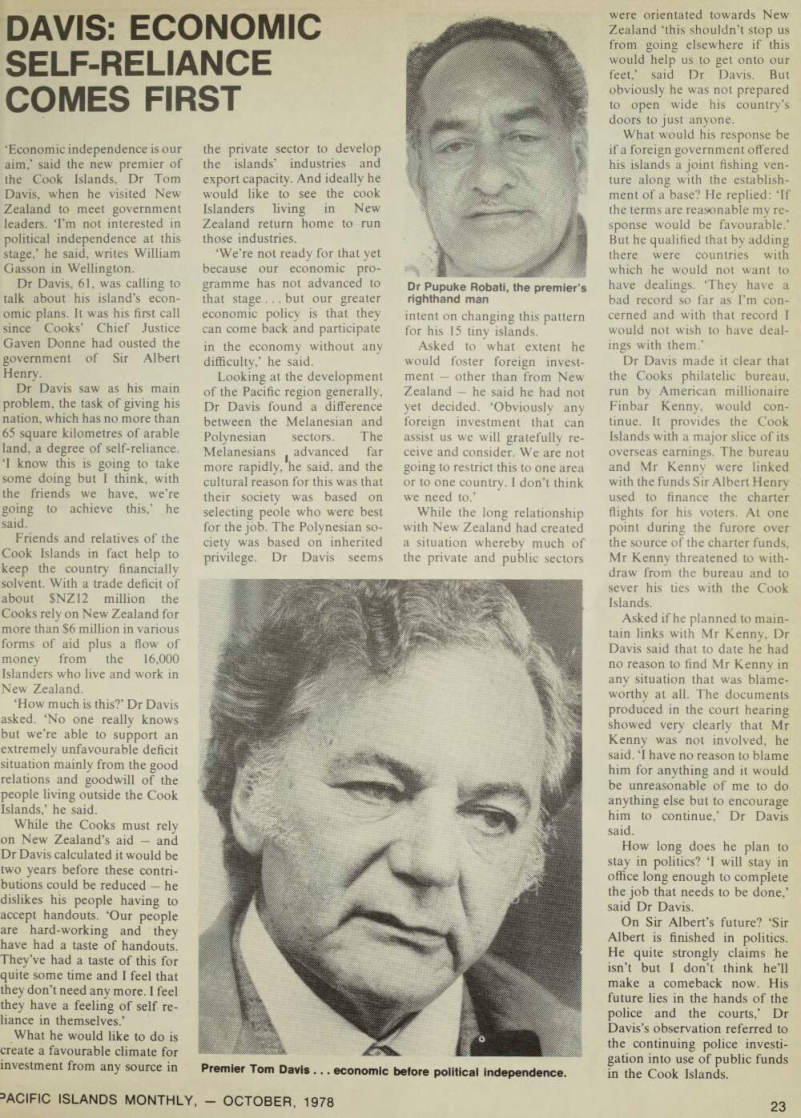
Premier Tom Davis ... economic before political independence.
Dr Pupuke Robati, the premier’s righthand man