Island Tattoo
pp. 13-14 · Read in the full issue
The Fall And
Rise Of The
ustom-tattooing, a traditional t, tribal symbol or merely as coration, has been practised r centuries. In the Samoas, here tattooing is a status sym l, the art lives on. Leulu Felisi la describes the 'pattern ’. But the Carolines, says the Cu tor of the Tattoo A rt Museum, n Francisco, Leo Brereton, ly one small group of tat lists remains.
i Carolines
’s a dying
edition
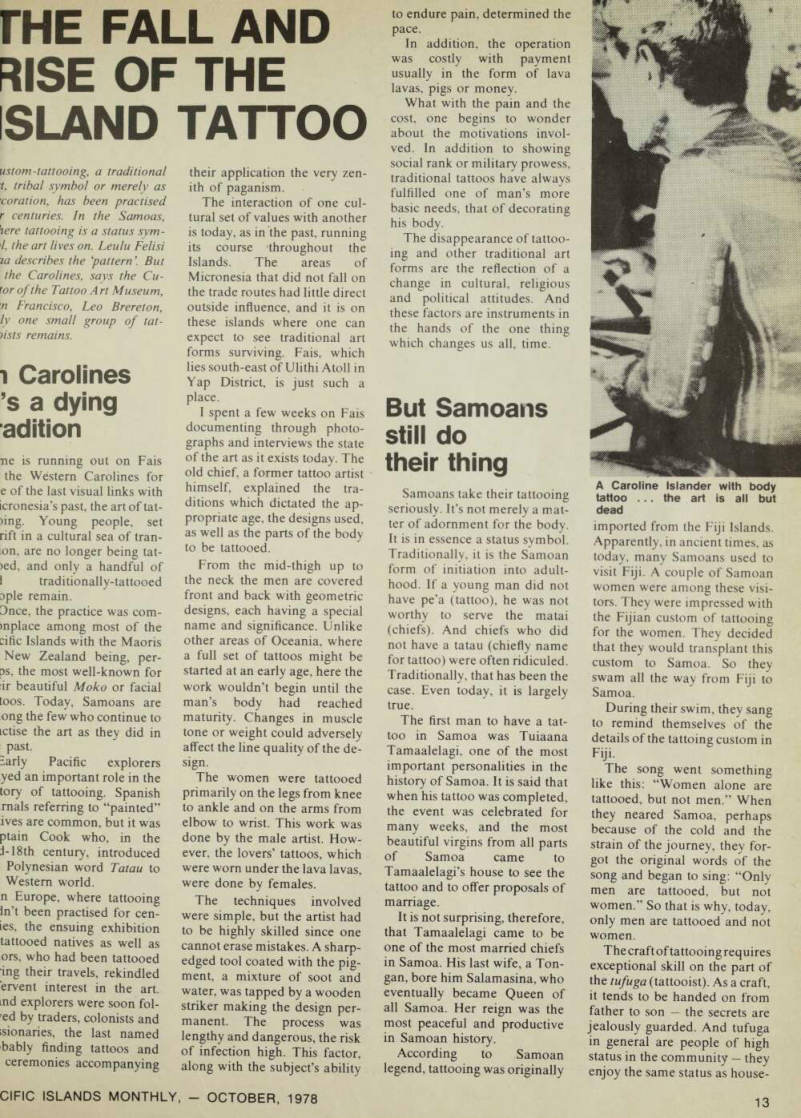
ne is running out on Fais the Western Carolines for e of the last visual links with icronesia’s past, the art of tat
)ing. Young people, set
rift in a cultural sea of tran on, are no longer being tat >ed, and only a handful of
1 traditionally-tattooed
Dple remain.
Dnce, the practice was com mplace among most of the rific Islands with the Maoris New Zealand being, per ps, the most well-known for ir beautiful Moko or facial toos. Today, Samoans are ong the few who continue to ictise the art as they did in past.
iiarly Pacific explorers
yed an important role in the
tory of tattooing. Spanish
mals referring to “painted” ives are common, but it was ptain Cook who, in the 3- 18th century, introduced Polynesian word Tatau to Western world,
n Europe, where tattooing
In’t been practised for cen
ies, the ensuing exhibition
tattooed natives as well as ors, who had been tattooed ing their travels, rekindled ervent interest in the art. md explorers were soon fol red by traders, colonists and isionaries, the last named
bably finding tattoos and
ceremonies accompanying
their application the very zen ith of paganism.
The interaction of one cul tural set of values with another is today, as in the past, running its course throughout the Islands. The areas of Micronesia that did not fall on the trade routes had little direct outside influence, and it is on these islands where one can expect to see traditional art forms surviving. Fais, which lies south-east of Ulithi Atoll in Yap District, is just such a
place.
I spent a few weeks on Fais
documenting through photo
graphs and interviews the state of the art as it exists today. The old chief, a former tattoo artist himself, explained the tra ditions which dictated the ap propriate age, the designs used, as well as the parts of the body to be tattooed.
From the mid-thigh up to the neck the men are covered front and back with geometric
designs, each having a special
name and significance. Unlike other areas of Oceania, where a full set of tattoos might be started at an early age, here the work wouldn’t begin until the man’s body had reached
maturity. Changes in muscle
tone or weight could adversely affect the line quality of the de
sign.
The women were tattooed primarily on the legs from knee to ankle and on the arms from elbow to wrist. This work was done by the male artist. How ever, the lovers’ tattoos, which were worn under the lava lavas, were done by females.
The techniques involved were simple, but the artist had to be highly skilled since one cannot erase mistakes. A sharp edged tool coated with the pig ment, a mixture of soot and water, was tapped by a wooden striker making the design per manent. The process was lengthy and dangerous, the risk of infection high. This factor,
along with the subject’s ability
to endure pain, determined the pace.
In addition, the operation was costly with payment usually in the form of lava lavas, pigs or money.
What with the pain and the cost, one begins to wonder about the motivations invol ved. In addition to showing social rank or military prowess, traditional tattoos have always fulfilled one of man’s more basic needs, that of decorating
his body.
The disappearance of tattoo ing and other traditional art forms are the reflection of a
change in cultural, religious
and political attitudes. And these factors are instruments in the hands of the one thing which changes us all, time.
But Samoans
still do
their thing
Samoans take their tattooing seriously. It’s not merely a mat ter of adornment for the body.
It is in essence a status symbol.
Traditionally, it is the Samoan form of initiation into adult hood. If a young man did not have pe’a (tattoo), he was not worthy to serve the matai (chiefs). And chiefs who did not have a tatau (chiefly name for tattoo) were often ridiculed.
Traditionally, that has been the case. Even today, it is largely true.
The first man to have a tat too in Samoa was Tuiaana Tamaalelagi, one of the most
important personalities in the
history of Samoa. It is said that when his tattoo was completed, the event was celebrated for many weeks, and the most beautiful virgins from all parts of Samoa came to Tamaalelagi’s house to see the tattoo and to offer proposals of
marriage.
It is not surprising, therefore, that Tamaalelagi came to be one of the most married chiefs in Samoa. His last wife, a Ton gan, bore him Salamasina, who eventually became Queen of all Samoa. Her reign was the
most peaceful and productive
in Samoan history.
According to Samoan
legend, tattooing was originally
imported from the Fiji Islands.
Apparently, in ancient times, as today, many Samoans used to visit Fiji. A couple of Samoan women were among these visi tors. They were impressed with the Fijian custom of tattooing for the women. They decided that they would transplant this custom to Samoa. So they swam all the way from Fiji to Samoa.
During their swim, they sang to remind themselves of the details of the tattoing custom in
Fiji.
The song went something like this: “Women alone are tattooed, but not men.” When
they neared Samoa, perhaps
because of the cold and the strain of the journey, they for got the original words of the
song and began to sing: “Only
men are tattooed, but not women.” So that is why, today, only men are tattooed and not women.
The craft of tattooing requires exceptional skill on the part of the tufuga (tattooist). As a craft, it tends to be handed on from father to son the secrets are
jealously guarded. And tufuga
in general are people of high status in the community they enjoy the same status as house-
A Caroline Islander with body tattoo ... the art is all but dead
builders, also called tufuga.
And they also receive generous rewards for their efforts. Many such tufuga still exist in Samoa, one of the most famous of whom is Faafetai of Manono.
When the London Mission ary Society missionaries came in the 1830 s, they tried to stop
tattooing. They were against it
because it involved the shed ding of blood.
On the other hand, the Roman Catholics were not
against tattooing, seeing in it
just a peculiar custom. Perhaps,
largely because the various re ligious denominations in Samoa are not agreed as to the
correct theological policy
towards tattooing, it is still as popular as ever in Samoa. Even a number of Peace Corps volunteers are reportedly tat tooed Samoan style and dur ing World War 11, some US marines were similarly tat tooed.
Recently, there has been an
upsurge in the popularity of Samoan tattooing. It is taking place daily in all parts of Samoa and people with tattoos are a common sight these
days.
It is not hard to recognise tat tooed people because people here are tattooed from the waist on down to the knees. It is a pity that there is no registry of tattooed people, but the number certainly runs into the thousands and continues to in crease despite the LMS Church’s old ban. If a member of the LMS Church has viola ted the anti-tattoo rule, he is banned from Holy , Com munion, but only for a short time. For Catholics, there is no worry.
A famous example of how Samoans would go to any length to have a tattoo is that of a Samoan king of the late 1800 s, Malietoa Laupepa.
Malietoa was about 70. Many of his people did not give him their total allegiance because he did not have a tattoo. So, despite his age, he finally agreed to go through the ordeal.
Tattooing, Samoan style, is
far from being a picnic. It is a very painful process. Common
reactions during tattooing are
crying, screaming, cursing, sob
bing and so on. Some feel the pain more than others. To help relieve the pain, the tattooing is usually done on as many young men as possible simul taneously. And, in the old days, pretty village maidens used to soothe the young men with their touch, smiles and songs.
The late Sir Peter Buck, the noted Maori anthropologist, has made a study of Samoan tattooing. (Lots of other highly scientific studies have been made since.) According to Sir Peter, tattooing implements in clude a wooden container called the tunuma; tattooing combs made of human bone or boar’s tusk lashed to a turtle shell plate fastened to a handle, and the mallet called sausau
made of dry lapalapa (dry, hard
part of coconut leaf). There are four different types of combs, each used for a specific func tion. One is for making dots, one for fine lines, one for thick lines and one for filling in the dark parts.
The pigment, Sir Peter said, is made from the soot of the candlenut and is kept in a coco nut shell called pupu lama. The lama (soot) is ground in the coconut shell and water is added to it. The resultant mix ture is placed in the ipu tuu lama, which is half a coconut shell covered with a taro leaf.
Towels of siapo are used for stretching the skin and wiping off the blood.
At the end of the tattooing ceremony, the subject is sprin kled with coconut milk to re move the tabu he has been under for many weeks or months.
Nowadays, even children as young as nine are being tat tooed, and there is a milder form of tattooing for women called the malu. Who says Samoan custom is dying out?
This is certainly not true in the case of tattooing, of having a pe’a, tatau, malofie.
Samoans aie doing their thing and they are not ashamed of it. How long this trend will continue is hard to say. When it is no longer practised, that will mark the decline and fall of the Samoan cultural
empire.
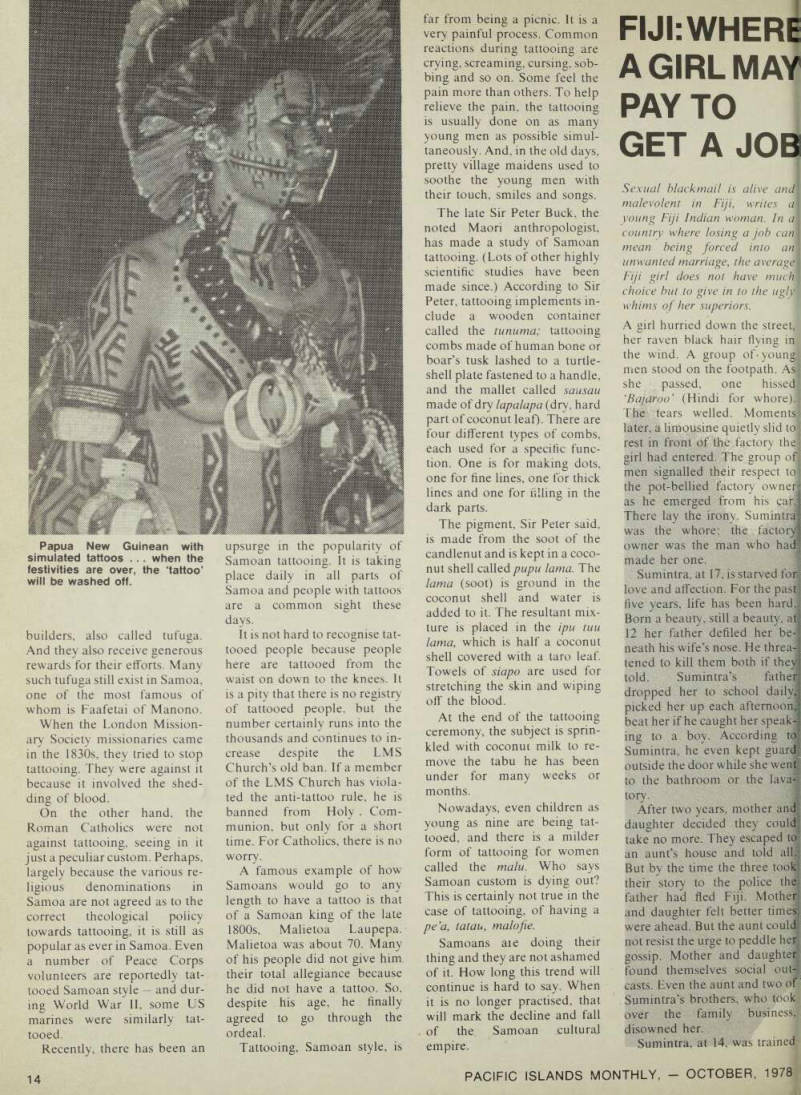
Papua New Guinean with simulated tattoos . . . when the festivities are over, the ‘tattoo’ will be washed off.