Letters
pp. 8-9 · Read in the full issue
Holy Mama
The article in your July issue on the Holy Mama is inac curate and patronising, a dis grace to the writer and to your magazine. It does no service either to the Holy Mama, the Christian Fellowship Church of which he is leader, or to the Solomon Islands people.
Mistakes abound. ‘Mama’ means ‘Father’ not priest. Silas Eto received training in the conduct of worship like every other Methodist pastor of his day no more and no less.
Menekasapa was an outstand
ing village long before the war.
In the 19305, under the leader ship of the late Josaia Alim bete, the village leaders and people won much acclaim.
W.C. Groves (later Director of Education in Papua New Guinea) considered it edu cationally and socially an out
standing place and suggested
that it should be a model for the whole of the Solomons. Dr A. G. Rutter (later Senior Medical Officer for the Protec torate) noted that its hygiene was among the best in the area and its health problems among the lowest. Visitors several times commented on the plan ning and design of the vil
lage.
The Kusaghe people may
have been despised in the past they were also feared. In one battle their warriors are re puted to have killed 400 of the enemy in one day. If in years that followed they chose to keep themselves to themselves, they were not alone in this. The Christian Fellowship Church which owes its immediate ori gin to Silas Eto, has some of the same tendencies to keep itself to itself.
Silas and I have had our dis agreements, and when the C.F.C. was formed in the 1960 s (not 19505) we were on opposite sides, but I have far more respect for him as a per
son and for his followers than is shown by the careless writer of this slick, shoddy article.
G.G. Carter
(Chairman, Solomon Islands Methodist Church 1959-65) 5 Miriona Grove Paekakariki New Zealand Dr Richard Chester’s article was shown to Mr Sam Kuku, a prominent supporter of the Holy Mama, while he was in Sydney.
He pronounced it as “very good” and added that Silas would be very pleased with it. He took a copy back to the Solomons and, presumably, Silas Eto has since read it. Nowhere in the article is the date given for the forma tion of the Christian Fellowship Church. Editor.
The Banabans
On Rabi
We see the Banaban leaders here a lot and we are very pleased about this as they are our brothers and sisters but I am very confused about one
thing.
With all the compensation they have been given recently why do they not develop Rabi Island into a pleasant place to live in? I was so amazed after working on Banaba, when I took my leave on Rabi, to find it green and fertile with all kinds of fruits, vegetables and fish. To me it seemed a para dise. But the main villages were neglected with none of the modern buildings I expected to see. The roads were bad and the housing seemed uncom fortable and old-fashioned. I could not understand this as I expected to see a high standard of living and welfare state.
What has happened to the money that was given so that everyone could live comfort ably in a modem way?
I am going back to Banaba (Ocean Island) in a few weeks and can assure all Banabans that when the phosphate has gone the island will resemble a desert with only the fish in the sea as food. Many people seem to think that it is no use developing Rabi as everyone will settle in Banaba again. I suggest that these people come out and take a look at what is
left of the island before they leave their present tropical paradise.
Temaaka Naumata
T arawa
More Power
I sympathise with the Bishop of
Aipo Kongo (PIM July) in his
frustration vis-a-vis the Simbai hydro-electric power station.
However, the purpose of my article was to contrast maxi
hydro-electric projects, which
are potentially destructive of rural life, with mini projects, which are potentially ben eficial to it.
The operative word, in both cases, is “potentially”. Whether the potential is realised, for harm in one case and for good in the other, depends on where the projects are sited and how they are used. It should be obvious that a mini power station will not give satisfaction if everyone connected to it rushes off and buys an electric stove. In this connection I can only suggest that Papua New Guinea’s Minister for Public Utilities should sack his speech writer and hire one with better clues.
But there are plenty of less current-consuming ways in which such a power supply can be used to improve the quality of rural living. At least, I think so. And evidently Bishop Jeremy thinks so too; otherwise he wouldn’t be so upset over his difficulty in getting his mission station and school hitched up to the Simbai power.
Percy Chatterton
Port Moresby
Papua New Guinea
On The Track
Of History
I am carrying out a study of the railways and tramways that have been built in Papua New Guinea since the coming of the white man to find out the suc cess or failure of these rail ways.
By railway I mean any set of rails (wood or steel) that were used to transport goods, no matter how insignificant it may seem to be. These range from
what is normally considered a i railway to small plantation tramways and trolleyways from warehouse to wharf, around plantation factories, at sawmills and in mines, man or animal powered to locomotive powered.
I know of the existence of many of these railways (built by the Germans, Australians and Japanese) but have very little detailed information about any of them and I am sure there are more that I do not know about.
If old residents of Papua New Guinea could write and tell me as much as they can of such railways it would be
highly appreciated. Also I
would appreciate photo
graphs.
Michael R. Pearson
PO Box 93 Dam, PNG
Fakaleiti
In Tonga
For the social scientist, there remain a great many blanks to be filled in about the phenom enon of the transvestite in Pa cific culture which was extensively treated in PIM, August.
What is the developmental sequence of the fa’a fefine in Samoa? Are Tongan fakaleitis necessarily also homosexual?
What specific social roles do transvestites perform in their various Pacific situations?
Major populations of such
people exist in Tahiti, Samoa and Tonga, but little study has been done to date.
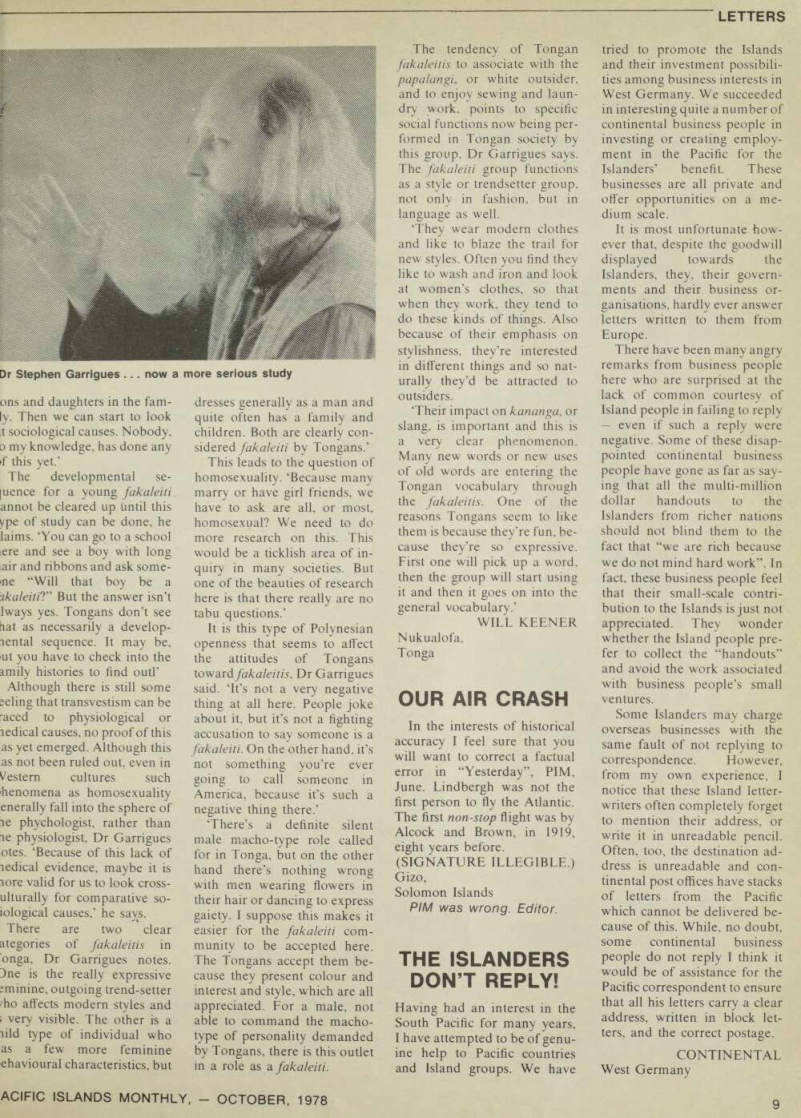
Dr Stephen Garrigues, who
teaches anthropology and soci ology at Atenisi University near Nukualofa, uses his obser vations of fakaleitis in Tonga to illustrate certain social con cepts to his students. He now hopes to begin a more serious study of the fakaleiti com munity, involving some of his students in the research
phases.
In Tonga, particularly, little study has been done. The fakaleiti needs to be carefully studied. Dr Garrigues believes.
He says: ‘We need to have life histories, recording what their childhood years were like, their feelings, things like the order of
ons and daughters in the famly. Then we can start to look
t sociological causes. Nobody,
d my knowledge, has done any
►f this yet.’
The developmental se- [uence for a young fakaleiti annot be cleared up until this ype of study can be done, he laims. ‘You can go to a school ere and see a boy with long air and ribbons and ask somene “Will that boy be a :ikaleitiT ’ But the answer isn’t Iways yes. Tongans don’t see
hat as necessarily a develop-
lental sequence. It may be, ut you have to check into the amily histories to find outl’
Although there is still some seling that transvestism can be
■aced to physiological or
ledical causes, no proof of this as yet emerged. Although this as not been ruled out, even in Western cultures such henomena as homosexuality enerally fall into the sphere of
ic phychologist, rather than
le physiologist. Dr Garrigues
otes. ‘Because of this lack of tedical evidence, maybe it is tore valid for us to look cross-
ulturally for comparative so-
iological causes,’ he says.
There are two clear ategories of fakaleitis in onga, Dr Garrigues notes. 3ne is the really expressive
;minine, outgoing trend-setter
fho affects modern styles and 1 very visible. The other is a lild type of individual who as a few more feminine ehavioural characteristics, but
dresses generally as a man and quite often has a family and children. Both are clearly con
sidered fakaleiti by Tongans.’
This leads to the question of homosexuality. ‘Because many marry or have girl friends, we have to ask are all, or most, homosexual? We need to do more research on this. This would be a ticklish area of in quiry in many societies. But one of the beauties of research here is that there really are no
tabu questions.’
It is this type of Polynesian openness that seems to affect the attitudes of Tongans toward fakaleitis , Dr Garrigues said. ‘lt’s not a very negative thing at all here. People joke about it, but it’s not a fighting accusation to say someone is a fakaleiti. On the other hand, it’s not something you’re ever going to call someone in America, because it’s such a
negative thing there.’
‘There’s a definite silent male macho-type role called for in Tonga, but on the other hand there’s nothing wrong with men wearing flowers in their hair or dancing to express gaiety. I suppose this makes it easier for the fakaleiti com munity to be accepted here, The Tongans accept them be cause they present colour and interest and style, which are all appreciated. For a male, not able to command the macho type of personality demanded by Tongans, there is this outlet in a role as a fakaleiti.
The tendency of Tongan fakaleitis to associate with the papalangi , or white outsider, and to enjoy sewing and laun dry work, points to specific social functions now being per formed in Tongan society by this group. Dr Garrigues says.
The fakaleiti group functions as a style or trendsetter group, not only in fashion, but in language as well. ‘They wear modern clothes and like to blaze the trail for new styles. Often you find they like to wash and iron and look at women’s clothes, so that when they work, they tend to do these kinds of things. Also because of their emphasis on
stylishness, they’re interested
in different things and so nat urally they’d be attracted to outsiders. ‘Their impact on kananga, or slang, is important and this is a very clear phenomenon.
Many new words or new uses of old words are entering the
Tongan vocabulary through
the fakaleitis. One of the reasons Tongans seem to like them is because they’re fun, be
cause they’re so expressive.
First one will pick up a word, then the group will start using it and then it goes on into the
general vocabulary.’
Will Keener
Nukualofa, Tonga
Our Air Crash
In the interests of historical accuracy I feel sure that you will want to correct a factual error in “Yesterday”, PIM, June. Lindbergh was not the first person to fly the Atlantic.
The first non-stop flight was by Alcock and Brown, in 1919, eight years before.
(Signature Illegible.)
Gizo, Solomon Islands RIM was wrong. Editor.
The Islanders
Don’T Reply!
Having had an interest in the South Pacific for many years, I have attempted to be of genu ine help to Pacific countries and Island groups. We have
tried to promote the Islands and their investment possibili ties among business interests in West Germany. We succeeded in interesting quite a number of continental business people in
investing or creating employ
ment in the Pacific for the Islanders’ benefit. These businesses are all private and offer opportunities on a me dium scale.
It is most unfortunate how ever that, despite the goodwill displayed towards the Islanders, they, their govern ments and their business or
ganisations, hardly ever answer
letters written to them from
Europe.
There have been many angry remarks from business people here who are surprised at the lack of common courtesy of
Island people in failing to reply
- even if such a reply were negative. Some of these disap pointed continental business people have gone as far as say ing that all the multi-million dollar handouts to the Islanders from richer nations should not blind them to the fact that “we are rich because we do not mind hard work”. In fact, these business people feel that their small-scale contri bution to the Islands is just not
appreciated. They wonder
whether the Island people pre fer to collect the “handouts” and avoid the work associated with business people’s small ventures.
Some Islanders may charge overseas businesses with the same fault of not replying to
correspondence. However,
from my own experience, I notice that these Island letter
writers often completely forget
to mention their address, or write it in unreadable pencil.
Often, too, the destination ad dress is unreadable and con tinental post offices have stacks of letters from the Pacific which cannot be delivered be cause of this. While, no doubt, some continental business people do not reply I think it would be of assistance for the Pacific correspondent to ensure that all his letters carry a clear address, written in block let ters, and the correct postage.
Continental
West Germany
Dr Stephen Garrigues . . . now a more serious study