bridging Fiji’s Rewa River
pp. 78-79 · Read in the full issue
A record broken, a life lost, in bridging Fiji’s Rewa River
Fiji recently heard the depressing news that shortage of funds will delay until the next development plan completion of the section of the Queen’s Road between Deuba and Sigatoka on the island of Viti Levu. The delay in particular means a further postponement of the hoped-for prosperity from the full-fledged operation of the Pacific Harbour tourist complex at Deuba. But when the road is finally completed, it is doubtful whether it will be greeted with any greater joy by the Fiji population than was the completion 41 years ago of the bridge at Nausori over Fiji’s longest river, the Rewa. Ken James, who with his wife taught for several years at the secondary school in nearby Davuilevu, recounts the history of the bridge over the mighty Rewa.
The Rewa River is the longest in Fiji, and most road traffic uses the 12-span concrete bridge at the township of Nausori to cross it. However, not many regular users or tourists realise that last year, 1977, marked the 40th anniversary of the opening of the bridge, whose construction took more than two years, caused the death of at least one workman, and set a Southern Hemisphere record for the deepest sinking of a bridge pylon. . * Crossing the river at Nausor, at the end of last century was a matter of either swimmmg or travelling across by canoe, rowboat or punt. Indian ferrymen operated a service across the river, and, depending on time of day and the weather, one could be charged from 3d to 2/6 for the crossing. b The opening of the road between Suva and Nausori at the turn of the century led to an increase in traffic seeking to cross the river, and in 1902 a hand-driven pontoon was put into service. It was operated privately and a toll was charged for crossing between the township and Mission Hill
(Dilkusha). The journey took about 45 minutes, This service proved ade quate for many years, although complaints did arise concerning the speed of the service. In 1912, Mr Scott, member for the Southern Division in the Legislative Council moved a resolution urging that a steam-driven pontoon replace the existing hand-driven ferry. The re solution was carried, the Col onial Secretary agreeing that the matter needed looking into. But it was not until 1917 that a change . o ver took place. i n Janu a r y I 9 I 7 th e government took over the fer * scrvice from Hill and Co of J : A crossing toll was ... . . . ® . 1,1 charged, but the new steam-driven pontoon took only five minutes to make the ‘ r , oasraB ’ Th . e servlce °P erated 15 hours a day.
The opening up of a number of roads in the Rewa area (e.g. Nausori-Naduruloulou, Nausori-Wainibokasi Hospi tal, Wainibokasi-Bau), and the subsequent increase in car ownership in the area, meant continual growth in the traffic seeking to cross the river. As only four vehicles could be accommodated in the ferry at
one time this often meant delays at the river of an hour or more. Although the pon toon size was increased on several occasions it was “no uncommon sight to see 40 or 50 motor cars waiting on either side of the river to be taken across”.
In the mid-20s the ferry crossing had to moved 200 m (600 ft) downstream to the 12mile post cm the Suva-Nausori road. This was made necess ary by the changing nature of the riverbed, for a large bank of sand had formed in the river across the path used by the service. At times it was im possible for the pontoon to reach the landings, for where in 1913 some places had two metres of water, by 1923 there was only a little more than one metre.
The first positive con sideration of the possibility of a road bridge replacing the fe rry service came in 1925 when Mr Barker, junior member for the Southern Division, moved “that in the opinion of the Council, it is desirable in view of the increased vehicular traffic that consideration should be given by the government to the question of erecting a bridge over the
River Rewa at or in the vicini ty of Nausori.”
Traffic certainly had in creased. Whereas average weekly motor-car crossings in December 1922 were about 330, by October 1928 such crossings had exceeded 2 000.
Over the same period the number of passengers of all types making the crossing rose from just under 4 000 to well over 17 000.
The concept of a road bridge was well received, the Governor promising to have an estimate made for the cost of a bridge. In 1926 a loan committee supported the idea, while a select committee in 1928 recommended that the bridge was “a genuine necessi ty”. This judgement was based upon the fact that vehicular traffic in the Rewa area was about to increase still further with the opening of the Tailevu road, and also, even more importantly, that the continual silting up of the river in the vicinity of the township was threatening to cut back operating times of the ferry service to peak-tide periods. A telegram in 1933 from the Secretary of State for the Colonies gave his support:
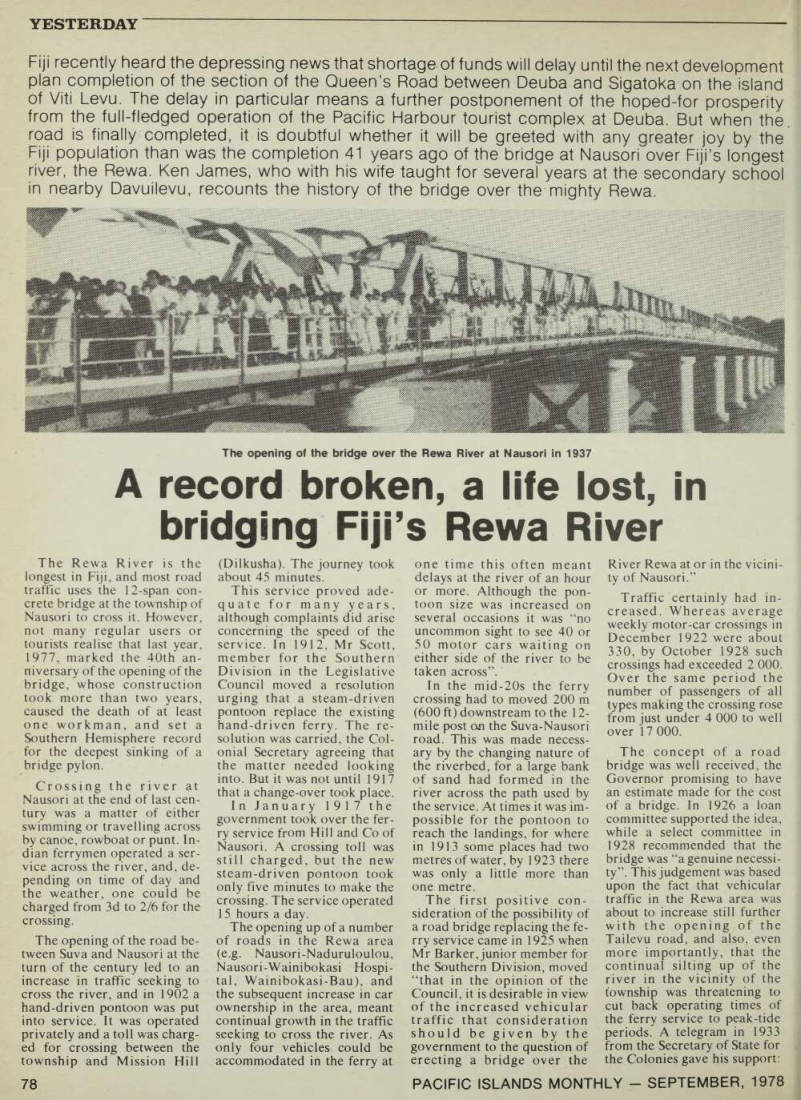
The opening of the bridge over the Rewa River at Nausori in 1937
if 1 rightly understand bridge is important link in communication scheme and is urgently required, and as moreover, project is in productive class and assistance from Colonial Development Fund might be lost, I would be prepared to authorise project being commenced without further delay.”
Work on the bridge began in early 1935. The plan was for a 12-span concrete bridge, the materials to come from England. The first task was
the sinking of the bridge pylons, and it was here that lengthy delays were encoun tered, extending the construc tion period to well over two years.
Unexpected difficulties
arose when the solid sandstone which provided firm foundations on the Mis sion side of the riverbed gave way to a very deep layer of soft clay halfway across the river. The result was that the pylons on the Nausori side had to be sunk to a depth two
or three times greater than an ticipated. One pylon was sunk to a depth of 37.5 m (123 ft), while another was sunk to 49.4 m(162 ft), at that time a record pylon depth for the Southern Hemisphere.
In late 1936 a Fijian work man, hit by a moving bucket, fell to his death 30.5 m( 100 ft) inside one of the pylon cas ings. His body was recovered but only with great difficulty.
The sinking of the pylons was completed in March 1937, the structural work in
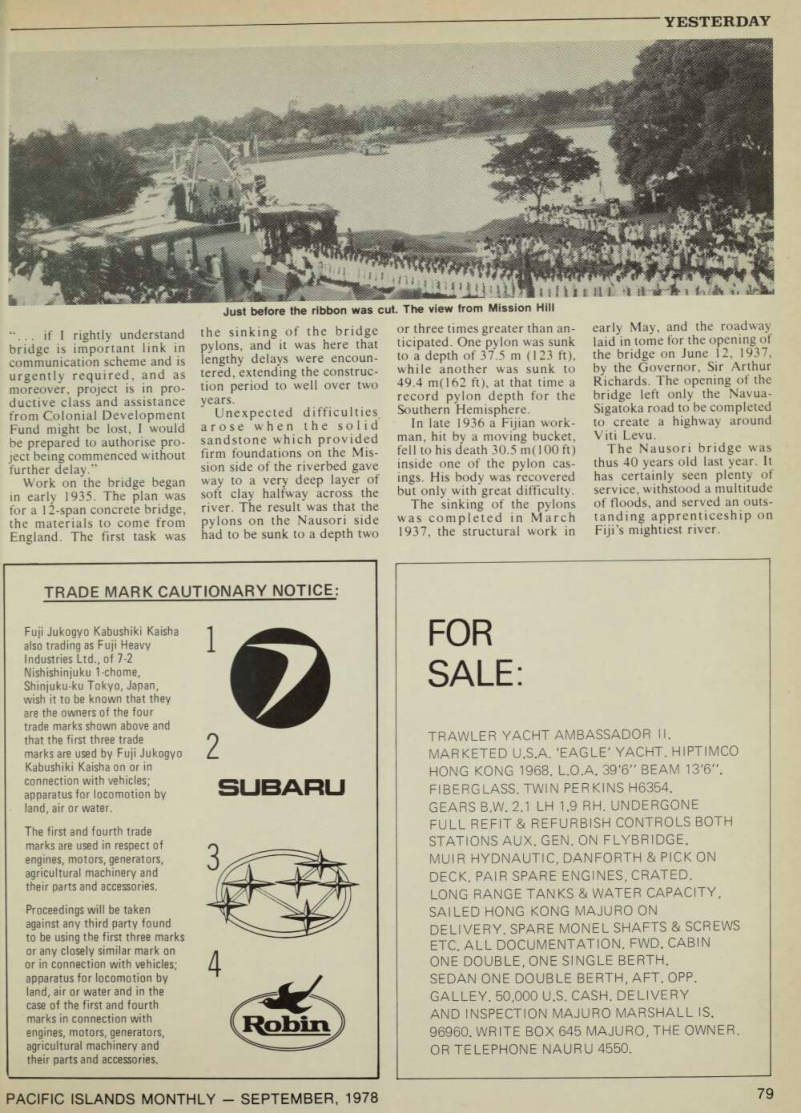
early May, and the roadway laid in tome for the opening of the bridge on June 12, 1937, by the Governor, Sir Arthur Richards. The opening of the bridge left only the Navua- Sigatoka road to be completed to create a highway around Viti Levu.
The Nausori bridge was thus 40 years old last year. It has certainly seen plenty of service, withstood a multitude of floods, and served an outs tanding apprenticeship on Fiji’s mightiest river.
Just before the ribbon was cut. The view from Mission Hill