Island governments
p. 77 · Read in the full issue
must act to keep Suva archives in the Pacific
The ravages of tropical climate and wars, and the simple passage of time, have posed problems enough in the task of maintaining adequate records of Pacific history. But now human indifference threatens to rob the region of a priceless source of documentation on the history of the past century in a number of important Pacific Island groups. C. Guy Powles, of the Monash University’s Department of Law, makes a strong appeal for action to stop the planned transfer to Britain of most of the contents of the Western Pacific Archives in Suva.
It has been announced that the Western Pacific Archives in Suva will be closed by the end of this year. I understand that most of this collection is being sent to the other side of the world, to the United Kingdom, without being fully microfil med.
The Western Pacific Ar chives contain the only sub stantial record available in the Pacific of the history of the Solomon Islands, the Gilbert Islands, Tuvalu, the New Hebrides and Pitcairn the evidence of 100 years of his tory. As far as the Kingdom of Tonga is concerned, some re cords were retained in Nukualofa, but there are many gaps in them. The records of the British Consul in Tonga, and of the High Commissioner (stationed in Suva) relating to the affairs of Tonga, are part of the Western Pacific Archives.
As the Western Pacific High Commission was the adminis trative centre for the Island groups in the region, (other than Fiji), its papers and docu ments recorded much of their
history. Although some local
material may be allowed to re main in the Pacific, I under stand that all the High Commission records (and microfilms already made), and the bulk of the total archives, are to be sent to the Foreign and Commonwealth Office, London.
It is true that a large part of the written material which comprises the history of this
vital 100-year period was
recorded by British officials, but the political process of which they were part contribu ted to the history of what are
now independent, or soon-to become independent, nations.
The history therefore belongs
as much, if not more, to those nations as it does to Britain’s colonial past. The British Foreign Office already has its own documentation in the form of reports which were sent to it at the time from its representatives in the Pacific.
Britain can have no need for these Pacific records, and, even if it did, do not the Pacific nations have a better claim?
I write this for fear that the records may be leaving the Pa cific without the governments and others interested in them being fully aware that the re moval is actually now taking place.
British justification for the removal may be that proper housing for the records cannot be found in the countries con cerned and, if this is so, cannot immediate consideration be given to the construction or ad aptation of suitable premises in the Pacific? It is sometimes dif ficult to separate out those parts of the material which ought to belong to specific Island groups. Much, however,
clearly relates to particular
areas. It may be appropriate for one or two central repositories to be maintained until such time as the more general docu ments may be copied, so that each country to which they re late will eventually have a com plete set of its own historical records.
In Honiara there is a suitable building large enough for all of these records. Altenatively, I understand that the Australian Government once offered to look after the papers tem-
porarily. The Fiji Government
may perhaps be prepared to permit the Western Pacific Ar chives to remain temporarily in Suva. Of course, the proposal that the records be allowed to remain in the Pacific means that costs will have to be met locally. The wealthier nations
would provide assistance if
concrete proposals are put for ward.
There is a compromise, and that is for the records to be microfilmed before they are moved.
I have lived and worked in the Pacific for many years and am fully aware that official documents are by no means the only source of historical infor mation about the Pacific. Oral history and vernacular manu
scripts, linguistic analyses and
archaeological research, pro vide their own systems of ex
planation and emphasis. But
the perspective provided by
official written records is an essential part of historical reconstruction.
A rapidly growing number
of Pacific Island citizens are interested in undertaking aca demic research into their coun tries’ past. Historical docu
ments should be available to senior school pupils and students from Pacific tertiary institutions in the same way that those of other countries are available to their students.
Local people unconnected with schools or universities may wish to refer to archival material for various reasons, and should be able to do so.
The removal of this source material from the reach of the citizens of the countries to which it pertains is, in a sense, to deliver the responsibility for the interpretation of the Pa cific’s past into the hands of those academics, mostly non- Pacific citizens, who, with study leave and large grants from overseas universities, can travel to Britain.
For some time this issue has been the concern of a few people in the Pacific who are aware of the problem. Unfor tunately, I believe that the plans for removal and the actual removal of some docu ments have already gone so far that the only action which can now be effective is direct representations at government level from Pacific nations to the United Kingdom.
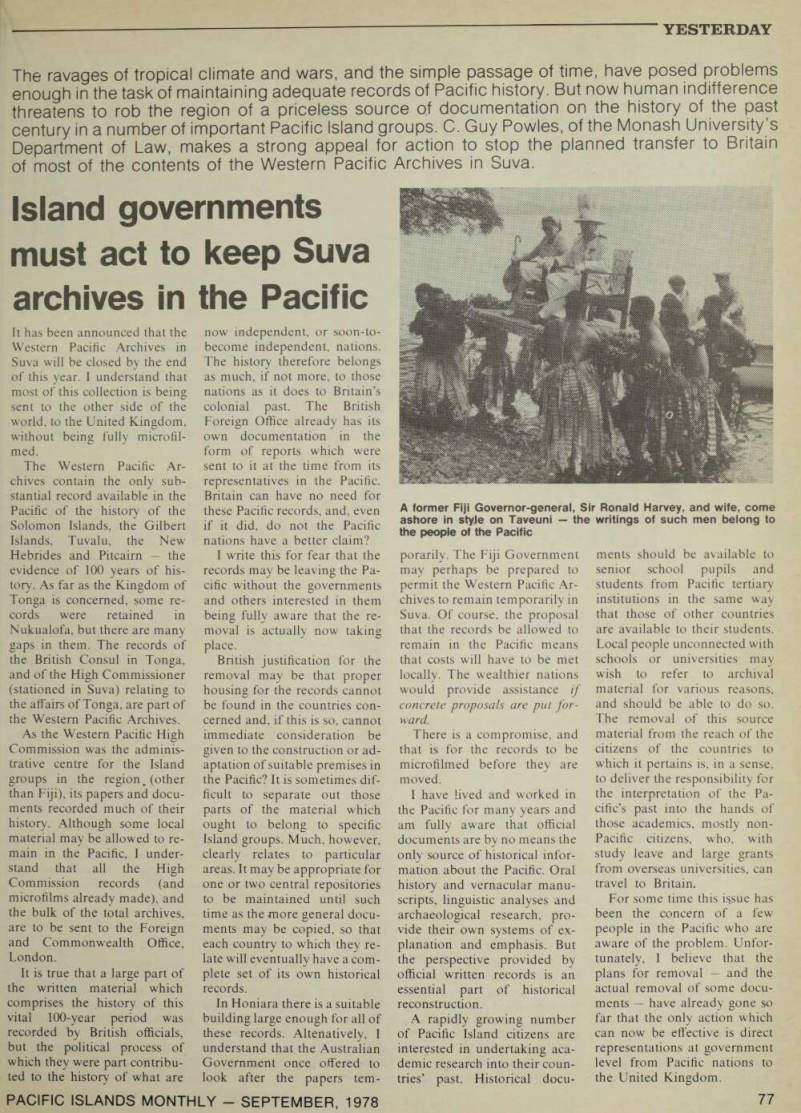
A former Fiji Governor-general, Sir Ronald Harvey, and wife, come ashore in style on Taveuni - the writings of such men belong to the people of the Pacific