fields-or gold dust in the sky
pp. 67-70 · Read in the full issue
Stirring days in the New Guinea gold fields-or gold dust in the sky
They were stirring days in the New Guinea goldfields half a century ago. They were also the days when men flew in “crates,” of string and cardboard. Bert Weston writes of those days and of a flight in a “crate” to deliver a cargo of gold dust to Australia.
The history of most of the world’s richest alluvuial goldfields has followed the same pattern of discovery, boom and eventual petering out and abandonment to fossickers.
The fabulously- rich Morobe goldfield on the mainland of New Guinea from which many millions of ounces were won during the 15 years before World War II was no exception in its progress from the day of the individual miner with his team of native labourers working with a sluice box and shovels on to the era of big business winning gold by hy draulic sluicing, lode mining with its attendant stamp bat teries and cyanide treatment and to floating dredges op erating to a depth of over 31 metres.
The Pacific War brought total stoppage of all forms of mining activity and much de struction of equipment and plant: work was resumed after the war but never to the same degree of productivity and, in fact, with the inevitable tail ing-off indicative of a worked out goldfield.
The gold rush of the late
1920 s following discovery of
the rich Edie Creek alluvial deposits brought all kinds of hopefuls to the field and when I reached there in 1928 a number of individuals were already famous as owners of high-producing claims with winnings of over 100 ounces a day.
Until the advent of air transport in 1927, the sole method of bringing in supplies of native rations such as rice and tinned meat and of pro visions and mining gear for the Europeans was on the back of native carriers and it was essential for a miner to periodically send part of his labour line out to Salamaua on the coast to pick up and tote back the required goods.
This entailed at least a two
week trip over difficult moun tain country and at times under attack by hostile tribes.
On these trips the accumu lated gold dust would be entrusted to the miner’s boss boy for delivery to the agent or the store manager at Salamaua who would credit the owner’s account with an interim payment pending re ceipt of final assay and treat ment returns from the Australian Mint.
In contrast to goldmining in Australia last century with its history of armed hold-ups and robbery of coaches and drays taking gold to banks and to the coast, the killing of police escorts, claim-jumping, race riots involving the hordes of Chinese miners and murders by the dozen, there was no disorder on the Morobe field and vast quantities of gold were carried to the coast by the most haphazard means
with never a recorded loss by robbery or theft. Everyone trusted the next man down the delivery line.
This happy state of affairs was due to the large content of Australians among the goldfields population and, furthermore, most of them were ex-servicemen with a highly developed sense of mateship and fair play. It was not at all uncommon for a man to step off the steamer at Salamaua. broke and jobless owing to the depression in Australia, and, within hours, to be befriended by a suc cessful miner and given a claim to work on shares. This
was not always entirely
altruistic as a mining claim, once pegged and recorded, had to be manned and worked after a stated time or other wise forfeited. But some pen niless newcomers achieved prosperity in this manner.
In the late 1920 s I was cargo manager at Lae, on the coast, for the Taylor and Ross air service and almost every flight from the mining centre at Wau brought large and small parcels of gold dust from trusting miners for on ward delivery in cockleshell launches to Burns Philp or Carpenter’s stores across the Huon Gulf at Salamaua.
It would reach me packed in 1 lb tea tins, tobacco and cigarette tins and in jam-jars with the lids secured with a strip of sticking plaster. Some more careful types would make up small canvas packages, edges sewn and all of them addressed and iden tified in indelible pencil. 1 remember several hundred ounces reaching me tied up in a pair of dirty white socks and inscribed ”B P from Snowy”.
It reached Burns Philp safely.
All this wealth was carried
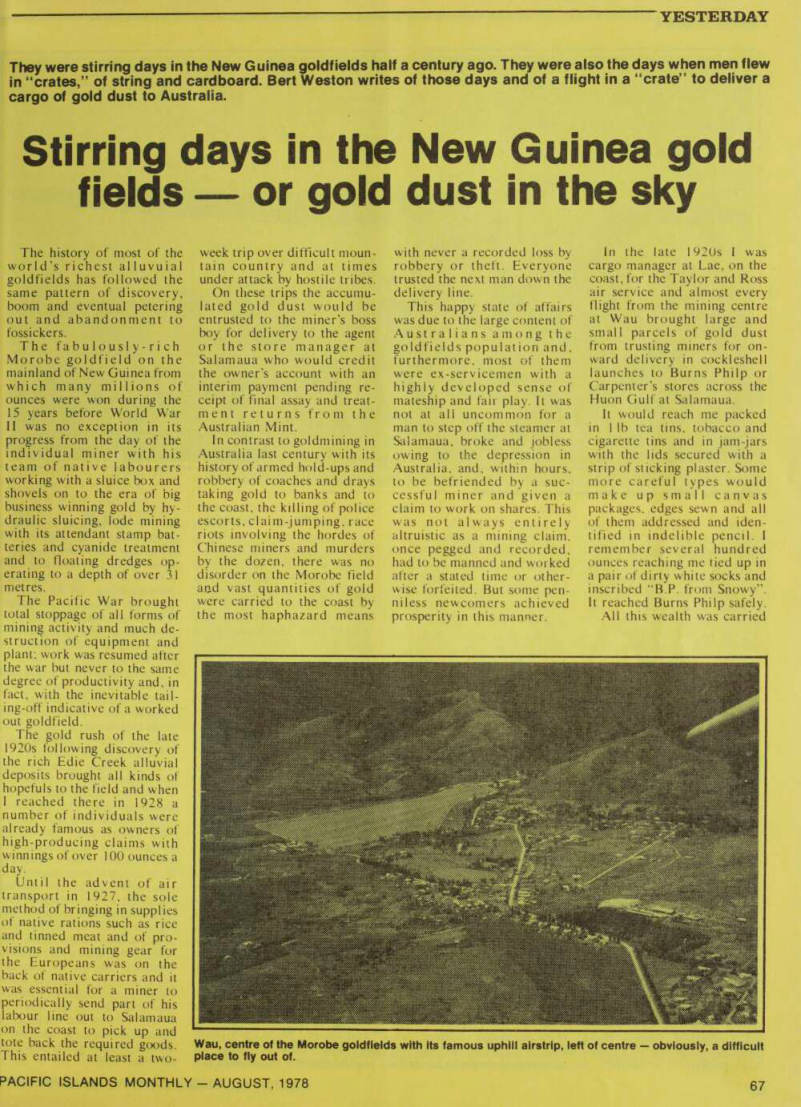
Wau, centre of the Morobe goldfields with its famous uphill airstrip, left of centre-obviously, a difficult place to fly out of.
by plane without knowledge of the pilot and without benefit of protection by receipts or freight notes. On one occasion a tin containing 300 ounces was found in a seldomopened small locker on the side of the aircraft after traveiling to and fro for over a month. The owner had never queried it safe delivery.
My usual practice was to collect the assorted packages of gold from the plane and toss them into a wooden box under my bed to await the arrival of a launch from Salamaua when they would be loaded into a barrow and wheeled by a native down to the beach and handed over to the native crew for delivery to the store and, later, to the bank at Salamaua.
There were times when I slept above an accumulation of several thousand ounces with no qualms as to its safetv At the end of 1928, Hector Wales - one of the very suecessful miners - together with two of his cronies was flown down to Lae by World War I fighter pilot Jerry Pentland, who operated a one-man service with a Moth small plane. They were en-route for a Christmas in Sydney taking with them a quarter of a ton of gold packed in a number of
pinewood boxes. By the time that Jerry had landed the gold at Lae, wind and rain had stopped all launch traffic to Salamaua and the boxes lay out on the airstrip for three days while Hector and party staged a wild grog-spree, Q nly two thefts come to mind These were of company gold at Bulolo when in one in stance, several bars of smelted go ld wer e taken from the treatment room one night and t h e other theft was from a dredge. The sluices in which the gold was caught and held j ay behind locked gates and every week these were opened and a team of trusted employees entered to remove t he accumulated ore. ... . .
F'g ures ‘" d ' cat « d ,ha ' P dfe , rl "B was tak '"8 P lace and a dete h ct,ve was flown up from Brtsbane incognito and
employed as a dredge-hand,
He soon discovered that two members of the clean-up a father and s . on com ’ were slipping handfuls of dust into t ei “at pockets. Their tr,a at Salamaua by udge Wanless f arned them lon g B aol sen ‘
tences -
Gold was shipped by sea from Salamaua to Sydney ev cry few weeks by the ordinary process of registered mail.
However, these movements were halted in 1940 owing to the presence of, and uncertainty as to the whereabouts of, enemy raiders in Australian waters. For the same reason, Australia’s bullion stocks were secretly moved from Melbourne to an emergency ‘Fort Knox’ located in the interior of the gaol in the NSW inland township of Broken Hill.
The stoppage of shipments from New Guinea soon imposed hardships on miners awaiting final payment from the Mint and also left dormant a national asset in the way of many hundredweights of untreated gold dust and it was, therefore, decided to fly a consignment to Australia per medium of W. R. Carpenter Ltd, holders of the airmail contract.
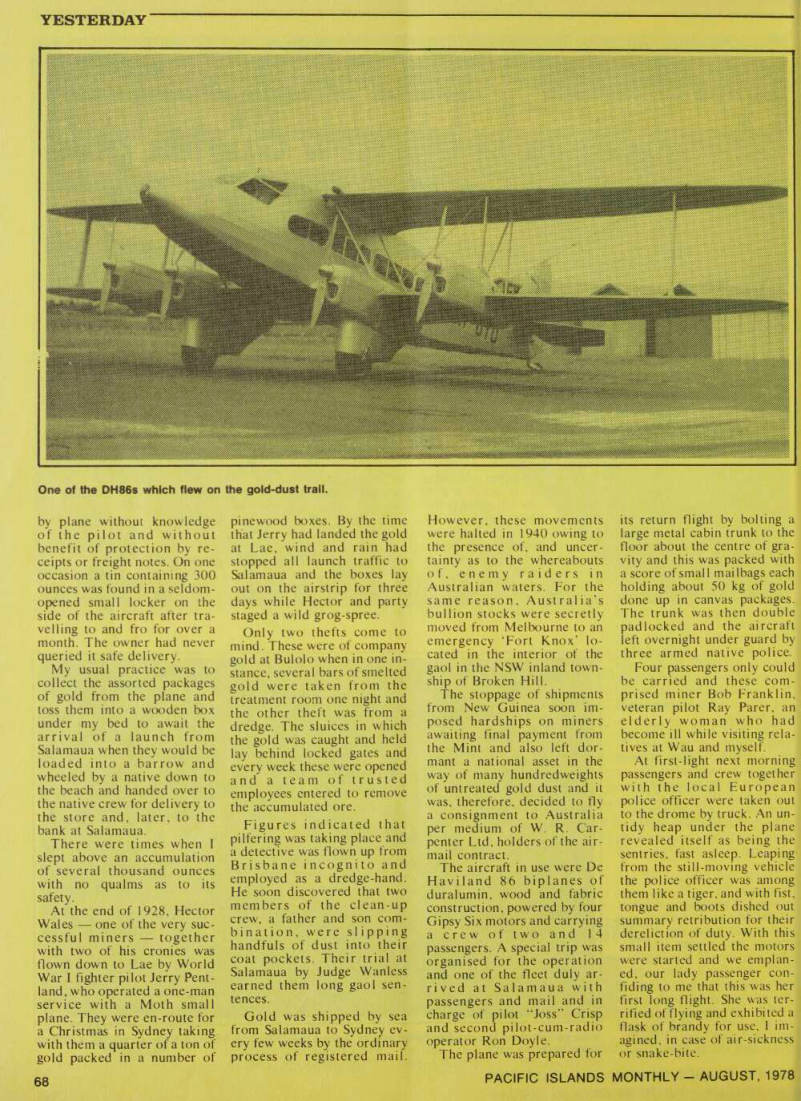
The aircraft in use were De Haviland 86 biplanes of duralumin, wood and fabric construction, powered by four Gipsy Six motors and carrying a crew of two and 14 passengers. A special trip was organised for the operation and one of the fleet duly arrived at Salamaua with passengers and mail and in charge of pilot “Joss” Crisp and second pilot-cum-radio operator Ron Doyle.
The plane was prepared for
its return flight by bolting a large metal cabin trunk to the floor about the centre of gra vity and this was packed with a score of small mailbags each holding about 50 kg of gold done up in canvas packages, The trunk was then double padlocked and the aircraft left overnight under guard by three armed native police, Four passengers only could be carried and these com prised miner Bob Franklin, veteran pilot Ray Parer, an elderly woman who had become ill while visiting rela tives at Wau and myself, At first-light next morning passengers and crew together with the local European police officer were taken out to the drome by truck. An un tidy heap under the plane revealed itself as being the sentries, fast asleep. Leaping from the still-moving vehicle the police officer was among them like a tiger, and with fist, tongue and boots dished out summary retribution for their dereliction of duty. With this small item settled the motors were started and we emplan ed, our lady passenger con fiding to me that this was her first long flight. She was ter rified of flying and exhibited a flask of brandy for use, I im agined, in case of air-sickness or snake-bite.
One of the DHB6s which flew on the gold-dust trail.
Fifty minutes later we land ed on Kila Kila airstrip at Port Morseby and were rush ed into the township for breakfast; then followed a three-hour crossing of the Coral Sea, landfall at Lizard Island and a touchdown at Cooktown where an official wearing an HM Customs cap cleared us into Australia. The same jack-of-all-trades then took the solitary mailbag to the post office and, in his postal capacity, sorted the let ters. Reputedly once a week he donned a cap labelled Sta tion Master and flagged out the rail motor to Laura on the Palmer River goldfield.
Here again we were driven into the township for lunch, passing en-route along a street of mainly empty houses tenanted by ruminating goats.
Returning to a refuelled machine a run of 45 minutes brought us in for a mail stop at Cairns where a perfect land ing ended in a loud report and a swerve into the rough with a blown tyre. The local agent telephoned Townsville where a spare wheel and tyre were kept for just such an emergen cy and arranged for it to be flown up by light plane. In the meantime the “86” was jacked up and the offending wheel removed.
Late in the afternoon, the Moth arrived with the spare roped to the side of the fuselage. It was soon fitted and with assurances of emergency lighting for our landing at Townsvilie we were in the air again by dusk.
“Joss” poured on the coal and at a low altitude fast progress was being made when a dense pall of smoke and miles of flames ahead denoted that sugar cane farmers were burn ing off dead leaves and “trash” along our route.
To avoid being suffocated and to see the way a detour was made out to sea until Townsville lights showed up with the airfield picked out by a double row of flares com posed of dozens of buckets of burning petrol. Following a very rough landing, the plane was immediately surrounded by a platoon of infantry with fixed bayonets; police swarm ed everywhere and a team of bank officers rushed on board
flashing identity papers and
requesting the "keys to the treasure.
A fleet of taxis drew along side and a bag of gold was lo cked in the boot of each and
with bank staff and police rid ing shotgun they were driven under army escort into the city where the gold was placed in a vault overnight. After a stay at the Queen’s Hotel and an early breakfast the process was reversed when we and the cargo were taken back to the plane and packed aboard for a 7 am take-off. Hour after hour the scenery rolled past at 6 000 ft and 120 knots under a cloudless sky. Following a short stop at Rockhampton we
reached Brisbane for a onehour lunch and fuel break.
The weather report gave warning of flood rains and strong head winds on the NSW coast and with a gallon vacuum jar of tea (4.54 L) and a cardboard box of sandwiches added to the cabin amenities the final stage of the odyssey was entered into.
A rampart of cloud towered up ahead over the Macpherson Range on the NSW border and with the pilot riding the
beam from Kempsey DF sta tion the plane headed up into the murk. Ray Parer, who in 20 years of pioneer flying had never flown an aircraft fitted with electrical power and navigation equipment and who flew by the seat of his pants and ground visibility, grew very disturbed and remarked to me that we were over the high country where a former New Guinea pilot Rex Boyden had hit a mountain in a Stinson tri-
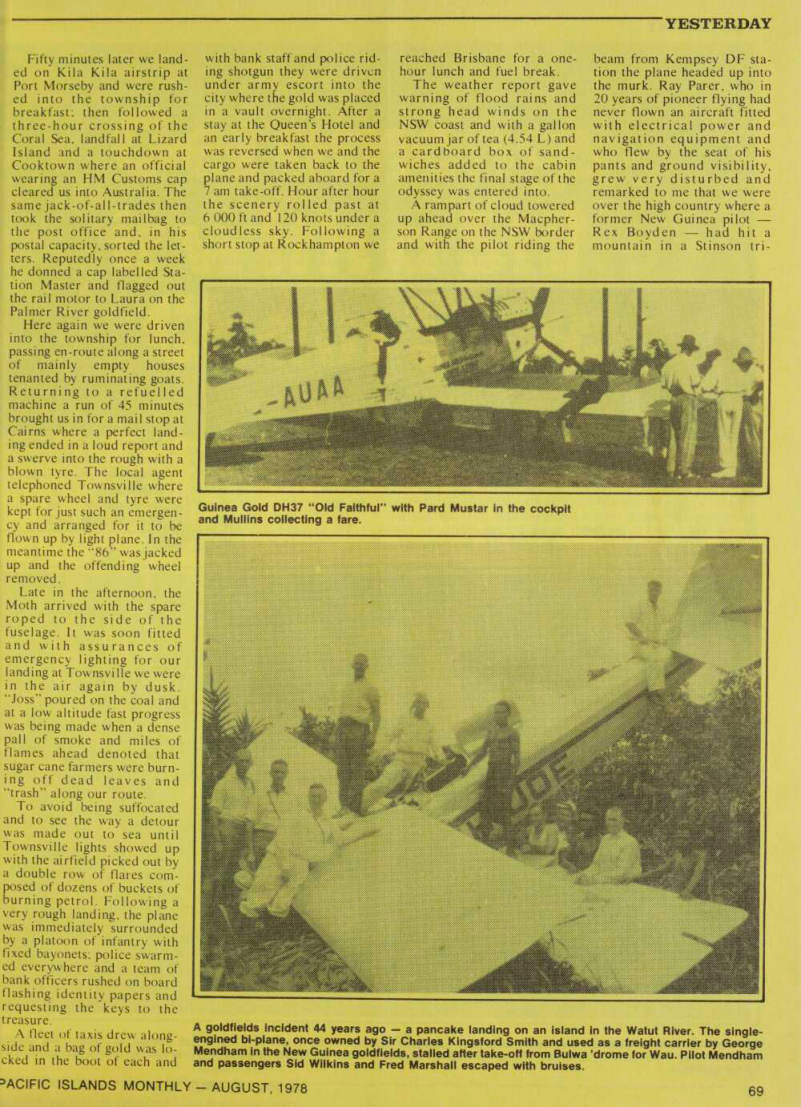
Guinea Gold DH37 “Old Faithful" with Pard Mustar in the cockpit and Mullins collecting a fare.
A goldfields Incident 44 years ago-a pancake landing on an island In the Watut River. The single engined bi-plane, once owned by Sir Charles Kingsford Smith and used as a freight carrier by George Mendham In the New Guinea goldfields, stalled after take-off from Bulwa ’drome for Wau. Pilot Mendham and passengers Sid Wilkins and Fred Marshall escaped with bruises.
motor with fatal results to himself and all but two of his passengers.
I reminded him that with the cabin altimeter showing 16 000 ft there was a lot of air space between the floor and the peaks and the beam had us on course. He was still mut tering his distrust of instru ments and new-fangled navigation aids when our at tention was drawn to the lady
across the aisle who was blue in the face, gasping for breath and fumbling with a spilt bot tle of capsules.
Realising that we had a heart emergency on our hands, Ray sprang to tell the pilot who immediately put the nose downhill while I and the other passenger crammed a few pills and a brandy chaser into her mouth.
With the altimeter still un winding rapidly, it was a com forting sight when a hole in the clouds revealed farms and coastal scenery about 8 000 feet below denoting that we had crossed the range and could bring the patient down to survival level. Although she had somewhat recovered, it was certain that the rest of the flight would need to be at low altitude so, on reaching Kempsey, we made a hedge hopping run over flooded farmlands to the coast and. bucking a wild southerly under an extremely low cloud base, flew from headland to headland and followed the beaches during the rain squalls into increasingly bum py conditions the further south we travelled.
Somewhere off the mid coast the co-pilot came aft to serve refreshments and, set ting out six cups on the floor, had just filled them with tea when the plane dropped like a brick. He and the food hit the ceiling leaving it dripping with tea and festooned with sopping fragments of tomato sandwich. It was a wonder that the sudden jolt at the bot tom of the downdraft did not send the concentrated weight of the gold through the floor.
Tea-less, the flight pushed on under cloud so low that the wingtips almost combed the hair of a solitary watcher on the gallery of Nobby’s Lighthouse at Newcastle.
Turbulence and bumps became so bad along the beaches and bluffs in the Hawkesbury area that the final 80 km were flown some distance off the coastline and almost at sea level followed by an entry through Sydney Heads at dusk and a roof-top skip over the Eastern Suburbs to a landing at Mascot and a meeting with more armed troops, police. Treasury of ficials and an ambulance.
To present-day air tra
vellers, who streak in air pressurised cabin comfort be tween Papua New Guinea and Australia, six miles above the weather, the foregoing may seem to be the height of trauma and discomfort.
To us of those pioneer fly ing days, it was a fact of life.
We were more impressed with the vast difference between panic-stricken security measures in Australia and the casual manner prevailing in New Guinea.
Bert Weston, the author, in his “gold-mining” days.
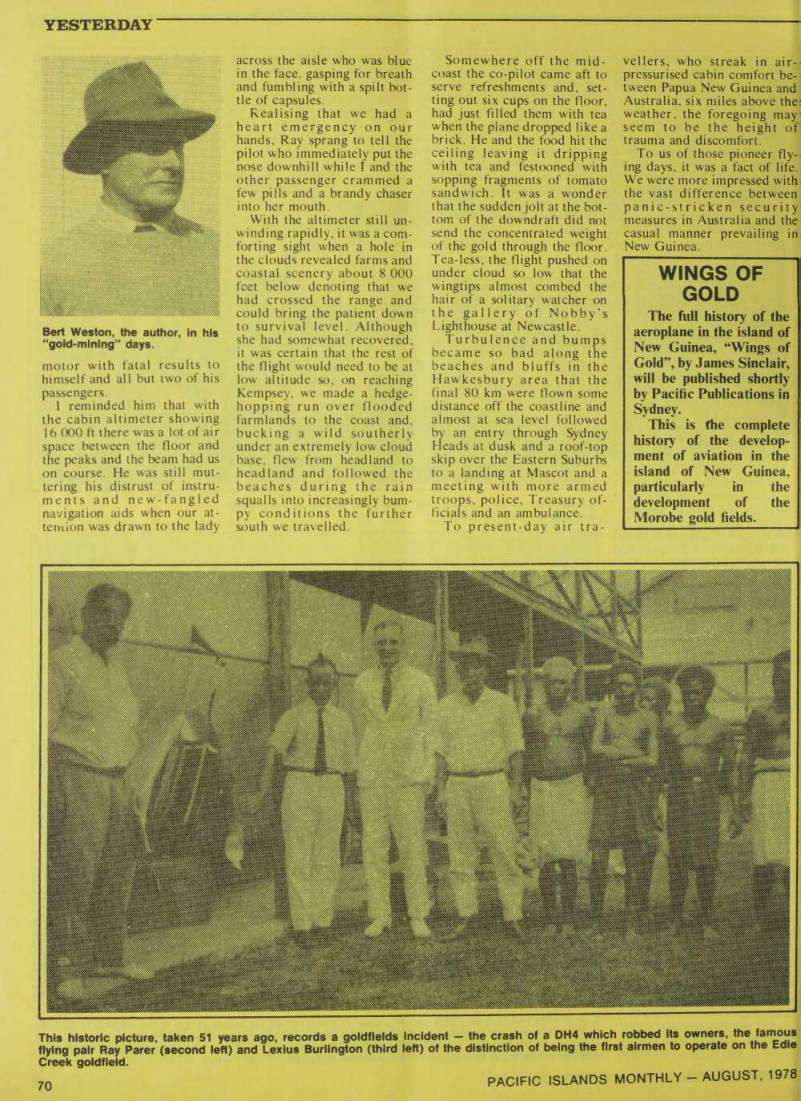
This historic picture, taken 51 years ago, records a goldfields Incident-the crash of a DH4 which robbed Its owners, the famous flying pair Ray Parer (second left) and Lexius Burlington (third left) of the distinction of being the first airmen to operate on the Edle Creek goldfield.