Cash cropping or subsistence farming
pp. 61-63 · Read in the full issue


a PNG dilemma
Like other developing countries Papua New Guinea has a long and difficult struggle towards a viable economy. Not least of the tasks is that of feeding its people with home-grown food, of making the nation self-sufficient. This article by Geoff Harris, formerly of the University of Papua New Guinea and now research economist with the Agricultural Economics Research Unit at Lincoln College, Canterbury (NZ), examines agriculture’s role in improving the villagers’ living standards.
The PNG Government’s 1976 National Development Strategy has emphasised the need to maintain the ability of subsistence agriculture to feed village people. Thus far, it appears that production per head has generally remained steady. A study by the author in two high population press ure areas (Wabag and Chimbu) found that there were adequate amounts of good quality land, and that the growth of resident population has been much slower that an ticipated. In addition subsist ence farming has engaged its workers, on average, only four or five hours a day.
Population in an area may increase to such a level that soil productivity declines because the ground is subjected to increasingly frequent usage and spends less time under fal low.
However, it is the relation ship between increasing popu lation and the carrying capacity of the area concerned that is of
crucial importance. Calcu
lation of the carrying capacity of group land areas is difficult, but estimates have been made in some areas and these pro vide useful bases from which to consider the impact of popu lation growth. This article examines two of these - the intensive Agricultural Survey 1962/64 carried out in Wabag ind Chimbu and, in particular, i 1960 study in Naregu, central Thimbu.
The intensive agricultural ;urveys were carried out in
ligh population-pressure areas
ind collected data which al owed estimation of the mini
num long-term requirements
)f land per head consistent
vith maintaining soil quality,
fhe figure for Chimbu was
0.17 ha of best quality equivalent land per person for sweet potatoes, pandanus, cof fee and pigs. In 1962/63 on av erage, the mean proportion of available land actually re quired was 52%; in 1973 it was 54%.
Taken as a whole, Chimbu, often regarded as the most
densely populated province,
does not appear to be facing severe population pressure.
Aggregate figures, however, cover up problems in small areas. For example, there is evidence to suggest that people in the most densely populated areas of Chimbu are staying at
home, not migrating, probably
to protect their rights to land.
Aggregate figures, as we have mentioned, hide import ant features at the local level.
Therefore we turn to examine population growth in one com
munity Naregu (present
population about 3 000) in Central Chimbu orginally studied in 1960 by Harold Brookfield and Paula Brown.
Overall, Brookfield and Brown found that 64% of the available land was actually required by the population at that time.
However, when figures for the 12 component sub-clans were analysed, there was a range be tween 22 and 97%. When these figures were updated to 1973, four of the 12 sub-clans had reached the maximum carrying capacity of their land.
The National Development Strategy sees dangers in an over-emphasis on cash crop ping: “too much land may be used for cash crop production
in periods of high prices. Soil
fertility may be depleted and the land may be unable to pro vide adequate subsistence in periods of unfavourable prices.
A related danger is that a lot
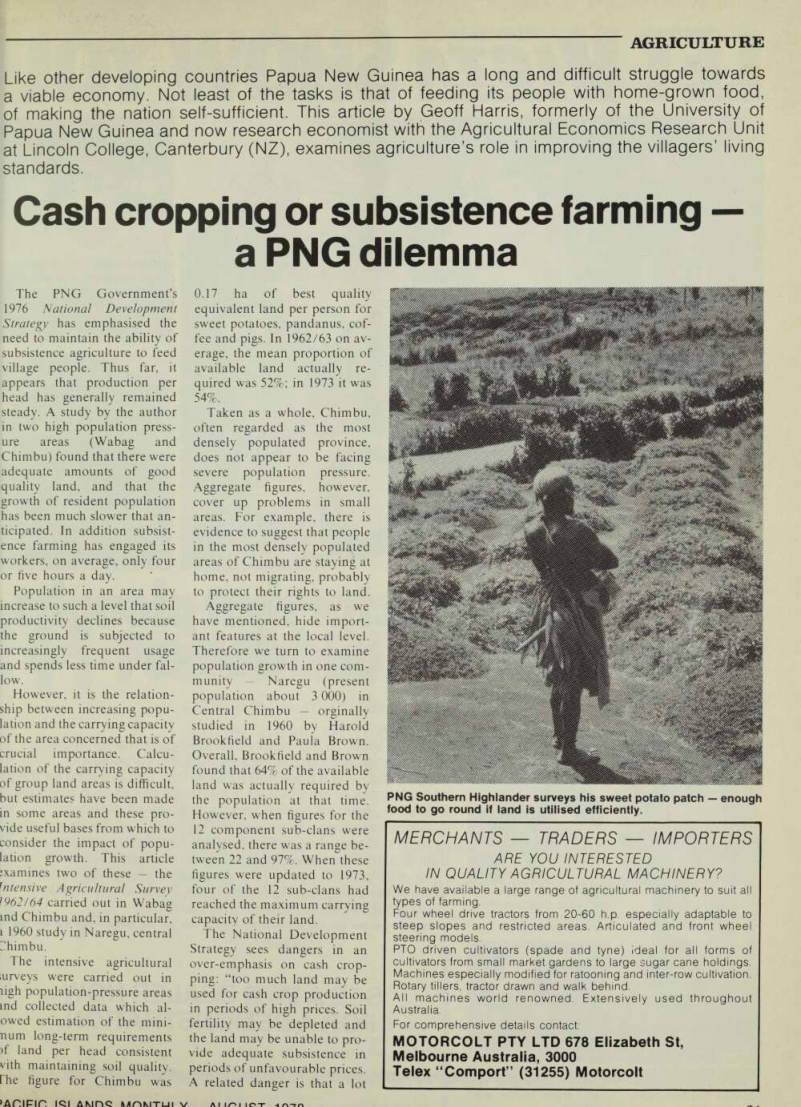
PNG Southern Highlander surveys his sweet potato patch-enough food to go round if land is utilised efficiently.
of income derived from export production will be directed to imported foods and may build up a reliance on imports. It will be extremely difficult to switch rapidly back to food pro duction when export prices fall
or import prices rise.”
This section compares the amount of land required for a “pure subsistence consumer”
(deriving his calorific require
ments solely from sweet potato), with the amount needed if he consumed only tinned fish and rice and earned
the necessary cash by growing
coffee.
Under a set of assumptions about food requirements, food values and yields, a sweet potato grower will need about 0.07 ha of best quality land to produce all his food require ments, allowing for periods of fallow.
At the other extreme, we consider a farmer who con sumes tinned mackerel and rice, financed by coffee pro duction. Under a set of assumptions about food re quirements, food values and yields, it can be shown that the
amount of land required to grow sufficient coffee to live on tinned fish and rice is consider ably greater than 0.07 ha. This casts doubts on the efficacy of an agricultural policy which has concentrated upon pro duction of export crops for sale.
This does not necessarily mean that cash cropping is re
sponsible for the disturbingly
high levels of malnutrition found in many parts of rural Papua New Guinea, especially amongst pregnant and lactat ing women and young chil dren. One puzzling aspect of malnutrition is that it does not appear to be related to the amount of land available.
A study of Enga children, for example, has shown that high volume traditional staples may
satisfy the consumer’s hunger
before he has obtained ad equate nutrition. The import ance of low volume foods such as peanuts and winged beans is at once apparent. This is all the more important given that in
the highlands protein de
ficiency is much more import ant than calorie deficiency.
As we have noted, the National Development Strat egy is concerned about trans ferral of garden land to cash
cropping during high price
periods and the difficulty of reverting to food production if prices fell. Another possibility is that villages may develop a
preference for imported foods
while earning high incomes
and not be willing to reduce
their consumption when prices
fall.
Finally, we consider the in fluence of absenteeism on the work-load of those remaining in the village. It is not uncom mon to find 20% of a village’s population absent, and the pro portion is highest among young
single men.
Clear evidence of the precise impact of absences on village agriculture is hard to collect. It can be expected that the absence of young energetic men would mean harder work for the remaining and, possibly (since males are responsible for
clearing and fencing) longer
use of gardens between fallows than would otherwise occur.
We have a picture of a sys
tem which has developed to meet the needs of its people in a highly efficient manner. This article has shown that its use of land is efficient when com pared to cash cropping; other studies, notably Eric Waddell’s The Mound Builders (a study of Enga agriculture), show that it
provides adequate food from
small inputs of labour, and that its methods are “finely tuned” to the particular environment it faces in different areas.
The major threats to subsist ence agriculture appear to be
population growth and cash
cropping and these should form the major areas for plan ners’ attention. In addition there is, in my view, a need for a reorientation of planning efforts.
The initial question has to be “In what ways can the village environment be improved?” .This leads to a search for prob lems, which in PNG include malnutrition and other specific health problems, lack of basic access, lack of knowledge (eg in the care of cash crops), lack of accessible water supplies and
adult illiteracy.