Is PNG TV-free? Well, yes, and then again no
pp. 55-57 · Read in the full issue
then again no...
The Papua New Guinea Government has set its face
against introducing a national
television service for at least five years.
But that doesn’t mean that
increasing numbers of people
in PNG are not enjoying TV programmes.
The reason lies not in any il
legal operations by pirate
stations, but in the rapidly
mounting popularity of video
cassette players in PNG.
Video equipment was introduced commercially into PNG in December, 1976. In the past 12 months the two main manufacturers JVC
(Japanese Victor Company, or
Nivico) and Sony have each enjoyed gross sales of more than K 1 million. These have netted K3OO 000 for PNG government revenue from the import duty of 50%, plus a 2Vi%
levy.
Sales are growing par ticularly in the government and commercial sectors, which are increasing their use of video as a training tool, replacing the traditional 16 mm film.
The video cassette recor der/player is connected to the aerial input of a normal dom estic TV receiver. It operates in much the same way as the sound cassette tape player, but permits the recording of both pictures and sound on mag netic tape. This may be erased and the tape used over and over again. Since it stores both visual and sound images, a wider tape than the conven tional audio cassette tape must be used. The cassette is there
fore somewhat bigger.
It is simply a matter of load ing the pre-recorded cassette into the TV receiver and press ing the start button, as with a conventional sound cassette.
The cassette may be rewound, and the programme viewed time and again. The machines generally have the same four functions as ordinary tape re corders - start, stop, fast for ward and rewind.
More sophisticated ma
chines have, in addition to a pause control, a still frame con trol which allows one frame to be held for as long as desired.
This is particularly useful when people want to have a critical discussion about a given film.
It is possible with some video cassette players to play back sound from either of two audio tracks or both. This means one sound track could be in English, and the other in. say,
Melanesian Pidgin. By using
both tracks, it is possible to re produce stereo sound.
Playing time of a video tape cassette depends on the length of tape loaded in the cassette and the speed of the cassette player. This can vary from an hour to three and a quarter hours per cassette.
There are three main video cassette types in popular use
throughout the world. They
are: • U-Matic System, 19 mm (Va in) tape: This system is widely used for commercial and government work where
heavy duty conditions and
handling are expected. The
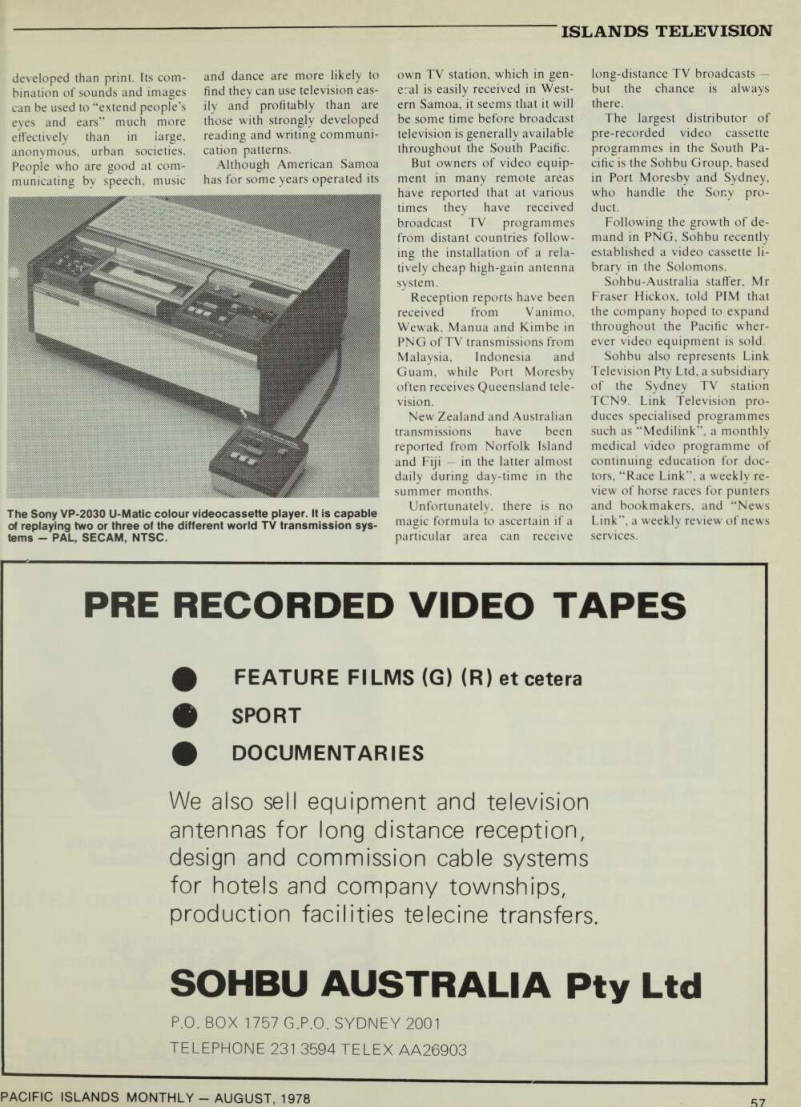
tapes have the advantage that they can be used with Sony, JVC, Rank, National and all other types of U-Matic ma chines. They can also replay two or three of the different world TV transmission systems
(Pal, Ntsc, Secam), And
have two audio track facili ties.
A disadvantage of the U- Matic type is that apart from having a 60-minute maximum recording time for each cas sette, it is larger and heavier than the 12 mm (Vi in) types.
A 60-minute cassette weighs 750 grams.
• Sony Betamax System,
12 mm (Vi in) video tape: A
relatively new type designed
specifically for home television systems and offering three and a quarter hours of recording time per cassette. The cassette weighs only 250 grams. It is ac
tually cheaper than a single 60-
minute U-Matic cassette. • JVC VHS (Video Home
System), 12 mm (Vi in) tape: Like Betamax, a relatively new system designed for the home entertainment market. Unfor tunately, it is not possible to in terchange cassettes between any of the three types for example, a programme recorded in the U-Matic for mat cannot be replayed on either VHS or Betamax players. Neither VHS nor Betamax has the facility of selecting various TV trans mission systems, or dual sound track facilities, offered by the U-Matic machine.
But both Betamax and VHS enable the recording of one TV station while the transmission of another is actually being viewed. The machines may also be preset at a specified time to start recording while unattended. (These features are useful in TV broadcasting areas, for which the machines were designed. They appear to offer an answer to the problem of TV channels, fighting for ratings, offering their best pro grammes at overlapping times).
The first formal meeting of the Pacific Group members of the Commonwealth Broadcast ing Association was held in Suva in July, 1977. The meet
ing was attended by delegates
from Fii, PNG, the Solomons, Tonga, Western Samoa, Aus tralia and New Zealand. Also present was the secretary general of the CBA.
The meeting decided that, for the next five years at least, the Pacific’s main field for
expansion and improvement
would be radio broadcasting.
There was agreement that tele vision, partly because of its
enormously expensive charac
ter, ought not to be introduced prematurely and at the expense of the proper development of radio services. The introduc tion of television, the meeting decided, “should be properly
planned at the appropriate
time to take account of proper training so that each country would be able to develop its own expertise in the pro duction of local television pro
grammes”.
It was at this meeting that Mr Sam Piniau, chairman of the PNG Broadcasting Com mission, named a target date of five years for the introduction of TV in PNG.
Television has a far greater impact than radio, especially in countries with strong oral tra ditions, where speech and action are much more highly-
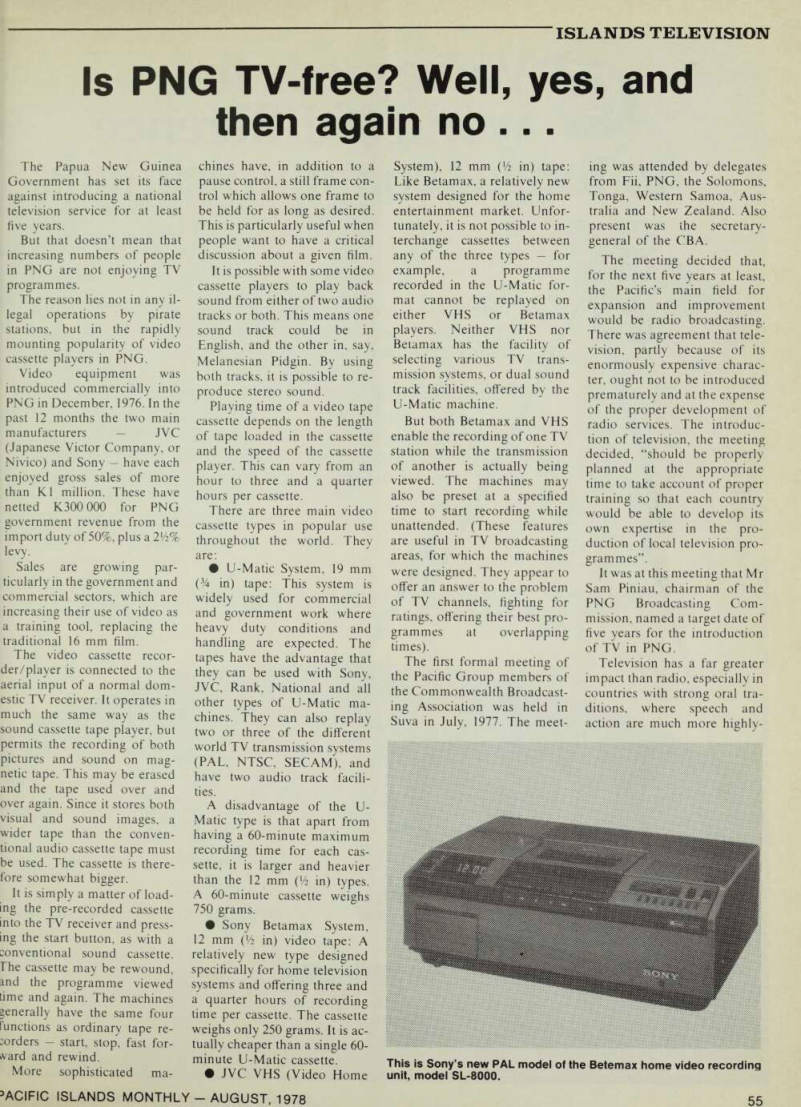
This is Sony’s new PAL model of the Betemax home video recording unit, model SL-8000.
developed than print. Its combination of sounds and images can be used to “extend people’s eyes and ears” much more
effectively than in large,
anonymous, urban societies, People who are good at communicating by speech, music
and dance are more likely to find they can use television eas ily and profitably than are
those with strongly developed
reading and writing communi
cation patterns.
Although American Samoa has for some years operated its
own TV station, which in gen eral is easily received in West ern Samoa, it seems that it will be some time before broadcast television is generally available throughout the South Pacific.
But owners of video equip ment in many remote areas have reported that at various times they have received broadcast TV programmes from distant countries follow ing the installation of a rela
tively cheap high-gain antenna
system.
Reception reports have been received from Vanimo, Wewak, Manua and Kimbe in PNG of TV transmissions from Malaysia, Indonesia and Guam, while Port Moresby often receives Queensland tele vision.
New Zealand and Australian transmissions have been reported from Norfolk Island and Fiji in the latter almost
daily during day-time in the
summer months.
Unfortunately, there is no magic formula to ascertain if a particular area can receive
long-distance TV broadcasts but the chance is always there.
The largest distributor of pre-recorded video cassette programmes in the South Pa cific is the Sohbu Group, based in Port Moresby and Sydney, who handle the Sony pro duct.
Following the growth of de mand in PNG, Sohbu recently established a video cassette li brary in the Solomons, Sohbu-Australia staffer, Mr Fraser Hickox, told PIM that the company hoped to expand throughout the Pacific wher ever video equipment is sold.
Sohbu also represents Link Television Pty Ltd, a subsidiary of the Sydney TV station TCN9. Link Television pro duces specialised programmes such as “Medilink”, a monthly medical video programme of continuing education for doc tors, “Race Link”, a weekly re view of horse races for punters and bookmakers, and “News Link”, a weekly review of news services.
The Sony VP-2030 U-Matic colour videocassette player. It is capable of replaying two or three of the different world TV transmission sys