Fiji is
pp. 23-26 · Read in the full issue
Tropicalities
New Hebrides'
all-seeing sentries
Standing in the gardens of the Port-Vila Intercontinental Island Inn like an all-seeing sentry, is the largest slit gong in New Hebrides and most prob ably the world, writes Greg Nosworthy from Vila.
The six-metre monster, seemingly out of place in the New Hebrides premier inter national hotel, was com missioned in early 1975 to complement the hotels “Island
Style” decor.
Constructed from a natora log from Tukutuk Ranch, Efate, by craftsmen from
Ambrym, the awesome carving
took a total of eight months painstaking work by hand.
Although the monster was
fashioned by Ambrym people
it is not actually a custom slit gong.
The slit gongs, or tum-tums as they are also known are mostly found, in the New Hebrides islands of Ambrym and to a lesser extent, Malekula. In previous years the statues were more wide spread through the group but due to the rush into westernisa tion they are now confined to the more primitive islands.
Stone figures have been found with similar forms to current slit gongs which some anthropologists believe date back a thousand years. The actual history behind the slit gong is vague, due to the vil lagers’ reluctance to divulge in
formation gained by them
through years of complex
ceremonies and rituals.
Previously the slit gongs were constructed from hard wood using stone tools but in more modern times have been constructed from breadfruit tree logs, also used for dug-out canoes.
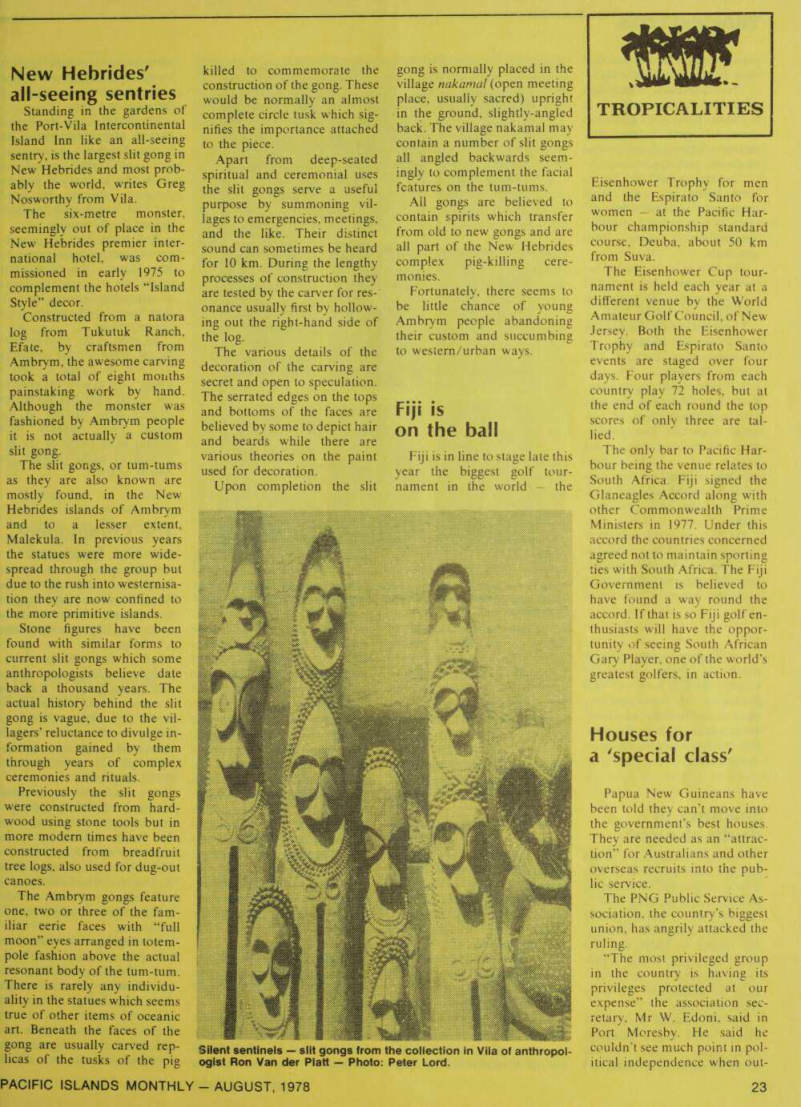
The Ambrym gongs feature one, two or three of the fam iliar eerie faces with “full moon” eyes arranged in totem pole fashion above the actual resonant body of the tum-tum.
There is rarely any individu ality in the statues which seems true of other items of oceanic art. Beneath the faces of the gong are usually carved rep licas of the tusks of the pig
killed to commemorate the construction of the gong. These would be normally an almost complete circle tusk which sig nifies the importance attached to the piece.
Apart from deep-seated spiritual and ceremonial uses the slit gongs serve a useful purpose by summoning vil
lages to emergencies, meetings,
and the like. Their distinct sound can sometimes be heard for 10 km. During the lengthy processes of construction they are tested by the carver for res onance usually first by hollow ing out the right-hand side of
the log.
The various details of the decoration of the carving are secret and open to speculation.
The serrated edges on the tops and bottoms of the faces are believed by some to depict hair and beards while there are various theories on the paint used for decoration.
Upon completion the slit
gong is normally placed in the
village nakamal (open meeting
place, usually sacred) upright
in the ground, slightly-angled
back. The village nakamal may contain a number of slit gongs all angled backwards seem ingly to complement the facial features on the tum-tums.
Ail gongs are believed to contain spirits which transfer from old to new gongs and are all part of the New Hebrides
complex pig-killing cere
monies.
Fortunately, there seems to be little chance of young
Ambrym people abandoning
their custom and succumbing to western/urban ways.
Fiji is
on the ball
Fiji is in line to stage late this year the biggest golf tour nament in the world the
Eisenhower Trophy for men and the Espirato Santo for women at the Pacific Har bour championship standard course, Deuba, about 50 km from Suva.
The Eisenhower Cup tour nament is held each year at a different venue by the World Amateur Golf Council, of New Jersey. Both the Eisenhower
Trophy and Espirato Santo
events are staged over four days. Four players from each country play 72 holes, but at the end of each round the top scores of only three are tal lied.
The only bar to Pacific Har bour being the venue relates to South Africa. Fiji signed the
Glaneagles Accord along with
other Commonwealth Prime Ministers in 1977. Under this accord the countries concerned agreed not to maintain sporting ties with South Africa. The Fiji Government is believed to have found a way round the accord. If that is so Fiji golf en thusiasts will have the oppor tunity of seeing South African Gary Player, one of the world’s greatest golfers, in action.
Houses for
a 'special class'
Papua New Guineans have been told they can’t move into the government’s best houses.
They are needed as an “attrac tion” for Australians and other overseas recruits into the pub lic service.
The PNG Public Service As
sociation, the country’s biggest
union, has angrily attacked the
ruling.
“The most privileged group in the country is having its
privileges protected at our
expense” the association sec retary, Mr W. Edoni, said in Port Moresby. He said he couldn’t see much point in pol itical independence when out
Silent sentinels slit gongs from the collection in Vila of anthropol ogist Ron Van der Platt- Photo: Peter Lord.
siders were given a better deal than Papua New Guineans.
The instruction which has angered the union was given in a Public Service Commission circular regarding the allo cation of government-owned houses to public servants.
The circular said that for the time being no more “high covenant reserved houses” were to be allocated to public servants who were PNG nationals.
The houses were needed for
public servants being recruited
from overseas to fill specialised positions, the circular said.
The main outside sources of
public service recruiting are
Australia, New Zealand, UK and the Philippines.
Mr Edoni said the govern ment was betraying its own people in the interests of “so called experts”. The govern ment didn’t mind that its own people had to live in sub standard houses or stay with relatives simply to make good housing available to out siders.
He claimed that Papua New Guineans were being treated as subordinate people because their government believed that outsiders were in a special class.
“People forget that these so called experts are already receiving four to five times as much pay as we get and pay ab solutely nothing for rent,” said Mr Edoni. “On top of that they have a multiplicity of allow ances which must make them the most privileged group in
the country.”
Shadows of
death at night
The road carnage in Fiji has reached such proportions that a Suva magistrate, Mr Kenneth Moore, when dealing with a case of a driver having caused
death by dangerous driving,
felt bound to speak out. He called for urgent action to pre vent a mountain of deaths cre ating a monument to Fiji’s reckless drivers.
Mr Moore said pedestrians should wear bright garments when they walked on the streets at night. Something had
to be done immediately to cut down the number of people being killed or injured in road accidents. Between January 1 and April 30 this year 683 drivers had been convicted of careless driving, 12 for having caused death by dangerous driving, and 46 for having driven while under the influ ence of alcohol or drugs.
This is what Mr Moore said: “If what is wanted is the cre ation of a monument to reck less, dangerous or careless drivers, or those under the in fluence of drink or drugs, by building a mountain of dead bodies or by filling the streets, towns and villages with maimed, broken and crippled men, women and children, then the position should be left as it is.
“If such a monument is not wanted then it is time some thing is done, apart from bring ing more offenders before the courts. A start could be made
by asking people who use the roads at night-time to wear white garments, or perhaps even a belt or sash of luminous or reflective material which will show up at night.
“Many people are just
shadows on the road at night.
Mrs Kamikamica (the driver charged) said she did not see the man she hit, even though he was standing on the road in front of her. If a driver loses concentration for an instant it can prove fatal, as it did in this case. There are too many road deaths in Fiji.
“This is a matter which re quires to be looked into now; not tomorrow or the next day or the day after that, but today and now.”
He directed the police pros ecutor to take the matter to his superiors so that they could act as soon as possible.
Just as Mr Moore was about to pass sentence in Mrs Kami kamica’s case, a 17-years-old canecutter died at Labasa
when he was knocked from his bicycle by a vehicle which first carried him for about 50 m and then ran over him.
Mr Moore found Mrs Kami kamica, who is president of the Fijian Teachers’ Association, guilty of having caused the death of a 35-year-old man by
dangerous driving. He fined
her $lOO and barred her from driving for 12 months.
And while they are launch ing the campaign suggested by Mr Moore, the authorities might like to consider a series of safety-first lectures for chil dren living in villages along the Queen’s Road.
As soon as the road is com pleted, some drivers are going to revel in trying to “do a tonne”. Up to now the state of the gravel road has prevented drivers from driving at top
speed and villagers have
always been aware of the ap proach of traffic through the clouds of dust.
The Commodore
on the Russians
“The super-power that styles itself the natural ally of the Third World and uses ‘support for national liberation’ as a cover is trying by every means to barge into the South Pacific,” said Chinese Vice- Premier Li Hsien-nien in his welcoming speech to Ratu Sir Kamisese Mara, Prime Minis ter of Fiji, during his visit to China in June. The remark prompted a walkout by Soviet bloc diplomats at the reception
(PIM, July, p 5).
A considerably more sober estimate of Soviet intentions and capacities for action in the South Pacific has been made by one of Australia’s top
military analysts, Commodore
K. D. Gray, who until recently was military adviser to Aus tralia’s Joint Intelligence Or
ganisation.
Writing in an Australian newspaper, Commodore Gray said: “To compensate for the
loss of fishing grounds through
the establishment of national resources zones, the Soviet Union will probably seek ad ditional fisheries agreements with Indian Ocean littoral and
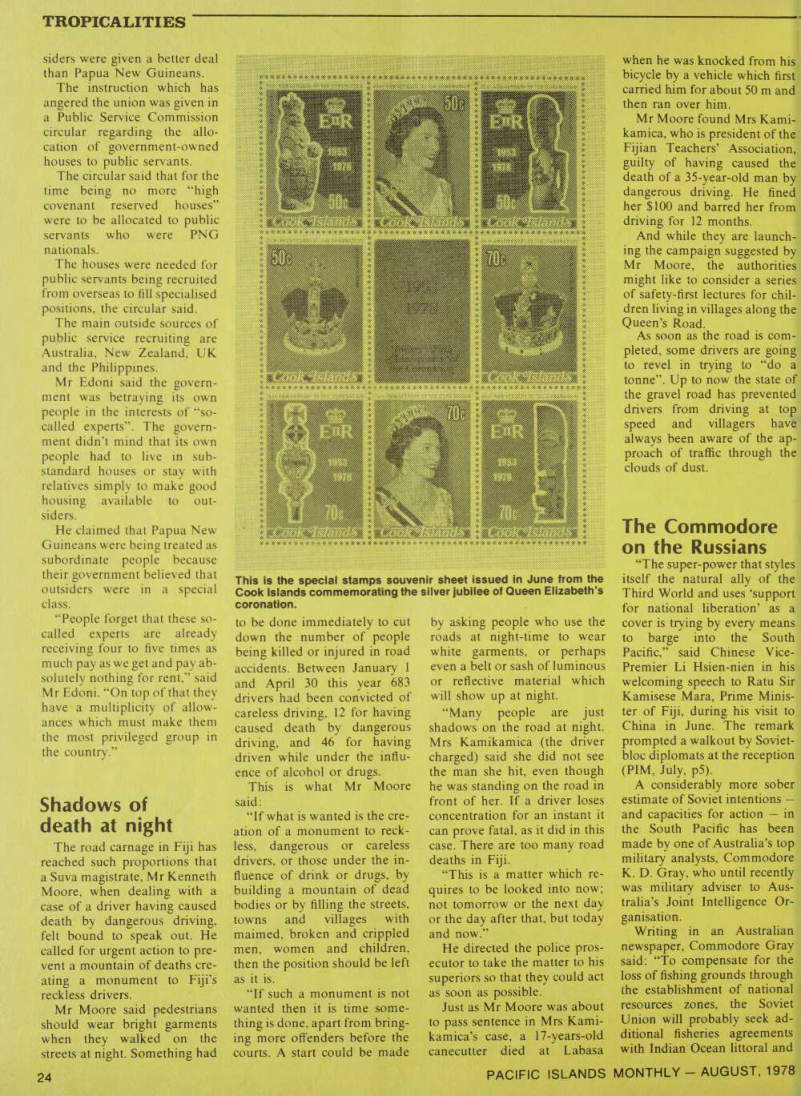
This is the special stamps souvenir sheet issued in June from the Cook Islands commemorating the silver jubilee of Queen Elizabeth’s coronation.
island states and perhaps with some Pacific Island states ...
“In areas of importance to Australia but with which it is only indirectly concerned stra tegically Middle East oil source areas for example, the western Indian Ocean and South Atlantic - the Soviet Union has a high capability for
projecting power.
“In areas of direct strategic concern to Australia such as the eastern Indian Ocean and South Pacific, the Soviet
Union’s capacity to project
power is greatly reduced. In the South Pacific, for example, it is difficult to see that the Soviet Union has any real strategic interests short of a situation of
global conflict.
“It is not likely to resort to force in this area unless major
political and strategic objec
tives emerge in the future which cannot be achieved in any other way. These seem un
likely.”
Writing from an Australian
viewpoint, Commodore Gray
concluded that “the develop ment of appropriate Australian military capacity, and the will to use it, combined with sen
sible regional policies, includ
ing those of aid, will tend further to inhibit Soviet ca pacity to intervene.”
The Senator said
a mouthful
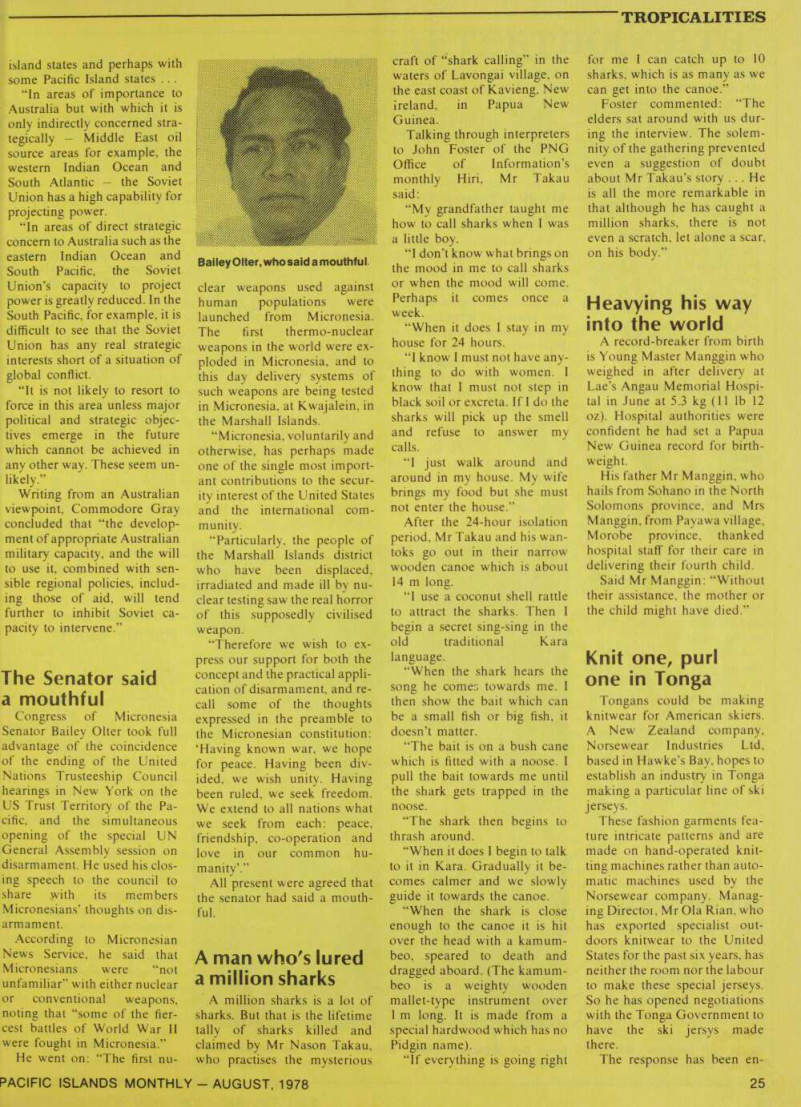
Congress of Micronesia Senator Bailey Offer took full advantage of the coincidence of the ending of the United Nations Trusteeship Council hearings in New York on the US Trust Territory of the Pa cific, and the simultaneous opening of the special UN General Assembly session on disarmament. He used his clos ing speech to the council to share yvith its members Micronesians’ thoughts on dis armament.
According to Micronesian News Service, he said that Micronesians were “not unfamiliar” with either nuclear or conventional weapons, noting that “some of the fier cest battles of World War II were fought in Micronesia.”
He went on: “The first nu-
clear weapons used against human populations were launched from Micronesia.
The first thermo-nuclear weapons in the world were ex ploded in Micronesia, and to this day delivery systems of such weapons are being tested in Micronesia, at Kwajalein, in the Marshall Islands.
“Micronesia, voluntarily and otherwise, has perhaps made one of the single most import ant contributions to the secur ity interest of the United States and the international com
munity.
“Particularly, the people of
the Marshall Islands district who have been displaced, irradiated and made ill by nu clear testing saw the real horror of this supposedly civilised weapon.
“Therefore we wish to ex press our support for both the concept and the practical appli cation of disarmament, and re call some of the thoughts expressed in the preamble to the Micronesian constitution: ‘Having known war, we hope for peace. Having been div ided, we wish unity. Having been ruled, we seek freedom.
We extend to all nations what we seek from each: peace,
friendship, co-operation and
love in our common hu
manity’.”
All present were agreed that the senator had said a mouth ful.
A man who's lured
a million sharks
A million sharks is a lot of sharks. But that is the lifetime tally of sharks killed and claimed by Mr Nason Takau, who practises the mysterious
craft of “shark calling” in the waters of Lavongai village, on the east coast of Kavieng, New Ireland, in Papua New Guinea.
Talking through interpreters
to John Foster of the PNG Office of Information’s monthly Hiri, Mr Takau said:
“My grandfather taught me
how to call sharks when I was a little boy.
“I don’t know what brings on the mood in me to call sharks or when the mood will come.
Perhaps it comes once a week.
“When it does I stay in my house for 24 hours.
“I know I must not have any thing to do with women. I know that I must not step in black soil or excreta. If I do the sharks will pick up the smell and refuse to answer my calls.
“I just walk around and around in my house. My wife brings my food but she must not enter the house.”
After the 24-hour isolation period, Mr Takau and his wan toks go out in their narrow wooden canoe which is about 14 m long.
“I use a coconut shell rattle to attract the sharks. Then I begin a secret sing-sing in the old traditional Kara
language.
“When the shark hears the song he comes towards me. I then show the bait which can be a small fish or big fish, it doesn’t matter.
“The bait is on a bush cane which is fitted with a noose. I pull the bait towards me until the shark gets trapped in the noose.
“The shark then begins to thrash around.
“When it does I begin to talk to it in Kara. Gradually it be comes calmer and we slowly guide it towards the canoe.
“When the shark is close enough to the canoe it is hit over the head with a kamum beo, speared to death and dragged aboard. (The kamum beo is a weighty wooden mallet-type instrument over 1 m long. It is made from a special hardwood which has no
Pidgin name).
“If everything is going right
for me I can catch up to 10 sharks, which is as many as we can get into the canoe.”
Foster commented: “The elders sat around with us dur ing the interview. The solem
nity of the gathering prevented
even a suggestion of doubt about Mr Takau’s story ... He is all the more remarkable in that although he has caught a million sharks, there is not even a scratch, let alone a scar, on his body.”
Heavying his way
into the world
A record-breaker from birth is Young Master Manggin who weighed in after delivery at Lae’s Angau Memorial Hospi tal in June at 5.3 kg (11 lb 12 oz). Hospital authorities were confident he had set a Papua New Guinea record for birth
weight.
His father Mr Manggin, who hails from Sohano in the North Solomons province, and Mrs
Manggin, from Payawa village,
Morobe province, thanked hospital staff for their care in delivering their fourth child.
Said Mr Manggin: “Without their assistance, the mother or the child might have died.”
Knit one, purl
one in Tonga
Tongans could be making
knitwear for American skiers.
A New Zealand company, Norsewear Industries Ltd, based in Hawke’s Bay, hopes to establish an industry in Tonga making a particular line of ski
jerseys.
These fashion garments fea ture intricate patterns and are made on hand-operated knit ting machines rather than auto matic machines used by the Norsewear company. Manag ing Directoi, Mr Ola Rian, who
has exported specialist out
doors knitwear to the United States for the past six years, has neither the room nor the labour to make these special jerseys.
So he has opened negotiations with the Tonga Government to have the ski jersys made there.
The response has been en
Bailey Olter, who said a mouthful
thusiaslic. “It only remains for agreement to be reached with the airlines serving Tonga on the question of freight con cessions and we will be in business,” he said.
Tongan government officials have visited Mr Rian’s plant to see what is required for the island factory which will oper ate from an industrial centre in
Tonga.
Norsewear will supply the knitting machines and one of his managers will train Tongan staff to operate them. Norse wear was established 10 years ago as a cottage industry and now has an annual turnover of more than $2 million.
Marx's disciples
in Morobe
A new party, the Melanesian
People’s Party, has been
formed in Papua New Guinea’s Morobe Province.
Based on research work said to have lasted three years, the party is made up of Papua New Guineans who have come to believe in socialism.
They say it is based on collective ideas from scientific socialism as developed by Karl Marx, democratic ideologies, and Melanesian culture, which is also socialistic.
As reported in Hailans Nius, the party in its priorities aims to equalise the present in equality in economic standards and to eliminate the classifi cation of human beings that
accompanies capitalism.
The party has already been registered and the platform has been laid down, according to the party’s secretary. It is said to receive its support from the East New Britain province and
its province of origin
Morobe.
PNG artifacts as
Kina-spinners
The government-approved
export of artifacts is proving a profitable business for Papua New Guinea.
Taking February 1978 as a sample month, an official news release says that K 24 227worth of artifacts left the country in that period.
Australia was the biggest re ceiver, with Kl 3 777-worth, followed by the United States with K 8 478.
Smaller quantities went to buyers in the Netherlands, Japan and Canada.
Shell scheme for
scholarships
The Shell Co, to mark 50 years of doing business in Fiji, has not only put out a hand some commemorative publi cation, it is also sponsoring 15 new secondary school scholar ships for students resident in
Fiji.
The first 15 students are expected to study for four years and to take themselves to university entrance standard.
They will then be replaced by another 15 students.
Priority will be given to students from outer islands, or isolated inlands areas where a high school education is not
readily available.
'Snail Day'
in Port Vila
For the second year in suc cession the Kiwanis Club of Port Vila recently held their “Snail Day” to help ease the Great African Snail {Achatma fulica) problem in and around Port Vila.
Originally from Eastern Africa the snails were introduced to the Pacific by the Japanese in World War Two as a food source. They have be come a widespread pest since then and arrived in the New Hebrides in early 1973 with a ship-load of timber. The prob lem has now grown to unman
ageable proportions despite the
introduction of predator snails and the availability of
poisons.
The Snail Day was organised by the Kiwanis in 1977 after discussions with the Con
dominium Agriculture Depart
ment and requests from concerned residents. The volunteer collectors, vying for various prizes, last year col-
lected 30 tonnes. This year’s catch was 25 tonnes which was well above expectations.
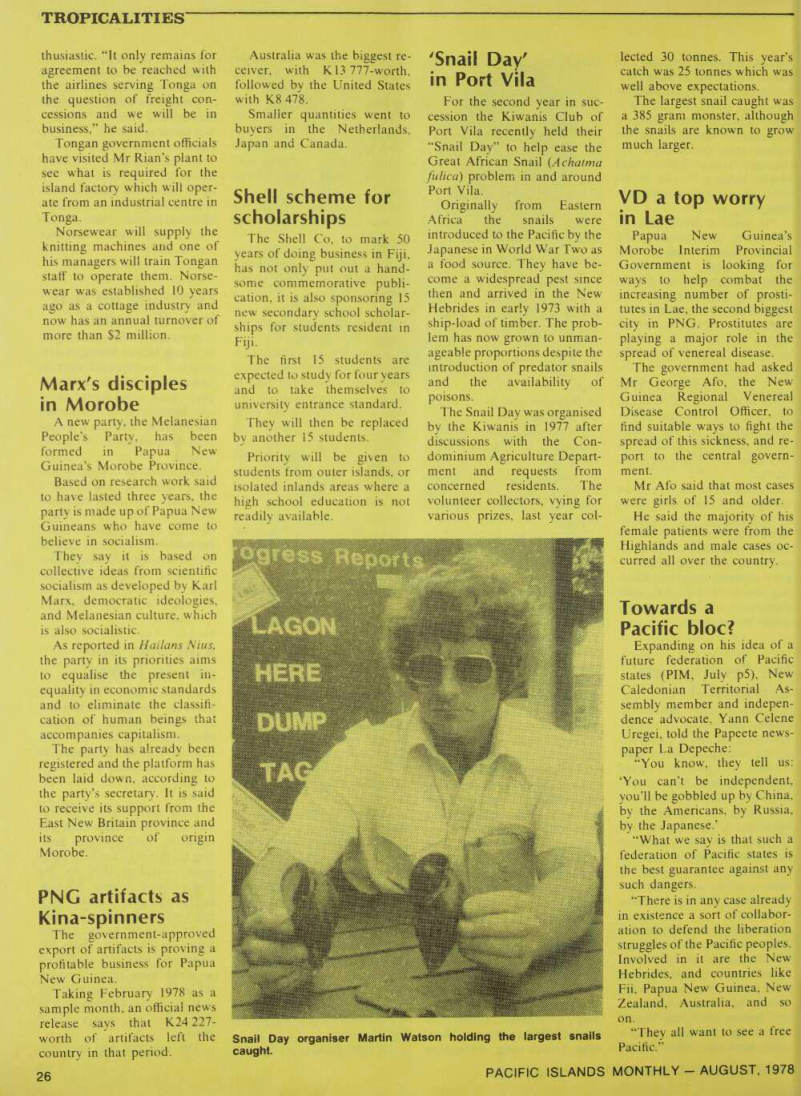
The largest snail caught was a 385 gram monster, although the snails are known to grow
much larger.
VD a top worry
in Lae
Papua New Guinea’s Morobe Interim Provincial Government is looking for ways to help combat the
increasing number of prosti
tutes in Lae, the second biggest city in PNG. Prostitutes are playing a major role in the spread of venereal disease.
The government had asked Mr George Afo, the New Guinea Regional Venereal Disease Control Officer, to find suitable ways to fight the spread of this sickness, and re port to the central govern ment.
Mr Afo said that most cases were girls of 15 and older.
He said the majority of his female patients were from the Highlands and male cases oc curred all over the country.
Towards a
Pacific bloc?
Expanding on his idea of a future federation of Pacific states (PIM, July p 5), New Caledonian Territorial As
sembly member and indepen
dence advocate, Yann Celene Uregei, told the Papeete news paper La Depeche: “You know, they tell us: ‘You can’t be independent,
you’ll be gobbled up by China,
by the Americans, by Russia,
by the Japanese.’
“What we say is that such a federation of Pacific states is the best guarantee against any
such dangers.
“There is in any case already in existence a sort of collabor ation to defend the liberation struggles of the Pacific peoples.
Involved in it are the New Hebrides, and countries like Fii, Papua New Guinea, New Zealand, Australia, and so on.
“They all want to see a free Pacific.”
Snail Day organiser Martin Watson holding the largest snails caught.