Sir Albert
pp. 17-19 · Read in the full issue
in a coner
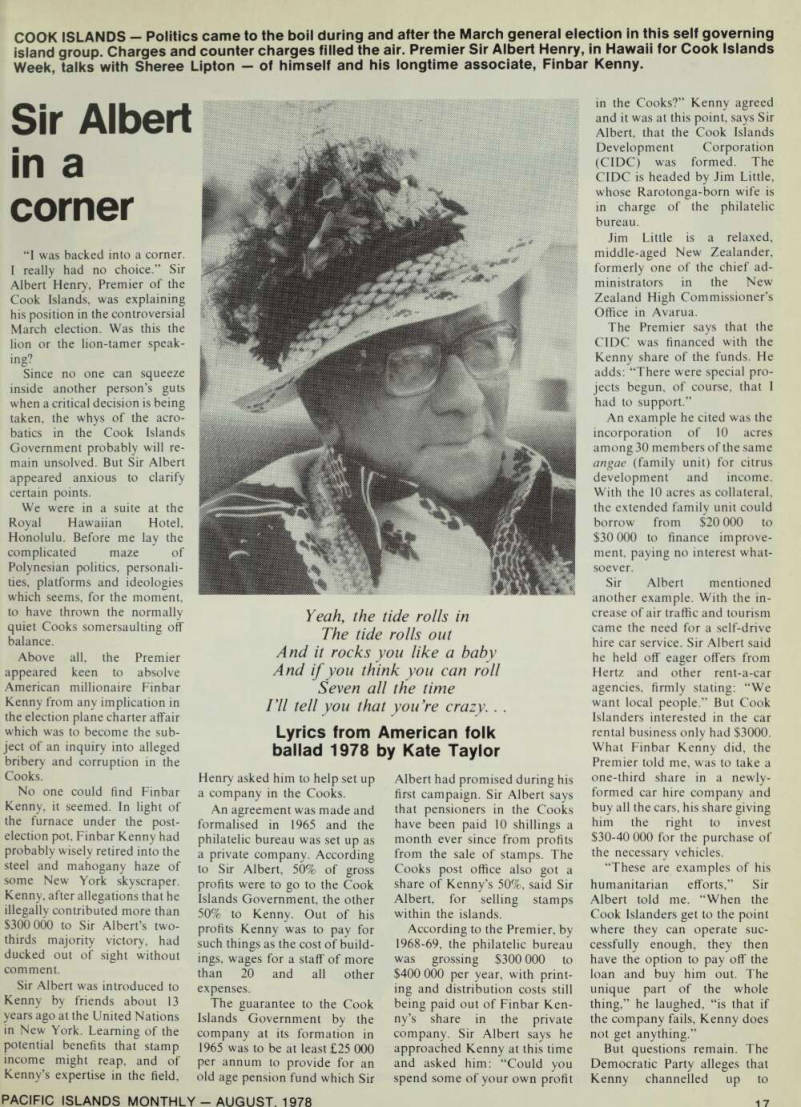
COOK ISLANDS Politics came to the boil during and after the March general election in this self governing island group. Charges and counter charges filled the air. Premier Sir Albert Henry, in Hawaii for Cook Islands Week, talks with Sheree Lipton of himself and his longtime associate, Finbar Kenny.
“I was backed into a comer.
I really had no choice.” Sir Albert Henry, Premier of the Cook Islands, was explaining his position in the controversial March election. Was this the lion or the lion-tamer speak
ing?
Since no one can squeeze inside another person’s guts when a critical decision is being taken, the whys of the acro batics in the Cook Islands Government probably will re main unsolved. But Sir Albert
appeared anxious to clarify
certain points.
We were in a suite at the Royal Hawaiian Hotel, Honolulu. Before me lay the complicated maze of
Polynesian politics, personali
ties, platforms and ideologies
which seems, for the moment, to have thrown the normally
quiet Cooks somersaulting off
balance.
Above all, the Premier appeared keen to absolve American millionaire Finbar Kenny from any implication in the election plane charter affair which was to become the sub
ject of an inquiry into alleged
bribery and corruption in the Cooks.
No one could find Finbar Kenny, it seemed. In light of the furnace under the post election pot, Finbar Kenny had probably wisely retired into the steel and mahogany haze of some New York skyscraper.
Kenny, after allegations that he illegally contributed more than $3OO 000 to Sir Albert’s two
thirds majority victory, had
ducked out of sight without comment.
Sir Albert was introduced to Kenny by friends about 13 years ago at the United Nations in New York. Learning of the potential benefits that stamp income might reap, and of Kenny’s expertise in the field,
Henry asked him to help set up a company in the Cooks.
An agreement was made and formalised in 1965 and the philatelic bureau was set up as
a private company. According
to Sir Albert, 50% of gross profits were to go to the Cook Islands Government, the other 50% to Kenny. Out of his profits Kenny was to pay for such things as the cost of build ings, wages for a staff of more than 20 and all other expenses.
The guarantee to the Cook Islands Government by the company at its formation in 1965 was to be at least £25 000 per annum to provide for an old age pension fund which Sir
Albert had promised during his first campaign. Sir Albert says that pensioners in the Cooks have been paid 10 shillings a month ever since from profits from the sale of stamps. The Cooks post office also got a share of Kenny’s 50%, said Sir Albert, for selling stamps within the islands.
According to the Premier, by 1968-69, the philatelic bureau was grossing $3OO 000 to $4OO 000 per year, with print ing and distribution costs still being paid out of Finbar Ken ny’s share in the private company. Sir Albert says he approached Kenny at this time and asked him: “Could you spend some of your own profit
in the Cooks?” Kenny agreed and it was at this point, says Sir Albert, that the Cook Islands
Development Corporation
(CIDC) was formed. The CIDC is headed by Jim Little, whose Rarotonga-born wife is in charge of the philatelic bureau.
Jim Little is a relaxed, middle-aged New Zealander, formerly one of the chief ad ministrators in the New Zealand High Commissioner’s Office in Avarua.
The Premier says that the CIDC was financed with the Kenny share of the funds. He adds: “There were special pro jects begun, of course, that I had to support.”
An example he cited was the incorporation of 10 acres among 30 members of the same angae (family unit) for citrus development and income.
With the 10 acres as collateral, the extended family unit could borrow from $2O 000 to $3O 000 to finance improve ment, paying no interest what soever.
Sir Albert mentioned another example. With the in crease of air traffic and tourism came the need for a self-drive hire car service. Sir Albert said he held off eager offers from Hertz and other rent-a-car
agencies, firmly stating: “We
want local people.” But Cook Islanders interested in the car rental business only had $3OOO.
What Finbar Kenny did, the Premier told me, was to take a one-third share in a newly formed car hire company and buy all the cars, his share giving him the right to invest $3O-40 000 for the purchase of the necessary vehicles.
“These are examples of his humanitarian efforts,” Sir Albert told me. “When the Cook Islanders get to the point where they can operate suc
cessfully enough, they then
have the option to pay off the loan and buy him out. The unique part of the whole thing,” he laughed, “is that if the company fails, Kenny does not get anything.”
But questions remain. The Democratic Party alleges that Kenny channelled up to
Yeah, the tide rolls in The tide rolls out And it rocks you like a baby And if you think you can roll Seven all the time Til tell you that you ’re crazy.. .
Lyrics from American folk ballad 1978 by Kate Taylor
$350 000 through a company that was set up to help Sir Albert fly in his voters. While the way in which the money as pect was managed remains unclear, Sir Albert kept no secrets about the fly-in voters nor did the opposing Demo crats.
About 800 Cook Islands Party (CIP) voters flew in from Auckland on chartered Ansett
jets accompanied by national
television and press people, wondrous at the local colour
and extraordinary voting sys
tem. The returnees were escorted to makeshift booths set up right at the airport ter minal. Then after voting, they were greeted with cheers and ebullience by relatives, fragrant flower eVs and a Polynesian umukai which in cluded sweet oranges, bananas,
poke (pudding), mitiore (coco
nut) and fish.
Democratic Party voters flew in on a chartered Air Nauru 727, more modest in number.
But they were greeted with the same enthusiasm.
However much ah of this may have contributed to his
victory. Sir Albert apparently
wants no more of this type of fly-in voting system in the
Cooks. He passed legislation
against it almost immediately
after taking office. Though he felt, as he stated, “backed into a corner” to fly in his voters, as the Democrats had done back in 1974 and again this year, he apparently is unhappy with the system.
“I want to prove that fly-by night-voters will not, in the long run, be good for the future stability of our country. Take the Cook Islander in New Zealand, for instance. He has his life and interests 10 years away from Rarotonga.” Sir Albert wrinkled his nose.
“How can he decide what is right for the country? The one who is digging his hand into the dirt of his country,” he went on philosophically, “he has the right to decide!”
Now the law is considerably changed. After the election he whisked Parliament into session and changed the elec toral act so that only residents may vote. If other Cook Islanders wish to vote and have been residing outside of the Cooks for one year or more they must return home for a
three-month period prior to
election. “This way,” Sir Albert smiled, “you can really see if the government is doing any good or not! After all, how would we run our country if we had the majority of voters as non-residents?” (Current fig ures show that about 9000 eli gible voters live in Rarotonga and outer islands. Eleven thou sand Cook Islanders live in New Zealand or elsewhere overseas.)
Other legislative changes by
Sir Albert since he took his new oath of office include controls for lawyers (Lawyers Practices Act), retroactive to April 1, 1978. It requires stricter super vision of solicitors in the Cooks and is designed to ensure that certain ethical standards are
upheld. Immigration laws also
have been made tougher.
So, who then is Sir Albert?
Prince or frog? Saint or sinner?
Father of his country or, as one prominent Cook Islander suc cinctly phrased it, “a Benevol ent Cobra”. Tough and ballsy, or gentle and caring? Or could it be a combined tapestry of all these components that lend the man the dynamism he so pro
foundly possesses?
Because of alleged illegali
ties on the validity of fly-in voters, court proceedings in New Zealand and Rarotonga have intensified the drama.
One would speculate that the Cook Islanders are rather enjoying the stimulus and
complexities of this fascinating
‘whodunit’. There is, in any case, no longer excessive public credulity lent to anyone and this may be a good thing.
The outcome may be de cided from a legal viewpoint even before this article is pub lished. But it is likely that the controversy of the players and their varying roles in the drama will be carried down through the next several centuries in the sleepy Cooks, much like the oral genealogies of their ances tors.
Surely, one of the emotions that Sir Albert feels at present is a sense of betrayal amongst the bedlam. Some of the fledgeling chicks he helped to raise not only have left his side, but moved against him like Doctor Joe Williams, former minister of health and Sir
Albert’s personal physician.
Williams is now the leader of
his own Unity Party which, while it did not fare well in the March 1978 elections, never theless managed to make its
opinions and platforms known
to the voters.
And, aside from internal dis sension, Sir Albert feels rather strongly that much of the prob lem comes from what he labels ‘a copied influence’. A few weeks after the March 30 vic tory, Sir Albert returned one night from New Zealand to be
greeted not only by traditional
kudos and ei katus but by some young members of the Demo cratic Party. Smiling for the cameras but apparently not so friendly toward Sir Albert Henry, the opposition waved
large placards proclaiming
‘Corruption! Injustice! Per
secution!’, and compared the Premier with Idi Amin.
The warrior, now 73, looked tired and sad. He had been in Hawaii for a week to escape from some of the pressures, to celebrate the now annual Cook Islands Week in Hawaii, but he had hardly left the hotel room.
We talked about his almost fatal heart attack back in 1974 when he fooled the grave-faced doctors in Rotorua who only gave him four days to live.
“And,” I asked, “if the doc tors told you now the stress was life-threatening, would you stop?” “No,” he shouted, “if I retire now, I’ll get old. I’ll stay to the end of all this and
fight!”
Mra Poses Challenge
To Australia
Three hundred and fifty people from 26 countries at tended the International Con ference for the Pacific-Asian region called recently in Brisbane, Queensland, by the Moral Rearmament move ment.
Among Island countries represented were Papua New Guinea, Fiji, Western Samoa, New Caledonia and Tonga.
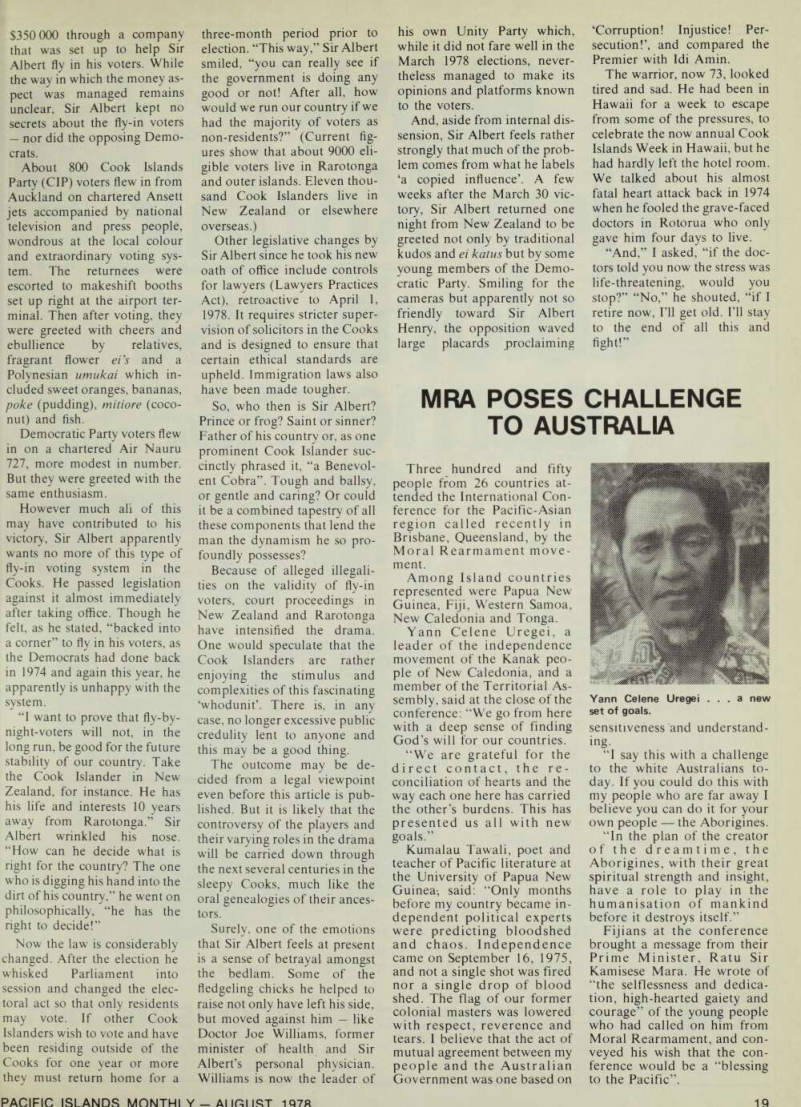
Yann Celene Uregei, a leader of the independence movement of the Kanak peo ple of New Caledonia, and a member of the Territorial As sembly, said at the close of the conference: “We go from here with a deep sense of finding God’s will for our countries.
“We are grateful for the direct contact, the re conciliation of hearts and the way each one here has carried the other’s burdens. This has presented us all with new goals.”
Kumalau Tawali, poet and teacher of Pacific literature at the University of Papua New Guinea-, said; “Only months before my country became in dependent political experts were predicting bloodshed and chaos. Independence came on September 16, 1975, and not a single shot was fired nor a single drop of blood shed. The flag of our former colonial masters was lowered with respect, reverence and tears. I believe that the act of mutual agreement between my people and the Australian Government was one based on
sensitiveness and understand ing.
“I say this with a challenge to the white Australians to day. If you could do this with my people who are far away I believe you can do it for your own people the Aborigines.
“In the plan of the creator of the dreamtime, the Aborigines, with their great spiritual strength and insight, have a role to play in the humanisation of mankind before it destroys itself.”
Fijians at the conference brought a message from their Prime Minister, Ratu Sir Kamisese Mara. He wrote of “the selflessness and dedica tion, high-hearted gaiety and courage” of the young people who had called on him from Moral Rearmament, and con veyed his wish that the con ference would be a “blessing to the Pacific”.
Yann Celene Uregei... a new set of goals.