Polynesia’S Third Sex: The Gay
pp. 10-13 · Read in the full issue
Life Starts In The Kitchen
They are called ‘Mahu’ in French Polynesia, ‘Fakaleitis’ in Tonga and 'Fa’a Fafines’ in the Samoas They are the true transvestites, the Third Sex of Polynesia, with a life-style which, in the case of the Samoans, has been thrust upon them from birth through custom. PIM prints their story, not as a sideways glance at a situation which has been the butt of comedians for years, but as a serious study of a phase of life in the Islands, Flusband and wife authors Bengt and Marie Therese Danielsson in Tahiti write about the Mahu, Robin Pierson tells the Samoans’ story and a Tonga correspondent brings out both the sad and the glad side of the Third Sex.
In Tahiti
Ever since its discovery Tahiti has enjoyed a world wide reputation for being the Island of Love, and the earliest European visitors all describe in the most glowing terms the islanders’ untram meled promiscuity, their un ashamed public intercourses and their artful strip-tease shows. Another amusing
example of this general permis
siveness was recorded in 1789
by Lieutenant George Mor
timer of the British ship Mer cury which, on her way to the American Northwest coast to engage in the fur trade, made a short call at Tahiti.
As Mortimer himself tells the story, during a heiva show, one of the mates, “took it into his head to be very much smit ten with a dancing girl, went up to her, made her a present of some beads and other trifles, and rather interrupted the per formance by his attentions. But what was his surprise, when the performance was ended, and after he had been endeavour ing to persuade her to go with him on board our ship, which she consented to, to find that this supposed damsel, when stripped of her theatrical para phernalia, was a smart, dapper lad! The Otaheiteans on their part enjoyed the mistake so much that they followed us to the beach with shouts and re
peated peals of laughter”.
This anecdote from Mor timer’s Observations and Re marks made during a Voyage to the Islands, which appeared in 1791, is the first published account we have of a Tahitian mahu transvestite.
Shortly afterwards a group of ministers and brethren from the London Missionary Society
arrived on the scene and suc
ceeded gradually in converting
the Tahitians to their puritan and sectarian form of the Prot estant faith.
Yet today, 180 years later, in spite of all the attempts made by the church and civilian authorities to stamp out all the
obscene and lascivious prac tices that delighted the early navigators, the mahu is still a popular and honoured mem ber of every village throughout the Society Islands. Similar comedies of error where love’s labour is definitely lost are also constantly being re
enacted, and produce always bursts of laughter among the Tahitian spectators.
Under other names, true transvestites have existed from immemorial times in most other Polynesian islands. The most complete and detailed coverage of this fascinating subject can be found in a book which we wrote in the early 1950 s and which has often been reprinted since then Love in the South Seas.
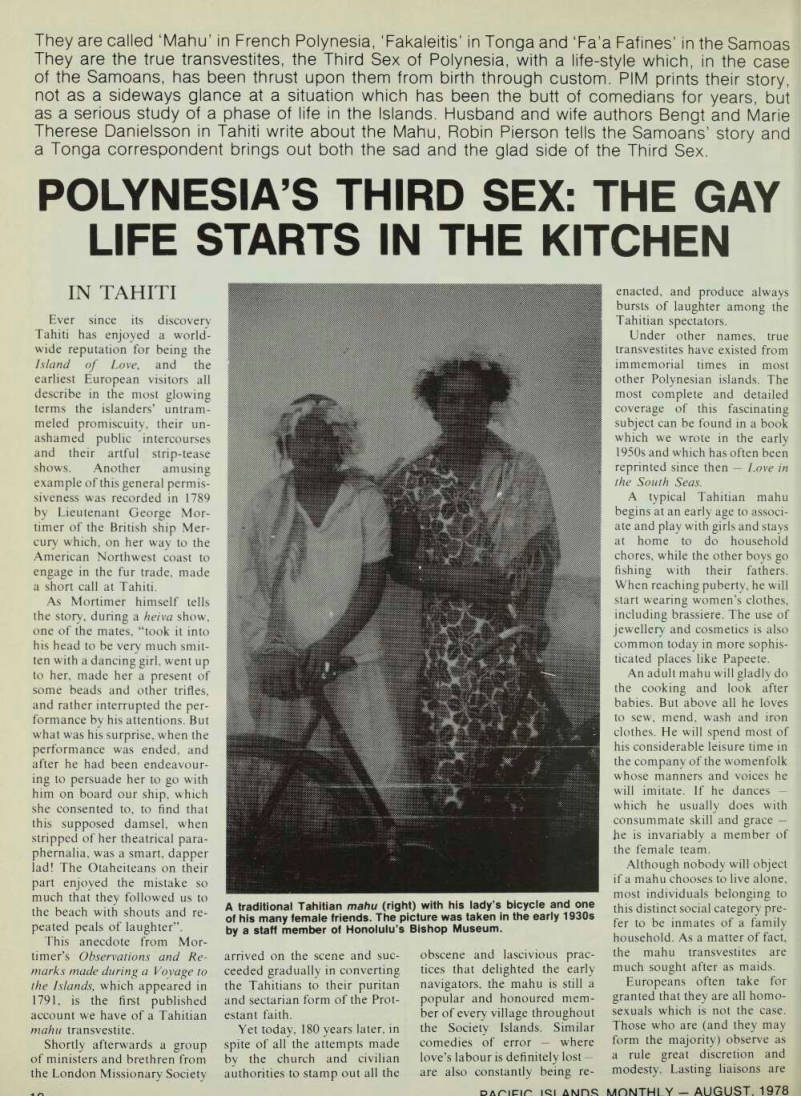
A typical Tahitian mahu begins at an early age to associ ate and play with girls and stays at home to do household chores, while the other boys go fishing with their fathers.
When reaching puberty, he will start wearing women’s clothes, including brassiere. The use of jewellery and cosmetics is also common today in more sophis
ticated places like Papeete.
An adult mahu will gladly do the cooking and look after babies. But above all he loves to sew, mend, wash and iron clothes. He will spend most of his considerable leisure time in the company of the womenfolk whose manners and voices he will imitate. If he dances which he usually does with consummate skill and grace he is invariably a member of the female team.
Although nobody will object
if a mahu chooses to live alone, most individuals belonging to this distinct social category pre fer to be inmates of a family household. As a matter of fact, the mahu transvestites are much sought after as maids.
Europeans often take for granted that they are all homo sexuals which is not the case.
Those who are (and they may form the majority) observe as a rule great discretion and modesty. Lasting liaisons are
A traditional Tahitian mahu (right) with his lady’s bicycle and one of his many female friends. The picture was taken in the early 1930s by a staff member of Honolulu’s Bishop Museum.
rare and the most common pat tern for a mahu is to have occasional, furtive contacts, usually with adolescents still at
an experimenting, exploratory
stage of their sexual develop ment.
This leaves, however, a small number of mahu transvestites who must be described as indif ferent or asexual. Bisexual individuals are not totally un known, and some have even sired children, but all available evidence indicates that such blatantly heterosexual behav iour represents only short epi sodes in their lives.
In sharp contrast to the basi
cally negative attitude towards
homosexuals in our Western societies, the individuals in Polynesia who follow the tra ditional mahu way of life are not only tolerated but meet
with general approval and
praise. We can even go one step farther and say that there exists a definite social pressure to produce individuals with this deviant behaviour.
However, a very important point here which should be bom in mind is that there must never be more than one mahu in each village or community.
This unwritten law, as well as the fact that a new mahu will always emerge in the case of a vacancy due to death or depar ture, show even more clearly that we have to do with a socio logical and not a biological
phenomenon.
How it all started, we shall, of course, never learn, since there are no scientifically-valid
traditions or legends, explain
ing the origin of this time honoured institution. The only thing we can do, therefore, is to speculate about its possible
psychological significance and
social implications. The best hypothesis will be found in Professor Robert L. Levy’s excellent study Tahitians, Mind and Experience in the Society
Islands (University of Chicago
Press, 1973), based on several years of intensive field work in Tahiti and Huahine, carried out in the native language.
His conclusions are briefly that the Polynesians, like all other peoples, need models and that a mahu is a sort of
negative image that helps the
boys to become men, or real males, by showing them in a
particularly striking manner
the sex role which they must not choose.
Although the venerable mahu institution survived for almost 200 years, in spite of the constant ppprobrium of all church and government digni taries, there are now many signs that it will eventually disappear as a result of the brutal modernisation process also called “progress” to which Tahiti and the other So ciety Islands have been exposed during the last 15 years, or so. What is happen ing, ironically enough, is that the rising tide of Western type homosexual prostitution is rap
idly engulfing the native style
mahu transvestites. Like thou sands of other Polynesians they have migrated to the Sodom and Gomorra called Papeete, where they are all bewildered and lost, since the French laws and European customs which prevail there are utterly incom
prehensible. Having no other
means of making a living in this new harsh environment, the mahu transvestites sooner or later resort to the expediency of selling their favours to the numerous foreign homosexual tourists.
Several bars and night clubs now openly cater to this special category for which the special word raerae has been coined even to the point of
organising beauty contests for
the title of Miss Tane, or Miss Male. The ultimate stage in this westernisation of the Tahitian sexual customs is the recent emergence of lesbian prosti tutes whose behaviour all real mahu transvestites, of course, disapprove of as being defi
nitely abnormal . . .
In Samoa
Mention the words fa’a fafine, and most Samoans giggle. Ask them what the words mean, and they’ll tell you, “like a lady, you know, 50-50”. Many think this defi nition is sufficient in explain ing the large fellows who speak so sweetly, dress so finely, and carry a purse, but it doesn’t, not quite. For the Third Sex in Samoa is unique fa’a fafines don’t choose to be gay, they are raised that way.
It so happens, that the chil dren of Samoa are their famil ies’ work force, and a
continuous stream of tasks are bestowed upon them from the time they cease being babies, until they have children of their own.
Boys and girls tasks are
segregated, integrating chil
dren into an accepted role within their community and family at an early age. Oc casionally, a family may have an abundance of male chil dren. which means there is a disparity in the work-load, and, basically, that the woman of the household needs more
help.
At times like this, Samoan parents often find that little
boys can do girls’ work quite
adequately, hence, the prob
lem is solved the labour re mains equally distributed, and most importantly, it gets done.
So the young boys grow up doing women’s work, associat
ing primarily with women,
therefore picking up feminine mannerisms and traits, and
gradually they develop into
fa’a fafines - like a lady, while at the same time, being very different from a lady.
Yet, an effeminate young man, who reaches maturity
wearing women’s clothing, is
often disconcerting to the male members of his family, to the village priests he is sinful, and it is usually the school authori ties who exert pressure on the individual to tone down his
style while attending high
school. But having been raised as a woman from day one onward, the individual’s ident ity is established, and a tran sition at this stage would be
difficult to make. Besides, re gardless of the changes the young man may make out wardly or inwardly, he has already been labelled as a fa’a fafine, making it extremely dif ficult to be anyone else in the eyes of his community and family. So, even though pres sured during adolescence, most fa’a fafines continue to emerge and grow into the role they have been placed in. In other words, the fa’a fafine traits in most of these individuals do not die, but rather come into full bloom.
Many of the fa’a fafines of Samoa have lived, attended school or have been employed in the United States, and the general consensus is that it’s a lot easier to be a fa’a fafine in Samoa. The practice of raising a boy child as a girl is accepted in Samoa and generally the end product is accepted also, as long as the individual isn’t too blatant about it. But many are
blatant. Feeling quite comfort
able masquerading as women, and doing remarkably well at
it, they’re bucking powerful
family and societal pressures, which is something that not many Samoans have the cour age to do.
Others, who hold high pos itions within the community, have acquired a subdued fa’a fafine-type appearance, mak ing them more acceptable to the general populus. Yet even these people will most prob ably stay within their role as fa’a fafines for the rest of their lives, for as with many things on the island, everyone knows
your background, making it
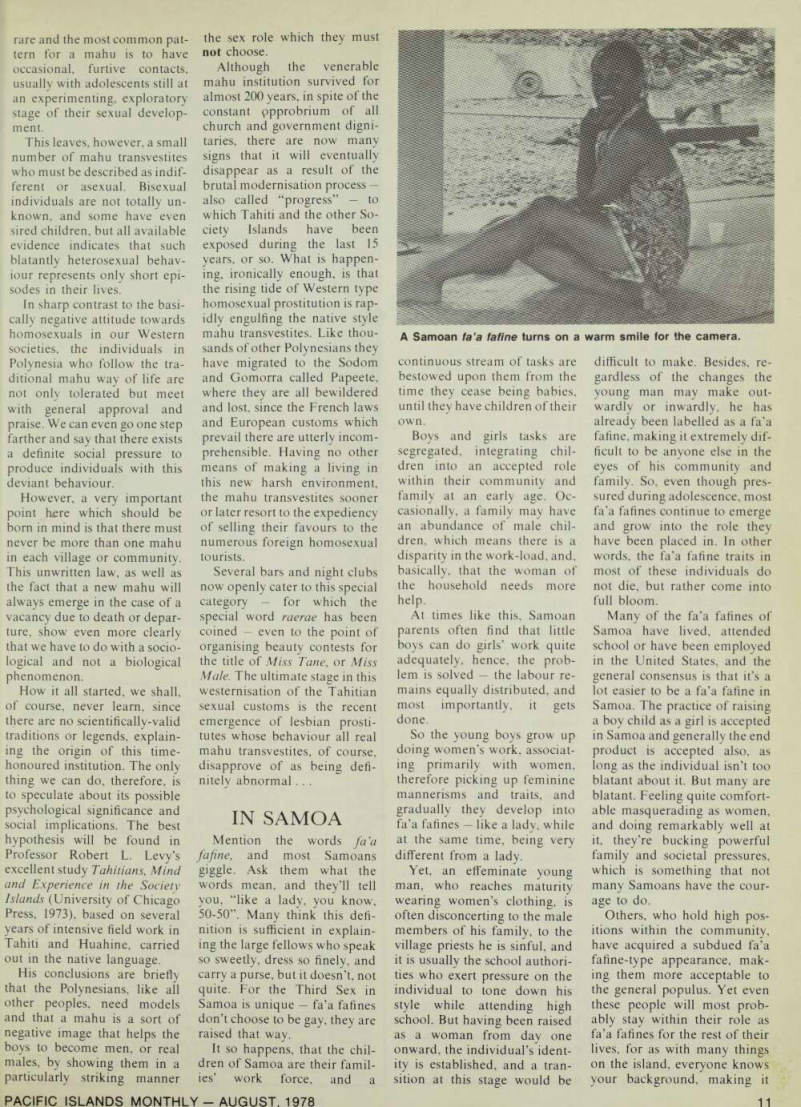
A Samoan fa’a fafine turns on a warm smile for the camera.
difficult to change, but accept able to remain as you are.
Each Sunday afternoon, a
unique gathering takes place in
downtown Fagatongo in American Samoa. Super ficially, the scene is that of a small club meeting. The min utes from last week’s meeting are read, donations to the club’s treasury are com mended, and new fund-raising projects are discussed. Some of the group’s members are extravagantly dressed for this informal gathering. Some sport
immaculately-groomed coif
fures, heavy makeup and long
gowns, while others are more casual in lava-lavas tied dis creetly above the chest. Sitting close to one of the more elegant individuals, a small hint of a heavy beard becomes appar ent. The laughter that ema nates from the group comes in
giggles deep throated and
husky, yet giggles just the same.
It’s the weekly meeting of the Tamua Stars, American Samoa’s first and only fa’a
fafine organisation.
The group represents the emergence of individual fa’a fafines who have accepted their unique roles and are striving to strengthen their own self image within that role. They gather together to share their problems, their joys and to counsel others, especially younger fa’a fafines to make their unique path a smoother one.
In June, the Tamua Stars of American Samoa, along with The My Girls, the fa’a fafine or ganisation of Western Samoa, was to host the fa’a fafines of New Zealand for a gala, including a beauty contest, a fashion show, and an array of sports competitions. At a simi lar event last Christmas, the New Zealanders shone the
brightest, but they probably
found a bit of competition this year from the lovelies of American and Western Samoa.
Generally, the island’s fa’a fafines are considered respon sible and efficient employees and students, and having no sexual interest in women or their fellow fa’a fafines, they seldom marry, but instead pro vide intimate diversity for some Samoan males.
Though not readily nor
openly discussed, the original
function of the village fa’a fafines was to introduce young men into the art of love
making. Though this practice
seems to have rapidly diminished, the fa’a fafines are still a source of pleasure in the
Samoan society.
They see themselves as ve hicles of happiness and good
feelings which they endeavour
to share with others. To many it may seem that these men have been dealt an unfair hand
by their family and society, but
even a bad hand can result in an enjoyable game if the player’s attitude is a positive one. The general open and can did manner displayed by the fa’a fafines of Samoa is refresh ing and they are a source of de light to the majority of those living among them.
In Tonga
Outside, men both young and old peered through open
ings in the foliage-screened
front windows of the Dateline
Hotel in Tonga’s capital,
Nukualofa. At the front door, a young, effeminate man col lected happily a one pa'anga cover charge for those going in.
Inside, a standing-room crowd looked on.
The occasion was the annual Fakaleiti Ball, an event that has become popular with both Tongans and foreign visitors to Nukualofa. Although the event was more toned-down this year than in the past, it still provided plenty of interest and a chance for Tonga’s more visible fakaleitis to strut their stuff.
The beauty pageant format, used last year at Joe’s Hotel, was discarded with the move ment of the ball to the Dateline, Tonga’s main tourist hotel, which has a much less
rowdy reputation.
Instead, each of the five main participants was introduced and performed a dance routine on the hotel’s main dance floor, surrounded by tables of interested spec tators.
The audience was in good
humour as participants perfor
med their routines in outfits that ranged from short shorts
and long nylons to long gowns
with low necklines and even in-
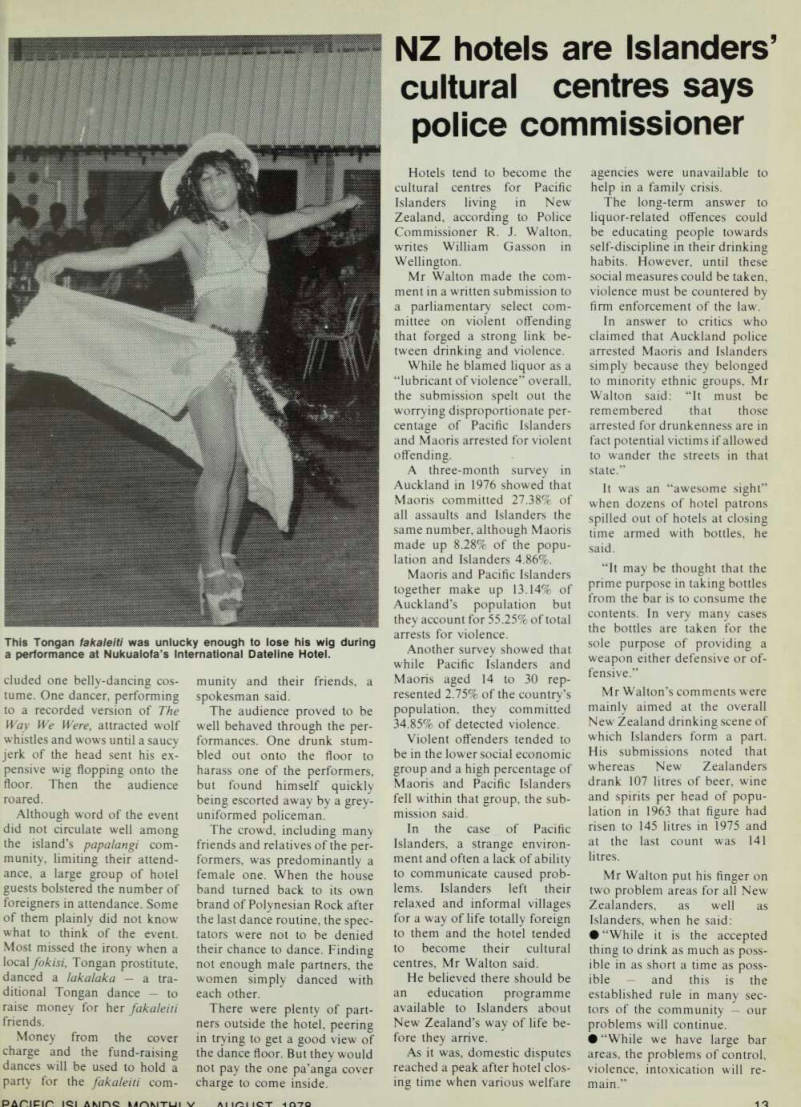
eluded one belly-dancing costume. One dancer, performing to a recorded version of The Way We Were, attracted wolf whistles and wows until a saucy jerk of the head sent his ex-
pensive wig flopping onto the
floor. Then the audience roared.
Although word of the event did not circulate well among the island’s papalangi com-
munity, limiting their attend-
ance, a large group of hotel guests bolstered the number of foreigners in attendance. Some of them plainly did not know what to think of the event, Most missed the irony when a
local fokisi, Tongan prostitute,
danced a lakalaka a traditional Tongan dance to raise money for her fakaleiti friends.
Money from the cover
charge and the fund-raising
dances will be used to hold a party for the fakaleiti com-
munity and their friends, a
spokesman said,
The audience proved to be well behaved through the per formances. One drunk stum bled out onto the floor to harass one of the performers, but found himself quickly being escorted away by a grey
uniformed policeman,
The crowd, including many friends and relatives of the per formers, was predominantly a female one. When the house band turned back to its own brand of Polynesian Rock after the last dance routine, the spec tators were not to be denied their chance to dance. Finding not enough male partners, the women simply danced with each other, There were plenty of part ners outside the hotel, peering in trying to get a good view of the dance floor. But they would not pay the one pa’anga cover charge to come inside.
This Tongan fakaleiti was unlucky enough to lose his wig during a performance at Nukualofa’s International Dateline Hotel.