A Sore Fiji Plans To Clip
p. 75 · Read in the full issue
New Zealand’S Wings
Transport
The Fiji Government, fed up at the apparent raw deal Air Pacific
is getting on Fiji-New Zealand
routes, has given notice that it will ;nd all Air New Zealand flights 0 Fiji in 12 months. The 12 nonths will expire about the end
)f April, 1979.
This sudden, unilateral move aught New Zealand by surprise is negotiations of routes were in >rogress between the two coun ties, and New Zealand under tood there were to be further
iiscussions. Whatever happens,
towever. Air New Zealand will
>e flying to Fiji throughout 1979
md for many years thereafter!
The effect of Fiji’s move is to pve both countries time to rethink heir attitudes and come up with 1 completely new agreement. And riji will expect any new agree nent to remove what are, in Fiji’s
:yes, some glaring anomalies.
The Fiji Minister for Civil Avi tion, Mr Tomasi Vakatora, nnouncing the Fiji decision, said le move had been taken “with Dme regret” because of the
notorious” and “glaring” restric
ons placed on Air Pacific flights ) NZ by both the NZ Govem lent and Air NZ. He had moved ) cancel the agreement because f the failure of negotiations be veen the two countries’ civil avi tion officials trying to reach an greement on a new arrangement Dr air services.
The current agreement, Ithough of the Bermuda type, nposed severe restrictions on Air 'acific operations, while Air NZ njoyed freedom to operate as it dshed. (Under the Bermuda greement between the US and le UK in 1946, countries have le right to carry their own zmntry’s passengers to another 3untry. This principle is still ap
lied generally, although there
ave been many changes in civil viation since then.) Mr Vakatora complained that te most notorious of the restric ons was a requirement that Air acific be forced to stop at inter lediate points on its NZ route.
Jiother glaring restriction affect
ig Air Pacific was the frequency f services. Air NZ could operate nlimited frequencies with DC 10
aircraft, while Air Pacific with BAC 1-1 Is was at the mercy of the NZ civil aviation authorities.
But the most unpalatable de cision dictated by New Zealand was that Air Pacific flights to and from NZ had to originate and fin ish at Nausori, and not at Nadi.
Air Pacific has five direct flights a week to New Zealand, while three are via Fua’amotu in
Tonga.
A week after Mr Vakatora’s an nouncement Air Pacific withdrew its proposed weekly BAC 1-11 service from Nadi to Auckland.
The flights were proposed earlier in 1978 under the Fiji-NZ agree ment "which then existed. This
weekly flight was designed to give
Air Pacific a bigger slice of the traffic between Nadi and Auckland.
Air Pacific was keen to operate the service but could not go ahead with it because of talks between Fiji and NZ civil aviation auth orities in March. Permission to operate the flights was withdrawn after those talks.
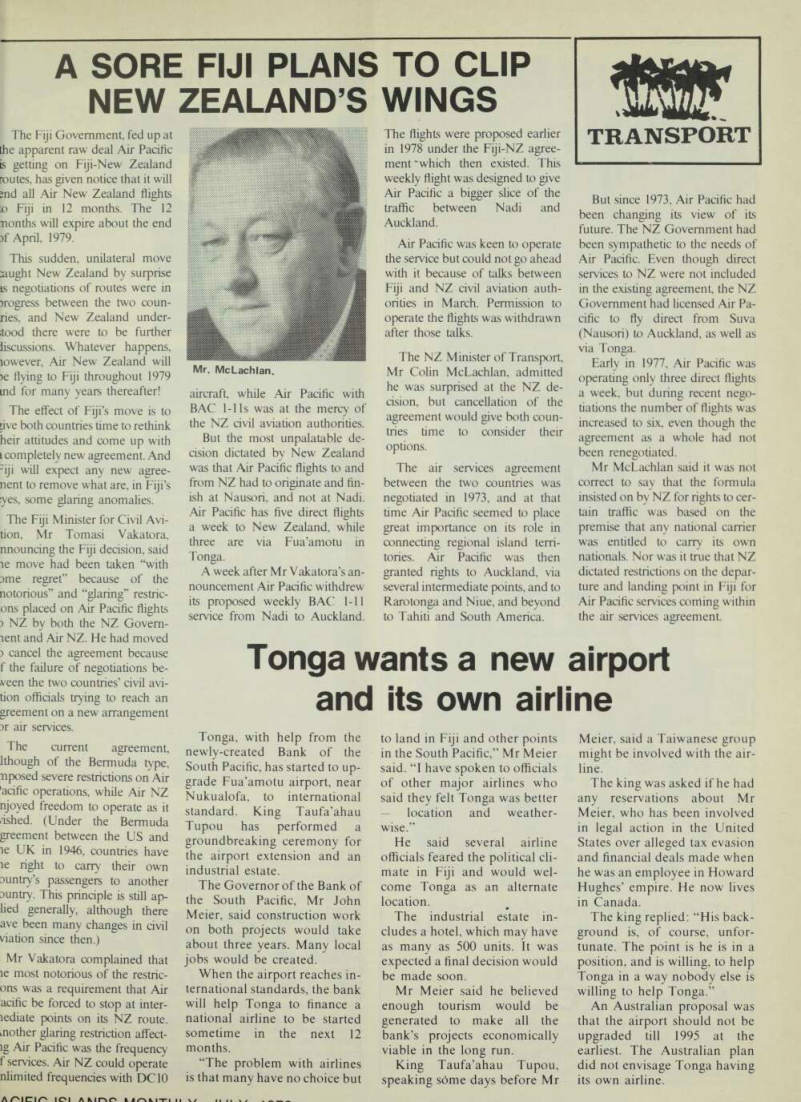
The NZ Minister of Transport, Mr Colin McLachlan, admitted he was surprised at the NZ de cision, but cancellation of the agreement would give both coun tries time to consider their
options.
The air services agreement between the two countries was negotiated in 1973, and at that time Air Pacific seemed to place great importance on its role in
connecting regional island terri
tories. Air Pacific was then granted rights to Auckland, via several intermediate points, and to Rarotonga and Niue, and beyond to Tahiti and South America.
But since 1973, Air Pacific had been changing its view of its future. The NZ Government had been sympathetic to the needs of Air Pacific. Even though direct services to NZ were not included in the existing agreement, the NZ Government had licensed Air Pa cific to fly direct from Suva (Nausori) to Auckland, as well as
via Tonga.
Early in 1977, Air Pacific was
operating only three direct flights
a week, but during recent nego tiations the number of flights was increased to six, even though the agreement as a whole had not
been renegotiated.
Mr McLachlan said it was not correct to say that the formula insisted on by NZ for rights to cer tain traffic was based on the premise that any national carrier was entitled to carry its own nationals. Nor was it true that NZ dictated restrictions on the depar ture and landing point in Fiji for Air Pacific services coming within the air services agreement.
Mr. McLachlan.