Islands history
pp. 67-70 · Read in the full issue
The light and shade of Solomon Islands history
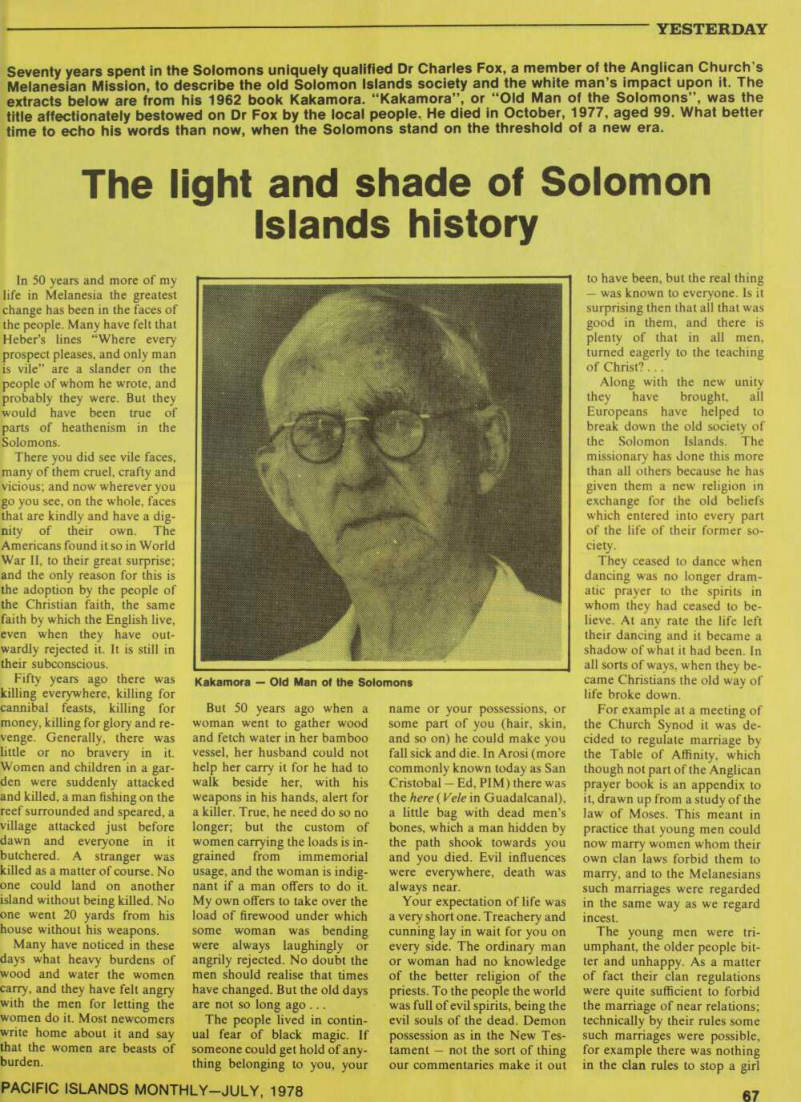
Seventy years spent In the Solomons uniquely qualified Dr Charles Fox, a member of the Anglican Church's Melanesian Mission, to describe the old Solomon Islands society and the white man’s impact upon it. The extracts below are from his 1962 book Kakamora. “Kakamora”, or “Old Man of the Solomons”, was the title affectionately bestowed on Dr Fox by the local people. He died in October, 1977, aged 99. What better time to echo his words than now, when the Solomons stand on the threshold of a new era.
In 50 years and more of my life in Melanesia the greatest change has been in the faces of the people. Many have felt that Heber’s lines “Where every prospect pleases, and only man is vile” are a slander on the people of whom he wrote, and
probably they were. But they
would have been true of parts of heathenism in the Solomons.
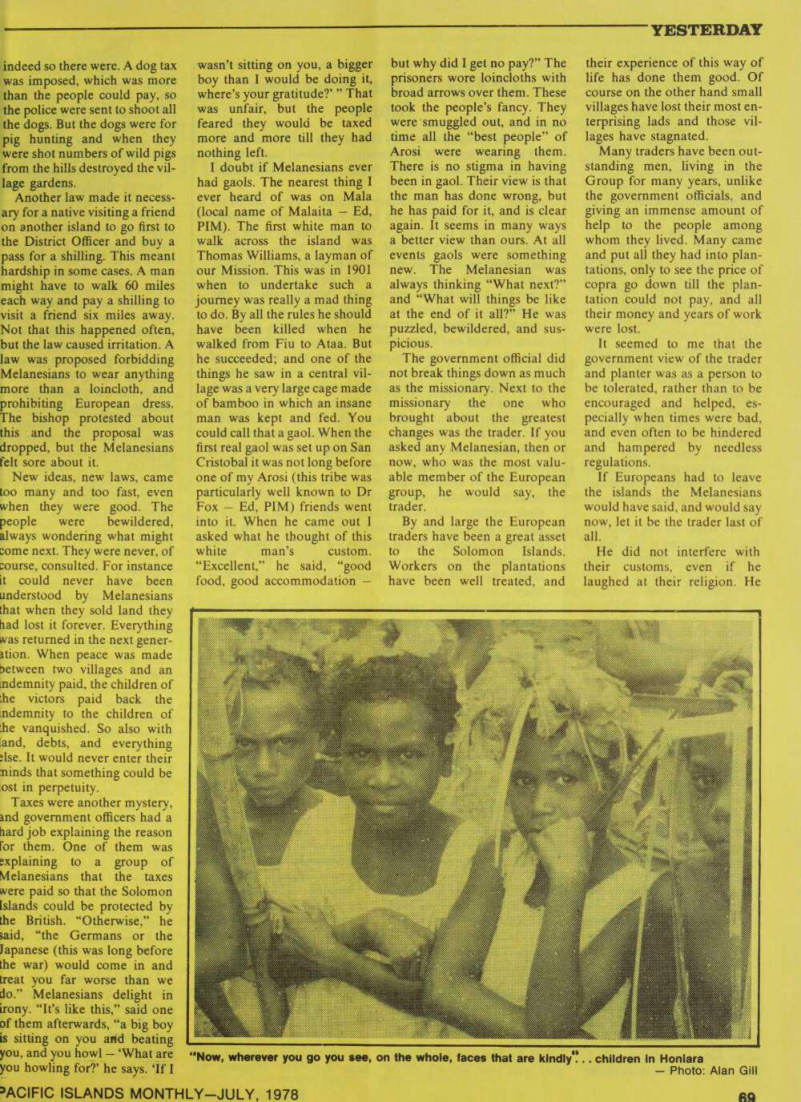
There you did see vile faces, many of them cruel, crafty and vicious; and now wherever you go you see, on the whole, faces that are kindly and have a dig nity of their own. The Americans found it so in World War 11, to their great surprise; and the only reason for this is
the adoption by the people of
the Christian faith, the same faith by which the English live, even when they have out wardly rejected it. It is still in their subconscious.
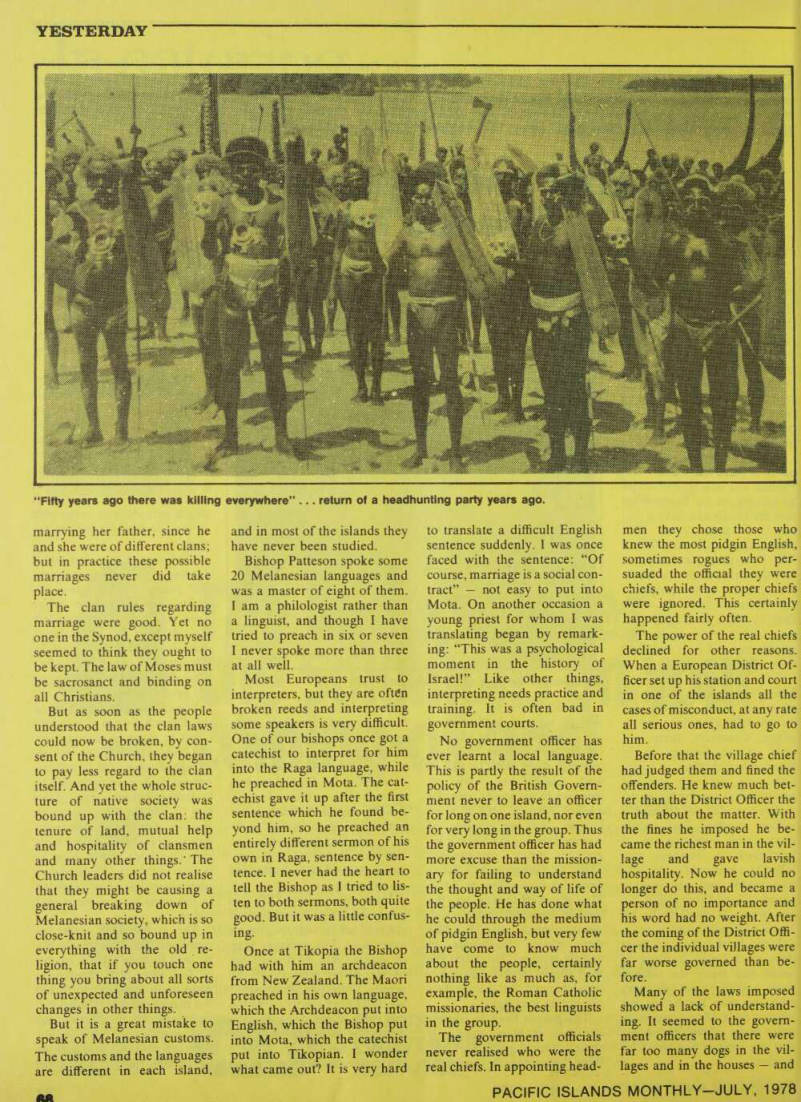
Fifty years ago there was
killing everywhere, killing for
cannibal feasts, killing for money, killing for glory and re venge. Generally, there was little or no bravery in it.
Women and children in a gar den were suddenly attacked and killed, a man fishing on the reef surrounded and speared, a
village attacked just before
dawn and everyone in it butchered. A stranger was killed as a matter of course. No one could land on another island without being killed. No one went 20 yards from his house without his weapons.
Many have noticed in these days what heavy burdens of wood and water the women carry, and they have felt angry with the men for letting the women do it. Most newcomers write home about it and say that the women are beasts of burden.
But 50 years ago when a woman went to gather wood and fetch water in her bamboo vessel, her husband could not help her carry it for he had to walk beside her, with his weapons in his hands, alert for a killer. True, he need do so no longer; but the custom of women carrying the loads is in grained from immemorial usage, and the woman is indig nant if a man offers to do it.
My own offers to take over the load of firewood under which some woman was bending
were always laughingly or
angrily rejected. No doubt the men should realise that times have changed. But the old days are not so long ago ...
The people lived in contin ual fear of black magic. If someone could get hold of any thing belonging to you, your
name or your possessions, or some part of you (hair, skin, and so on) he could make you fall sick and die. In Arosi (more commonly known today as San Cristobal Ed, PIM) there was the here (Vele in Guadalcanal), a little bag with dead men’s bones, which a man hidden by the path shook towards you and you died. Evil influences were everywhere, death was
always near.
Your expectation of life was a very short one. Treachery and cunning lay in wait for you on every side. The ordinary man or woman had no knowledge of the better religion of the priests. To the people the world was full of evil spirits, being the evil souls of the dead. Demon possession as in the New Tes tament not the sort of thing our commentaries make it out
to have been, but the real thing was known to everyone. Is it surprising then that all that was good in them, and there is plenty of that in all men, turned eagerly to the teaching of Christ? ...
Along with the new unity
they have brought, all
Europeans have helped to
break down the old society of the Solomon Islands. The missionary has done this more than all others because he has given them a new religion in exchange for the old beliefs which entered into every part of the life of their former so
ciety.
They ceased to dance when dancing was no longer dram atic prayer to the spirits in whom they had ceased to be lieve. At any rate the life left their dancing and it became a shadow of what it had been. In all sorts of ways, when they be came Christians the old way of life broke down.
For example at a meeting of the Church Synod it was de
cided to regulate marriage by
the Table of Affinity, which though not part of the Anglican prayer book is an appendix to it, drawn up from a study of the law of Moses. This meant in practice that young men could now marry women whom their own clan laws forbid them to many, and to the Melanesians
such marriages were regarded
in the same way as we regard incest.
The young men were tri umphant, the older people bit ter and unhappy. As a matter of fact their clan regulations were quite sufficient to forbid the marriage of near relations; technically by their rules some
such marriages were possible,
for example there was nothing in the clan rules to stop a girl
Kakamora-Old Man of the Solomons
marrying her father, since he and she were of different clans; but in practice these possible marriages never did take
place.
The clan rules regarding marriage were good. Yet no one in the Synod, except myself seemed to think they ought to be kept. The law of Moses must be sacrosanct and binding on all Christians.
But as soon as the people understood that the clan laws could now be broken, by con sent of the Church, they began to pay less regard to the clan itself. And yet the whole struc ture of native society was bound up with the clan; the tenure of land, mutual help and hospitality of clansmen and many other things. ' The Church leaders did not realise that they might be causing a
general breaking down of
Melanesian society, which is so close-knit and so bound up in everything with the old re ligion, that if you touch one thing you bring about all sorts of unexpected and unforeseen changes in other things.
But it is a great mistake to speak of Melanesian customs.
The customs and the languages are different in each island,
and in most of the islands they have never been studied.
Bishop Patteson spoke some
20 Melanesian languages and was a master of eight of them.
I am a philologist rather than a linguist, and though I have tried to preach in six or seven I never spoke more than three at all well.
Most Europeans trust to interpreters, but they are often broken reeds and interpreting some speakers is very difficult.
One of our bishops once got a catechist to interpret for him into the Raga language, while he preached in Mota. The cat echist gave it up after the first sentence which he found be yond him, so he preached an entirely different sermon of his own in Raga, sentence by sen tence. I never had the heart to tell the Bishop as I tried to lis ten to both sermons, both quite good. But it was a little confus
ing.
Once at Tikopia the Bishop had with him an archdeacon from New Zealand. The Maori preached in his own language, which the Archdeacon put into English, which the Bishop put into Mota, which the catechist put into Tikopian. I wonder what came out? It is very hard
to translate a difficult English sentence suddenly. I was once faced with the sentence: “Of course, marriage is a social con tract” not easy to put into Mota. On another occasion a young priest for whom I was
translating began by remark
ing: “This was a psychological moment in the history of Israel!” Like other things,
interpreting needs practice and
training. It is often bad in government courts.
No government officer has ever leamt a local language.
This is partly the result of the policy of the British Govern ment never to leave an officer for long on one island, nor even for very long in the group. Thus the government officer has had more excuse than the mission ary for failing to understand the thought and way of life of the people. He has done what he could through the medium of pidgin English, but very few have come to know much
about the people, certainly
nothing like as much as, for example, the Roman Catholic missionaries, the best linguists in the group.
The government officials never realised who were the real chiefs. In appointing head
men they chose those who knew the most pidgin English, sometimes rogues who per suaded the official they were chiefs, while the proper chiefs
were ignored. This certainly
happened fairly often.
The power of the real chiefs declined for other reasons.
When a European District Of ficer set up his station and court in one of the islands all the cases of misconduct, at any rate all serious ones, had to go to him.
Before that the village chief had judged them and fined the offenders. He knew much bet ter than the District Officer the truth about the matter. With the fines he imposed he be came the richest man in the vil lage and gave lavish hospitality. Now he could no longer do this, and became a person of no importance and his word had no weight. After the coming of the District Offi cer the individual villages were far worse governed than be fore.
Many of the laws imposed showed a lack of understand ing. It seemed to the govern ment officers that there were far too many dogs in the vil lages and in the houses and
“Fifty years ago there was killing everywhere”... return of a headhunting party years ago.
indeed so there were. A dog tax was imposed, which was more than the people could pay, so the police were sent to shoot all the dogs. But the dogs were for pig hunting and when they were shot numbers of wild pigs from the hills destroyed the vil
lage gardens.
Another law made it necess ary for a native visiting a friend on another island to go first to the District Officer and buy a pass for a shilling. This meant hardship in some cases. A man might have to walk 60 miles each way and pay a shilling to visit a friend six miles away.
Not that this happened often, but the law caused irritation. A
law was proposed forbidding
Melanesians to wear anything more than a loincloth, and prohibiting European dress.
The bishop protested about
this and the proposal was dropped, but the Melanesians felt sore about it.
New ideas, new laws, came too many and too fast, even when they were good. The people were bewildered,
always wondering what might
come next. They were never, of course, consulted. For instance it could never have been understood by Melanesians
that when they sold land they
iiad lost it forever. Everything ivas returned in the next gener ation. When peace was made between two villages and an indemnity paid, the children of the victors paid back the indemnity to the children of the vanquished. So also with and, debts, and everything ;lse. It would never enter their ninds that something could be ost in perpetuity.
Taxes were another mystery, and government officers had a
hard job explaining the reason
for them. One of them was explaining to a group of Melanesians that the taxes were paid so that the Solomon Islands could be protected by the British. “Otherwise,” he iaid, “the Germans or the Japanese (this was long before the war) would come in and treat you far worse than we
do.” Melanesians delight in
irony. “It’s like this,” said one of them afterwards, “a big boy
is sitting on you and beating
you, and you howl ‘What are you howling for?’ he says. ‘lf I
wasn’t sitting on you, a bigger boy than I would be doing it, where’s your gratitude?’ ” That was unfair, but the people feared they would be taxed more and more till they had
nothing left.
I doubt if Melanesians ever had gaols. The nearest thing I ever heard of was on Mala (local name of Malaita Ed, PIM). The first white man to walk across the island was Thomas Williams, a layman of our Mission. This was in 1901 when to undertake such a
journey was really a mad thing
to do. By all the rules he should have been killed when he walked from Fiu to Ataa. But he succeeded; and one of the things he saw in a central vil lage was a very large cage made of bamboo in which an insane man was kept and fed. You could call that a gaol. When the first real gaol was set up on San Cristobal it was not long before one of my Arosi (this tribe was particularly well known to Dr Fox - Ed, PIM) friends went into it. When he came out I asked what he thought of this white man’s custom.
“Excellent,” he said, “good food, good accommodation
but why did I get no pay?” The prisoners wore loincloths with broad arrows over them. These
took the people’s fancy. They
were smuggled out, and in no time all the “best people” of Arosi were wearing them.
There is no stigma in having been in gaol. Their view is that the man has done wrong, but he has paid for it, and is clear again. It seems in many ways a better view than ours. At all
events gaols were something
new. The Melanesian was
always thinking “What next?”
and “What will things be like at the end of it all?” He was puzzled, bewildered, and sus-
picious.
The government official did not break things down as much as the missionary. Next to the missionary the one who brought about the greatest changes was the trader. If you asked any Melanesian, then or now, who was the most valuable member of the European group, he would say, the trader.
By and large the European
traders have been a great asset to the Solomon Islands.
Workers on the plantations have been well treated, and
their experience of this way of life has done them good. Of course on the other hand small villages have lost their most en terprising lads and those vil
lages have stagnated.
Many traders have been out standing men, living in the Group for many years, unlike the government officials, and giving an immense amount of help to the people among whom they lived. Many came and put all they had into plan tations, only to see the price of copra go down till the plan tation could not pay, and all their money and years of work were lost, It seemed to me that the government view of the trader and planter was as a person to be tolerated, rather than to be
encouraged and helped, es
pecially when times were bad, and even often to be hindered
and hampered by needless
regulations,
If Europeans had to leave the islands the Melanesians would have said, and would say now, Jet it be the trader last of all.
He did not interfere with their customs, even if he laughed at their religion. He
“Now, wherever you go you see, on the whole, faces that are kindly"... children in Honiara Photo: Alan Gill
brought them goods they
needed. He was fair and just.
Their respect for the justice of white men, their belief that white men always keep their word and don’t lie, is largely from their knowledge of the
trader and planter . ..
Fifty years ago, the way of life was full of excitement. On Gela (more generally known today as Florida Ed, PIM) in those days people went on
dancing parties from village to
village, and it was a thrilling experience for the audience, because sometimes the dancing party had concealed weapons and in the middle of the dance fell on the watching people and massacred every one of them.
You never knew what might happen when you went to see the dance! Men went into ter rible rages and sweated blood.
A Gela chief named Dikea went into one of these rages with his wife for a very small matter, and beat her with a club till she was a bloody mess.
Life could be full of terror.
But all the same it was full of colour, of rich ceremonial and of adventure; and to many it now seems drab and grey, just working for white men on plantations, or making copra or perhaps working in a mine. As for excitement nothing much. This is why many of the
present generation, knowing
nothing now of what life was really like 50 years ago, but hearing of the old customs, cer emonial, adventure and excite ment, sometimes think wistfully of the old ways and wonder if European civilis ation has been for them a bless ing or a curse.
They know that with the
coming of the Europeans they
themselves have been rapidly dying out, and that this is still going on in some islands, that the population is static on others, and that it is increasing in only a few. Europeans know, from what has happened else where in the Pacific, that more medical help and more preven tive medicine, better food crops and more variety of food, can bring about a healthy and increasing race. The great work of an American doctor (Dr S.
M. Lambert, of the Rockefeller
Foundation Ed, PIM) who conceived the idea of a medical school in Suva for Pacific Islanders, and brought it about, is bearing fruit. Mission hospi tals are producing nurses.
There is plenty of hope for the people. But they have not much faith yet, though it is growing, in their own future.
Europeans have been bring ing unity to the people. Fifty years ago there was none. The people of one island, or even one district, knew little of any others, except that they were enemies. The great number of different languages kept them all apart from one another.
But missionary, government official and trader have all helped to bring about a grow
ing unity.
On the coconut plantations, year after year, some 2 000 of
the men from different islands came together, and got to know one another. They all spoke pidgin English. I am no be liever in pidgin English as the future language of the whole people, it is too clumsy a me dium of thought, but it has served a very useful purpose in
thus drawing together people
of different islands who had no
common language.
Wishing to try everything
and to know what it was like I was once allowed by a friendly trader to become for a time one of his plantation boys and live their life. We were up at 5.30 am and after a cup of tea and a hard biscuit went out
“brushing” the plantation, or
making copra. We had a spell in the middle of the day and then worked till 5 pm a nine hour day. The evenings we
spent in talk, boys from dif ferent islands all friendly together. It was a good life. The plantations have done as much as anything else to bring about the unity of the people, and break down the old hostilities and distrust of one another.
One government for all, with one law for everyone, has also
helped. The missionary has
helped too, with one faith. This would have had the greatest effect of all if it had not been a divided Christianity which we brought them, making fresh divisions among them, div isions for which many of them could see no reason, and which many of them think would cease but for the white mis sionaries among them.
But like the plantations, the missionary schools have been a strong influence for bringing them all together, and getting rid of the suspicion and distrust they felt for one another. Not only have boys lived together in these schools for far longer periods than they ever spent on the plantations, but they have been able, because of this, to
form lifelong friendships with
boys from other islands than their own, and hundreds have gone as missionaries, often for life, to other parts of Melanesia. The great work the schools have done for unity has never been recognised. They ought to be helped and encouraged, for with a merely materialistic education the people any people will in the end wither and die.
With the coming of girls’ schools a new era is opening, because the women have a deeper influence in the village than the men. The white women who kept this aim always in view and worked their way towards it, have done more than anyone else in this generation for the Solomon Islanders. One of these, Sister Nellie Stead, a highly qualified
nurse, especially in maternity
work, well deserved the MBE the Queen gave her ... • The above extracts are from the book Kakamora, by Charles E. Fox, MBE, MA, D Litt, which was first published by Hodder & Stoughton, London, in 1962.