PNG deal with Japan
pp. 63-64 · Read in the full issue
Australian interests won’t be affected by a million-dollar fishing deal which Papua New Guinea has negotiated with Japan. Under the deal PNG has licensed three Japanese syndicates to operate in its new 200-mile fisheries zone.
Part of the zone overlaps a similar 200-mile zone which Australia is about to declare under legislation now before parliament in Canberra.
But in deference to final ar rangements yet to be made with Australia, PNG has excluded the overlapping re gions from the new Japanese
deal. The overlapping regions
are to the north and north-east of Australia.
PNG and Australia have already reached an interim agreement on the overlapping zones. The effect of the agree ment is that each country claims fishing rights in the zones, but each also recognises the claim of the other.
This means that any third
country would have to make complex individual nego tiations with Australia and with PNG if it wanted to use the
overlapping waters.
The agreement involves a separate issue to what is invol ved in the fixing of inter national Torres Strait boundaries between Australia and PNG.
The new fisheries deal be tween PNG and Japan will
apply for only eight months,
but will be subject to renegotia ted renewal.
But, in the eight months alone, the contract is expected to earn uncapitalised revenue of $1.5 million for PNG. This will be made up of a lump sum of $1.21 million to be paid by Japan, and ship licence fees.
Under its recently-defined national fisheries policy, PNG
will licence foreign fishing
fleets only until its own econ omy and technology are
capable of handling the
catch.
A gradual phasing period is
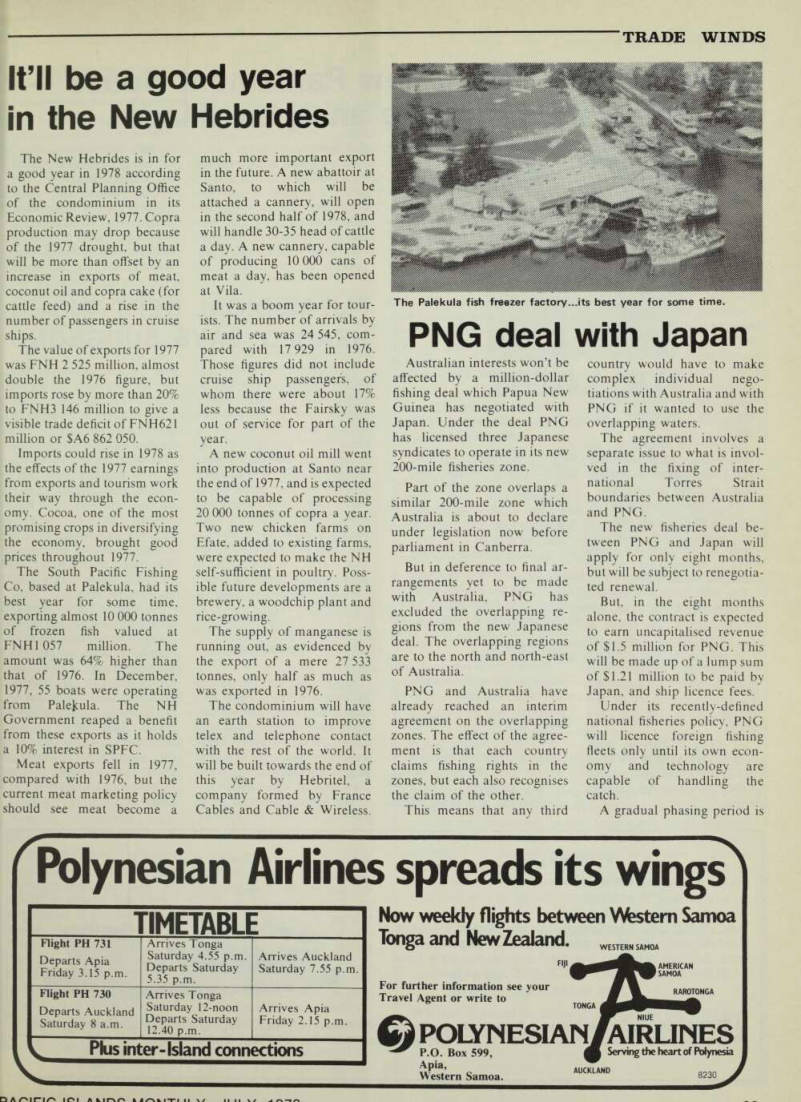
The Palekula fish freezer factory...its best year for some time.
anticipated as PNG takes over from foreign operators.
The bulk of the fish re sources in PNG’s 800 000 sq. miles of ocean is tuna.
The agreement came under heavy fire from the Opposition in the National Parliament towards the end of May.
The Deputy Opposition
Leader, Sir John Guise, and
Opposition finance spokesman
Mr Michael Pondros led the attack. Sir John telling parlia ment to “beware of Japanese
fishing policies”.
Accusing the government of allowing itself to be exploited.
Sir John said that provincial governments controlling the PNG coastline, and the National Parliament itself, should have been consulted be fore the contracts were
signed.
He believed PNG could get a better deal if it diversified its fishing contracts to include countries other than Japan.
The finance spokesman, Mr Pondros, said another real fear was that fishing resources would be depleted. He urged PNG to establish its own fish canneries without delay.
The Natural Resources Minister. Mr Julius Chan, told parliament that there was no fear of depletion under con trols agreed to. The contracts with Japanese interests were only interim arrangements while PNG developed its own technology to fish its own waters.
Mr Chan undertook, how ever, to take note of all criti cism as part of current research to prepare a national fisheries
policy.