Money For The Samoans
p. 62 · Read in the full issue
A Bad Smell Means
™ade
American Samoans have two major options when it comes to trying to get a job the government or the tuna canneries. The government employs nearly 4 000 persons, while Star Kist and Van Camp canneries combined provide jobs for 2 000 more, writes Robin Pierson from Pago Pago.
While the highly-sought after positions are the air-con ditioned, government office jobs, there are never quite enough of these for all ap plicants. However, with the US$46 million pumped into American Samoa each year, the government has found jobs for more than 40% of the ter ritory’s labour force.
Yet many individuals prefer working at the cann eries, where the minimum wage is higher US$l.66 an hour at Star Kist and Van Camp vs $1.25 government minimum wage— and there is always the possibility of pick ing up overtime pay.
Often short of employees, the canneries’ staffs are made up largely of Western Sa moans who find the wages good in comparison with their own islands. About 85% of the employees, who are mainly women, receive the minimum wage. Employees have a traditional 40-hour work week, unless there is a surplus of fish, during which time packing may go on late into the night. Then too, there are the times when there’s a shortage of fish or water, which can close down the can ner ies and lay off the employees for months at a time.
Inside the canneries the fish is rapidly transformed from its whole, frozen state and is thawed, cooked, cleaned, packed and cooked again. It’s a smelly, steamy, noisy pro cess and earplugs are safety requirements in many parts of the plant.
A strong, fishy odour fills the air around this industry.
The same type of smell, plus the very poignant deodorant scent of Odo-ban, regularly passes through town in large trucks on the way to private
dumping sites. The contents of these trucks are the canneries’ waste materials.
The Environmental Protec tion Agency specifies that water used by the plants and later dumped into Pago Pago Harbour must be purified.
Unfortunately, after one look at the bay, it’s obvious the EPA’s regulations are being by-passed by individuals using it as a dumping area.
Less obvious, but more dangerous, is the waste that comes from the can plant across the street from the can neries. Here Star Kist manufactures its own cans, 3 000 to 4 000 daily, all of which are soldered with 98% lead. I was assured that almost none of this lead enters the can, and the amount going into the air complies with government regulations.
In 1 975, an election (referendum) was held at Star Kist regarding the admittance of a union to the cannery. The employees defeated the pro posal, yet union members pro tested due to what they felt to be irregularities during the pre-election campaigning.
The case was taken to court in American Samoa and it was ordered that another election be held. However, the union, claiming that irrevocable damage has already been done to their cause, is now ap pealing against the decision in California, hoping to establish their organisation without an election.
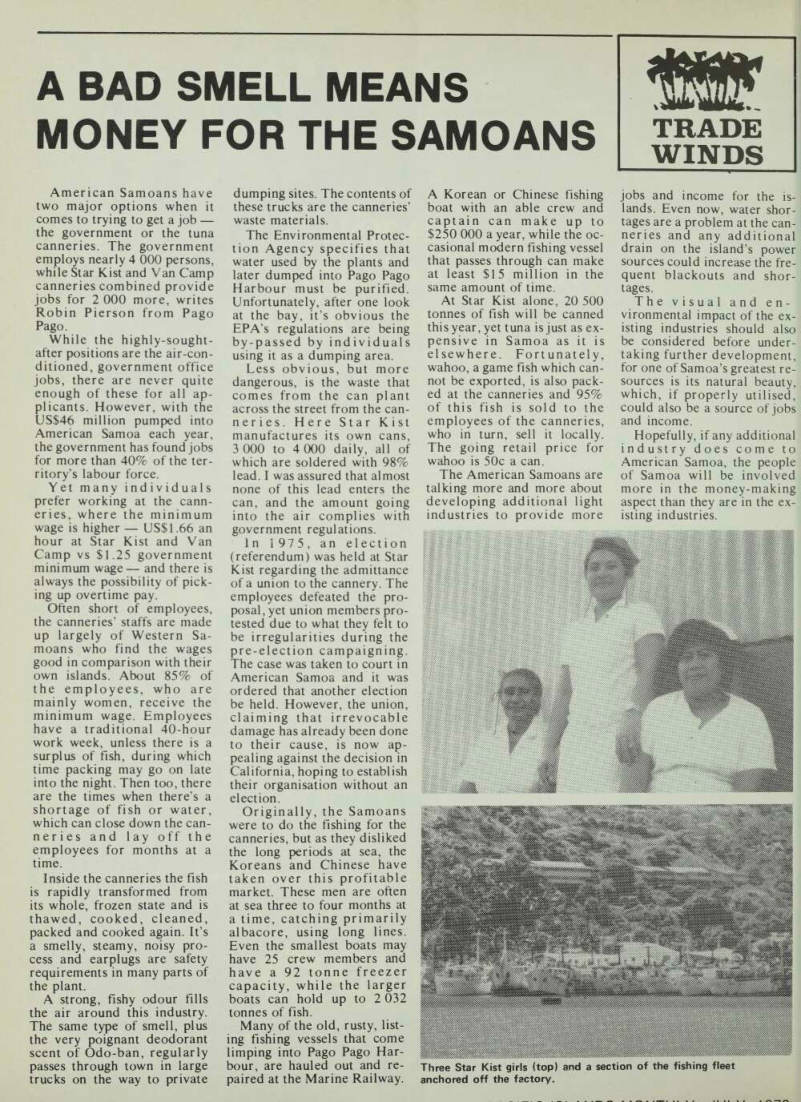
Originally, the Samoans were to do the fishing for the canneries, but as they disliked the long periods at sea, the Koreans and Chinese have taken over this profitable market. These men are often at sea three to four months at a time, catching primarily albacore, using long lines.
Even the smallest boats may have 25 crew members and have a 92 tonne freezer capacity, while the larger boats can hold up to 2 032 tonnes of fish.
Many of the old, rusty, list ing fishing vessels that come limping into Pago Pago Har bour, are hauled out and re paired at the Marine Railway.
A Korean or Chinese fishing boat with an able crew and captain can make up to $250 000 a year, while the occasional modern fishing vessel that passes through can make at least $l5 million in the same amount of time.
At Star Kist alone, 20 500 tonnes of fish will be canned this year, yet tuna is just as expensive in Samoa as it is elsewhere. Fortunately, wahoo, a game fish which cannot be exported, is also packed at the canneries and 95% of this fish is sold to the employees of the canneries, who in turn, sell it locally.
The going retail price for wahoo is 50c a can.
The American Samoans are talking more and more about developing additional light industries to provide more
jobs and income for the is lands. Even now, water shor tages are a problem at the can neries and any additional drain on the island’s power sources could increase the fre quent blackouts and shor tages.
The visual and en vironmental impact of the ex isting industries should also be considered before under taking further development, for one of Samoa’s greatest re sources is its natural beauty, which, if properly utilised, could also be a source of jobs and income, Hopefully, if any additional industry does come to American Samoa, the people of Samoa will be involved more in the money-making aspect than they are in the ex isting industries.
Three Star Kist girls (top) and a section of the fishing fleet anchored off the factory.