the Solomons’ economic future
pp. 15-17 · Read in the full issue
A Minister’s clear-eyed look at the Solomons’ economic future
Peter L. Young in Honiara has talked to Mr Benedict Kinika, Deputy Prime Minister and Minister of Finance in the first government of the independent Solomon Islands. The interview, exclusive to PIM, provides a number of rare insights into the economic thinking of the new leaders of the Solomons.
YOUNG: Mr Kinika, how do you see the economic future of the independent Solomon Islands?
KINIKA: According to the information I have at the mo ment that is, for the first four years after independence
they will be quite good years
and I don’t think we will run into any major difficulties. In our economic negotiations with London, the British Government agreed with us that they would give us aid for four years immediately after independence, and that’s where the $43 million post independence financial settle ment comes into the picture. It remains to be seen how we use the money made available to us
during the four-year post
independence period.
PLY: What about the aid sources available to the Solomons other than the UK?
BK: Even at the moment, we are drawing on multilateral aid from the Asian Development Bank who have already ap proved loans to us for a cattle
project, improvements to the
port of Honiara and one of our fishery projects. The last two loans were for $2Vi million each. And there are others in the pipeline which are not yet approved such as the hydro electric dam scheme for the
Lunga River. Recently,
through the UK, we have been getting aid from the European Economic Community. We are getting Stabex money already this year we have received SIV4 million in aid through this scheme. We will also be getting aid through the
European Development Fund,
which we hope to use to im prove our telephone system.
Also through the UK we have been gaining assistance from the International Monetary Fund in Washington.
Another form of aid, or stimulus to our economy, is the fact that the South Pacific
Forum has agreed that a fish ery development agency should be set up for the South Pacific with its headquarters in Honiara, our capital.
We are also getting scholar ships for our students to study at various regional institutions such as the University of the South Pacific, the University of Papua New Guinea, and other institutions such as the Univer sity of Technology at Lae and Goroka Teachers’ College.
Also our students get some
scholarships for overseas study
from Australia, New Zealand, and of course the UK.
The World Bank is another future source of aid, but we will have to join formally before we can make use of it. We have been getting assistance from various world bodies through the UK but after indepen dence, we are on our own.
PLY: What is the place of Japan in the economic development of the Solomons?
BK: Their emphasis is on
fishery development, naturally,
and we feel that this is an area
where they can play a major
part. I must say that our fishery development is ahead of other Pacific countries. We have shore bases, a localisation pro gramme, and training schemes.
Another area in which the Japanese have indicated that they would help is in com munications. They are also looking at our inter-island
shipping problems.
So far, the Japanese have only been able to give us tech nical assistance. Normal Japanese aid, according to their rules, cannot be granted until a country becomes indepen dent.
Japanese private companies
have been here. The Taiyo Company operates in our waters and has a canning fac tory here. It is obviously the most important to us at pre sent.
PLY: What about aid from other countries?
BK: The UK, Australia and New Zealand have been our mainstays. As for others, we are being cautious. We know that all aid has strings attached. We are wanting to get the type of aid that is most beneficial to us.
In the Prime Minister’s office we have an international econ omic adviser, who came to us from the Commonwealth Sec retariat. We have received offers from other countries and we are looking at them closely.
We are tending to look more at multilateral aid.
PLY: What do you see as the
major problem facing the
Solomons immediately after
independence?
BK: The problem I see my self is not an economic one, but it will certainly have an econ omic effect. This is regionalist loyalty in the Solomons. Vari ous areas in the Solomon Islands want to take more power into their own hands.
This regionalism is gathering
momentum. In the past the power was with the central government. Only since 1974 has local government been
encouraged.
The local areas now have more power than ever. A recent
bill ensures that the money we give to the local councils is no longer tied. We just give it in a lump sum and it is up to them to do with it what they like according to their own priori ties. They have more autonomy now than they seem to re alise.
However, we must all be re alistic about this. What tasks we give to the local authorities they must be able to perform.
If we give too much then they
just can’t do it. They might
have the money, but not the manpower.
We have democracy here, a traditional kind of consensus, a rather extreme kind of democ racy sometimes. Solomon Islanders want a say in every thing. The decisions made by the central government will
always be questioned.
Solomon Islanders are very critical of their politicians and their government and we are aware of this.
I think that when the people in the districts are satisfied with what we have given them, they will not break away altogether.
I think myself that this regionalism will only be a tem
porary thing.
PLY: After independence there will be three levels of government national, provincial and local. How does the new provincial government set-up fit in with the national and local governments operat
ing here at present?
BK: The provincial govern ments will simply take the place of what we now call local government. These councils will become known as provin cial assemblies after indepen dence. What we now call area committees, which at present operate at sub-local council level, will then become known as local governments. It’s only a name change, really.
PLY: What are the economic priorities of your govern ment?
BK: We are trying to
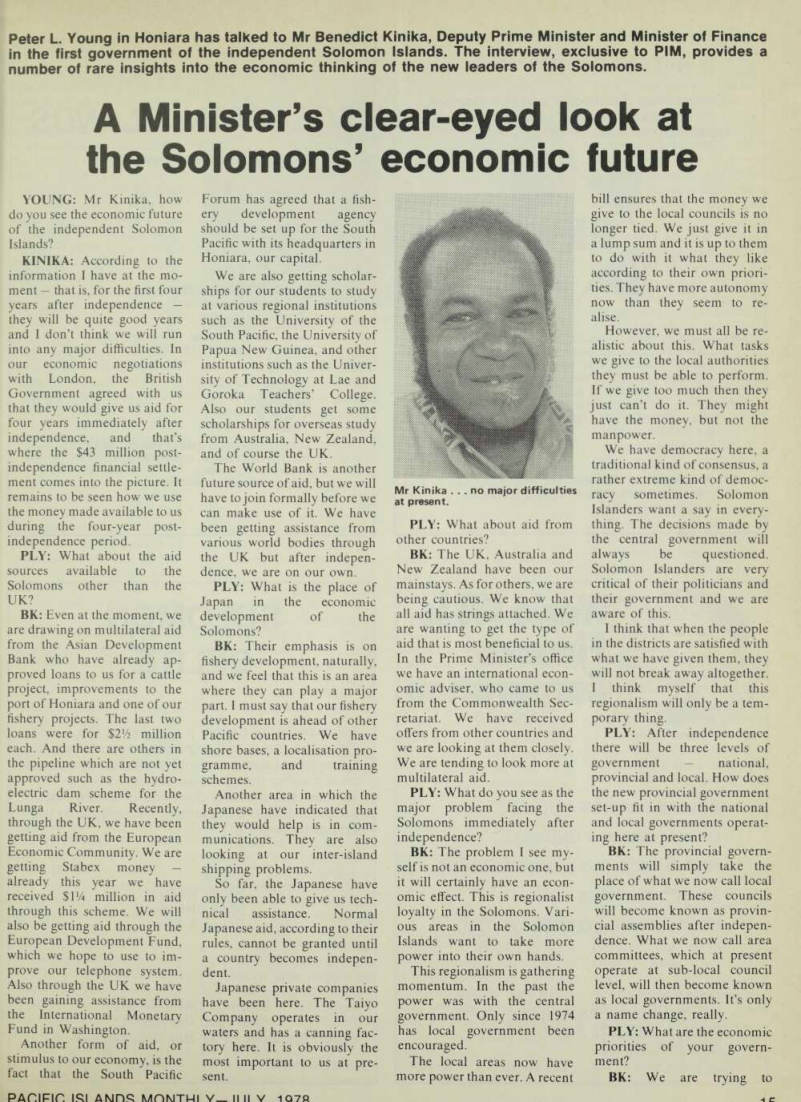
Mr Kinika... no major difficulties at present.
encourage development that will not be unduly detrimental to our society or environment.
This is why our emphasis is on
rural development and agricul
ture. We are trying to decen tralise development. We do not want to encourage too much of the kind of development that leads to the drift to the city.
We are trying to diversify our economy. There was a time when our only export was copra. New industries develop ing are oil palm, fisheries, beef cattle, chillies and a rice pro ject. There are also a number
of timber-logging operations in
our islands, and a certain
amount of light industry
developing nails, corrugated
iron, soap, bread, biscuits which is in keeping with our needs. Maybe later on mining will come bauxite on Rennell Island for example.
PLY: What of the social costs of this development?
BK: Economic development, no matter how gradual, will disturb our society, we know. I think we’ll have to face that fact, but we are learning a lot from other countries. We are quite aware of the dangers of industrialisation, such as pol lution. Our politicians when they have gone overseas have seen the costs of industrialisa tion.
PLY: What are the prospects for logging in the Solomons?
There seems to have been some local opposition to logging op erations.
BK: Our forestry industry is centred around logging, the
logs being exported to Japan.
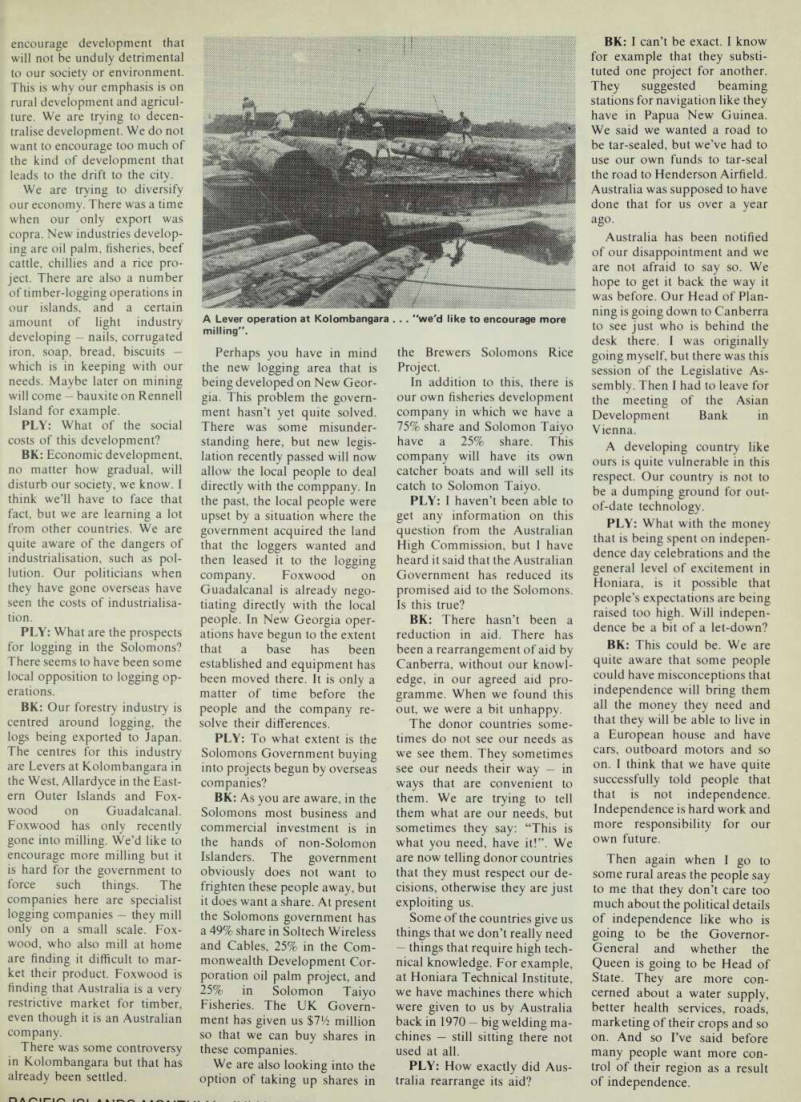
The centres for this industry are Levers at Kolombangara in the West, Allardyce in the East ern Outer Islands and Fox wood on Guadalcanal.
Foxwood has only recently
gone into milling. We’d like to encourage more milling but it is hard for the government to force such things. The
companies here are specialist
logging companies they mill
only on a small scale. Fox wood, who also mill at home are finding it difficult to mar ket their product. Foxwood is finding that Australia is a very restrictive market for timber, even though it is an Australian company.
There was some controversy in Kolombangara but that has already been settled.
Perhaps you have in mind the new logging area that is being developed on New Geor gia. This problem the govern ment hasn’t yet quite solved.
There was some misunder standing here, but new legis lation recently passed will now allow the local people to deal directly with the comppany. In the past, the local people were upset by a situation where the government acquired the land that the loggers wanted and then leased it to the logging company. Foxwood on Guadalcanal is already nego tiating directly with the local people. In New Georgia oper ations have begun to the extent that a base has been established and equipment has been moved there. It is only a matter of time before the people and the company re solve their differences.
PLY: To what extent is the Solomons Government buying
into projects begun by overseas
companies?
BK: As you are aware, in the Solomons most business and commercial investment is in the hands of non-Solomon Islanders. The government obviously does not want to frighten these people away, but it does want a share. At present the Solomons government has a 49% share in Soltech Wireless and Cables, 25% in the Com monwealth Development Cor
poration oil palm project, and
25% in Solomon Taiyo Fisheries. The UK Govern ment has given us $7!/2 million so that we can buy shares in these companies.
We are also looking into the option of taking up shares in
the Brewers Solomons Rice
Project.
In addition to this, there is our own fisheries development company in which we have a 75% share and Solomon Taiyo have a 25% share. This company will have its own catcher boats and will sell its catch to Solomon Taiyo.
PLY: I haven’t been able to get any information on this question from the Australian High Commission, but I have heard it said that the Australian Government has reduced its promised aid to the Solomons.
Is this true?
BK: There hasn’t been a reduction in aid. There has been a rearrangement of aid by Canberra, without our knowl edge, in our agreed aid pro gramme. When we found this out, we were a bit unhappy.
The donor countries some times do not see our needs as we see them. They sometimes see our needs their way in ways that are convenient to them. We are trying to tell them what are our needs, but sometimes they say: “This is what you need, have it!”. We are now telling donor countries that they must respect our de cisions, otherwise they are just
exploiting us.
Some of the countries give us things that we don’t really need things that require high tech
nical knowledge. For example,
at Honiara Technical Institute, we have machines there which were given to us by Australia back in 1970 big welding ma chines still sitting there not used at all.
PLY: How exactly did Aus tralia rearrange its aid?
BK: I can’t be exact. I know for example that they substi tuted one project for another.
They suggested beaming
stations for navigation like they have in Papua New Guinea.
We said we wanted a road to be tar-sealed, but we’ve had to use our own funds to tar-seal the road to Henderson Airfield.
Australia was supposed to have done that for us over a year ago.
Australia has been notified of our disappointment and we are not afraid to say so. We hope to get it back the way it was before. Our Head of Plan ning is going down to Canberra to see just who is behind the desk there. I was originally going myself, but there was this session of the Legislative As sembly. Then I had to leave for the meeting of the Asian Development Bank in Vienna.
A developing country like ours is quite vulnerable in this respect. Our country is not to be a dumping ground for out
of-date technology.
PLY: What with the money that is being spent on indepen dence day celebrations and the general level of excitement in Honiara, is it possible that
people’s expectations are being
raised too high. Will indepen dence be a bit of a let-down?
BK: This could be. We are quite aware that some people could have misconceptions that
independence will bring them
all the money they need and that they will be able to live in a European house and have cars, outboard motors and so on. I think that we have quite
successfully told people that
that is not independence.
Independence is hard work and more responsibility for our own future.
Then again when I go to some rural areas the people say to me that they don’t care too much about the political details of independence like who is going to be the Governor- General and whether the Queen is going to be Head of State. They are more con cerned about a water supply, better health services, roads, marketing of their crops and so on. And so I’ve said before many people want more con trol of their region as a result
of independence.
A Lever operation at Kolombangara... "we'd like to encourage more milling".