Fiji’s shipping facilities
pp. 93-95 · Read in the full issue

need upgrading say experts
The Fiji Government ship
yard at Walu Bay, Suva, needs to be extended according to the retiring manager of the yard, Ame Sannergren, who will leave Fiji in June to live in his native Sweden.
Mr Sannergren went to Fiji in 1969 as a United Nations Industrial Organisation spon sored expert to study and rec ommend ways of improving shipbuilding in Fiji. In 1971, he took over management of the shipyard on contract to the government.
He said the shipyard should be reorganised as a commercial
enterprise. Dry-docking facili
ties had to be extended and reinforced to lift capacity for the slipway to ships of 500 tonnes. At present the yard can build ships up to 200 tonnes
only.
The workshops, stores and office areas could be extended without difficulty. The govern ment should make a concerted drive to advertise and market the products of the shipyard throughout the South Pacific.
Later the government could ac quire a floating dock with a
5 000 tonnes lifting capacity, which would enable a variety of ships for regional trade to be built there.
When Mr Sannergren took over management of the ship yard in 1971 there were 150 in the work force. That number has more than doubled to 325.
The yard could be extended to employ 500 workers.
Fiji has the biggest shipyard
in the South Pacific Islands, and the need for further expan sion was imperative. As Fiji
was the natural centre for a number of groups, with good communications and a reason ably stable economy, the pros pects for the future were
good.
The last vessel built in the shipyard under Mr San
nergren’s supervision was the
Marie-Anda, which was to go into service for Blue Lagoon Cruises. The Marie-Anda, 38 metres, will have a crew of 16, and can carry 66 passengers in three-berth cabins. All cabins are air-conditioned and are
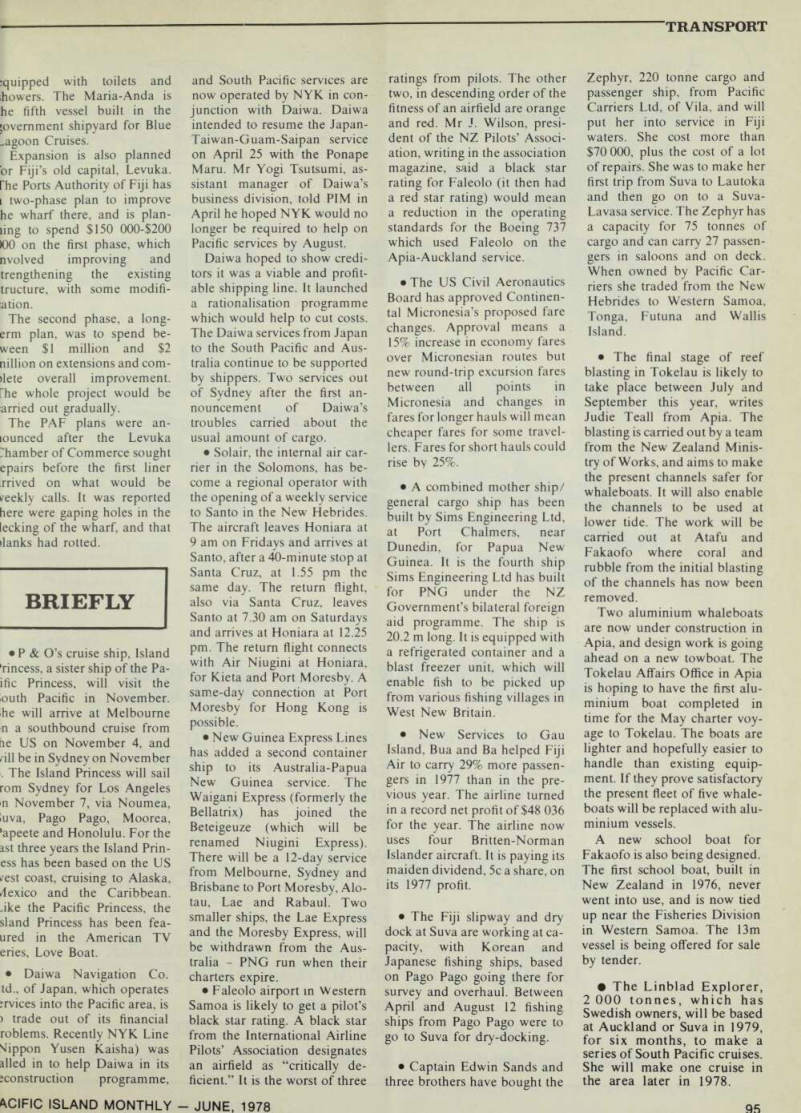
Walu bay slipway.
iquipped with toilets and bowers. The Maria-Anda is he fifth vessel built in the jovemment shipyard for Blue
_agoon Cruises.
Expansion is also planned
or Fiji’s old capital, Levuka. fhe Ports Authority of Fiji has i two-phase plan to improve he wharf there, and is plan ting to spend $l5O 000-$2OO K)0 on the first phase, which nvolved improving and lengthening the existing tructure, with some modifi ation.
The second phase, a long
erm plan, was to spend be
ween $1 million and $2 nillion on extensions and com pete overall improvement, fhe whole project would be arried out gradually.
The PAF plans were an lounced after the Levuka Chamber of Commerce sought epairs before the first liner rrived on what would be weekly calls. It was reported here were gaping holes in the lecking of the wharf, and that ►lanks had rotted.