A Tragic Chapter In The Odyssey
p. 91 · Read in the full issue
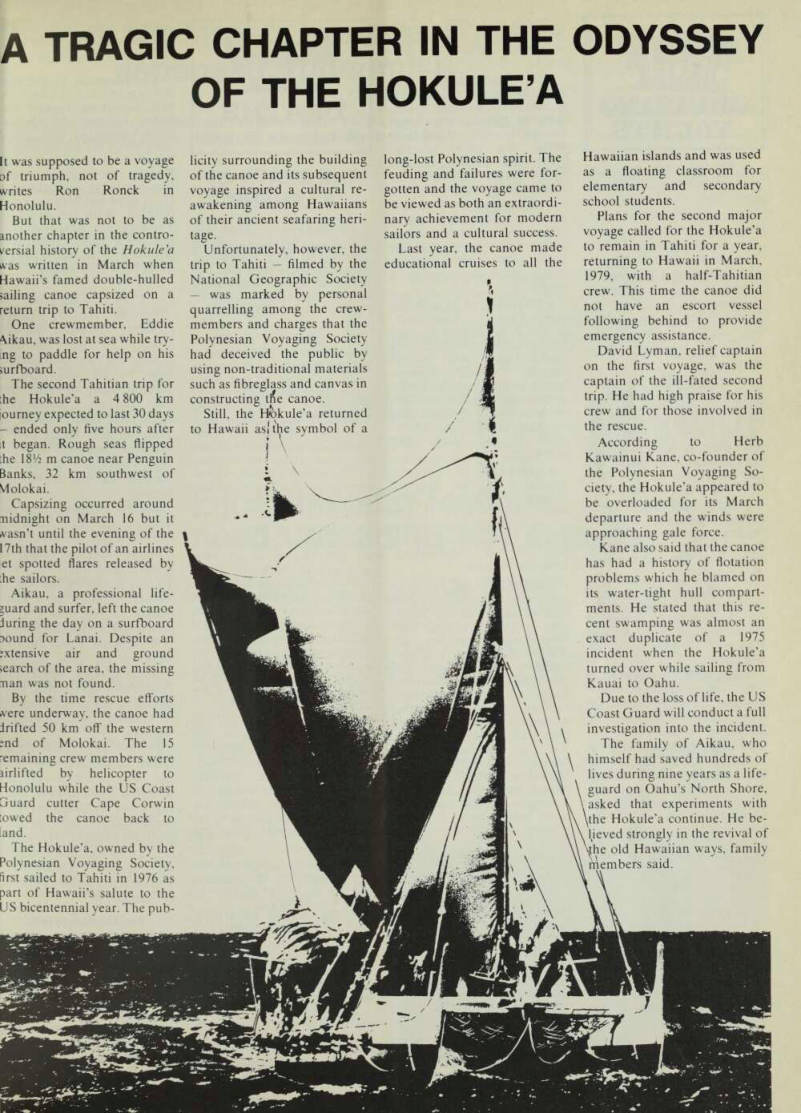
Of The Hokule’A
It was supposed to be a voyage of triumph, not of tragedy, writes Ron Ronck in Honolulu.
But that was not to be as another chapter in the contro versial history of the Hokule’a was written in March when Hawaii’s famed double-hulled jailing canoe capsized on a
return trip to Tahiti.
One crewmember, Eddie \ikau, was lost at sea while try ing to paddle for help on his surfboard.
The second Tahitian trip for :he Hokule’a a 4 800 km oumey expected to last 30 days - ended only five hours after
X began. Rough seas flipped
the 18'/2 m canoe near Penguin Banks, 32 km southwest of Molokai.
Capsizing occurred around nidnight on March 16 but it wasn’t until the evening of the 17th that the pilot of an airlines et spotted flares released by ;he sailors.
Aikau, a professional life guard and surfer, left the canoe during the day on a surfboard sound for Lanai. Despite an
jxtensive air and ground
search of the area, the missing nan was not found.
By the time rescue efforts were underway, the canoe had drifted 50 km off the western ;nd of Molokai. The 15 remaining crew members were
airlifted by helicopter to
Honolulu while the US Coast
Guard cutter Cape Corwin
towed the canoe back to land.
The Hokule’a, owned by the
Polynesian Voyaging Society,
first sailed to Tahiti in 1976 as part of Hawaii’s salute to the US bicentennial year. The pub
licity surrounding the building
of the canoe and its subsequent voyage inspired a cultural re awakening among Hawaiians of their ancient seafaring heri tage.
Unfortunately, however, the trip to Tahiti filmed by the
National Geographic Society
was marked by personal
quarrelling among the crew members and charges that the
Polynesian Voyaging Society
had deceived the public by using non-traditional materials such as fibreglass and canvas in constructing tne canoe.
Still, the Hfekule’a returned to Hawaii aslthe symbol of a ? \
long-lost Polynesian spirit. The feuding and failures were for gotten and the voyage came to be viewed as both an extraordi nary achievement for modern sailors and a cultural success.
Last year, the canoe made educational cruises to all the
Hawaiian islands and was used as a floating classroom for elementary and secondary school students.
Plans for the second major voyage called for the Hokule’a to remain in Tahiti for a year, returning to Hawaii in March, 1979, with a half-Tahitian crew. This time the canoe did not have an escort vessel
following behind to provide
emergency assistance.
David Lyman, relief captain on the first voyage, was the captain of the ill-fated second trip. He had high praise for his crew and for those involved in the rescue.
According to Herb Kawainui Kane, co-founder of
the Polynesian Voyaging So
ciety, the Hokule’a appeared to be overloaded for its March departure and the winds were
approaching gale force.
Kane also said that the canoe has had a history of flotation problems which he blamed on its water-tight hull compart ments. He stated that this re cent swamping was almost an exact duplicate of a 1975 incident when the Hokule’a turned over while sailing from Kauai to Oahu.
Due to the loss of life, the US Coast Guard will conduct a full investigation into the incident.
The family of Aikau, who himself had saved hundreds of lives during nine years as a life guard on Oahu’s North Shore, \ asked that experiments with \the Hokule’a continue. He be \ lieved strongly in the revival of \the old Hawaiian ways, family I members said.