Four brave and practical
pp. 83-86 · Read in the full issue
men in a flying machine
June 9 1978, marks the 50th anniversary of the conclusion of the first flight across the Pacific. To mark the occasion the Australian Post Office has issued four special stamps honouring the two Australian airmen who made the flight, Charles Kingsford Smith and C. T. P. Ulm, and two other famous Australian aviators, Bert Hinkler and Harry Hawker. PIM staff writer Malcolm Salmon commemorates the flight in a special article which draws heavily on the fliers’ own account of it.
There are two main ways to commemorate an outstanding technical achievement of the past, such as the first trans pacific flight made in June 1928 by two Australians, Charles Kingsford Smith and C. T. P. Ulm, and two Americans, Harry Lyon and James Warner.
One is to emphasise the
primitiveness of the equipment
used in comparison with that in use today, the length of time re quired for the feat with the much shorter time in which the same thing can be done today, and so on.
Thus, we could talk about the performance characteristics of the three-engined Fokker monoplane, the Southern Cross, in which the flight was made and compare them with the same features of a Boeing 747; the more than 80 hours the Southern Cross was in the air between San Francisco and Brisbane with the 14 hours re quired for a 747 to make the same flight; the fact that the co pilots, Smith and Ulm, had to communicate with each other and with navigator Lyon and radio man Warner by pencilled messages, due to the deafening roar of the aircraft’s engines; the fact that the interior of the aircraft was completely unpres surised, and that for many hours of the flight the pilots’ legs and feet were soaking wet from rain which persistently leaked through the aircraft’s windshield.
Such matters are no doubt
interesting and impressive, but
they tend to set a distance be tween us and the human beings concerned, to erect barriers where none should be.
The other, and probably less subjective, method is to attempt to see the historic
achievement in terms of the technical levels of the day, and in particular to seek to uncover how the protagonists them selves saw the task they under took.
The immediate technical background to the first trans pacific flight 50 years ago can be briefly stated; the first factor was the tremendous spur given to the development of aviation by World War I, in which Kingsford Smith himself, born in 1897, cut his flying teeth. He won the Military Cross for ser vice with a Royal Flying Corps fighter squadron. Then, equally important, there was the first successful crossing of the Atlantic by air by Colonel Lindbergh in the Spirit of St Louis in 1927. Lindbergh’s flight was followed rapidly by other spectacular achievements in trans-Atlantic flying, no tably by Chamberlain and Levine, and by Byrd.
Smith and Ulm write in their book Story of Southern Cross
Trans-Pacific Flight 1928, a
work which they completed within two months of the flight, and which was off the press be fore 1928 was out;
“These trans-Atlantic flights caused long distance ocean fly ing in heavier than air ma chines to loom larger in aviation than it had ever loomed before. Its feasibility had been demonstrated. The ice, so to speak, had been broken, and broken with an
emphasis that was beyond
cavil.
“And those same trans- Atlantic hops, in addition to proving the theory that we had been propounding for so long as a forlorn hope, had in creased a hundredfold our am bition to be the first to master the Pacific ...
“Long distance flying over
oceans in planes was no longer the fantastic dream that men were disposed to regard it round 1920.”
The courage of these men goes without saying. What was remarkable about them was the extent to which such per
sonal qualities played second
fiddle to “the nuts and bolts” of their venture, the technical requirements for its success
what they called “equipment”
and “organisation.”
Their book is surely the strongest antidote to any “dare devil” theories about their his toric flight. What impresses the reader about it is the rigorously scientific character of their ap proach to the venture, and their
overriding concern with safety
in its execution.
Their motivation is best ex pressed in the following pass
age, describing their thoughts
just before the take-off from San Francisco’s Oakland air field at 8.45 am on May 31, 1928: “Heroics we felt were never less appropriate. We did not look on the venture ahead as being in any sense a dicing with death. Reflections of that kind did not oppress any of the four of us.
“It was no stunt that we essayed, but a calm, considered plan to show the world that
ocean flying in long hops was
a normal development of avi ation, and that given the proper
organisation and equipment it
ceased to be a desperate gamble. We had before us a schedule of flying, and with some justice, we considered we had the most efficient equip ment with which to carry out that schedule. Only the burn ing of gasoline at too rapid a rate, we felt, was the one factor that might have disturbed our schedule. To us the Southern Cross was, so to speak, a Valkyrie that could ride the storm so long as those motors could be fed with fuel. We were not animated by any spirit of bravado, nor were we unduly disturbed by doubts and mis
givings.
“Our aim was to show the world that the Pacific could be spanned by air, not by any des perate struggling to land far from our fixed destination or
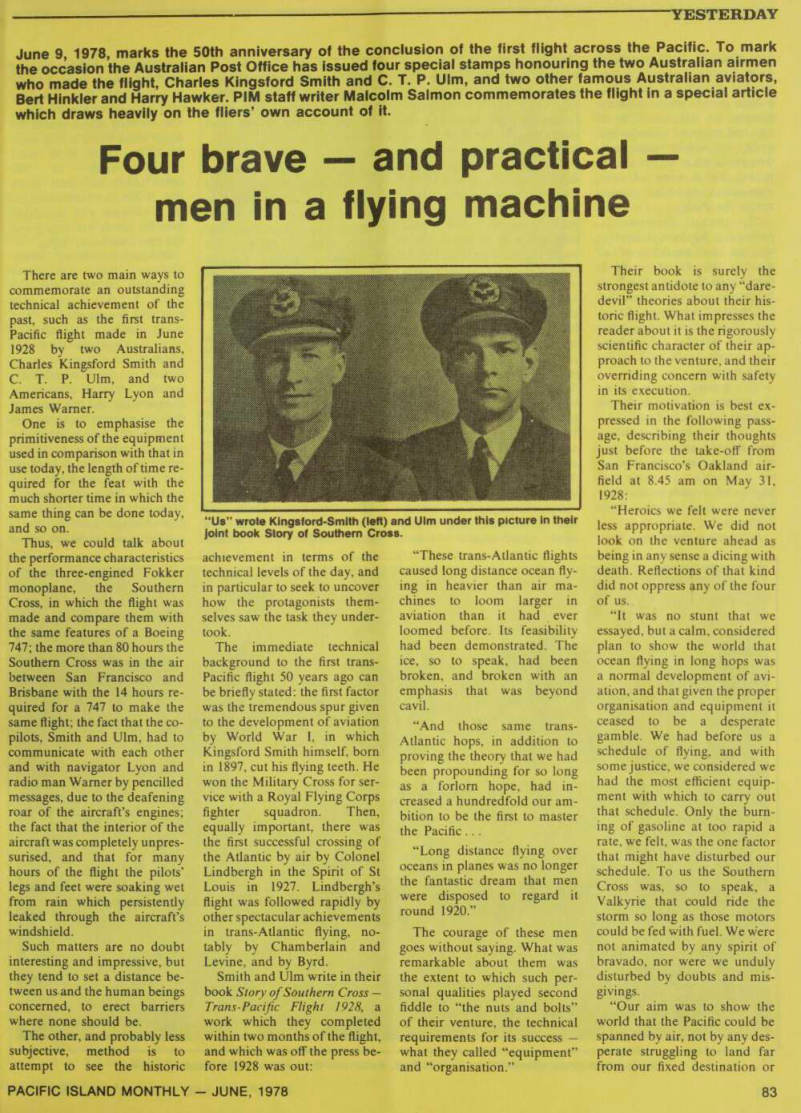
“Us” wrote Kingsford-Smith (left) and Ulm under this picture In their Joint book Story of Southern Cross.
any eleventh hour snatching from disaster, but with a sub
stantial margin of safety. Only
a flight carried out with such a margin, we felt, would be of any real scientific value to avi ation or would adequately determine what we set out to prove, that a route of com munication could be opened across the Pacific.
“To struggle feverishly to
perhaps a haphazard landing
was not at all the basis of our mission. We planned to fly in three hops from Oakland to Brisbane, and any effort that fell short of that by our losing our course and consuming our gasoline, would to us have been tantamount to failure in our main purpose.
“If we were to open an air route that would ever be of any commercial advantage to America or Australia, it had to be a defined air route, as cer tain as the route of a steamship, not a wavering air route that
might end anywhere between
Brisbane and Cape York Peninsula.”
At another point they say:
“In quite a friendly spirit many
of our American airmen friends criticised the meticu lous way in which we prepared for the big flight. Some of them indicated that they thought that we had carried our prep arations to a limit that might have been called ‘too fussy.’
Our safety measures, which were numerous, provoked most comment. They included such things as steel saws and a water still, that fortunately we had no necessity to use. Several other little devices also were not used on the flight. Yet, we are firmly convinced that the hard work, the time, and the money that we spent on those
careful preparations helped us
immensely to our success. We did not regret the loss of one hour of the time that we
employed on that organisation.
We feel that we certainly could not have kept to our schedule as we did had it not been for the completeness of our prep arations.”
So, their aims were strictly serious, scientific, and, in the most fundamental sense,
social. The task they had set themselves was nothing less than to achieve a drastic reduction in the physical gulf dividing the United States and Australia.
Their effort to raise the money necessary for their venture is a story in itself. Their success in this quest was due to two men above all symbolically, one American, and one Australian. They were the Californian rancher, Captain G. Allan Hancock, and the Melbourne businessman, Mr Sidney Myer, founder of the big retail stores chain.
T . f These fund-raising efforts took them much time, and often distracted them from their technical preparations. f 4 , The most important of these r , concerned two questions the . , ■ , techniques of blind flying, and . \ • D*. 5 heavy-load flying. Both were relatively new to them, and mastery of them was crucial to ... J 4 the,r P r °J ect Of blind flying, Smith and Ulm write: “When a pilot can train himself to fly for hours by
instruments, without seeing anything else then and only then is he ‘safe’ to pilot a plane over long stretches of water.
This training in instrument fly ing or blind flying is 90% men fal. The pilot must have implicit faith in the instruments; he must know that, if those instruments regis ter at variance with his senses, then his senses are wrong and the instruments are right.”
Of heavy-load flying: “Every
airplane that has ever embarked on long non-stop flights of 2 000 miles or over has been ‘overloaded’ and overloaded means the carrying 5 & T h c h it was designed to carry " T factors ... It is all a matter of r compromise, and the nature of • , , the compromise must be de j , , . rn- i i cided hy the type of flight the . u r 6 C
t,Z lh„h ‘ T
P . • P° wer oa ln S and comparatively lower wing loading’ the result being a plane with a large lifting sur
face (wing) and relatively
smaller power plant, which, as
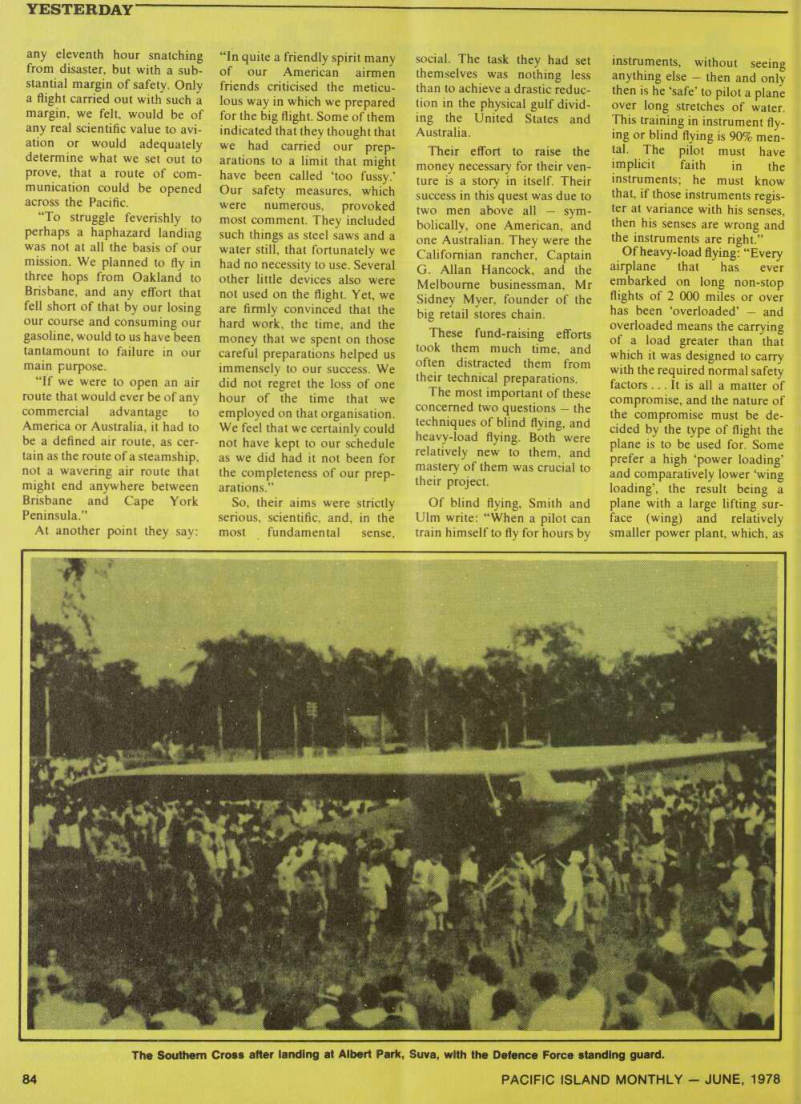
The Southern Cross after landing at Albert Park, Suva, with the Defence Force standing guard.
a whole, results in a slow air speed, a good range in hours, but a poor range in miles.
“On our trans-Pacific flight we needed range in miles, not range in hours. Our task was to determine the most economical speed at which to run our engines to enable us to fly the greatest number of miles, not hours...”
The course and outcome of
their flight offered proof
enough that their many hours of struggling with these prob lems were crowned with suc cess.
The 3 220 km (2 000 ml) flight between Oakland and Wheeler Field, Honolulu, was by far the easiest of their three
historic hops.
In Honolulu, they were reluc tant to use the word “triumph” about their achievement so far.
As they saw it, that term would
only become appropriate when
they landed at Suva, 5 052 km (3 138 ml) away.
Describing their feelings
moments before their beach take-off from Barking Sands on the island of Kauai, they wrote: “On our first hop to Wheeler Field we were following an ocean trail that had been blazed before. At Barking Sands we looked out over a rib bon of surf on to an expanse of ocean that had never been conquered by air, or that never had its conquest attempted.
Ahead of us every mile was to be aerial exploration. We were indeed on the borders of a new air world. Out over the sea there was the thrill and charm
of uncertainty.”
Their anticipation of thrills was not disappointed. Prob lems with the aircraft’s radio, fears of a gasoline leak (the
drips they saw were only
water), bufferings from seem ingly endless rainstorms and the accompanying worries about fuel consumption as they climbed and tacked to get above and around the storms, a short period in which their starboard motor “shimmied” (faltered), and more rainstorms all these things and more filled the long hours of their
mammoth “hop”.
Their first sighting of Fiji is described as follows in their
book: “Our eyes were strained for the first glimpse of the dot that was Fiji. It seemed as if the dot would never show up. So much had we been told of the long shot that we were making for a dot on the map, that we began to think in terms of ‘dots’...
“Ulm was at the controls.
Smith was dozing. Ulm was not expecting land exactly at that moment, when suddenly far ahead on the starboard bow a small dome sprang up from the sea...
“Ulm swung the plane for it The sudden oscillation woke Smith, and his language was forcible and full of colour. He thought Ulm had fallen asleep at the controls. But when he
peered through the windshield
his wrath vanished. It was land!
“There lay the first of the Fijian Islands far out silhouet ted against the angry glare of the sun ...
“Our big goal was in sight.
We were on the verge of tri umph. We had pioneered a new ocean airline of 3100 miles. It was a dramatic mo ment on the Southern Cross.
“The sea dozed lazily in a tropical heat, and the sun was high and relentless. We turned the nose of the plane straight for the small brown dome that grew darker and splashed with
a bronze green as we tore across the gleaming sea towards it. As we swept ahead another small grey-green dome popped up to port, and in the great water lane between these two distant islands other green domes appeared, until the ocean seemed to sprout a ram part of islands right across our path ...”
Let an eye-witness on the ground describe Smith’s his toric landing of the Southern Cross on Suva’s Albert Park, after 34 hours and 33 minutes in the air from take-off at Bark ing Sands. A reporter in the Fiji Times of June 6, 1928, thus de scribed the event of the day be fore: “It was the watchers on the roof of the GP (Suva’s Grand Pacific Hotel) who first saw the speck in the distance which was the Southern Cross ...
“Some distance out he banked and, dropping lower still towards the water, came in a bee-line to the opening which had been made for him, pass ing through the centre of it and right over the white cross which had been laid as a guide.
“From the cross he taxied straight towards the comer of the park and a group of 30 members of the Defence Club, mostly returned soldiers, form ing a volunteer rope gang stood horror-stricken as they felt that
the short hill was not sufficient to pull him up.
“But they reckoned without the wizard pilot. At the foot of the hill he realised this fact and immediately brought the ma chine round to the left, pulling up in a short distance near a great tree on the left and with another to the right and an iron shed on his right front...”
Suva did the aviation pion eers proud, with the Governor, Sir Eyre Hutson, the Mayor, Mr Henry Marks, and all local
dignitaries entertaining them
and showering them with gifts
including a splendid tortoise
shell casket containing 200 sov ereigns.
The Fijian population too was enormously excited by the event. The aviators were presented with a whale’s tooth (tabua) by Ratu Joni Mataitini, the oldest living Fijian and a member of the Legislative Council, in honour of their feat.
They even inspired a legend.
Smith and Ulm write in their book that Fijians in Lomaitivi Province, asked by the solitary European trader there to keep a lookout for the plane, actu ally failed ter see it. But unde terred, and not knowing that on the night of June 4 there was an eclipse of the moon, they formed the view that the shadow on the moon was actu ally the Southern Cross, run ning ahead of schedule on its flight to Suva, and taking a rest on a lunar plateau before con tinuing its flight!
Smith and Ulm commented: “Certainly the idea showed a fine imagination in the natives.
It would have been a boon to us in those squalls that we struck on the night before we got into Suva if we could have flung our grappling iron on to the moon or the tail of a comet for a welcome rest from the storm battering. But we were not the supermen that the natives believed we were.”
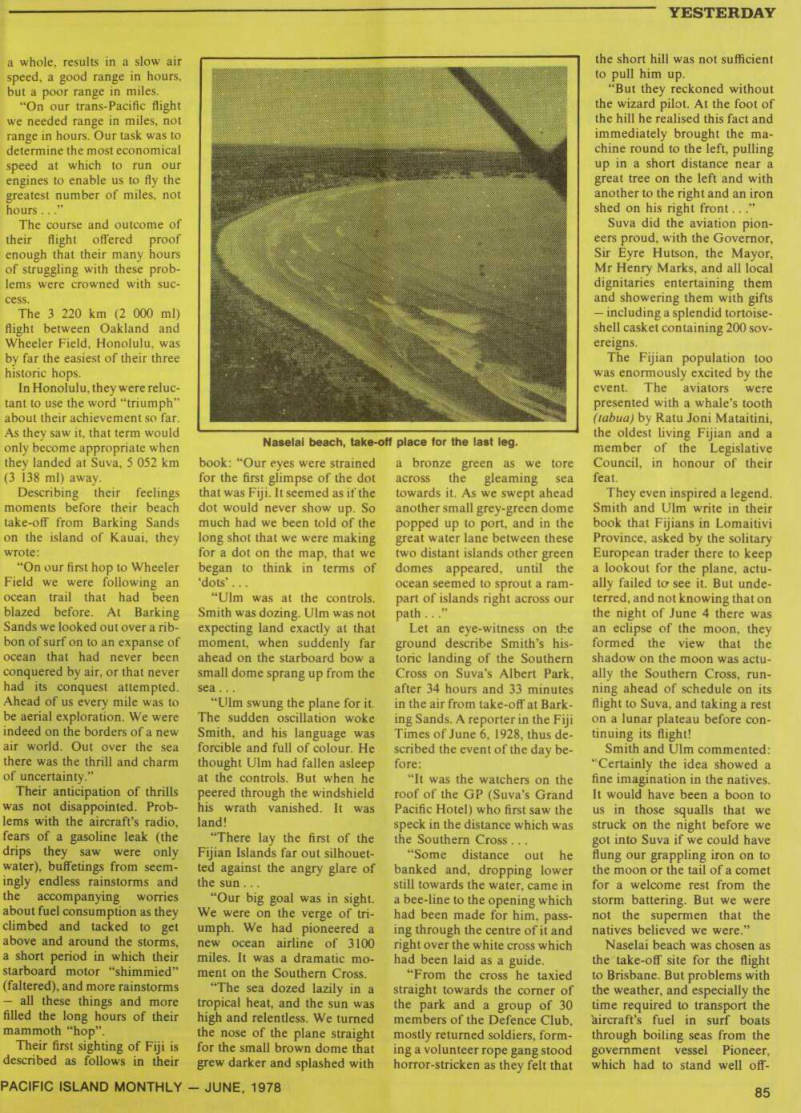
Naselai beach was chosen as the take-off site for the flight to Brisbane. But problems with the weather, and especially the time required to transport the aircraft’s fuel in surf boats through boiling seas from the government vessel Pioneer, which had to stand well off
Naselai beach, take-off place for the last leg.
shore, caused much anxiety and delay. A take-off on Thurs day was finally deemed im possible, so the impatient fliers spent the night on board the Pioneer.
However, they approached the 2427 km (1508 miles) flight to Brisbane with high con fidence it would be a “snack,” they felt, compared with what they had been through. They could not know that incessant storms would make this last and shortest hop of their trans-Pacific flight the most physically arduous of all.
They had not been long in the air on the next day, June 8, when they found that their earth induction compass “probably the most valuable instrument we carried” was
not functioning.
It was their own fault, they wrote. “During the battle of getting the fuel aboard at Naselai beach we completely forgot to oil this instrument.
Without any boasting, we really think that this was the only mistake that we made dur
ing the whole flight...
“We are convinced that had the earth induction compass been functioning we would have hit Brisbane accurately, and would not have struck the Australian coast 110 miles off our course.”
Actually, they came in over the coast at the NSW town of Ballina, turned north and landed at Brisbane’s Eagle Farm airport at 10.50, on the morning of June 9.
The welcomes they received in Brisbane, and later in Syd ney and Melbourne, were well up to the measure of their his toric achievement.
The historic flight was an Australian venture. True, Smith and Ulm pay unstinted tribute to the Americans Lyon and Warner, saying “Without Lyon’s skill as a navigator, and Warner’s skill as a radio oper ator, we would never have crossed the Pacific safely.” But
in conception and leadership,
the feat was Australian.
The 50th anniversary of the flight has called forth a number of reflections on how it was that a country so small in popu lation should come to play such
a role.
In a recent review of a book on Australia’s pioneering avi ation achievements, Australian journalist Robert Macklin noted that they were “wildly out of proportion, inter nationally, to our minuscule population”. Noting the rela tive cheapness of early aircraft, their ease of maintenance, and the great distances confronted on the Australian continent, he says “there was certainly no lack of motivation” for the Australian aviation pioneers.
“But,” he adds, “in all prob ability this will never happen
again. Today’s pioneers, be
they in space travel, medical re search, pure science or even Olympic sports are, almost in evitably, members of a team with the financial and tech
nological back-up that only the
great powers can provide.”
Aspects of the Australian temperament, at least as it manifested itself in those days, also played a part. In an article devoted to an earlier Aus
tralian aviation pioneer, Harry
Hawker, who is also honoured in the current stamp issue, an
English journalist, writing in
the Morning Post in 1919, made the following comments on Australian airmen: “They don’t want the Arch bishop of Canterbury to hold a special service for them before
they get olf the ground; they
are not going to die until they have done everything mortal man can to prevent it; if they do die, they will take it to be absolutely as natural a process as to be bom; and, in the mean time, instead of wasting their time collecting mascots and inventing fancy names for the
machines they fly, they prefer
to do as much of the building of them as time and oppor tunity allow, and they see to it that the financial side of the business is so fixed up that they will not be leaving spots of pov erty behind them.”
The comments might as well have been made about Smith and Ulm in their approach to their great venture of 1928.
As for death: flying claimed the lives of both men in the end. Ulm disappeared off Honolulu in 1934. Smith disap peared in the Bay of Bengal in 1935.
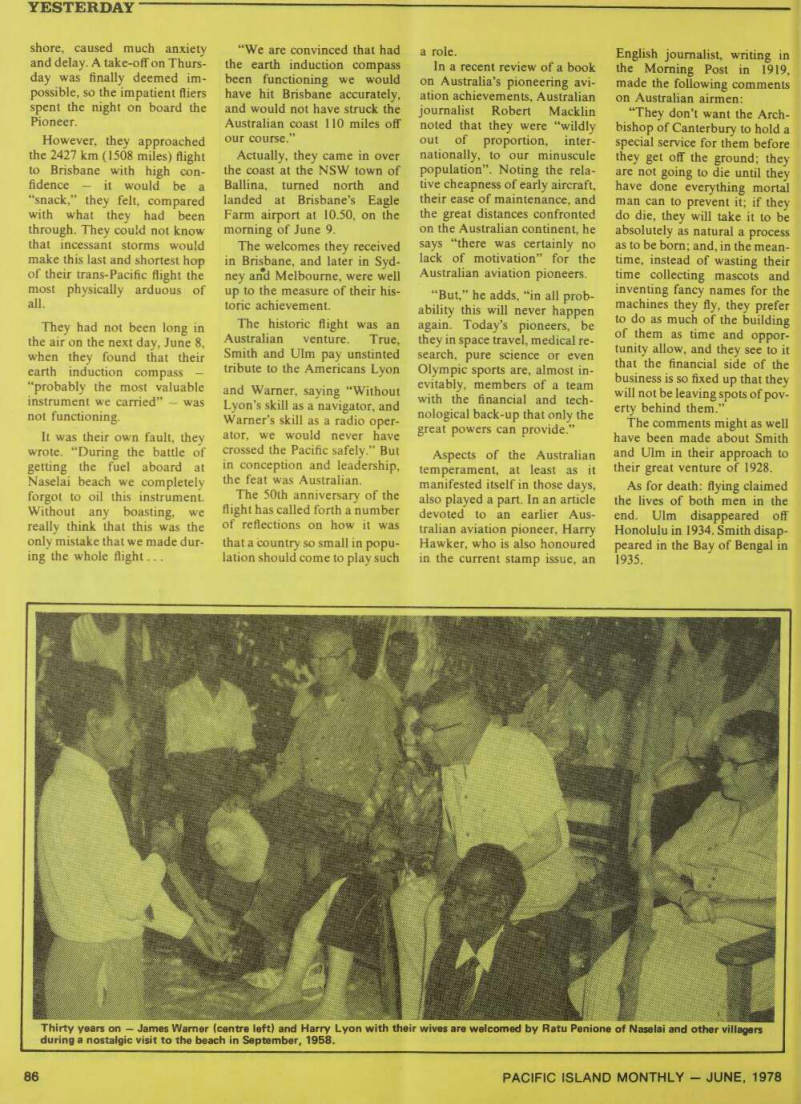
Thirty years on James Warner (centre left) and Harry Lyon with their wives are welcomed by Ratu Penione of Nasetai and other villagers during a nostalgic visit to the beach in September, 1958.