Electronic Winds Of Change
pp. 75-77 · Read in the full issue
Blow Through The Islands
Offices in the Islands are mosny now reeling me usual eiccuumt wmus ui anyc ■■■ merit acquisition regions, writes computer expert Ken McGregor, who has compiled this special section.
Office equipment, which until the last dozen or so years was largely electro-mechanical and didn’t vary much among the various offerings of suppliers, is now a very different ballgame.
In most developed countries,
indeed, projections towards
“automated office” are well in progress with visible and prac tical evidence of many of the key components of this
phenomenon here today.
Action, not surprisingly, has lagged somewhat under the :oconut trees, but with increas ing cost pressures, particularly Tom salary increases, most najor and some smaller, offices in the Islands, are mod
jmising, fast, and choosing
Tom a plethora of products.
Decisions about office jquipment are more complex n places such as Honiara, or Fiji’s Savusavu, lowever, because users must
dioose equipment with servic
ng support very much in nind.
An analysis of major sup )liers, distributors or retailers
elling sophisticated office
:quipment, however, will show hat not too many have made >ver-large servicing commit nents to back up what they ell.
Lack of support to ensure hat equipment sold keeps vorking, indeed, is one of the
najor reasons office equip
nent has not taken off in an :ven bigger way in the slands.
The impetus, meantime, lefinitely appears to be on the
ipturn now. One supplier
>oints out that administrat ve/office costs regions of an >rganisation’s total expendi ure used to comprise 20% to 10% of outgoings.
Today, office costs can range nto the 30% to 40% of total :osts, making the office a focal
)oint for increased efficiency.
And, apart from simply a :ost-cutting exercise, astute itilisation of office equipment
can mean much more infor mation of a more up-to-date nature.
Typewriters and accounting
machines remain the most common, most used and fun damental pieces of office equipment in the Islands.
Change in these two areas alone is not small.
Typewriters are going elec
tric, for both manuals and heavy-duty machines. Various types of golfball varieties are increasingly available, besides IBM. These include Reming ton, Olympia and Olivetti.
Cartridge-type electrics are also on the move Papua New
Trade
Winds
Guinea’s Nationwide Office and Business Machines, of Boroko, headed up by local businessman, John K. Jain tong, recently placed a first order from Sydney for 10 Smith-Corona SM 8000 s.
SM 8000 s are now being
assembled at a new plant at Hornsby, north of Sydney, by President Office Machines, an Australian-owned company headed up by Mr Tom Cooper.
Mr George Prescott, Presi dent’s marketing manager, large corporate and govern ment accounts, said the SC 8000 s were made under licence to SCM Corp, a SUSI billion
plus conglomerate
He foreshadowed further sales into Papua New Guinea
and other island groups, as
President’s cartridge-oriented
units take off.
Typewriters are also being
computerised - hence the , r , . , , * , . modest to-date arrival, but sie- . e t . , rP mficant future, predicted for , r word processers. r A word processer is basically
a heavy-duty electric typewriter, linked to an inbuilt desk minicomputer and either casse,te ° r . ma g netic card media.
On the typewriter console, a .. . T . . . , small extra keyboard controls . .7 operations which involve the t r . . ir . , typwnter itself, typing and
producing standard-type, but
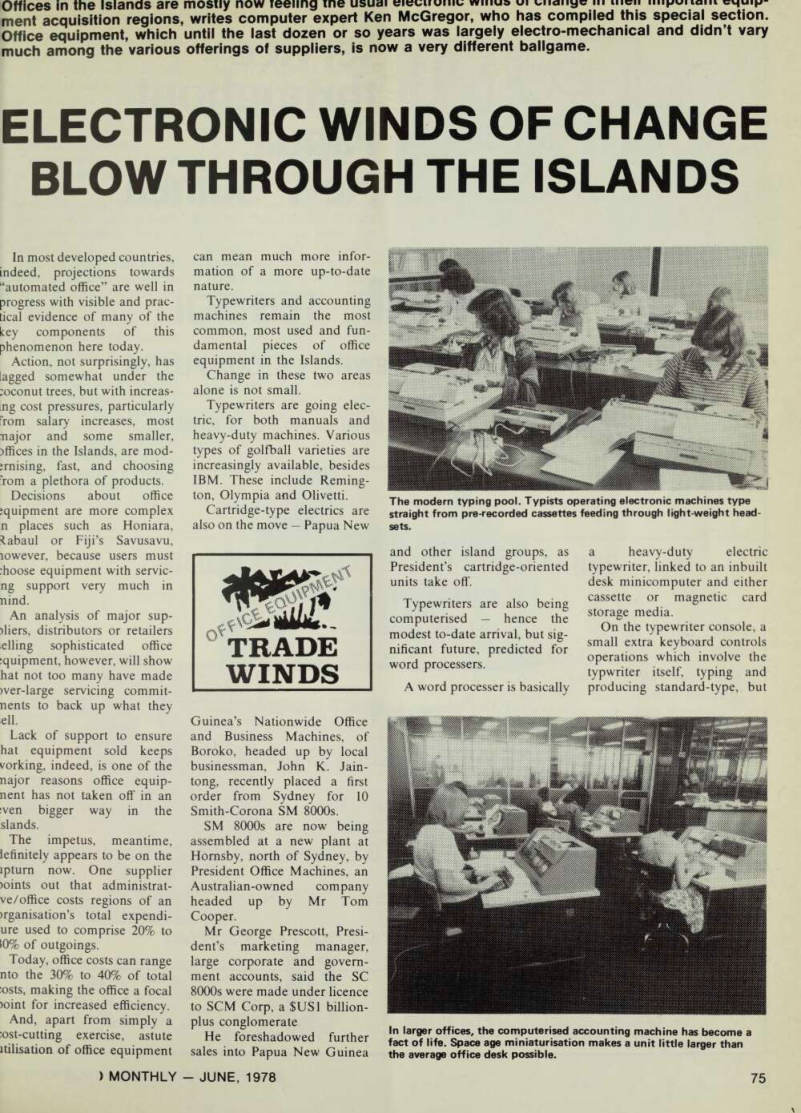
The modern typing pool. Typists operating electronic machines type straight from pre-recorded cassettes feeding through light-weight head sets.
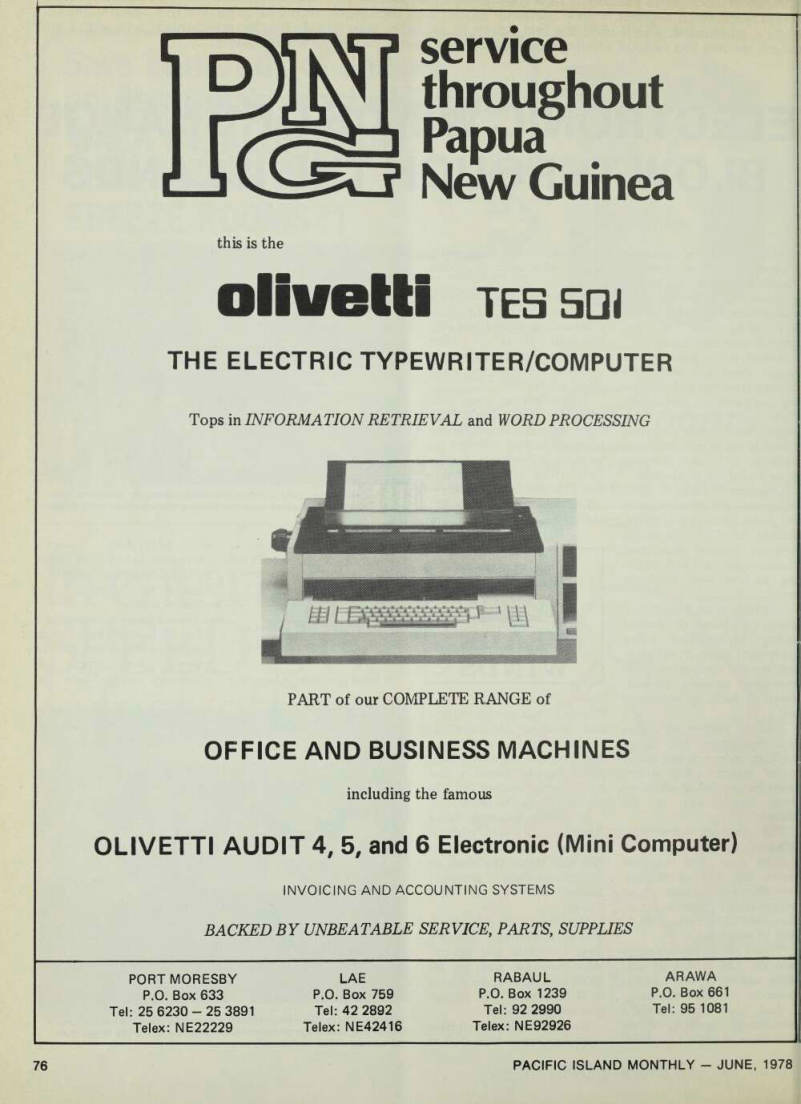
In larger offices, the computerised accounting machine has become a fact of life. Space age miniaturisation makes a unit little larger than the average office desk possible.
still personalised letters in huge volumes.
Here, IBM is leading the way, with initial word process ing installations underway, it is understood, in Papua New Guinea, New Caledonia, Fiji, Tahiti and Micronesia.
The interesting thing here is that despite the arrival of the above systems, sales of manual and electric typewriters remain buoyant, as do sales of com
plementary supplies, such as
ribbons.
Ribbons should not be dis missed as an unimportant re gion when it is considered that an average electric typwriter uses at least 25 ribbons a year, and a word processer can use up to 10 dozen in the same time-frame.
Accounting machines are not changing any less than typewriters, in fact they are changing even more.
Here, the changeover from electro-mechanical to elec tronic status is more obvious, with smaller and more power ful machines handling a
greater volume of tasks,
quicker.
Majors in this market in the Islands include NCR, Bur
roughs and Remington
which is now Australian owned, out of Sydney, Sharp, Canon and a host of others.
Functions of accounting ma chines are merging with the capabilities of office mini computers and already the first “minis” have hit the Islands,
particularly in the bigger-size
cities of Port Moresby, Noumea and Suva.
Office minicomputers mean
yesterday’s computing power
available in the office, at about a quarter of the price, without
the usually costly computer
staff and at about one-tenth the size.
They also mean some formi dable programming or soft
ware packages development,
and this is the region where costs can be high, at least in itially, and systems can become
particularly involved.
Those going office computer should weigh up very carefully
the costs of software pro duction as well as hardware and servicing contracts.
Not to do so, can be disas trous.
Another key equipment
component of most offices is the copier, which in recent years has become smaller. Be fore, copiers were large, ex
pensive and their operations
were heavily centralised.
Japanese, such as Sharp,
Ricoh and Canon, are battling out market supremacy here with others, such as Xerox, 3M and IBM.
Trends in copiers will be largely around the aim of
bringing big advantage fea
tures of large copiers down into
packages of small copiers.
Simply, it’s big systems charac teristics at small systems prices.
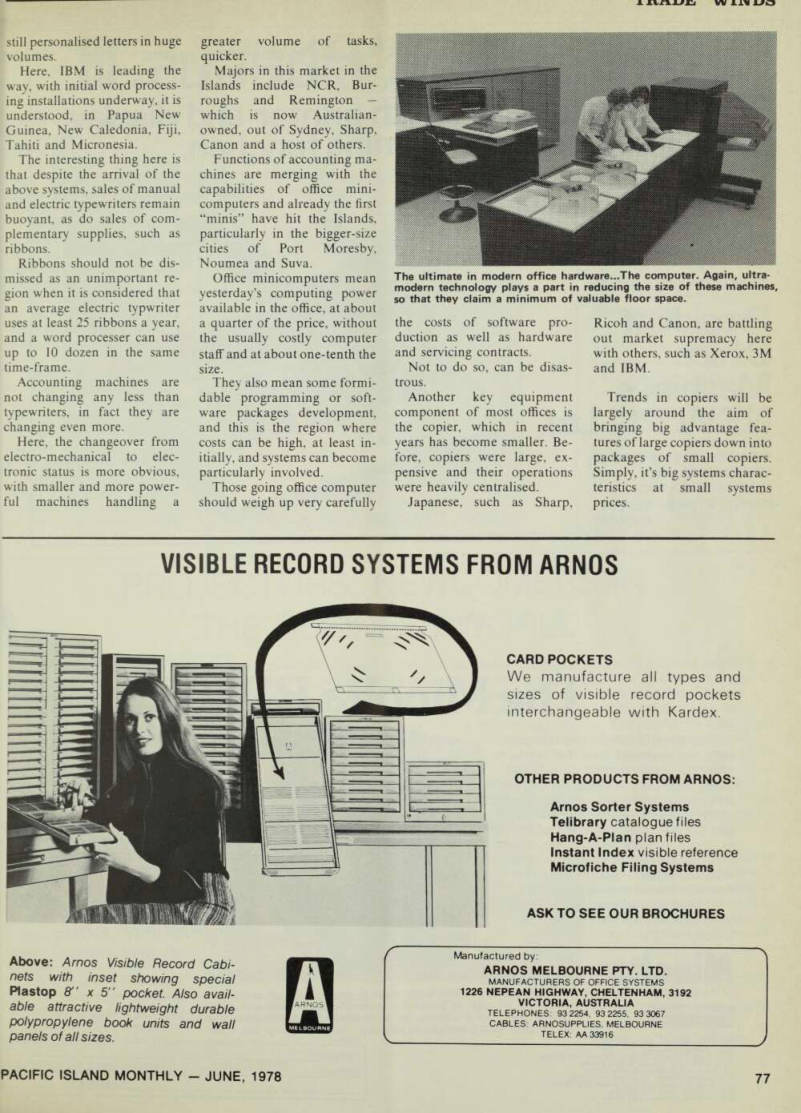
The ultimate in modern office hardware... The computer. Again, ultra modern technology plays a part in reducing the size of these machines, so that they claim a minimum of valuable floor space.