NZ vs. Japan: The midget and
pp. 57-59 · Read in the full issue
the sumo wrestler
Japan and New Zealand are involved in a dispute over trade and fishing rights which has soured relations between the two countries, and could bring substantial changes in the areas fished by Japan’s fleets in the world’s oceans.
In February, special Japanese trade representative.
Mr Zenko Suzuki, visited Wellington for talks with several New Zealand ministers, including the Foreign Minister, Mr Brian Talboys.
Mr Suzuki is a former Japanese Minister for Agriculture. His country was obviously interested in talking about fishing rights in New Zealand’s proclaimed 200mile exclusive economic zone.
But the New Zealand Government, facing a SNZSBB million trading
deficit from 1977, and with elections due in November, was in no mood to negotiate anything but a large increase in Japan’s imports of New Zealand goods.
The Japanese pointed out that they are intending to set aside $ 29 in fiscal 1978 to boost im P° rts from developing countries, and that
Kt P , ,
New Z ? aland ' ,*P u ‘ d B , et * maior share of this boost. This did not tmpress the New Zea land Government I ‘ als ° probably raised the hackles of the New Zealand populace, w h Q do no t appreciate being classified as a “developing country”, however accurate that desC ription might be.
Mr s uzu kj a j so sa j d that Tokyo would take steps to boost imports of New Zealand skim milk, as part of increased spending on schools (in this case school lunches). Once again the New Zealanders did
not find this a substantial con cession.
Totally unsatisfied with these reponses, Mr Talboys announced that his govern ment would not make any effort to negotiate Japanese access to his country’s ex clusive economic zone until Tokyo made a more positive response to Wellington’s call for a greater share in the Japanese market.
The refusal to negotiate on fishing questions was a blow to Japan. Japan has been suffering badly of late as a re sult of the declarations of ex clusive economic zones by a number of countries. This has meant that the Japanese like the Taiwanese, Russians and South Koreans have had to begin negotiating for ancess to areas which they had previously fished quite freely.
In addition to problems created by the zones, Japan is
also involved in disputes over fishing rights with the USSR, Canada and the United States, The USSR has, by flexing its political muscle, gained an agreement with Japan which allows it to double its catch in the Sea of Japan while keeping the Japanese catch to 1977 levels.
In January, the US an nounced its intention to with draw from the trilateral fish ing agreement which had bound it with Japan and Canada. The US was seeking exclusive fishing rights over the migratory species of fish spawned in its rivers, partic ularly salmon. The sum total of the various compromises which Japan was obliged to reach in northern waters meant that she set some store on being able to recoup them in the south.
The New Zealand Govern ment’s refusal to negotiate on
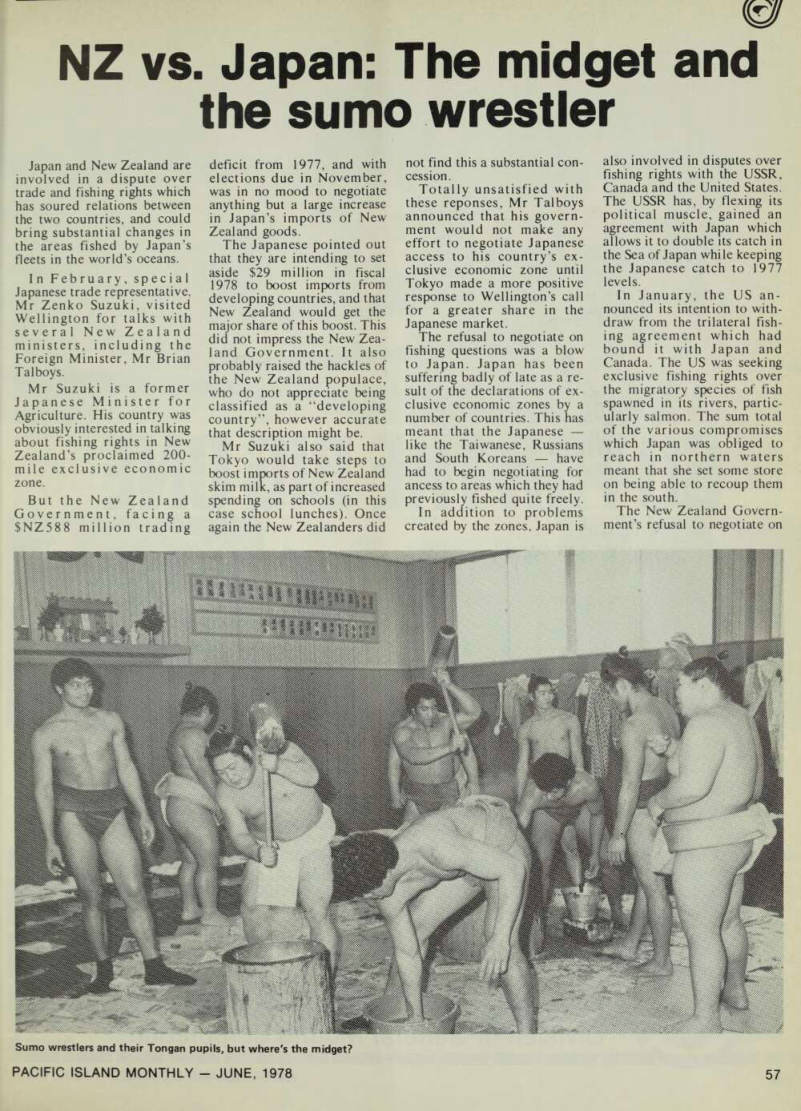
Sumo wrestlers and their Tongan pupils, but where's the midget?
Japanese access to her zone was upsetting. Japanese fishermen in 1976 took 165 000 tonnes of fish from these waters. This was certainly a small amount com pared with the total Japanese catch of 10 million tonnes, but Tokyo obviously hoped for a considerable expansion of it.
However, it was giving no ground. “Japan has no inten tion of meeting this demand,” said a government spokesman in Tokyo of the New Zealand stand.
The effect of various moves against Japanese fishing in both northern and southern waters could result in these vessels turning their at tentions to the more tropical area of the Central and South Pacific where exclusive econ omic zones are less likely to be enforced for want of navies to do the job. Mr Suzuki even threatened, after persistent questioning at a Wellington press conference, that Japan would take its fishing fleet to South African waters if New Zealand remained adamant.
New Zealand’s Prime Minister, Mr Robert Mul doon, in characteristically abrasive fashion, took the dis pute a long way further when he declared in a March speech in Christchurch: “There has been a con siderable element of com mercial imperialism in Japanese activities in the Pacific Basin since World War 11, and to some extent Japan has achieved, by peaceful means, what it failed to do during the war.”
He talked of Japan’s penetration of Pacific markets, and accused the Japanese Government of being oblivious to the fact that trade was “a two-way street”.
Japan was prepared to ac commodate the larger com munities, such as Europe and the United Staes, but “their attitude to smaller countries like New Zealand is to take a much harder line”, Mr Mul doon said.
There was some speculation in Canberra that Mr Muldoon was aiming at more than one of his varied foes. Some Australian trade officials believed that his statement was aimed at least in part at embarrassing the Australian Government, whose Deputy Prime Minister, Mr Anthony, was about to leave for im portant talks on Japan on bilateral trade questions.
In any case, Mr Anthony was quick to dissociate him self from the Muldoon state
ment. “I am not going to be associated with those remarks as I don’t think they apply to Australia,” he said on the eve of his departure for Tokyo. “I don’t see why Australia should buy into Japan-New Zealand problems.”
Arriving for a visit to Australia shortly after Mr Muldoon’s statement, the New Zealand Foreign Minister Mr Talboys denied that he had come to enlist Australia’s help in a united offensive against what he called Japan’s re strictive trade policies.
He said these policies denied his country access to a lucrative livestock products market.
But after 15 years of unsuc cessful negotiations, New Zealand, he said, now had a lever Japan’s interest in continuing to fish within New Zealand’s newly proclaimed 200-mile economic zone.
One New Zealand com mentator has compared New Zealand, in its dispute with Japan, to “a midget trying to break the arm of a sumo wrestler”.
Despite all the brave words about exclusive economic zones, New Zealand will face great problems in enforcing hers. No less a person than the New Zealand Defence Minister, Mr Allan McCrea dy, wrote in the Pacific Defence Reporter (September 1977): “It would not surprise me if, when the coastal states have all established their 200-mile economic zones, New Zealand was found to have the world’s lowest ratio of law-enforce ment resources to square miles of ocean, or of law-en forcement resources to foreign fishing activity. Nor would I be surprised if one concluded from this that the problems in policing New Zealand’s exclusive economic zone were likely to prove overwhelming.”
But if the zone could be en forced even partially, it will be of some benefit to New Zealand’s fishing industry, which has in the past had to compete with fishing vessels from a number of countries in this area.
Official estimates from Wellington put the number of foreign vessels that begin the fishing season in this area in November at close to 600.
These ships compete with the New Zealand vessels mainly for schnapper, which is as highly prized among Kiwis as it is in Tokyo, Seoul, Taipei and Moscow.
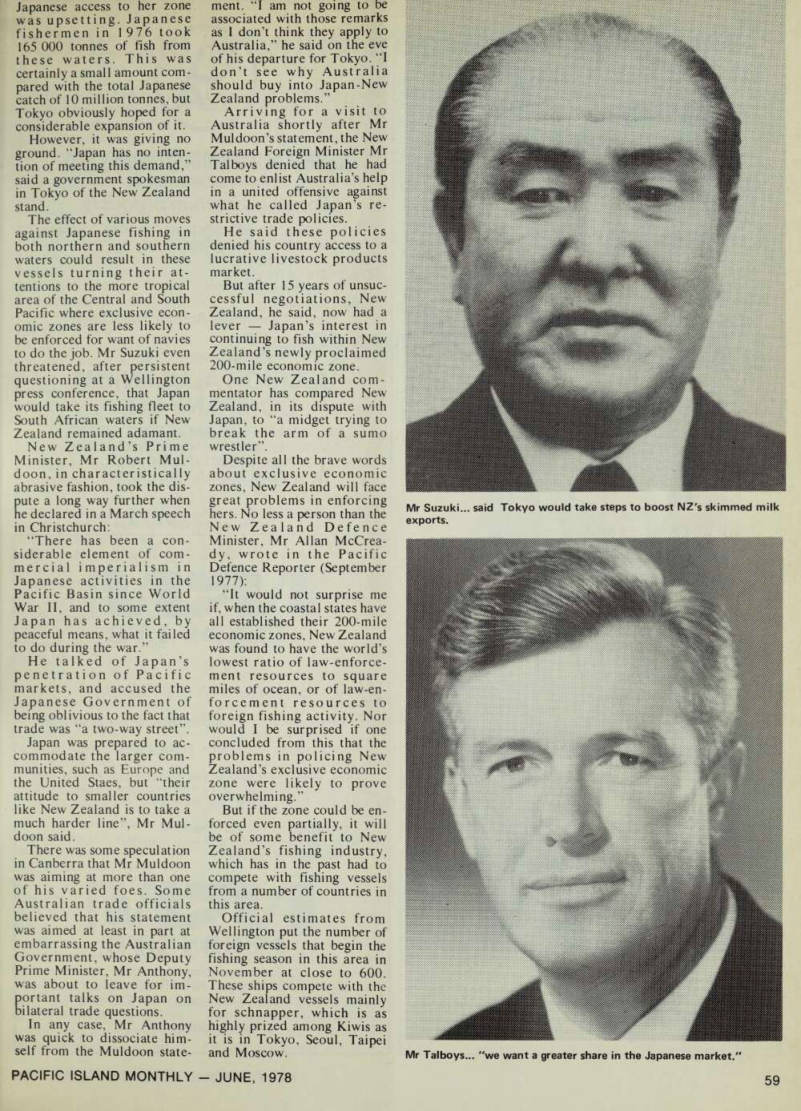
Mr Suzuki... said Tokyo would take steps to boost NZ's skimmed milk exports.
Mr Talboys... "we want a greater share in the Japanese market."