‘By Golly,’ Said The American, And
pp. 53-55 · Read in the full issue
WENT TO LIVE IN HA WKE’S BAY
Ten years ago writes Kate Contos, I pinned a world map to the wall of my New York City apartment and stared at it for five years, searching for an exciting new place to live.
America was great, but I yearned to adventure and ex plore the other side of the world, to widen my horizons, to meet people educated to dif
ferent assumptions.
Today, that map hangs on the wall of my home in New Zealand, where I have lived for five years.
I had been looking for a place that was foreign but not too foreign. Uncrowded, unpolluted, safe, with great
natural beauty. Small enough
to comprehend, to poke into every nook and cranny comfortably. A sunny warm
English-speaking Shangri La
with plumbing, central heating,
good roads, transport and theatres.
And, by golly, there it was, all the time, hanging off the edge of the map. Possibly the last of its kind.
New Zealand’s 1 000-mile length (the same distance as from New York to Florida) encompasses Riviera beaches,
Swiss Alps and Norwegian
fiords on a smaller scale. Part of the country’s charm for any blase traveller jaded by over exposure to the world’s biggest-of everything is that it’s
a perfectly proportioned
miniature. It has a gentle beauty, a modest loveliness punctuated with the spec tacular.
In square miles the size of Colorado, with the population of Connecticut, New Zealand enhances one’s sense of per sonal significance. Being one in 3.1-million people rather than one in unthinkable millions is
downright revitalising.
And for the traveller who loves England it is enchanting to find yet another “precious stone set in a silver sea” but with a special South-Pacific
cum-Australasian character all its own.
American tourists are dis covering New Zealand at last; but too often they tend to fol low a preordained route down the west side of the North Island: Auckland, Waitomo (glow-worm caves), Rotorua (thermal area), Lake Taupo (trout fishing). Chateau Ton gariro (multi-million dollar ski resort), south to Wellington, thence to the South Island.
A fine trip but it bypasses one of the most beautiful prov inces in the country: Hawke’s Bay, on the east coast, where I settled after travelling around both islands for 39 days.
Hawke’s Bay is an area which one should explore by rental car, for it is not just a series of sights to see but a way of life, a state of mind one that will particularly intoxicate
fed-up big-city dwellers who
continue to dream of a place where people live in the
country surrounded by sheep
yet within minutes of cities; a place where one’s eyes do not
continually bump into sky
scrapers; where stars shine at night; where there is time to chat, space to move around (even parking space).
To reach the province from Taupo (and Lake Taupo is a must for any visitor), turning eastward on State Highway 5
brings one immediately into
Hawke’s Bay. The 95-mile
Taupo Road winds through
Kaingaroa Forest, climbs mountains with wide vistas in all directions, then descends to the great curving sweep of blue South Pacific that is Hawke Bay, from the Mahia Peninsula in the northeast to the cliffs of
Cape Kidnappers in the
south.
Hawke Bay (the water) was named by Captain James Cook in 1769 after his boss Sir Edward Hawke, First Lord of
the Admiralty. Cape Kidnap
pers was also named by Cook when local fishermen tried to
make off with his servant boy whom they grabbed out of the water.
The next visitors to the Cape came by air 80 years after Cook: Australasian gannets.
Today Cape Kidnappers is a
world-famous gannet sanc tuary, easily accessible to tour ists.
But this sharp point of land has another name in Maori: Te-Matau-a-Maui (Maui’s fishhook), for this was the hook by which the entire North Island was fished up out of the sea by the demigod Maui. (We have this on the best authority and tourists are advised not to
be taken in by geological chit chat about the unstable circum-Pacific mobile belt and buckling of the earth’s crust).
Hawke’s Bay (the land) is a fertile, prosperous province lit tered with orchards and crops, sheep and cattle, neat farm houses and woolsheds, hun dred year-old-homesteads, and cities in which the highest building is the cathedral bell tower.
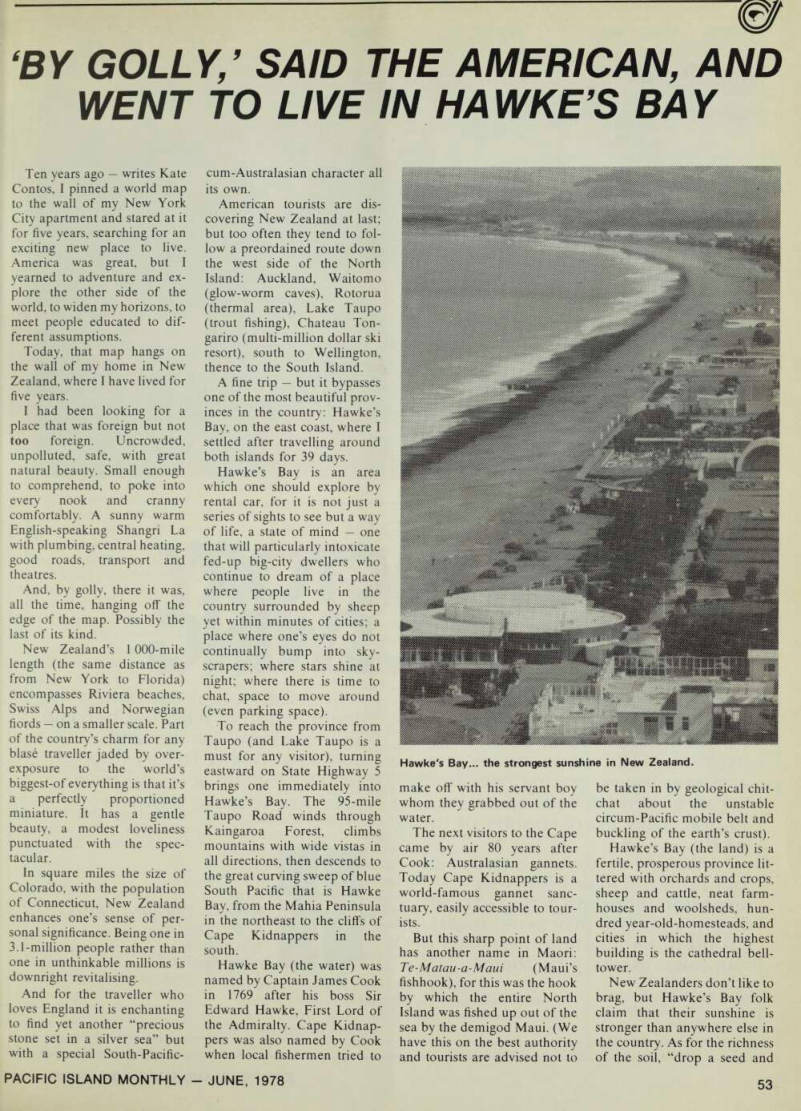
New Zealanders don’t like to brag, but Hawke’s Bay folk claim that their sunshine is stronger than anywhere else in the country. As for the richness of the soil, “drop a seed and
Hawke's Bay... the strongest sunshine in New Zealand.
jump back.” Sheep grow fat, woolly and tasty on lush grass “but of course we feed them mint and garlic as well,” farmers will tell you with
straight faces.
A string of cities runs
through the province from
Wairoa in the north to Wood ville in the south, connected by State Highway 2: Napier, Hast
ings, Waipawa, Waipukurau,
Norsewood and Dannevirke 176 miles then south to the capital of Wellington. A fast modern train, the Endeavour, runs the same route from Napier to Wellington, a
s‘/2-hour trip.
Napier is the largest city
(pop 47 000) and provincial
capital. A sunny, leisurely,
clean town, it rises like an island from the sea. Once called Scinde Island, its Bluff Hill was cut off from the sur rounding flat by marshes and
lagoons.
But in 1931 a devastating earthquake razed the city, and raised the land six feet, drain ing the marshes and providing acres of new land for homes.
Napier doggedly rebuilt
itself, burying its rubble under the seafront and covering it up with a fine Marine Parade lined with pines from Norfolk
Island. Today this promenade
is nationally known as Napier’s “Golden Mile” of entertain ments, to which the city con tinually adds. The latest building is a modern
aquarium, largest in the
southern hemisphere, opened
one year ago.
But Napier is also a commer cial and government centre,
airport, shipping port, import
ant wool exchange, home of
the country’s first community
college and a centre for the arts.
Twelve miles south of Napier is its sister city and vig
orous competitor, Hastings,
pop 34 000. When both cities
acquired concert grand pianos
in the same year, newspaper
headlines happily proclaimed
that Hastings’ piano was three
inches longer than Napier’s.
Besides being a busy farming
service centre with good shops and a gusto for horse-racing,
Hastings enthusiastically pro
motes itself with three names: City of Parks, Hive of Industry and Fruit Bowl of New Zealand all of which are
quite true.
Lush and green all year round, watered by pure under
ground aquifer, these Here
taunga Plains are the largest fruit-growing area in New Zealand. In September and October, Hastings almost disappears in a sea of blossoms.
Roadside stands offer fruits and vegetables fresh out of the ground all year a particular bonus for travellers who like to prepare their own meals in motor camps as a change from hotel and restaurant fare.
Hastings and Napier, indeed
all Hawke’s Bay cities and towns, welcome foreign visitors (“Where in Canada are you from? How do you like New Zealand? Have a cup of tea.”) but this attitude has not
resulted in spurious hospitality
or false fronts.
Unlike many small countries forced to revamp their per sonalities, customs, and way of life to suit tourists, in order to survive, New Zealand is genu ine, building for its own people
and coming generations.
Admittedly some of the smaller villages look like Hollywood western movie frontages, but they too are
genuine, having changed little
from pioneer days. After all, New Zealand is a relatively new country, younger than the USA. There are still general
stores selling everything im
aginable, corner dairies with penny candies, toy-like post offices all of which trigger a nostalgia, a sudden whiff of childhood.
The natives are friendly and if any should be discovered waltzing around in “native cos tume” it is not by arrangement with Walt Disney but more likely the town’s centenary cel ebration, with descendants of the original settlers having a
great time wearing their great grandparents’ Victorian cloth
ing.
Or Maoris might be per forming a serious ritual haka to welcome an important guest to their marae.
Scandinavian costumes would mean the traveller has found his or her way to Norse wood, near Dannevirke, where Olsens and Jensens’ and Maoris are celebrating some
anniversay, perhaps that of
their delightful local museum in which they have lovingly collected artifacts from the last hundred years, including some
brought from Norway and
Sweden in the Hovding in 1872.
Where such museums have been established, with enor mous patience and labour on the part of local citizens, where fine old homesteads have been preserved and there are
many throughout Hawke’s Bay
- where gold-mining towns have been restored, as in the South Island, it is not for love of the tourist buck but because New Zealanders are urgently
occupied with capturing and
preserving their history before
the old folk with their memor ies and cherished souvenirs pass away.
But such serendipitous sights
and places are likely to reveal themselves only to the seren dipitous traveller who takes time to poke into corners, invite conversation, ask the way, exchange stories.
Such a traveller cruising around in the northwest country of Hawke’s Bay will come upon a place called Puketitiri and screech to a halt at the sight of three windmills and invitation to visit a fine pri vate museum, miles from any where.
Or in the southwest a sign will appear pointing to
Taumatawhakatangihang
akoauauotamateaturipuka-
kapikimaungahoronukupo-
kaiwhenuakitanatahu.
“This region,” wrote the French explorer Dumont D’Urville about Hawke’s Bay in his diary for Feb 3, 1827, “is undoubtedly the one which I found the richest and most at tractive scenery in the whole of New Zealand.”