weird and wonderful things
pp. 47-50 · Read in the full issue

New Zealand’s midget dinosaurs and weird and wonderful things
Superb scenery, splendid bathing, fishing, hiking, quiet valleys, majestic mountains, hot springs, snow slopes, volcanoes, glaciers - New Zealand has them all, in greater variety than almost anywhere in the world. But it’s got more throwbacks to pre-history and other weird and wonderful things. Below, Kendrick Howard tells about “weird and wonderful” New Zealand.
On a rocky island off the coast of New Zealand some thing stirs in the bracken. A scaly claw appears from a half hidden burrow, followed by a reptilian head with two hooded unblinking eyes and a squat lizard-like body heaves out of the dark ages into twentieth
century sunlight.
Looking as though he’s just
wandered onto the set of a sci-fi film this creature the tuatara is the answer to a special effects man’s prayer.
Fully matured, the tuatara is only about 60cm (2 ft) in length but reproduce a close-up of this fellow on the wide screen and you have a near-perfect replica of the prehistoric dinosaur.
What’s more, he’s authentic down to the last vertebra.
This creature is not a lizard;
it belongs to a group of ancient reptiles whose ancestry dates back millions of years to the Mesozoic Age the age of the dinosaurs! Only the tuatara has survived and he, virtually un
changed, as though by-passed
by evolution.
One clue may be found in its strange metabolism. From studies that have been made, it would seem that the tuatara’s life-span is linked to an entirely different time-scale from our own.
Although they move quickly
when hunting insects, their natural state is one of monumental calm. The breathing-rate is much slower than in other vertebrates. One specimen clocked did not breathe at all during a 60minute period. It is as though
these creatures exist in a state of suspended animation which makes time meaningless.
This living fossil is only one of many oddities among the fauna and flora of New Zealand.
This land has some of the world’s strangest plants, including a giant lily as tall as a tree; a pine tree that, fully grown, is no bigger than a
gladiolus; and the largest
member of the violet family: the mahoe which is covered with tiny violet blooms and grows to an enormous 10m (32 ft).
Geologists have long sought
the answers to such classic New Zealand riddles as the remark able “pancake” rock forma tions at Punakaiki on the west coast of the South Island, and
the Moeraki Boulders, an even more intriguing oddity, on the east coast.
There is a scientific expla nation as to how nature came to cook up enormous limestone formations resembling stacks of pancakes, but no one can even hazard a guess as to the significance of the boulders.
On Moeraki Beach, near Dunedin, are hundreds of almost perfectly round boulders ranging in size from golfball to beach-ball dimen sions. One boulder, almost as tall as a man, looks like a rather worn tennis ball. How were they formed? And where did
they come from? Geologists
attempting to answer this riddle have lost in straight sets.
Punakaiki’s pancakes and
Moeraki’s boulders both have easy access from a main high way and are popular attrac tions.
In New Zealand, nature is seen in her most whimsical mood. Here you will find mountain lakes high above the clouds, deep-water harbours in what once were the craters of volcanoes, and “hot” and “cold” attractions in both islands volcanoes in the North and glaciers in the South.
New Zealand has some of
the longest valley glaciers out
side the polar regions. Tasman glacier in Mount Cook National Park, an enormous river of ice some 27 kilometres
in length, is a popular play
ground with high-altitude
skiers.
Mt Ruapehu, a volcano in Tongariro National Park, is also a winter ski resort. A lake at 2 615 m (8 500 ft), stoked by the fires within the mountain, is warm enough to swim in, but because of the danger of con tamination from acids, visitors are warned not to take the
plunge.
Glaciers, volcanoes, these were the great creators, the
country’s main geological in
fluences. The primeval gran deur of the South Island, the fiords, the magnificent lakes that have become tourist
attractions, these are the result of glacial action.
Thousands of years ago, rivers of slow-moving ice ploughed down from high snow basins, bulldozing a path relentlessly to the sea. Geolo gists say that in places this ice was hundreds of metres deep.
At Lake Manapouri, it gouged a basin 40km long to a depth of 450 m (1 468 ft).
Of the 475 lakes in the South Island lakes a half kilometre, or more, in area 268 are glacial lakes. The largest, Lake Te Anau, covers 347.5 km.
But the bulldozing propensi
ties of the glaciers is insig nificant compared with the tremendous power and excavating abilities of the vol canoes. Of the 294 North Island lakes, 29 were created by
volcanic eruptions, including
this country’s largest lake and its longest river.
Reconstructing this event, geologists say the lake basin was gouged out by a series of eruptions so tremendous that pulverised rock showered over half the North Island. They left a crater covering 622 square kilometres and a 425 km rift that split the land clear to the sea.
This crater, in the centre of the island, is now Lake Taupo and the rift is the mighty Waikato river.
Lake Taupo, today re
nowned as a famous fishing “hole” is more than a lake, it is an inland sea. It even has an olf-shore island. Actually, Motutaiko Island is a volcanic plug, a column of solidified lava stoppering the vent of a once-active volcano. Areas of bubbling water from hot springs on the lake bed suggest that this activity is far from extinct.
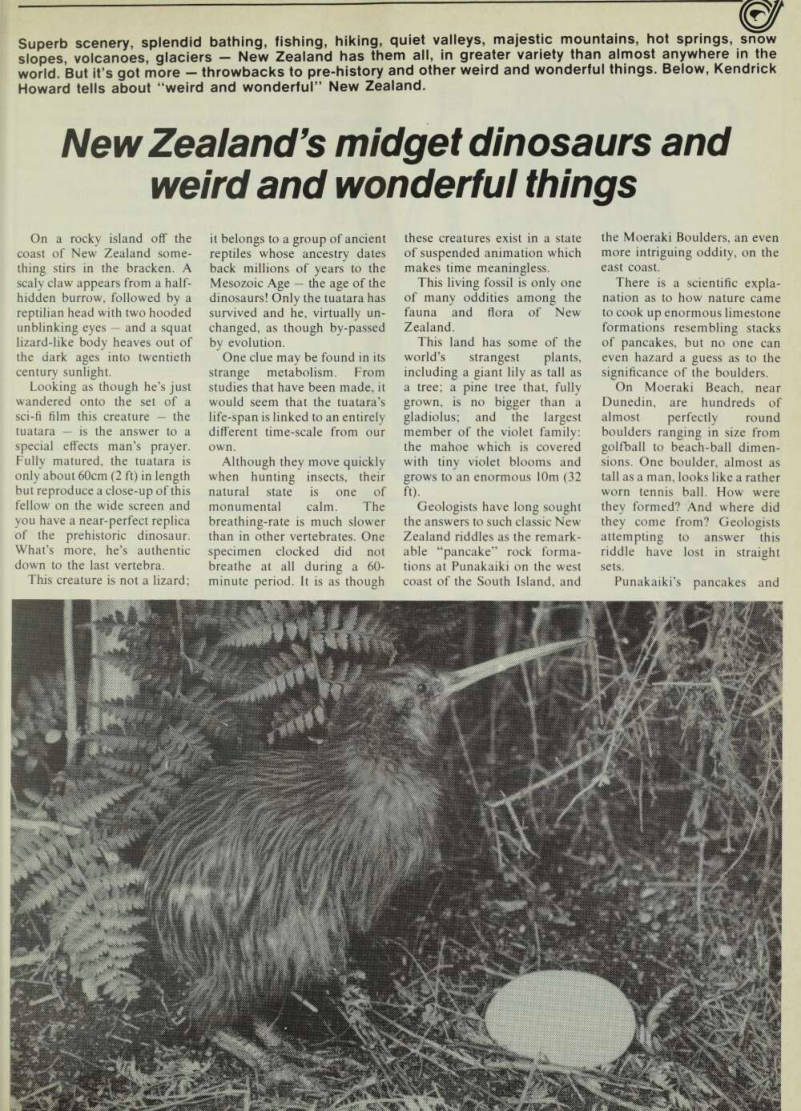
New Zealand is also the home of a strange race of flightless birds not found else
where on earth. Most are now extinct but as they were the only form of wildlife (apart from the tuatara) they are of immense historical import ance.
Only the kiwi, takahe and kakapo were alive when the first Europeans came to this land, but archaeological dis coveries confirm that the great eagle (Harpagornis) and one
moa species (Eurapteryx) were
alive when the first Polynesians came. The giant woodhen, wingless goose, swan, and the
larger moas died out centuries ago.
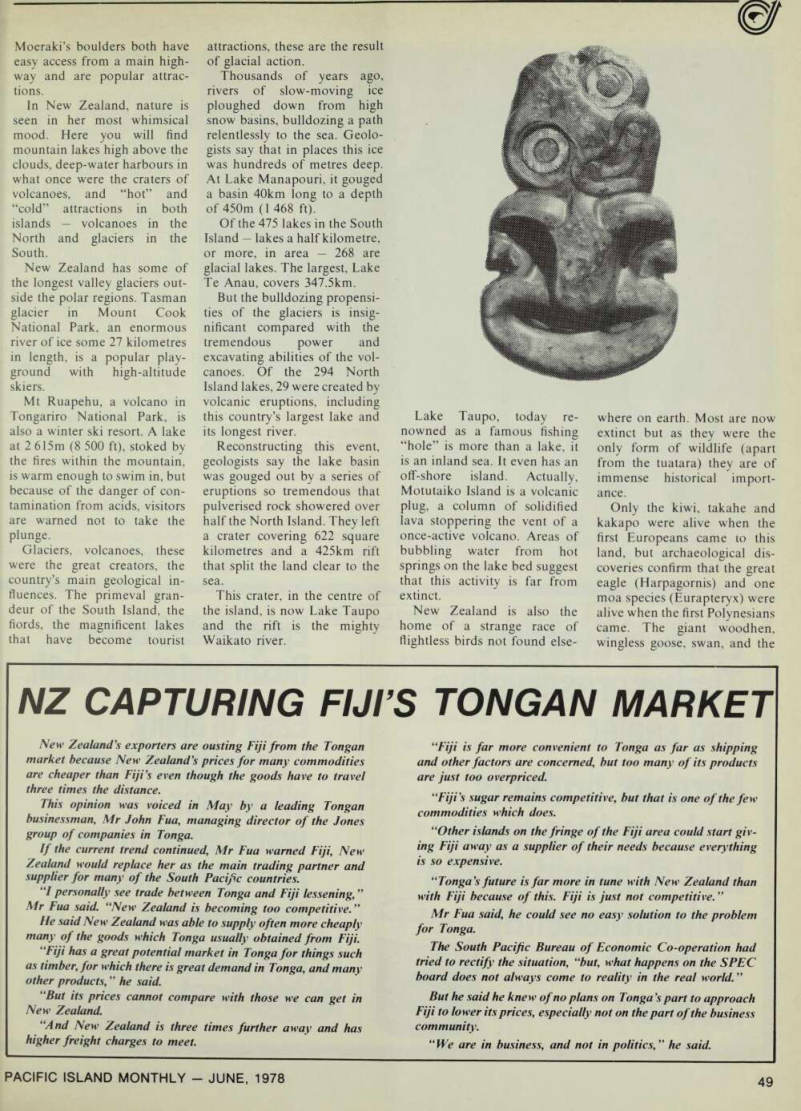
The moa had to be seen to be believed. Until the first complete skeletons were unearthed, few European scientists would believe that the bones of this creature were those of a bird. The largest of thp mnas rHinomic maximUS)
stood taller than any of the mammals except the giraffe.
This great lumbering monster had legbones bigger than a cart horse, a three metre stride, and ate as much as a bullock.
Moa remains have been found in grassland zones all over the country. Farmers breaking in virgin land, still
find gizzard crops heaps of pebbles, up to 200 in number that these birds regurgitated when they became worn and useless.
By far the most spectacular discovery was on a farm at Pyramid Valley on the Canter bury Plains in the South Island.
A field partv from Canterbury
Museum excavating this site, a former swamp into which the birds had tumbled and became trapped, found the remains of the giant woodhen, great eagle, and four moa species. Using the radio-carbon dating tech nique, physicists at the Institute of Nuclear Science were able to show that these remains are at least 3 600 years old.
More than 150 complete skeletons have been removed, but archaeologists estimate that this site could contain as many as 2 000 skeletons.
Today, Pyramid Valley is to Canterbury Museum what Pompeii is to the National Mu seum of Naples. This New Zealand museum which has a virtual monopoly on moa skel etons, is in world class. • Visitors to New Zealand can see the kiwi, the country's national symbol, at special view ing enclosures in Auckland, Napier, Rotorua and Otorohanga. The rare tuatara can be viewed at Napier and Invercargill. Skeletons and rep licas of the extinct moa can be seen at the Auckland War Memorial Museum and Canter bury Muspum.
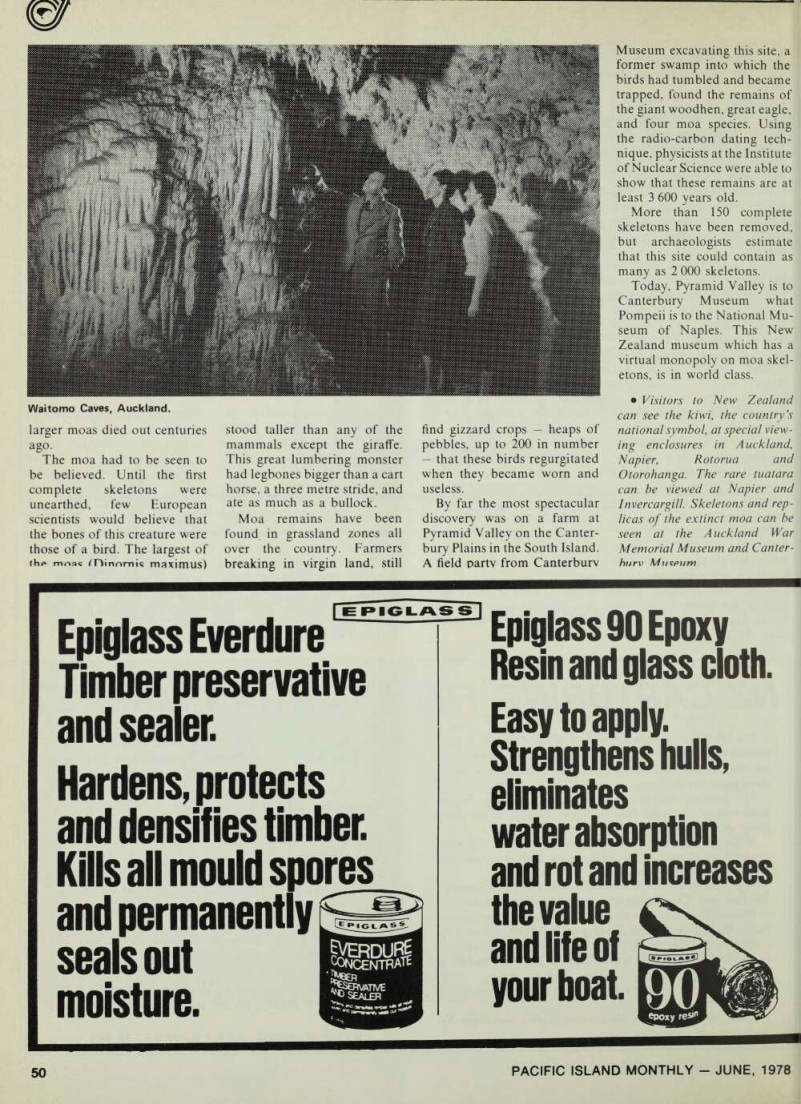
Waitomo Caves, Auckland.