Political
pp. 18-20 · Read in the full issue
Currents
Solomons:
West Rumbles
As the Solomons’ indepen dence day looms on July 7, re newed calls are being heard for independent, or semi independent, status for the Western Solomons, writes Peter L. Young from Honiara.
Following earlier murmur ings of discontent from some Western members of the Legis lative Assembly, it had been widely assumed that those re sponsible had had second
thoughts after discovering that
their autonomist ideas were not as popular at home as they had believed.
But the Western Local Council, the local government body for these islands, has re vived the whole issue by voic ing support for some measure of independence for their area.
The council’s move was soon backed by a walkout by five Western members of the Legis lative Assembly. The members said in a prepared statement that they wished to see the details of the country’s pro
posed provincial government
set-up clearly worked out be
fore independence.
Their demand reflects a widespread confusion in the Solomons as to what provincial government actually means a confusion the Kenilorea government has done little to clear up.
According to Deputy Chief
Minister Benedict Kinika, the new provincial governments will be very much the present local governments under a new name, and with a few ad ditional powers. The area com mittees which function at present under the local govern ments will be renamed as local governments. This will give the
Solomons a three-tiered governmental set-up: central
government, provincial
governments and local govern ments.
It seems that in introducing what seems to amount to little more than a change of name the Kenilorea government may
have caused regional political
expectations to rise far more than was intended, or than is
justified.
It is notable that Mr Kenilorea, so far at least, appears not to be giving the Western issue top political pri ority. He is dealing with the Western Council through the normal channels, specifically,
through Mr Francis Hilly,
Minister for Home Affairs. Mr Hilly himself represents a Western electorate.
The West Solomons is the most commercialised part of the country, with both large
copra plantations and large
scale logging operations.
Partly as a result of this, it also has the greatest area of alienated land of any part of the Solomons. Melanesian atti tudes towards land alienation
being traditionally strong, this
issue continues to be a sensitive one.
There is the further compli cation that it is the area of the controversial settlement by the former British administration of Micronesians from the Gil bert and Phoenix Islands dur ing the 19505. Whether any of the mutual antipathy felt be tween some Micronesians and some Melanesians in the West is widely based is not clear. But the tip of a possible iceberg of
racial disharmony has certainly
been sighted more than once.
Westerners are also upset that despite the fact that theirs is the most commercially pro ductive area, they have not
been receiving the develop
ment funds they feel they need.
They complain that although
they bear a greater share of the tax burden, their taxes are going to develop other areas. (A recent government survey showed that the average West ern Solomon Islander in em ployment earned close to twice as much as the national aver
age.)
The dispute has led to hasty
rounds of meetings between the government, the Western Council executive and the boy cotting Western members of
the Legislative Assembly.
There have been threats that the Western Council would boycott the independence cel ebrations, and that it might even make a unilateral declar ation of independence.
It is clear that no matter what immediate measures are taken, the basis for Western dis sidence will continue long after
independence.
New Png
Opposition
Papua New Guinea had a new Opposition when the National Parliament resumed on May 23.
The Opposition the Peoples United Front has de fined its responsibilities as “to oppose, to expose and to de pose,” and announced immediate planning for an alternative national develop
ment policy.
But there is already some questioning of how well the controversial new Opposition leader, Mr lambakey Okuk, will be able to maintain unity and control in what is a very mixed political group.
There is speculation, too, on the extent to which the
obviously aggressive attitude
being planned by the Oppo
sition could influence govern
ment policies.
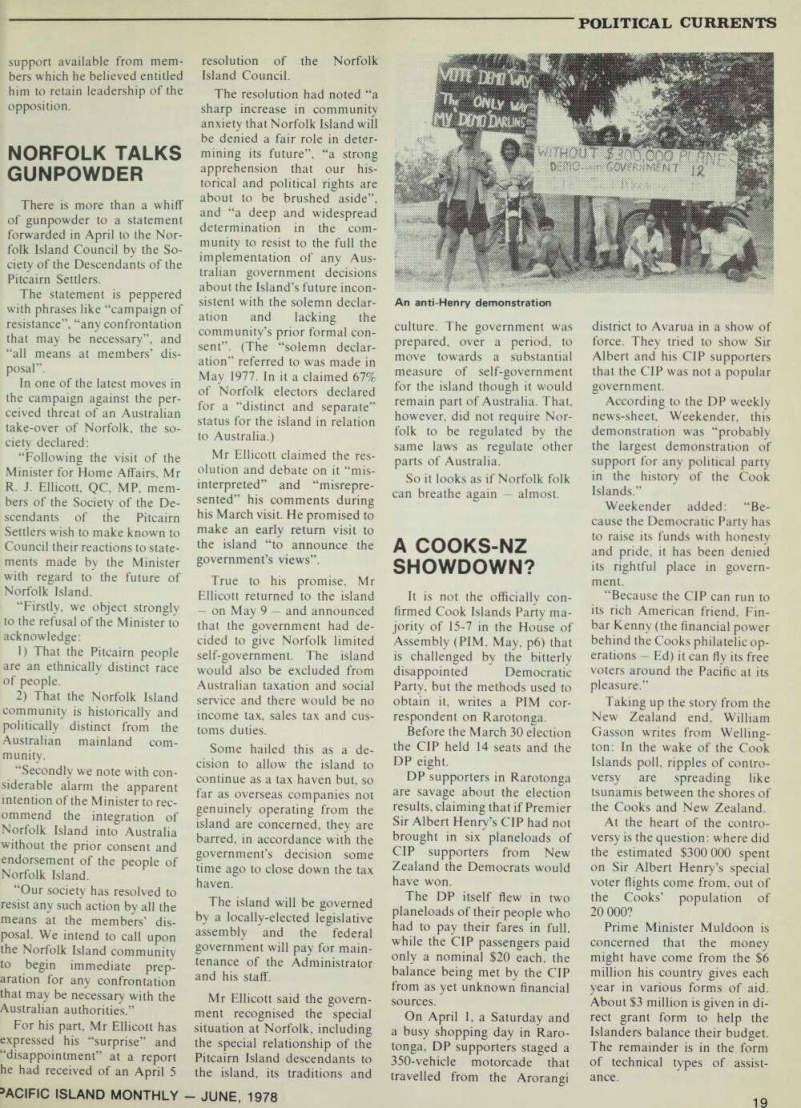
Mr Okuk, 35, a former motor mechanic, comes from the Chimbu area of the PNG Highlands and has been an MP since 1972. He has ousted Sir Tei Abal from the leadership.
The nucleus of the new Op position is drawn from former United Party members, from Mr Okuk’s own United Front, from the Papua Besena group and from an assorted collection
of independents. The previous
political attitudes of some of these members were often poles apart, and this has con tributed to speculation that Mr Okuk may strike trouble hold
ing the group together.
Personally and politically, he
is one of the most controversial figures in parliament. He was
a former minister in the Somare Government first for agriculture and later for trans port but he was dropped from cabinet after falling out with the leadership.
This drove him by fairly gradual stages into hard oppo sition, culminating in his suc cessful bid for leadership of a new look opposition.
Another controversial figure in the new Opposition is Sir John Guise, once a govern ment minister and who later re signed as Governor-General to re-enter politics. Mr Okuk and Sir John both tend to be at odds with Prime Minister Somare, in contrast to the friendship-in opposition which marked re lations between Mr Somare and Sir Tei Abal.
The complexity of the group is heightened by the inclusion
of Miss Josephine Abaijah’s
Papua Besena, a group inherently out of step with
highland-inspired politics.
Mr Okuk believes he will produce “the first effective Op position this country has known”. His supporters said this soon after his appointment was confirmed.
They said he was concerned
that the previous opposition
had bowed too often to govern ment policies and had been ineffective in its watchdog role.
Sir Tei Abal has described as
“outrageous” his displacement
from leadership. He claimed the speaker, Mr Dibela, has; made a serious error in recog nising Mr Okuk as the new Leader of the Opposition.
Sir Tei said he would test the matter in parliament. He would also demonstrate the
Mr. Okuk
support available from mem bers which he believed entitled him to retain leadership of the
opposition.
Norfolk Talks
Gunpowder
There is more than a whiff of gunpowder to a statement forwarded in April to the Nor folk Island Council by the So ciety of the Descendants of the Pitcairn Settlers.
The statement is peppered with phrases like “campaign of resistance”, “any confrontation that may be necessary”, and “all means at members’ dis
posal”.
In one of the latest moves in the campaign against the per ceived threat of an Australian take-over of Norfolk, the so
ciety declared:
“Following the visit of the Minister for Home Affairs, Mr R. J. Ellicott, QC, MP, mem bers of the Society of the De scendants of the Pitcairn Settlers wish to make known to Council their reactions to state ments made by the Minister with regard to the future of Norfolk Island.
“Firstly, we object strongly
to the refusal of the Minister to
acknowledge:
1) That the Pitcairn people are an ethnically distinct race of people. 2) That the Norfolk Island
community is historically and
politically distinct from the Australian mainland com
munity.
“Secondly we note with con siderable alarm the apparent intention of the Minister to rec ommend the integration of Norfolk Island into Australia without the prior consent and endorsement of the people of Norfolk Island.
“Our society has resolved to resist any such action by all the means at the members’ dis posal. We intend to call upon the Norfolk Island community to begin immediate prep aration for any confrontation that may be necessary with the Australian authorities.”
For his part, Mr Ellicott has
expressed his “surprise” and
“disappointment” at a report he had received of an April 5
resolution of the Norfolk Island Council.
The resolution had noted “a sharp increase in community anxiety that Norfolk Island will be denied a fair role in deter mining its future”, “a strong apprehension that our his torical and political rights are about to be brushed aside”, and “a deep and widespread determination in the com munity to resist to the full the implementation of any Aus tralian government decisions about the Island’s future incon sistent with the solemn declar ation and lacking the community’s prior formal con sent”. (The “solemn declar ation” referred to was made in May 1977. In it a claimed 67% of Norfolk electors declared for a “distinct and separate” status for the island in relation to Australia.) Mr Ellicott claimed the res olution and debate on it “mis
interpreted” and “misrepre
sented” his comments during his March visit. He promised to make an early return visit to the island “to announce the government’s views”.
True to his promise, Mr Ellicott returned to the island on May 9 and announced that the government had de cided to give Norfolk limited self-government. The island would also be excluded from Australian taxation and social service and there would be no income tax, sales tax and cus toms duties.
Some hailed this as a de cision to allow the island to continue as a tax haven but, so far as overseas companies not
genuinely operating from the
island are concerned, they are barred, in accordance with the government’s decision some time ago to close down the tax haven.
The island will be governed
by a locally-elected legislative
assembly and the federal government will pay for main tenance of the Administrator and his staff.
Mr Ellicott said the govern
ment recognised the special
situation at Norfolk, including the special relationship of the Pitcairn Island descendants to the island, its traditions and
culture. The government was prepared, over a period, to move towards a substantial measure of self-government for the island though it would remain part of Australia. That, however, did not require Nor folk to be regulated by the same laws as regulate other parts of Australia.
So it looks as if Norfolk folk can breathe again almost.
A Cooks-Nz
Showdown?
It is not the officially con firmed Cook Islands Party ma jority of 15-7 in the House of
Assembly (PIM, May, p 6) that
is challenged by the bitterly
disappointed Democratic
Party, but the methods used to obtain it, writes a PIM cor
respondent on Rarotonga.
Before the March 30 election the CIP held 14 seats and the
DP eight.
DP supporters in Rarotonga are savage about the election results, claiming that if Premier Sir Albert Henry’s CIP had not brought in six planeloads of CIP supporters from New Zealand the Democrats would have won.
The DP itself flew in two planeloads of their people who had to pay their fares in full, while the CIP passengers paid only a nominal $2O each, the balance being met by the CIP from as yet unknown financial sources.
On April 1, a Saturday and
a busy shopping day in Raro
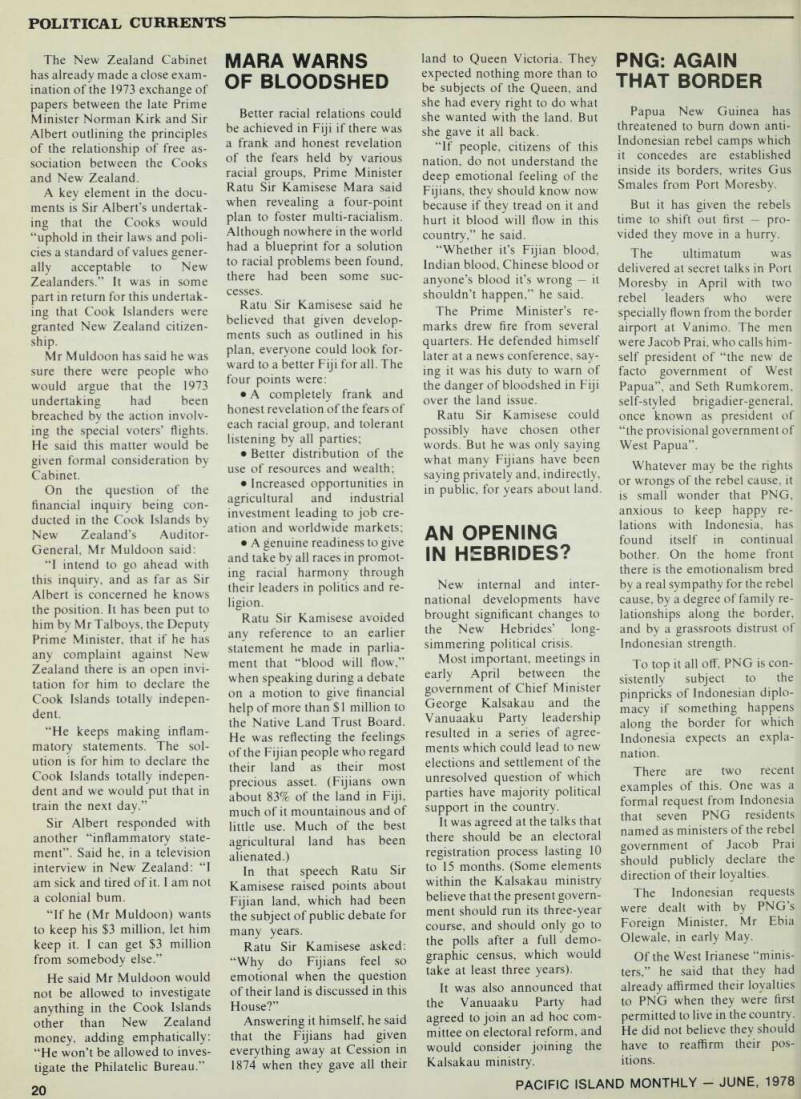
tonga, DP supporters staged a 350-vehicle motorcade that travelled from the Arorangi
district to Avarua in a show of force. They tried to show Sir Albert and his CIP supporters that the CIP was not a popular government.
According to the DP weekly news-sheet, Weekender, this demonstration was “probably the largest demonstration of support for any political party in the history of the Cook Islands.”
Weekender added: “Be cause the Democratic Party has to raise its funds with honesty and pride, it has been denied its rightful place in govern ment.
“Because the CIP can run to its rich American friend. Fin bar Kenny (the financial power behind the Cooks philatelic op erations Ed) it can fly its free voters around the Pacific at its
pleasure.”
Taking up the story from the New Zealand end, William Gasson writes from Welling ton: In the wake of the Cook Islands poll, ripples of contro versy are spreading like tsunamis between the shores of the Cooks and New Zealand.
At the heart of the contro versy is the question: where did the estimated $3OO 000 spent on Sir Albert Henry’s special voter flights come from, out of the Cooks’ population of 20 000?
Prime Minister Muldoon is concerned that the money might have come from the $6 million his country gives each year in various forms of aid.
About $3 million is given in di rect grant form to help the Islanders balance their budget.
The remainder is in the form of technical types of assist ance.
An anti-Henry demonstration
The New Zealand Cabinet has already made a close exam ination of the 1973 exchange of papers between the late Prime Minister Norman Kirk and Sir
Albert outlining the principles
of the relationship of free as sociation between the Cooks and New Zealand.
A key element in the docu ments is Sir Albert’s undertak ing that the Cooks would “uphold in their laws and poli cies a standard of values gener
ally acceptable to New
Zealanders.” It was in some part in return for this undertak ing that Cook Islanders were granted New Zealand citizen
ship.
Mr Muldoon has said he was sure there were people who would argue that the 1973 undertaking had been breached by the action involv
ing the special voters’ flights.
He said this matter would be
given formal consideration by
Cabinet.
On the question of the
financial inquiry being con
ducted in the Cook Islands by New Zealand’s Auditor- General, Mr Muldoon said: “I intend to go ahead with this inquiry, and as far as Sir Albert is concerned he knows the position. It has been put to
him by MrTalboys, the Deputy
Prime Minister, that if he has
any complaint against New
Zealand there is an open invi tation for him to declare the
Cook Islands totally indepen
dent.
“He keeps making inflam
matory statements. The sol ution is for him to declare the
Cook Islands totally indepen
dent and we would put that in train the next day.”
Sir Albert responded with another “inflammatory state ment”. Said he, in a television interview in New Zealand; “I am sick and tired of it. I am not a colonial bum.
“If he (Mr Muldoon) wants to keep his $3 million, let him keep it. I can get $3 million from somebody else.”
He said Mr Muldoon would not be allowed to investigate anything in the Cook Islands other than New Zealand
money, adding emphatically:
“He won’t be allowed to inves tigate the Philatelic Bureau.”
Mara Warns
Of Bloodshed
Better racial relations could be achieved in Fiji if there was a frank and honest revelation of the fears held by various racial groups, Prime Minister Ratu Sir Kamisese Mara said
when revealing a four-point
plan to foster multi-racialism.
Although nowhere in the world had a blueprint for a solution to racial problems been found, there had been some suc cesses.
Ratu Sir Kamisese said he
believed that given develop
ments such as outlined in his plan, everyone could look for ward to a better Fiji for all. The four points were: • A completely frank and honest revelation of the fears of each racial group, and tolerant
listening by all parties;
• Better distribution of the use of resources and wealth; • Increased opportunities in agricultural and industrial investment leading to job cre ation and worldwide markets; • A genuine readiness to give and take by all races in promot
ing racial harmony through
their leaders in politics and re
ligion.
Ratu Sir Kamisese avoided any reference to an earlier statement he made in parlia ment that “blood will flow,” when speaking during a debate on a motion to give financial help of more than $1 million to the Native Land Trust Board.
He was reflecting the feelings
of the Fijian people who regard
their land as their most
precious asset. (Fijians own
about 83% of the land in Fiji, much of it mountainous and of little use. Much of the best agricultural land has been alienated.) In that speech Ratu Sir Kamisese raised points about Fijian land, which had been the subject of public debate for many years.
Ratu Sir Kamisese asked: “Why do Fijians feel so emotional when the question of their land is discussed in this House?”
Answering it himself, he said that the Fijians had given everything away at Cession in 1874 when they gave all their
land to Queen Victoria. They expected nothing more than to be subjects of the Queen, and she had every right to do what she wanted with the land. But she gave it all back.
“If people, citizens of this nation, do not understand the deep emotional feeling of the Fijians, they should know now because if they tread on it and hurt it blood will flow in this country,” he said.
“Whether it’s Fijian blood, Indian blood, Chinese blood or anyone’s blood it’s wrong it shouldn’t happen,” he said.
The Prime Minister’s re marks drew fire from several quarters. He defended himself later at a news conference, say ing it was his duty to warn of the danger of bloodshed in Fiji over the land issue.
Ratu Sir Kamisese could possibly have chosen other words. But he was only saying what many Fijians have been
saying privately and. indirectly,
in public, for years about land.
An Opening
In Hebrides?
New internal and inter national developments have
brought significant changes to
the New Hebrides’ long
simmering political crisis.
Most important, meetings in
early April between the
government of Chief Minister George Kalsakau and the
Vanuaaku Party leadership
resulted in a series of agree ments which could lead to new elections and settlement of the unresolved question of which
parties have majority political
support in the country.
It was agreed at the talks that there should be an electoral
registration process lasting 10
to 15 months. (Some elements within the Kalsakau ministry believe that the present govern ment should run its three-year course, and should only go to the polls after a full demo graphic census, which would take at least three years).
It was also announced that the Vanuaaku Party had agreed to join an ad hoc com mittee on electoral reform, and would consider joining the Kalsakau ministry.
Png: Again
That Border
Papua New Guinea has threatened to burn down anti- Indonesian rebel camps which it concedes are established inside its borders, writes Gus Smales from Port Moresby.
But it has given the rebels time to shift out first pro vided they move in a hurry.
The ultimatum was delivered at secret talks in Port Moresby in April with two rebel leaders who were specially flown from the border airport at Vanimo. The men were Jacob Prai, who calls him self president of “the new de facto government of West Papua”, and Seth Rumkorem,
self-styled brigadier-general,
once known as president of “the provisional government of
West Papua”.
Whatever may be the rights or wrongs of the rebel cause, it is small wonder that PNG, anxious to keep happy re lations with Indonesia, has found itself in continual bother. On the home front there is the emotionalism bred by a real sympathy for the rebel cause, by a degree of family re lationships along the border, and by a grassroots distrust of
Indonesian strength.
To top it all off, PNG is con
sistently subject to the
pinpricks of Indonesian diplo
macy if something happens along the border for which Indonesia expects an expla nation.
There are two recent examples of this. One was a formal request from Indonesia that seven PNG residents named as ministers of the rebel government of Jacob Prai should publicly declare the direction of their loyalties.
The Indonesian requests were dealt with by PNG’s Foreign Minister, Mr Ebia Olewale, in early May.
Of the West Irianese “minis ters,” he said that they had
already affirmed their loyalties
to PNG when they were first permitted to live in the country.
He did not believe they should have to reaffirm their pos itions.