What’s pure, what isn’t? Guam and Tonga
pp. 13-15 · Read in the full issue

Tonga on the horns of a dilemma
PUBLIC MORALS Before contact with western ideas and morals the Islanders had their own moral codes and knew what was tabu and what was not. Today they’re not so> sure. The p ® r ™■ s s|y , inroads. Below, Dan Gibson writes of the problems new obscenity codes have created on Guam, and Will Keener, in Nukualofa, deals with the vagaries off film censorship in Tonga.
Friday night in Nuku’alofa
and Silver Streak, an American-made film of intrigue and comedy on a con tinental railroad trip, appears to be the main attraction among the capital city’s film offerings, writes Will Keener.
The plot moves rapidly
along and even those Tongans who can’t follow the fast
English and American slang
appear to know what’s going on. Then the picture turns to chaos: men chase each other, shoot at each other and the hero is thrown off the train. But
nobody can say why.
The reason is simple. A key scene, in which the body of a
distinguished art professor is
dumped off the moving train, has been censored. Too viol ent? No, the action was viewed by the hero and his woman friend, who were discreetly covered, but nevertheless in bed together. As a result of the cut, the plot becomes incom
prehensible.
A few weeks later at another theatre, an English-made film, The Bawdy Adventures of Tom Jones , gets an entirely different treatment. Rarely, it seems, does a scene pass without por traying the hero in or around the bed with a different woman, whose bare bottom or breasts are clearly visible.
Why the differences? The fact that the films played at dif ferent theatres does not seem to be the underlying cause.
Instead, the answer lies with a small group of men and women in Tonga, who com
prise the kingdom’s Cinemato
graphic Censorship Board.
The board, described as “authoritarian” and “Vic torian” by some critics and defended by others, has been under mounting pressure to reconsider its approach to film censorship, members admit. At last, the pressure has resulted in a call by the board’s chairman,
Minister of Police ’Akau’ola, for at least some sharpening of vague clauses in the 58-year old film law, which has not even been amended since 1953.
When the censorship regu lations were first drafted they were similar to many guidelines used in British Empire countries in the 19305, ’Akau’ola noted in a recent newspaper article addressing
the censorship problem in
Tonga. “But the extent of change in entertainment con cepts and public demand (has)
greatly widened the gap .. .
leaving Tonga adhering to the
original, very strict code dis carded by other commonwealth countries,” he explained.
At the heart of the matter lies the question of whether or not censors should admit any film to the kingdom which cannot be viewed comfortably by all members of the extended fam
ily. However, interpretation of
just what is “comfortable” for the extended family members
obviously varies greatly among
members of the committee, who sit in groups of three to re view and clip films brought into the kingdom.
Two trends appear to have developed among the nine members of the full committee, leading the Minister of Police to call for more sharply defined
and updated legislation. The
first trend is a growing aware ness that censorship cannot be used as a tool to shield the
mostly young Tongan audi
ences from the ethics and depravities of the outside world. The idea of protecting
Tongan audiences, quipped
’Akau’ola, “is receding in val idity as quickly as the value of
the pa’anga.”
“There is too much contact through radio, travel, overseas study and tourism to prevent Tongans from being exposed to these ideas,” one censorship
board member said. “If they don’t get the ideas from the movies, they’ll get them from somewhere else.”
A second trend is the tend ency to curtail violence in films, which has often been al lowed to run rampant in the past while sexual passages were
being clipped left and right.
This is partly the result of an influx of increasingly violent karate and kung fu films, made in Japan and China, which have been very popular with young audiences. But, violent, western-made films have also been subject to increased scru
tiny.
One board member de scribed a “balance” that has been shifting in recent years to a more permissive attitude about some sexual scenes and a more militant view of screen violence.
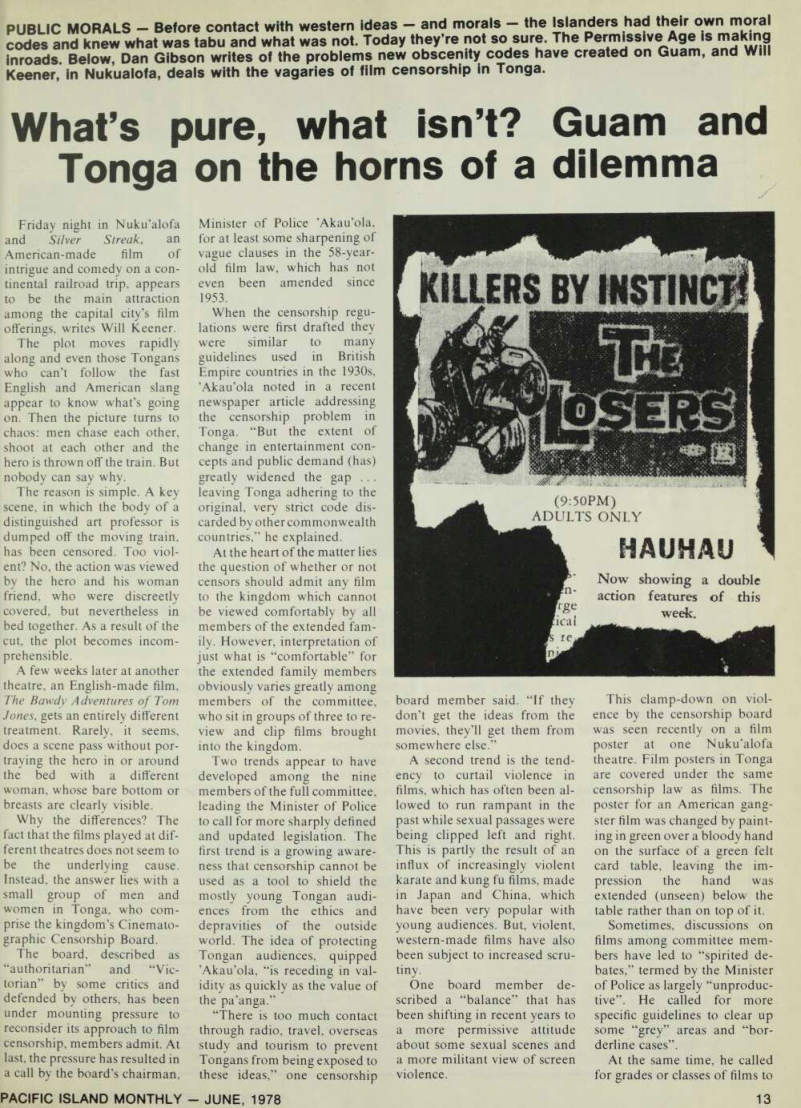
This clamp-down on viol ence by the censorship board was seen recently on a film poster at one Nuku’alofa theatre. Film posters in Tonga are covered under the same censorship law as films. The poster for an American gang
ster film was changed by paint
ing in green over a bloody hand on the surface of a green felt card table, leaving the im pression the hand was extended (unseen) below the table rather than on top of it.
Sometimes, discussions on films among committee mem bers have led to “spirited de bates,” termed by the Minister of Police as largely “unproduc tive”. He called for more specific guidelines to clear up some “grey” areas and “bor derline cases”.
At the same time, he called for grades or classes of films to
be introduced, including those suitable for general exhibition and others restricted to “adults only”. At first, highly-restricted films might only be shown by theatres in Nuku’alofa or Neiafu, the main city in the Vava’u group, he suggested.
Since films are often taken from village to village on the smaller islands along with projectors and electric gener ators, the need for family-type films remains real. At the same time, tastes in the area of the capital city can differ widely, ’Akau’ola recognised.
Describing a “vociferous minority, who become more insistent day by day,” the Minister of Police urged other members of the Tongan com munity to register their opinions on any future policy changes. Included in this min ority, he said, are expatriates in Tonga, Tongans exposed to overseas entertainment and widely-read residents of Nuku’alofa and Neiafu.
It is obvious, however, that this is not the main group being affected by foreign films in the kingdom. Theatre owners de scribe a young, 15-30 year-old audience, interested in fast paced, highly-visual films.
What they carry away from the film affects superficial changes in styles and clothing, while also causing some shifts in deeper cultural patterns of the kingdom, some observers be lieve.
Films affect Tongans in a variety of ways ranging from their attitudes about traditional architecture to their opinions about the family structure and other long-standing social tra ditions. And just what kinds of films are doing these things?
The answer is films that are often rejected by other audi ences as failures. Theatre owners in the kingdom deal with Australian and New Zealand distributors, who send films aimed at meeting local demands of both the audience and the censors. Explains ’Akau’ola: “The end result is a
series of low-priced, insipient,
flaccid and outrageous tech nical flops screened in the kingdom under the guise of entertainment.”
Will new censorship rules change any of this? “They can only help,” one member of the
board suggested.