A one-boat fishing revolution
p. 53 · Read in the full issue
comes to Niue
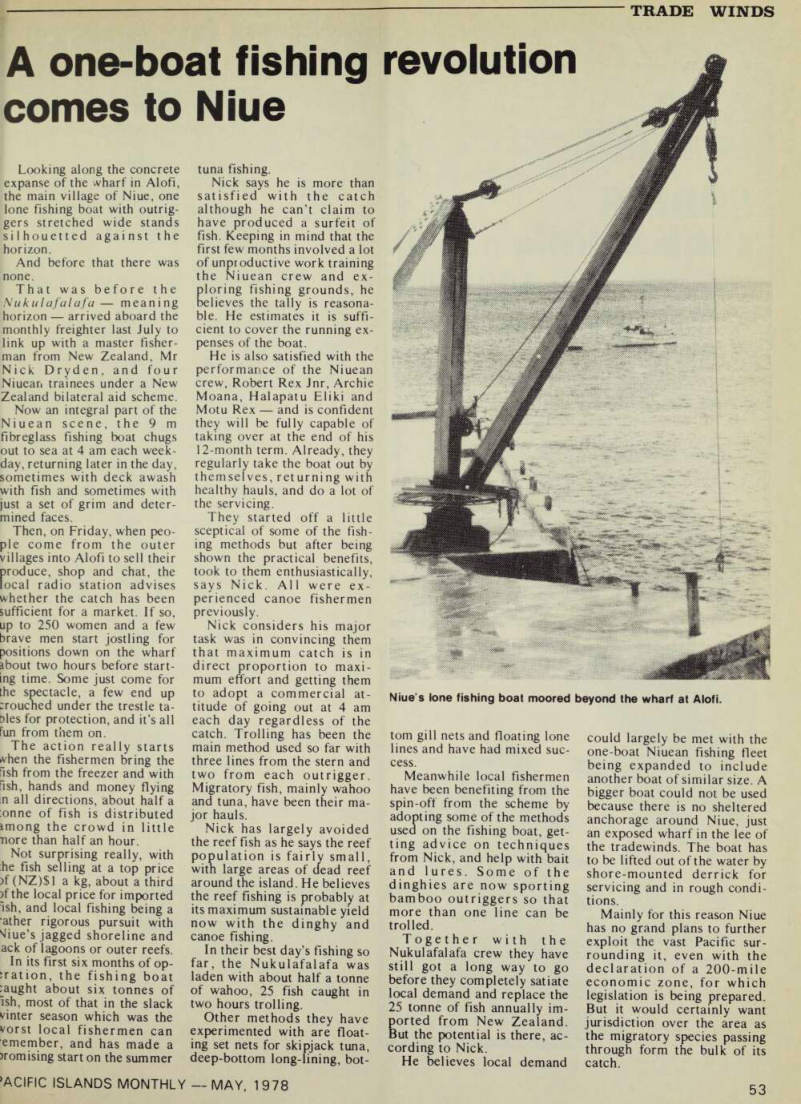
Looking along the concrete expanse of the wharf in Alofi, the main village of Niue, one lone fishing boat with outrig gers stretched wide stands silhouetted against the horizon.
And before that there was none.
That was before the Nukulafalafa meaning horizon arrived aboard the monthly freighter last July to link up with a master fisher man from New Zealand, Mr Nick Dryden, and four Niuean trainees under a New Zealand bilateral aid scheme.
Now an integral part of the Niuean scene, the 9 m fibreglass fishing boat chugs out to sea at 4 am each week day, returning later in the day, sometimes with deck awash with fish and sometimes with just a set of grim and deter mined faces.
Then, on Friday, when peo ple come from the outer villages into Alofi to sell their produce, shop and chat, the local radio station advises whether the catch has been sufficient for a market. If so, up to 250 women and a few brave men start jostling for positions down on the wharf about two hours before start ing time. Some just come for the spectacle, a few end up touched under the trestle ta bles for protection, and it’s all fun from them on.
The action really starts when the fishermen bring the fish from the freezer and with fish, hands and money flying n all directions, about half a ;onne of fish is distributed among the crowd in little tiore than half an hour.
Not surprising really, with he fish selling at a top price )f (NZ)$l a kg, about a third )f the local price for imported ish, and local fishing being a ather rigorous pursuit with Niue’s jagged shoreline and ack of lagoons or outer reefs.
In its first six months of op- Jration, the fishing boat caught about six tonnes of ish, most of that in the slack vinter season which was the vorst local fishermen can emember, and has made a )romising start on the summer
tuna fishing.
Nick says he is more than satisfied with the catch although he can’t claim to have produced a surfeit of fish. Keeping in mind that the first few months involved a lot of unproductive work training the Niuean crew and ex ploring fishing grounds, he believes the tally is reasona ble. He estimates it is suffi cient to cover the running ex penses of the boat.
He is also satisfied with the performance of the Niuean crew, Robert Rex Jnr, Archie Moana, Halapatu Eliki and Motu Rex and is confident they will be fully capable of taking over at the end of his 12-month term. Already, they regularly take the boat out by themselves, returning with healthy hauls, and do a lot of the servicing.
They started off a little sceptical of some of the fish ing methods but after being shown the practical benefits, took to them enthusiastically, says Nick. All were ex perienced canoe fishermen previously.
Nick considers his major task was in convincing them that maximum catch is in direct proportion to maxi mum effort and getting them to adopt a commercial at titude of going out at 4 am each day regardless of the catch. Trolling has been the main method used so far with three lines from the stern and two from each outrigger.
Migratory fish, mainly wahoo and tuna, have been their ma jor hauls.
Nick has largely avoided the reef fish as he says the reef population is fairly small, witn large areas of dead reef around the island. He believes the reef fishing is probably at its maximum sustainable yield now with the dinghy and canoe fishing.
In their best day’s fishing so far, the Nukulafalafa was laden with about half a tonne of wahoo, 25 fish caught in two hours trolling.
Other methods they have experimented with are float ing set nets for skipjack tuna, deep-bottom long-lining, bot-
tom gill nets and floating lone lines and have had mixed suecess - Meanwhile local fishermen have been benefiting from the spin-off from the scheme by adopting some of the methods used on the fishing boat, getting advice on techniques from Nick, and help with bait and lures. Some of the dinghies are now sporting bamboo outriggers so that more than one line can be trolled.
Together with the Nukulafalafa crew they have still got a long way to go before they completely satiate local demand and replace the 25 tonne of fish annually imported from New Zealand, But the potential is there, according to Nick.
He believes local demand
could largely be met with the one-boat Niuean fishing fleet being expanded to include another boat of similar size A bigger boat could not be used because there is no sheltered anchorage around Niue, just an exposed wharf in the lee of the tradewinds. The boat has to be lifted out of the water by shore-mounted derrick for servicing and in rough condi tions.
Mainly for this reason Niue has no grand plans to further exploit the vast Pacific sur rounding it, even with the declaration of a 200-mile economic zone, for which legislation is being prepared.
But it would certainly want jurisdiction over the area as the migratory species passing through form the bulk of its catch.
Niue’s lone fishing boat moored beyond the wharf at Alofi.