Pacific Islands Services
pp. 67-70 · Read in the full issue
Air New Zealand Steps Up
At least one new route and an increase in capacity on others are the key features of Air New Zealand’s immediate plans to better serve the air transport needs of the Pacific region in the months ahead.
Air New Zealand and Polynesian Airlines started services twice a week between Auckland and Faleolo, Western Samoa, from Febru ary 25, using a chartered Na tional Airways Boeing 737 jet.
The last Air New Zealand service to Western Samoa was in 1960 when a Solent flying boat operated the legendary Coral Route from Suva to Apia, Aitutaki and Papeete.
The new service will op irate direct northbound on Mondays with a technical stop it Nadi on the return. The Polynesian Airlines flight ;ach Saturday will stop at fonga in both directions.
In other developments affecting Pacific Islands, the wide-bodied DCIO aircraft will be used more often on flights between Auckland and Rarotonga to cater to in creased demand since the opening last year of the inter national standard hotel The Rarotongan. The DCIO will be used instead of a DCS for one of the three flights a week in the peak May and August holiday period.
Consideration is also being given to introducing the DC 10 to the Rarotonga/ Honolulu weekly flight in place of'the current DCS ser vice.
Further aviation develop ments expected and which will require deliberation by the New Zealand government are the declared intentions in respect of Air Nauru and Cathay Pacific Airways to op erate into New Zealand.
Air Nauru would like to operate a weekly service between Nauru and Auckland, and Cathay Pacific seeks two flights a week between Hong Kong, Port Moresby and Auckland.
In New Zealand itself, the merger of Air New Zealand and the National Airways Corporation on April 1 will present a strong single entity airline in the next few years.
An amalgamation of the two largest aviation operations in the country will take several years to com- P‘ ete ' , the integration being effected gradually in the best interests of both Air New Zealand and NAC Some of the obvious benefits which will materialise will be a joint and united marketing effort, a common reservations system and the opportunity to make better use of aircraft equip-
ment within the region, such as the new services launched to Western Samoa with Boe ing 7375. . ,r ew Zealand will con tinue as a bigger and stronger a ytetion force in the Pacific Wlt * l the possibility of inl- P rove d air service links be tween such countries as Papua Guinea, Tonga, New Hebrides and the Cook Is tends, Further afie|d- Ajr New Zealand's declared policy of operating services to Japan and possib y South Amer P ica have been partly responsible f or ,h e evaluation of future aircraft equ ip m en, which is
being conducted,
The airline is assessing Boe ing 7478 aircraft, the Special Performance 747 version, and a “stretched DC 10” to meet future needs.
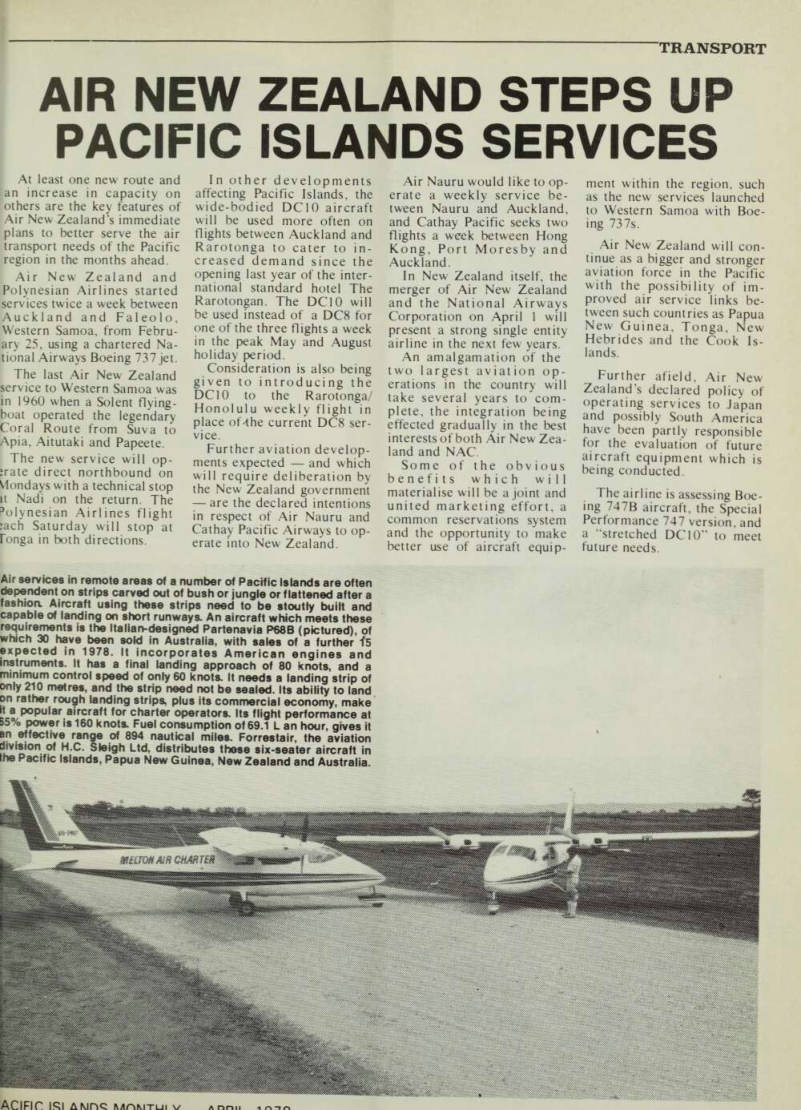
Air services in remote areas of a number of Pacific Islands are often dependent on strips carved out of bush or jungle or flattened after a fashion. Aircraft using these strips need to be stoutly built and capable of landing on short runways. An aircraft which meets these requirements is the Italian-designed Partenavia P68B (pictured), of which 30 have been sold in Australia, with sales of a further f5 expected in 1978. It incorporates American engines and instruments. It has a final landing approach of 80 knots, and a minimum control speed of only 60 knots. It needs a landing strip of only 210 metres, and the strip need not be sealed. Its ability to land on rather rough landing strips, plus its commercial economy, make ® popular aircraft for charter operators. Its flight performance at 55 power is 160 knots. Fuel consumption of 69.1 L an hour, gives it an effective range of 894 nautical miles. Forrestair, the aviation amsion of H.C. Sleigh Ltd, distributes those six-seater aircraft in the Pacific Islands, Papua New Guinea, New Zealand and Australia.
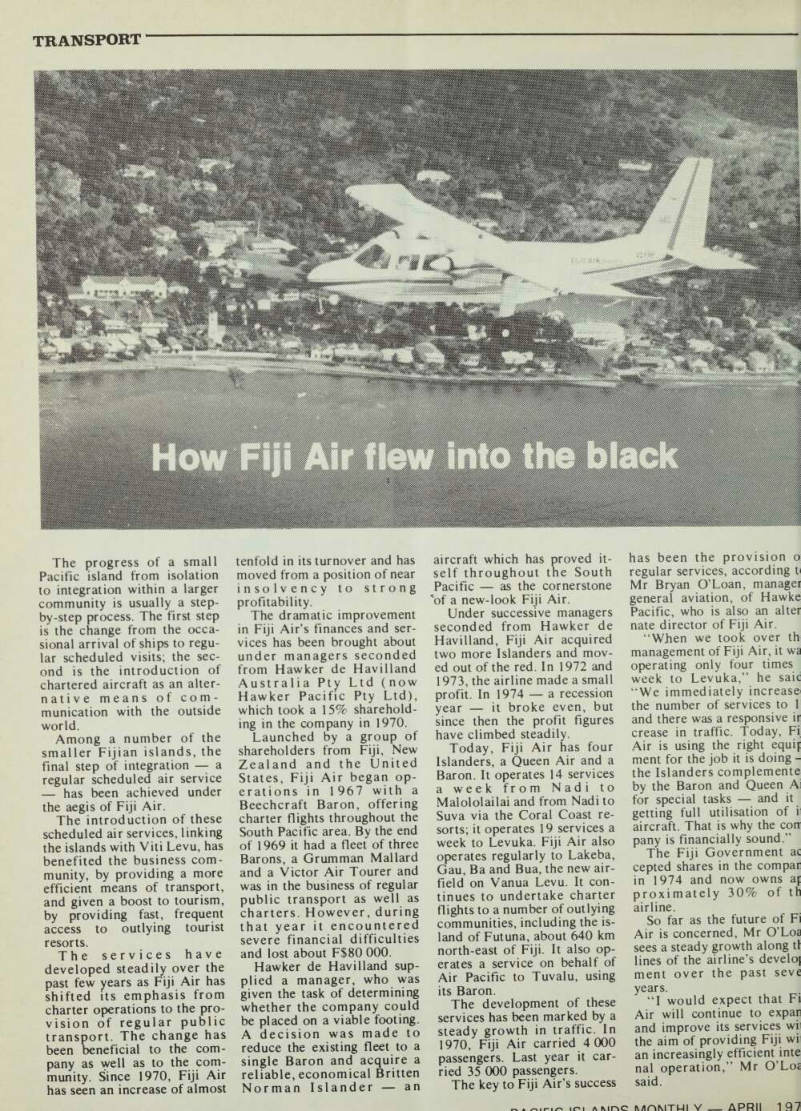
How Fiji Air flew into the black
The progress of a small Pacific island from isolation to integration within a larger community is usually a step by-step process. The first step is the change from the occa sional arrival of ships to regu lar scheduled visits; the sec ond is the introduction of chartered aircraft as an alter native means of com munication with the outside world.
Among a number of the smaller Fijian islands, the final step of integration a regular scheduled air service has been achieved under the aegis of Fiji Air.
The introduction of these scheduled air services, linking the islands with Viti Levu, has benefited the business com munity, by providing a more efficient means of transport, and given a boost to tourism, by providing fast, frequent access to outlying tourist resorts.
The services have developed steadily over the past few years as Fiji Air has shifted its emphasis from charter operations to the pro vision of regular public transport. The change has been beneficial to the com pany as well as to the com munity. Since 1970, Fiji Air has seen an increase of almost
tenfold in its turnover and has moved from a position of near insolvency to strong profitability.
The dramatic improvement in Fiji Air’s finances and ser vices has been brought about under managers seconded from Hawker de Havilland Australia Pty Ltd (now Hawker Pacific Pty Ltd), which took a 15% sharehold ing in the company in 1970.
Launched by a group of shareholders from Fiji, New Zealand and the United States, Fiji Air began op erations in 1 967 with a Beechcraft Baron, offering charter flights throughout the South Pacific area. By the end of 1969 it had a fleet of three Barons, a Grumman Mallard and a Victor Air Tourer and was in the business of regular public transport as well as charters. However, during that year it encountered severe financial difficulties and lost about FSBO 000.
Hawker de Havilland sup plied a manager, who was given the task of determining whether the company could be placed on a viable footing.
A decision was made to reduce the existing fleet to a single Baron and acquire a reliable, economical Britten Norman Islander an
aircraft which has proved it self throughout the South Pacific as the cornerstone of a new-look Fiji Air.
Under successive managers seconded from Hawker de Havilland, Fiji Air acquired two more Islanders and mov ed out of the red. In 1972 and 1973, the airline made a small profit. In 1974 a recession year it broke even, but since then the profit figures have climbed steadily.
Today, Fiji Air has four Islanders, a Queen Air and a Baron. It operates 14 services a week from Nadi to Malololailai and from Nadi to Suva via the Coral Coast re sorts; it operates 19 services a week to Levuka. Fiji Air also operates regularly to Lakeba, Gau, Ba and Bua, the new air field on Vanua Levu. It con tinues to undertake charter flights to a number of outlying communities, including the is land of Futuna, about 640 km north-east of Fiji. It also op erates a service on behalf of Air Pacific to Tuvalu, using its Baron.
The development of these services has been marked by a steady growth in traffic. In 1970, Fiji Air carried 4 000 passengers. Last year it car ried 35 000 passengers.
The key to Fiji Air’s success
has been the provision o regular services, according t( Mr Bryan O’Loan, manager general aviation, of Hawke Pacific, who is also an alter nate director of Fiji Air.
“When we took over th management of Fiji Air, it wa operating only four times week to Levuka,” he said “We immediately increase the number of services to 1 and there was a responsive in crease in traffic. Today, Fi Air is using the right equip ment for the job it is doing the Islanders complemente by the Baron and Queen Ai for special tasks and it getting full utilisation of ii aircraft. That is why the con: pany is financially sound.”
The Fiji Government ac cepted shares in the compar in 1974 and now owns ap proximately 30% of th airline.
So far as the future of Fi Air is concerned, Mr O’Loa sees a steady growth along tl lines of the airline’s develoj ment over the past seve years.
“I would expect that Fi Air will continue to expan and improve its services wii the aim of providing Fiji wi an increasingly efficient inte nal operation,” Mr O’Loa said.