PNG plans to erase tax dodgers
pp. 53-55 · Read in the full issue

and raise insects and crocodiles
Trade
Winds
A new national expenditure plan and the closing of tax-evading loopholes were features of the Papua New Guinea Government s budget session in Port Moresby towards the end of February. Finance Minister Barry Holloway s budget provides for an income of $A572 million and expenditure of SASB3 million with short-term borrowings to cover thesAll million budget deficit. Direct Australian aid content of the budget is SA2OB million with SA3OS million to be raised internally. Gus Smales reports.
Foreign businessmen mainly Australians have been using legal lurks to beat tax and investment re strictions in Papua New Guinea. One loophole alone has been costing the govern ment an estimated six million dollars annually and is fast approaching a grand total of $36 million.
But the government wrote new rules at its budget session, and now believes it can keep a tighter control on the situ ation without also scaring away badly-needed invest ment.
Finance Minister Mr Holloway described the loopholes and how he was closing them when he brought down what he called his “Let’s get moving” $583 million budget, the first in which the financial and calen dar years coincide, and, Mr Holloway claimed, the first to embody an integrated overall spending plan.
Just over 37% of its total revenue, apart from financing items, is an untied grant-in aid from Australia under a five-year assistance plan. The budget provides new in centives to businessmen and investors inside and outside the country, arising from Mr Holloway’s admission that the level of investment was not quite as high as hoped for.
But it also closes the legal loopholes which Mr Hollo way claimed were being used by investors to beat the spirit of the law.
The biggest loophole re ported by Mr Holloway was created by the tax holiday given to Papua New Guineans who bought businesses from Australians and other non-na tionals.
Mr Holloway said the plan had been designed to phase Papua New Guineans into their own economy, but in stead there had been an up surge of “nominal” ar rangements to deliberately
beat the tax laws. He told of one man who had nominally transferred a major business undertaking to his domestic servant. The boss continued to run it, he continued to get the profits but he was also keeping the tax which used to go to the government.
Mr Holloway said the tax holiday system had been greatly abused, and it had also artificially inflated the value of businesses which Papua New Guineans wanted to buy.
Under the new budget the tax holiday system will be abolished, replaced by a tax relief system applicable only to PNG nationals and eliminating nominal deals.
Mr Holloway said he was convinced the business of put ting the economy into line with the government’s wishes required “a set of precision tools rather than a blunt in strument”. The theme of the budget was to check the drain
of money which “flows first to the richest people and then flows out of the country”.
Another loophole to be closed will prevent non-re sident shareholders from avoiding payment or with holding tax on their divi dends. Mr Holloway an nounced three major in centives to attract major in vestment from outside: • Half tax on profits earned from an increase in the export of manufactured goods: • Government loan as sistance to approved manufac turing or processing industries which find the going tough in their first four years, and • Government aid of up to $l2O 000 for industry feasibility studies undertaken by approved syndicates.
The minister also announc ed easier loans for major ven tures being undertaken by companies consisting solely of Papua New Guinea nationals.
The budget does away with in come tax returns for people whose sole income is from wages and salaries.
This is expected to reduce the number of returns pro cessed each year from 140 000 to 20 000. Book makers will be taxed 1% of their turnover instead of by 24 cents per betting ticket as at present.
There will be a slight in crease in duty on cars, con fectionery, electrical ap pliances and household goods.
Livestock projects ranging
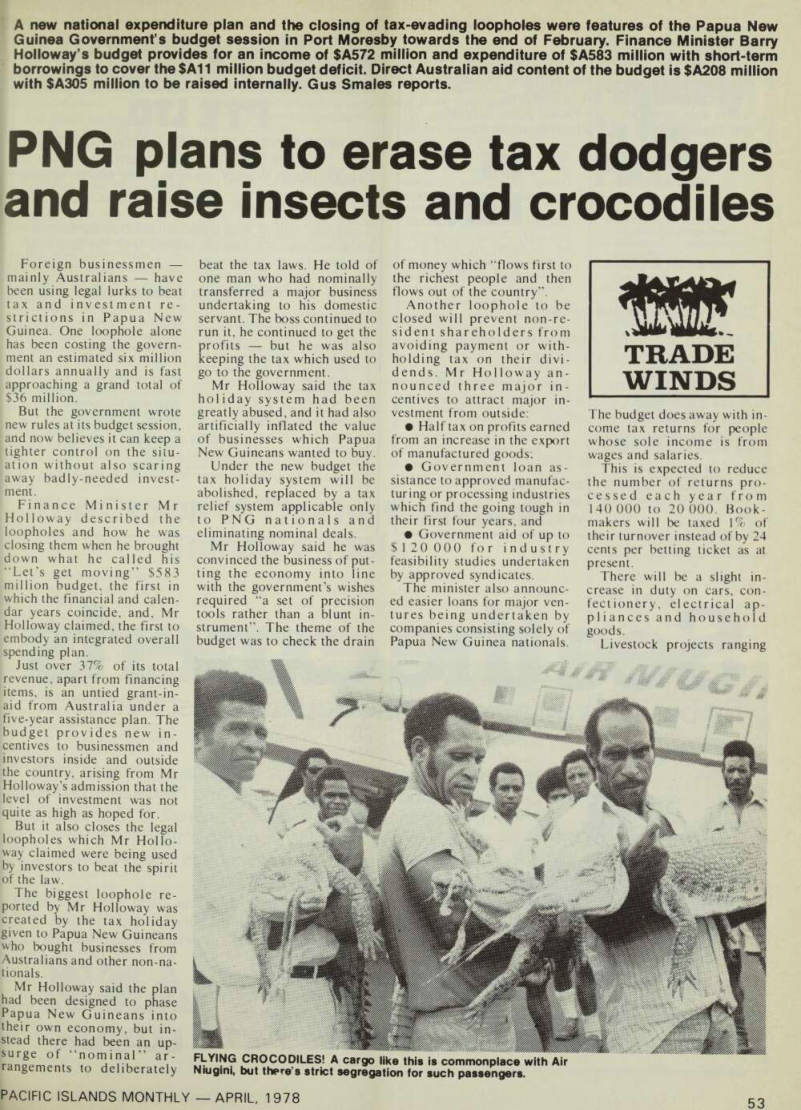
FLYING CROCODILES! A cargo like this is commonplace with Air Niugini, but there’s strict segregation for such passengers.
from insect farming to crocodile farming are among commercial ventures listed for development under the ex-
penditure plan.
The insect-farming is for an expenditure of $l3O 000 over the next four years to encourage some village communities to breed beetles and butterflies. The beetles and butterflies will be sold to collectors as part of a small but fast-developing industry.
Agricultural projects listed
:As"i: '■.'i'irx-
Rice-growing projects are an attempt to cut down PNG's heavy dependence on rice supplies from Australia, and orchid-farming is a fast-growing industry which could earn substantial money for PNG.
J The National Expenditure Plan was tabled by the Prime Minister, Mr Somare. It lays down expend iture projects which will serve as guidelines for the preparation of the annual budget.
It deals with capital ex-
penditure which is considered of a national developmental nature, ranging from some roads and bridges, through primary and secondary pro duction projects to specialised training courses, The guidelines in the plan the specific expenditure projects and the amount they will be allocated each year for four years ahead. The four year plan will be reassessed every year, and consultation between cabinet, parliament 3 changes and ad dl''°ns dunn 8 the reassess
cs’ e
Som t e . of , ' he expenditure P °J ect * llsted ln , lhe P lan ln ' clude deer farming, dugong courses 'n Pidgin at the PNG University, overseas police training, a w i de range of agricultural development absorbing large sums, radio station ex tensions, specialised services on matters ranging from con servation to public man agement and mineral ex
ploration, medical projects, youth training and sports development.
Total expenditure listed in the four-year plan is about $lOO million, of which about $24 million is allocated for spending this year.
It will represent just under 5% of the total budget ex penditure, and places special emphasis on rural develop ment.
Politically, the plan has had a mixed reception. The op position spokesman on finance, Mr Jaminan, said he considered the expenditure plan was “a good document” but he had doubts of how the government could keep to it.
And Sir John Guise, the in fluential independent in parliament, described the plan as “a great academic ex ercise by people who have a way with words”. He said that, although the plan went to lengths to set out how PNG should best spend its money, it failed to indicate how the money spent would im plement the aims.