The Golden Odyssey of a Fiji
pp. 70-71 · Read in the full issue
boat-sitter
Boat-sitting in Fiji has now top ped the list of things I have done in my life that might be termed “unusual”. However, it must be es tablished at the outset of this tale that “old salt” I am not! In fact, when I went aboard my first boat, I couldn’t even row. But I found, as time went on, that baby-sitting boats, learning to row, or even the ins and outs of chartering, which I was to do later, was like baking a cake you had to start from scratch, writes Harriette Allan from Honolulu.
For three months, after fate put me in the right place at the right time to become a baby-sitter of my first boat, the Bona Dea owned by Carl and Mary Leonard of the US, I learned about boats and, more im portantly, how to row, from that in credible and intrepid group of peo ple called “yachties”.
Yachties come in all sizes and shapes and all nationalities, as do their boats. They sail the seven seas with dash and aplomb and have the most amazing tales to tell over a drink as the sun goes slowly over the yardarm. Needless to say, I drank and listened, hoping some of the “salt” might rub off on me. It did a bit at least I learned to row a dinghy. And when I moved aboard Sayandra, my second boat-sitting job, I didn’t turn a hair when I was asked to consider a charter to one of the southernmost islands of the Lau group, by a charming Fijian gentle man.
Sayandra is a well-known vessel in Fijian waters, having come up
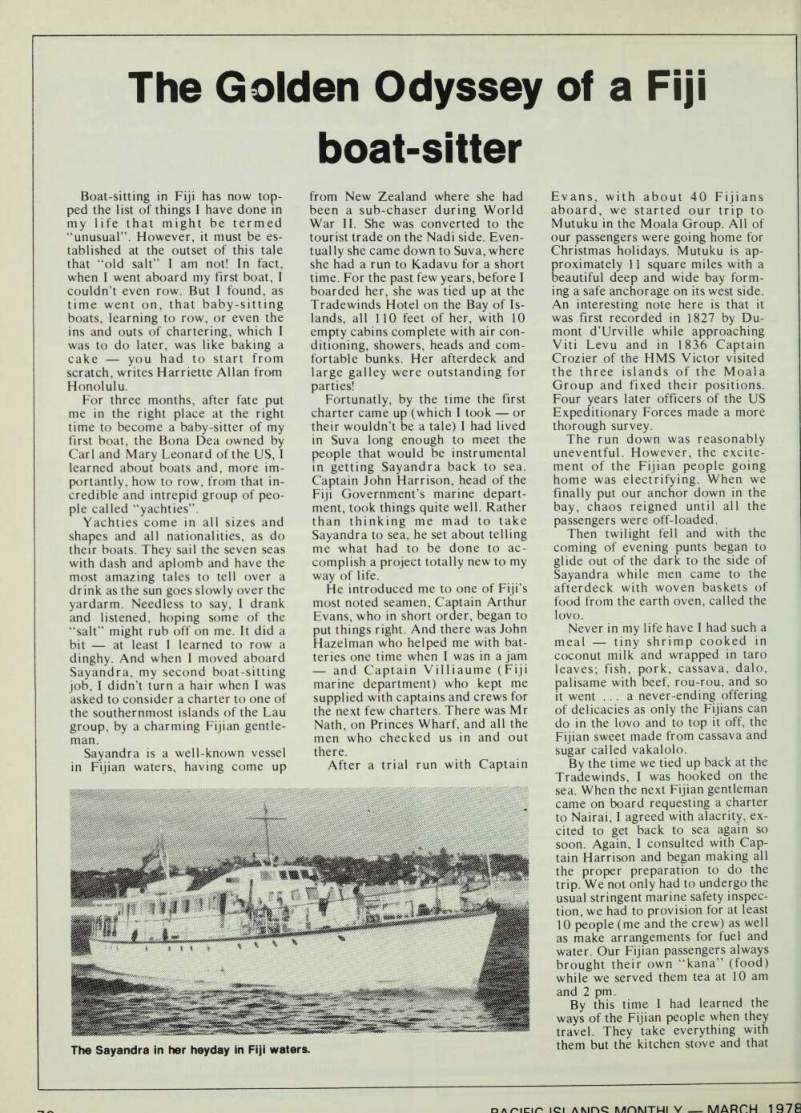
from New Zealand where she had been a sub-chaser during World War 11. She was converted to the tourist trade on the Nadi side. Even tually she came down to Suva, where she had a run to Kadavu for a short time. For the past few years, before I boarded her, she was tied up at the Tradewinds Hotel on the Bay of Is lands, all 110 feet of her, with 10 empty cabins complete with air con ditioning, showers, heads and com fortable bunks. Her afterdeck and large galley were outstanding for parties!
Fortunatly, by the time the first charter came up (which I took or their wouldn't be a tale) I had lived in Suva long enough to meet the people that would be instrumental in getting Sayandra back to sea.
Captain John Harrison, head of the Fiji Government's marine depart ment, took things quite well. Rather than thinking me mad to take Sayandra to sea, he set about telling me what had to be done to ac complish a project totally new to my way of life.
He introduced me to one of Fiji’s most noted seamen. Captain Arthur Evans, who in short order, began to put things right. And there was John Hazelman who helped me with bat teries one time when I was in a jam and Captain Villiaume (Fiji marine department) who kept me supplied with captains and crews for the next few charters. There was Mr Nath, on Princes Wharf, and all the men who checked us in and out there.
After a trial run with Captain
Evans, with about 40 Fijians aboard, we started our trip to Mutuku in the Moala Group. All of our passengers were going home for Christmas holidays. Mutuku is ap proximately 11 square miles with a beautiful deep and wide bay form ing a safe anchorage on its west side.
An interesting note here is that it was first recorded in 1827 by Du mont d’Urville while approaching Viti Levu and in 1836 Captain Crozier of the HMS Victor visited the three islands of the Moala Group and fixed their positions.
Four years later officers of the US Expeditionary Forces made a more thorough survey.
The run down was reasonably uneventful. However, the excite ment of the Fijian people going home was electrifying. When we finally put our anchor down in the bay, chaos reigned until all the passengers were off-loaded.
Then twilight fell and with the coming of evening punts began to glide out of the dark to the side of Sayandra while men came to the afterdeck with woven baskets of food from the earth oven, called the lovo.
Never in my life have I had such a meal tiny shrimp cooked in coconut milk and wrapped in taro leaves; fish, pork, cassava, dalo, palisame with beef, rou-rou, and so it went ... a never-ending offering of delicacies as only the Fijians can do in the lovo and to top it off, the Fijian sweet made from cassava and sugar called vakalolo.
By the time we tied up back at the Trade winds, I was hooked on the sea. When the next Fijian gentleman came on board requesting a charter to Nairai, I agreed with alacrity, ex cited to get back to sea again so soon. Again, I consulted with Cap tain Harrison and began making all the proper preparation to do the trip. We not only had to undergo the usual stringent marine safety inspec tion, we had to provision for at least 10 people (me and the crew) as well as make arrangements for fuel and water. Our Fijian passengers always brought their own “kana” (food) while we served them tea at 10 am and 2 pm.
By this time I had learned the ways of the Fijian people when they travel. They take everything with them but the kitchen stove and that
The Sayandra in her heyday in Fiji waters.
would go too if there was a need.
They also take as many four gallon drums of benzine as they can afford.
This creates somewhat of a problem.
At first we stored the drums in the chain locker forward but poor Sayandra sailed with difficulty; her twin screws barely touched the water. We finally ended up lashing the drums, evenly divided, down the passageways on either side of the ship, and she sailed with an even keel. And I prayed like hell no one would get careless with a cigarette.
Nairai is in the Lomaiviti Group in the Koro Sea, surrounded by is lands whose names fall trippingly off the tongue Ovalau (the old Capital island), Gau, Batiki, Wakaya, and off in the distance Koro and Makogai.
Coming into the beautiful tiny bay where we anchored to off-load passengers, we had to work our way through a reef that started the old adrenalin pumping we slid past a coral head bigger than all outdoors and I swear we weren’t more than inches away from the starboard side of it. As I looked back, I could see Gau in the distance, rising out of the water, blue and misty, as if someone were holding a gauzey veil between us.
There is a mystique about the Fiji Islands that is with you always, not just because of all the stirring tales of cannibals, battles, heroes and tro pical paradise, but because of the in credible beauty that is still there, untouched by this 20th-century world we live in. And because of the simplicity of life that is still lived in the villages, dotting these islands.
The people of Nairai enjoy a re putation for making mats and baskets, which in the early days were much in demand as articles of exchange with friendly tribes in other parts of Fiji. And I have seen the most exquisite tapa made in the Lau on the island of Nayau while being gifted with baskets, mats, tapa and pottery from other islands that are as beautiful as the people who gave to me.
There is not an island in the Fiji group which does not have some thing special about it.
Now that Sayandra and I had our feet wet (or should I say hull?) the charters began coming thick and fast. During the Christmas season we spent more time at sea than we did in port. And each trip had its comedy, drama and trauma, but we learned to weather it all Sayandra and I managed and sur vived.
Memories are crowded with such things as losing an anchor in fathoms of water when we did a trip to Nayau in the Lau. Memories are
also made when one had to go 20 miles by skiff (and outboard motor) for help when Sayandra’s engines decided they had had it for the day.
Going through the reef from the out side is a bit hairy for one as long in the tooth as I am. However, when Sayandra wallowed helplessly in the water with the reefs of Viti Levu not too far away, we did what we had to.
Lucky me, I met an inter-island boat and a captain I knew at the Nukulau Passage who promised to go to the aid of Sayandra while I continued on to Suva.
Then there is the memory of the time we went on the reef at Kadavu.
Not too far. Just enough to turn a few hairs pure white, while we back ed off, losing two blades on the port propeller and tore a nine-inch hole in the copper sheathing on the hull.
We limped home from that trip at less than five knots, with Sayandra shaking herself to death and me fuming. Even an “unsalted” salt like me knows you go out through the passage the same way you came in!
The last charter I made on Sayandra was a super one. Forty Fi jians going home from The South Pacific Arts Festival in New Zea land. We had the privilege of carry ing these artists to their home villages on Vanua Levu, second largest of the Fiji Group. A mar vellous trip, with calm waters, blue sky and sunshine all the way, through the tricky Bligh Waters, to the north and east of Fiji. I learned a lot about reefs, currents and the hazards of sailing that day.
When evening fell we sighted the port of Savusavu. If ever there was a setting for one of Somerset Maugham’s books, Savusavu is it.
We tied up at the old copra shed after coming up the bay with the lights marking the road shining on the dark, oily, turgid water. Here and there, specks of light told of a sprinkling of houses on the land.
As always, when Sayandra anchored or tied up at a dock, peo ple appeared out of nowhere, com ing on board to welcome their
friends and us. And as is the custom, the kava bowl comes out. A potent drink! My tongue gets numb when I drink it and legs get stiff many times I sat with the people for five hours at a crack, being the “hostess with the mostest”.
In the morning arrangements were made at Morris Hedstrom’s for fuel to be delivered on board. When the fuelling was done, we turned Sayandra’s 110 feet in a tight circle, said farewell and headed out to sea.
The trip back was a record breaker 12 hours flat from Savusavu to Suva with me as the only passenger.
Which I think is the height of some thing!
But I miss that old weatherbeaten copra shed; the Royal Fiji Band marching smartly up Victoria Parade; all the lovely bays, lagoons and incredible islands I saw on my Golden Odyssey. I miss the yarning in the morning at Morris Hedstrom’s milk bar; 1 miss Caines Jannif for my camera supplies and Musadilal’s on Cummings Street for “duty free” goodies. I miss sitting in the Travelodge where I know, if you sat there long enough, you would see everyone you knew in all the South Pacific; I miss rowing on a golden bay when the moon is full and I miss watching how Fijian women glide instead of walking and Fijian men in their Sulus; I miss the lush tropical growth in its myriads of colours and the sea, ever-changing, always caressing the shores of those lovely islands that can be a real pain in the neck too! I simply miss Fiji.
The love affair which began a couple of years ago between Fiji and me has blossomed and grown stronger. I guess the old adage of “Absence makes the heart grow fonder” is true. So, now I am doing the next best thing. Living and working in Hawaii and saving pen nies. One day I’ll have enough to go back to Fiji again and renew myself with the beauty and the people of
Fiji.
P.S. Fiji My Tabua has a place of honour in my home.
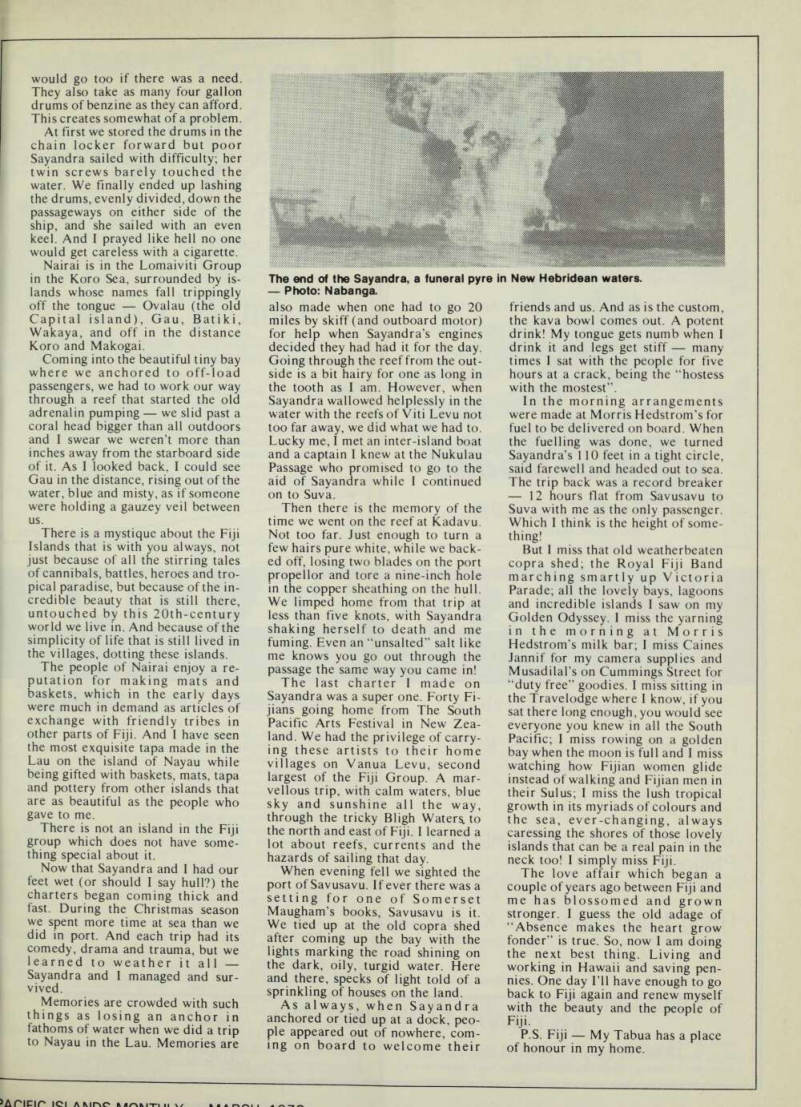
The end of the Sayandra, a funeral pyre in New Hebridean waters. -Photo: Nabanga.