A New Treasure From Unea, Papua
p. 51 · Read in the full issue
Archeology
New Guinea’S Easter Island
DR GEORGE BERGER, art historian and archeologist, writes on a priceless find of prehistoric rock sculpture made on Unea Island, north of New Britain, Papua New Guinea.
It was reported from Paris in December, 1977, that a wooden carving of a man, almost 1 m high, from Papua New Guinea’s Lake Sentani area had just been sold for more than $l4O 000.
But an even more interest ing piece recently reached Sydney, on offer as a loan ex hibit to the Art Gallery of New South Wales, i It is a prehistoric carving from a granite-like rock, and was unearthed under volcanic ashes on Unea Island, north of New Britain, when, during the war, army engineers built a light-aircraft landing strip on top of the mountain where Malangai Village is now situ ated.
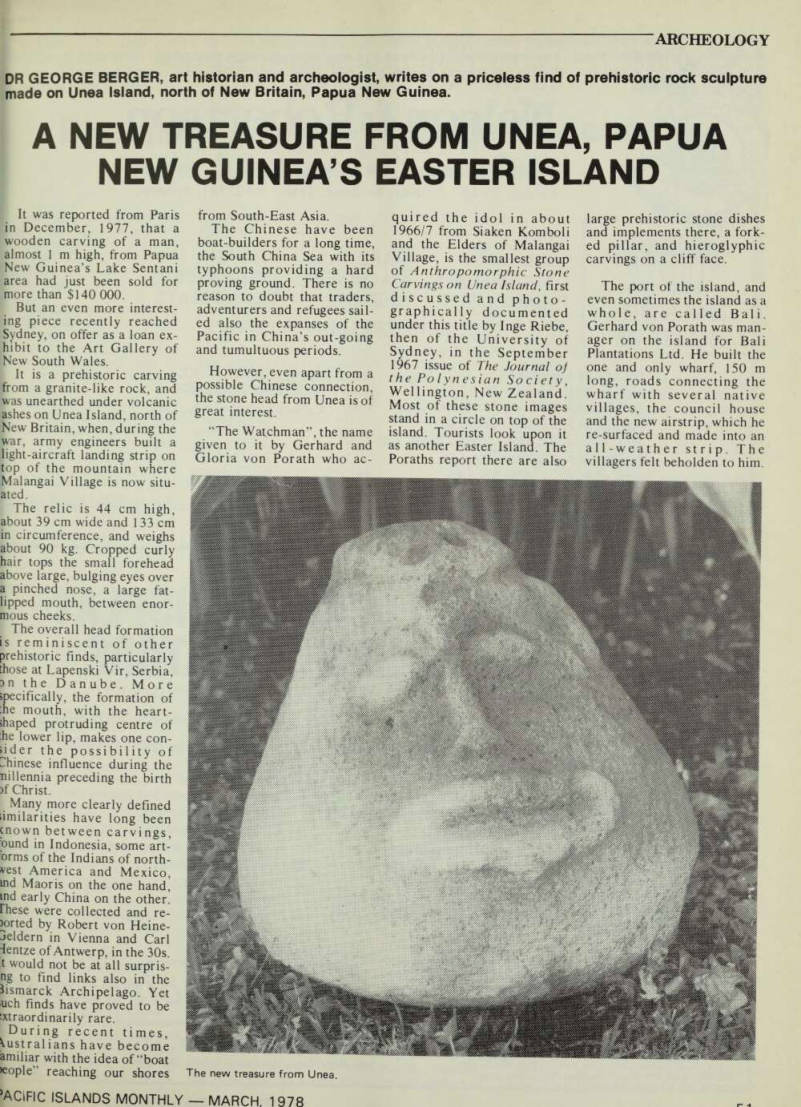
The relic is 44 cm high, about 39 cm wide and 133 cm in circumference, and weighs about 90 kg. Cropped curly hair tops the small forehead above large, bulging eyes over a pinched nose, a large fat lipped mouth, between enor mous cheeks.
The overall head formation is reminiscent of other prehistoric finds, particularly those at Lapenski Vir, Serbia, t>n the Danube. More specifically, the formation of the mouth, with the heart shaped protruding centre of :he lower lip, makes one con dder the possibility of Chinese influence during the nillennia preceding the birth )f Christ.
Many more clearly defined similarities have long been cnown between carvings, ound in Indonesia, some art brms of the Indians of north vest America and Mexico, md Maoris on the one hand, md early China on the other, fhese were collected and re ported by Robert von Heine jeldern in Vienna and Carl lentze of Antwerp, in the 30s. t would not be at all surpris ng to find links also in the Bismarck Archipelago. Yet tich finds have proved to be
extraordinarily rare.
During recent times, Australians have become amiliar with the idea of “boat £ople” reaching our shores
from South-East Asia.
The Chinese have been boat-builders for a long time, the South China Sea with its typhoons providing a hard proving ground. There is no reason to doubt that traders, adventurers and refugees sail ed also the expanses of the Pacific in China’s out-going and tumultuous periods.
However, even apart from a possible Chinese connection, the stone head from Unea is of great interest.
“The Watchman”, the name given to it by Gerhard and Gloria von Porath who ac
quired the idol in about 1966/7 from Siaken Komboli and the Elders of Malangai Village, is the smallest group of Anthropomorphic Stone Carvings on Unea Island, first discussed and photo-
graphically documented
under this title by Inge Riebe, then of the University of Sydney, in the September 1967 issue of The Journal oj the Polynesian Society, Wellington, New Zealand.
Most of these stone images stand in a circle on top of the island. Tourists look upon it as another Easter Island. The Poraths report there are also
large prehistoric stone dishes and implements there, a fork ed pillar, and hieroglyphic carvings on a cliff face, The port of the island, and even sometimes the island as a whole, are called Bali, Gerhard von Porath was man ager on the island for Bali Plantations Ltd. He built the one and only wharf, 150 m long, roads connecting the wharf with several native villages, the council house and the new airstrip, which he re-surfaced and made into an all-weather strip. The villagers felt beholden to him.
The new treasure from Unea.