Letters
pp. 8-10 · Read in the full issue
Nauruan Leaders
It is definitely true that the demands of the young blood in Nauru’s political circle have become more and more adamant. Twice, they have won political elections for Parliament. But, nevertheless, they have made independent Nauru a haven for Europeans who wish to come to Nauru for work to fill their bellies with gold.
Many expatriate workers or advisers here at the moment have been spreading rumours that because the young leaders are very young and un qualified, they are more or less insensitive to their ex patriate advisers' distasteful advice on many important policy matters.
What I think of the present young Nauruan leaders is that they are in the same boat as their expatriate advisers.
They are really out not to let Nauru progress as was the case with the former Presi dent. They are going to run Nauru for their own bellies and other kinds of luxuries for their families. This may sound absurd to many people from outside, but the truth remains as evidence. Before these young leaders had abruptly cut short the reign of Mr Deßoburt, they really had nothing planned or forecast in case Mr Deßoburt stepped down, as is the case with regard to the political plat forms of every political party in the world. (Once a party is campaigning for leadership, it must have a political platform to enable the people to decide whether such platforms are good for the country or not.) I believe these young Nauruan leaders, though well educated, have lacked this most important ingredient in the creation of a stable politi cal party. Instead, they had a political excuse about the former government, that some of its ministers were not good and should be sacked.
They have only paid lip service to their families, friends and many other Nauruans to have Mr Deßoburt thrown out of
government. Most, if not all of them, are not the true sons of Nauru. (In fact, they are il legitimate sons of Nauru.) They'have not seen and wit nessed how Nauru painfully struggled to survive the col onial era and achieve its most dear independence. They have not seen and felt how our former leaders during the many round-table negotia tions with the Australian Government for indepen dence, left their sick wives and children, to attend these many meetings on behalf of the Nauruan people. They have never seen or felt how our former leaders have made sacrifices with their families for the Nauruans to be Nauruans in the real sense.
These young leaders are Nauruans, but to what extent?
These are sad days for me to remember. And I would hate to become the immoral sup porter of a new government which is out to fill its belly with Nauruan monies and of ficial cars which can be used by their families for personal convenience and occupy posi tions of power.
I would appeal to those true Nauruans who wish to see their cultures preserved and, perhaps most important, their land properties which the pre sent government is looking at for nationalisation.
True Nauruan
Nauru.
Help Wanted
I am writing to ask the as sistance of any of your readers who may remember three authors of short stories and novels with Papuan settings; Beatrice Grimshaw, Gilbert Munro Turnbull, and Alys Brown. This is in connection with my thesis concerning Australian fiction about Papua and the Mandated Ter ritory of New Guinea between the wars.
Beatrice Grimshaw lived in Papua for 27 years and then in Bathurst, NSW. She was a close friend of the Lieutenant- Governor, Sir Hubert Mur ray, and wrote over 30 novels with South Seas settings, as well as tourist literature and reportage.
Turnbull wrote a number of stories with Papuan settings for the Bulletin in the 20s and 30s, as well as several novels.
He retired from the Papuan civil service to live at Wollombi near Armidale and died there in 1938. I have
very little biographical infor mation about him.
Lou Brown was a resident magistrate in Papua, and his wife Alys, in addition to being a doctor, wrote short stories with Papuan settings for the Bulletin in the 1920 s and early 19305. The last I know of the two of them is when they came to live in Manly in 1929.
I would be pleased to cor respond, and if possible to visit, with anyone who has in formation concerning these authors. I may be contacted c/o the English Dept, Univer sity of Queensland, St Lucia, Queensland 4067 Australia.
Susan Gardner
Brisbane, Q.
Dr Fox
The Church of Melanesia is hoping to produce a book in honour of the Reverend Dr Charles Fox of the Melane sian Brotherhood who died on October 28 last year at the age of 99. As he served in Melanesia for over 70 years, there must be many people who have memories of him and of what he said and did.
He was also a great letter writer, and it would be in teresting for many people to be able to read what he him self wrote.
The Archbishop of Melanesia has asked me to try to contact as many people as possible who have letters or other papers from Dr Fox in order that copies of these may be collected in one place, and then used in the preparation of a book about him. If people are willing to give the letters to the Church, they will be kept safely at provincial head quarters in Honiara.
However, if they want to keep the letters, photo-copies of them can be sent to us instead.
Or, if people would like us to make photo-copies of the let ters and then return the originals to them, this could be done in Honiara.
We hope many people will co-operate with us in making it possible to produce an in teresting book in honour of this great man. If you are sending letters, please let us know whether the Church can keep them or whether you want the letter sent back after photo-copies have been made.
We hope most people who have letters will be willing to give them to the Church to be kept together in safety, so that
they do not get lost or de
stroyed.
Any persons who have memories of things Dr Fox said or did and who would be willing to pass these on to us, should write them down or re cord them on a cassette tape and send them to us as soon as possible, so that the book can be prepared before too long.
The address to send them to is; Dr Fox Memorial Book, c/o Rev Brian Macdonald- Milne, Church of Melanesia, PO Box 19, Honiara, Solomon Islands.
We hope this book will be an inspiration and encourage ment to those whom God will call to follow up the many works which Brother Charles carried out in his long and fruitful life.
(Rev) Brian
Macdonald-Milne
Solomon Islands
Yachties
As a long-time resident ol the Solomons 1 have been in terested to read the extensive correspondence arising frorr the decision of the Solomon!
Government to impose a $ IOC levy on “yachties” visiting thii country. It is possible tha some of your correspondent: have misjudged the situatioi here, because of the unfor tunate experiences they hav< had and the difficulties the; have encountered.
I was surprised to read tha some of them thought th( Solomon Islanders racist o naive, or both. That is not m experience, after spending third of my life here.
I believe that a great deal o the recent legislation and th rules and regulations accom panying it is to prove a poin that our Solomon Islam legislators and civil servant are in control.
Maybe, some of the legisla tion is an over-reaction to to much foreign influence am control in the past, but it i understandable that when country is approaching indt pendence it wants to show tha it means business. Anythin] therefore, which might sugge the continuance of foreign ir fluence and control has bee under scrutiny, to discove whether this represents a fori of hidden exploitation or no This does not, however, i dicate a racist attituc towards those who come fro overseas to work for the is digenous government and ii digenous churches here
most cases, we are warmly ac cepted if we show that we can identify ourselves with the legitimate aims of the Solomon Island people.
This may explain the ap parent contradiction between legislation which some call discriminatory and the general harmony between racial groups here. It could also explain how “yachties”, while appearing to be dis criminated against, have often experienced a warm welcome from individual Solomon Islanders.
The same is true in other fields. Foreign investment is welcomed, but under strict conditions which make it ob viously beneficial to the Solomons; tourists are re ceived, but only in such a way and in such numbers as will not unduly disrupt the values and way of life of the people; researchers are allowed to op erate, but only if their re searches will be of some use to the people of the Solomon Is lands. There has been some suspicion of groups coming to settle here from overseas, in cluding Chinese, Gilbertese and people of European race, because it has not been clear to most Solomon Islanders how far these people really identify themselves with the Solomons and wish to help in its development. One hopes that after independence, it will become clear who are the people who really want to belong, and that the doubts in some people’s minds will be overcome.
Unfortunately, there is still a widely-held conviction that most foreigners are rich, and that some of them are out to exploit the Islanders for their own selfish purposes. In a few zases, these suspicions may be justified, but it is sometimes hard for academic researchers who are suspected of getting rich on the books and records hey produce! However, if hese people do make a profit, t is surely not unreasonable hat this be shared with the )eople who have assisted the researcher. It is not naive of ocal people to ask: “What is there in this for us?”
The attitude of Solomon slanders to those from out side appears to depend very nuch on how the outsiders sehaye towards them. If certain people and racial groups are in disfavour at the moment, this may be largely because of the way they are suspected of having taken ad
vantage of Solomon Islanders in the past.
My experience here is that people are normally judged on their individual merits, and not condemned because of their racial and national origins. It would be a tragedy if the Solomons got a false im age abroad of being “racist” or if actions taken by govern ment ministries were suspected of being largely a result of advice preferred by disgruntled expatriate ad visers! Criticisms from out side are unlikely to be heeded unless the critics show more understanding of why Solomon Islanders today think and act as they do.
(Rev) Brian
Macdonald-Milne
Honiara.
Devaluation
I am surprised there has been no mention of the effects in the New Hebrides of the Australian Government’s devaluation of their dollar.
They have been expensive for users of dollars.
I was in the New Hebrides in August, shortly after the of ficial rate had been declared to be $l.OO AUS = 85 FNH.
The effect was that all goods started costing 15% more in dollars, whatever their origin, instead of imports from Australia being sold for 15% less in francs.
On New Year’s Eve I was informed that the difference is now 20%, and still the dollar is falling. But if Australian ex porters think that this should give them a competitive edge in the New Hebrides, let them go there and find out how it doesn’t.
John Allan
Spring Hill, Brisbane.
Such Is Fame
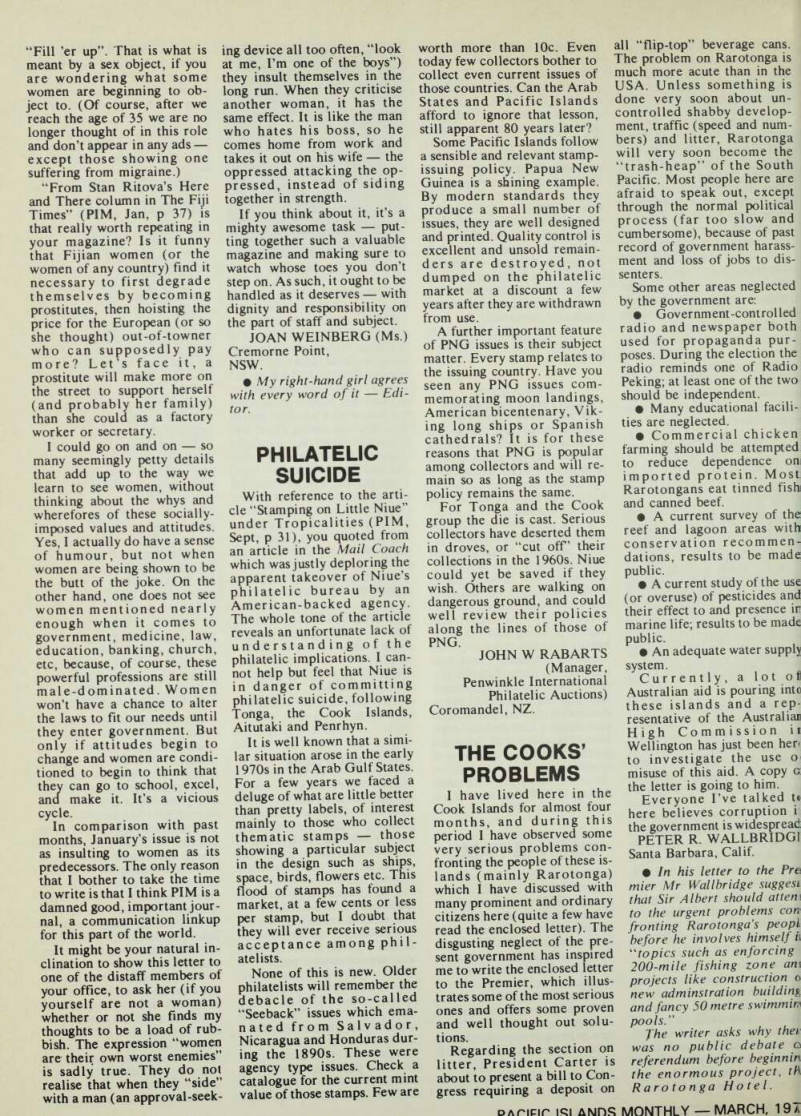
“Such is fame,” I said to myself when I read in the January PIM (p 24) that a pri celess human skull, which the people of New Georgia had given to “a Dr W. L. Allar dyce early in the 20th cen tury”, had been returned to the Solomon Islands.
The gentleman by the name of Allardyce was no less a per son than his Britannic Majes ty's principal representative in the South Seas from July, 1901, to September, 1902, being acting High Com missioner for the Western
Pacific as well as acting Governor of Fiji.
He was not a doctor, but he did end his days as Sir William Allardyce. He was born in Scotland in 1861; went to Fiji as a clerk at the age of 18, and gradually worked his way up through the ranks to Colonial Secre tary. He was acting chief ex ecutive between the governor ships of Sir George O’Brien and Sir Henry Jackson.
On leaving Fiji in 1904, he was appointed Governor of the Falkland Islands. I believe he later served as Governor in various parts of the West Indies. His death oc curred in 1930.
There is a biography of him, together with a photograph, on p 204 of the Cyclopedia of Fiji (Sydney, 1907). Philip A.
Snow’s A Bibliography of Fiji, Tonga and Rotuma lists a number of articles on Fiji that Allardyce contributed to learned journals.
Robert Langdon
Canberra.
Sexism
I have been an avid reader of your magazine for some time now. I enjoy reading its grab bag of juicy tidbits, shak ing my head in recognition at some of the human, humorous characteristics you so lovingly portray in PIM.
One of the things that has irked me and which I find necessary to remark on is your
continual, condescending
attitude towards the women who appear in your pages; this is not deliberate, I am sure, but nevertheless present, I speak especially to some items, eg, “ ... The job is effectively performed by a stout matron or two. One would expect that there would be hair-pulling, scratching and biting when tempers are lost on the field.” (“One”
who, one man? Who expects?) (PNG girls’ gusto for Rugby League, pp 23-4 Jan.) In this instance it happens that a por tion of those girls (some of whom are over the age of 18) “qualify” as women. Would you consider, when speaking of a men’s team, to call them “boys”?
They are University of Papua New Guinea students who are a part of the women’s movement. (They have found that members relate to each other on a better basis when they are involved in a group activity like sport.) How ironic that you should ascribe such se x-stere o t y p e d behaviour as the above “hair pulling, scratching and bit ing” to a group of strong, serious, intelligent women, as if to say that this is what all women are like when on the court, field, etc, compared to men who never exhibit such behaviour!
This makes for a low stan dard of journalism, quite the opposite effect from that which you are hoping for, I am sure. And as far as your cover is concerned; I under stand that your audience is not quite that of the National Geographic nor do you aspire to same. Therefore, it’s taken for granted, perhaps even un consciously, that a pretty girl enhances your cover, appeals to readers, maybe sells more copies. (“Beauty is the pro mise of happiness.” Marcel Proust.) At least you haven’t gotten to the point where a different female “graces” each month’s cover, a la Playboy.
Do you know what sexism means (aside from what the media have told us to believe)? It can best be de scribed as prejudice and dis crimination against people on the grounds of their sex. In our society this usually refers to prejudice against women.
So why do “Men who under stand the water best often choose Yamaha first”? This excludes women and in fluences people in thinking women incapable of making decisions, boating, spending money on major purchases. It is a linguistic form of sexism, aided by a picture of a woman even though women are not mentioned in the ad. Is Yamaha selling motors or sex? Same for Forrestair if the product is a quality one, why bother with a picture of a woman (who has nothing to do with the aircraft) unless she is to accompany the “sub liminally seductive” slogan,
Dr W. L. Allardyce
“Fill ’er up”. That is what is meant by a sex object, if you are wondering what some women are beginning to ob ect to. (Of course, after we reach the age of 35 we are no longer thought of in this role and don’t appear in any ads except those showing one suffering from migraine.) “From Stan Ritova’s Here and There column in The Fiji Times” (PIM, Jan, p 37) is that really worth repeating in your magazine? Is it funny that Fijian women (or the women of any country) find it necessary to first degrade themselves by becoming prostitutes, then hoisting the price for the European (or so she thought) out-of-towner who can supposedly pay more? Let’s face it, a prostitute will make more on the street to support herself (and probably her family) than she could as a factory worker or secretary.
I could go on and on so many seemingly petty details that add up to the way we learn to see women, without thinking about the whys and wherefores of these socially imposed values and attitudes.
Yes, I actually do have a sense of humour, but not when women are being shown to be the butt of the joke. On the other hand, one does not see women mentioned nearly enough when it comes to government, medicine, law, education, banking, church, etc, because, of course, these powerful professions are still male-dominated. Women won’t have a chance to alter the laws to fit our needs until they enter government. But only if attitudes begin to change and women are condi tioned to begin to think that they can go to school, excel, and make it. It’s a vicious cycle.
In comparison with past months, January’s issue is not as insulting to women as its predecessors. The only reason that 1 bother to take the time to write is that I think PIM is a damned good, important jour nal, a communication linkup for this part of the world.
It might be your natural in clination to show this letter to one of the distaff members of your office, to ask her (if you yourself are not a woman) whether or not she finds my thoughts to be a load of rub bish. The expression “women are their own worst enemies” is sadly true. They do not realise that when they “side” with a man (an approval-seek
ing device all too often, “look at me, I’m one of the boys’’) they insult themselves in the long run. When they criticise another woman, it has the same effect. It is like the man who hates his boss, so he comes home from work and takes it out on his wife the oppressed attacking the op pressed, instead of siding together in strength.
If you think about it, it’s a mighty awesome task put ting together such a valuable magazine and making sure to watch whose toes you don’t step on. As such, it ought to be handled as it deserves with dignity and responsibility on the part of staff and subject.
Joan Weinberg (Ms.)
Cremorne Point,
Nsw.
• My right-hand girl agrees with every word of it Edi tor.
Philatelic
Suicide
With reference to the arti cle “Stamping on Little Niue” under Tropicalities (PIM, Sept, p 31), you quoted from an article in the Mail Coach which was justly deploring the apparent takeover of Niue’s philatelic bureau by an American-backed agency.
The whole tone of the article reveals an unfortunate lack of understanding of the
philatelic implications. I can
not help but feel that Niue is in danger of committing philatelic suicide, following Tonga, the Cook Islands, Aitutaki and Penrhyn.
It is well known that a simi lar situation arose in the early 1970 s in the Arab Gulf States.
For a few years we faced a deluge of what are little better than pretty labels, of interest mainly to those who collect thematic stamps those showing a particular subject in the design such as ships, space, birds, flowers etc. This flood of stamps has found a market, at a few cents or less per stamp, but I doubt that they will ever receive serious acceptance among phil atelists.
None of this is new. Older philatelists will remember the debacle of the so-called “Seeback” issues which ema nated from Salvador, Nicaragua and Honduras dur ing the 1890 s. These were agency type issues. Check a catalogue for the current mint value of those stamps. Few are
worth more than 10c. Even today few collectors bother to collect even current issues of those countries. Can the Arab States and Pacific Islands afford to ignore that lesson, still apparent 80 years later?
Some Pacific Islands follow a sensible and relevant stamp issuing policy. Papua New Guinea is a shining example.
By modern standards they produce a small number of issues, they are well designed and printed. Quality control is excellent and unsold remain ders are destroyed, not dumped on the philatelic market at a discount a few years after they are withdrawn from use.
A further important feature of PNG issues is their subject matter. Every stamp relates to the issuing country. Have you seen any PNG issues com memorating moon landings, American bicentenary, Vik ing long ships or Spanish cathedrals? It is for these reasons that PNG is popular among collectors and will re main so as long as the stamp policy remains the same.
For Tonga and the Cook group the die is cast. Serious collectors have deserted them in droves, or “cut off’ their collections in the 19605. Niue could yet be saved if they wish. Others are walking on dangerous ground, and could well review their policies along the lines of those of
Png.
John W Rabarts
(Manager, Penwinkle International Philatelic Auctions) Coromandel, NZ.
The Cooks’
Problems
I have lived here in the Cook Islands for almost four months, and during this period I have observed some very serious problems con fronting the people of these is lands (mainly Rarotonga) which I have discussed with many prominent and ordinary citizens here (quite a few have read the enclosed letter). The disgusting neglect of the pre sent government has inspired me to write the enclosed letter to the Premier, which illus trates some of the most serious ones and offers some proven and well thought out solu tions.
Regarding the section on litter, President Carter is about to present a bill to Con gress requiring a deposit on
all “flip-top” beverage cans.
The problem on Rarotonga is much more acute than in the USA. Unless something is done very soon about un controlled shabby develop ment, traffic (speed and num bers) and litter, Rarotonga will very soon become the “trash-heap” of the South Pacific. Most people here are afraid to speak out, except through the normal political process (far too slow and cumbersome), because of past record of government harass ment and loss of jobs to dis senters.
Some other areas neglected by the government are: • Government-controlled radio and newspaper both used for propaganda pur poses. During the election the radio reminds one of Radio Peking; at least one of the two should be independent. • Many educational facili ties are neglected. • Commercial chicken farming should be attempted to reduce dependence om
imported protein. Most:
Rarotongans eat tinned fishi and canned beef. • A current survey of the reef and lagoon areas with conservation recommen dations, results to be made public. • A current study of the use (or overuse) of pesticides and their effect to and presence in marine life; results to be made
public.
• An adequate water supply system.
Currently, a lot oi Australian aid is pouring into these islands and a rep resentative of the Australian High Commission ii Wellington has just been her< to investigate the use o misuse of this aid. A copy a the letter is going to him.
Everyone I’ve talked u here believes corruption i the government is widespread
Peter R. Wallbridgi
Santa Barbara, Calif. • In his letter to the Pre mier Mr Wall bridge suggest that Sir Albert should attem to the urgent problems cor? fronting Rarotonga's peopi before he involves himself i\ “topics such as enforcing 200-mile fishing zone am projects like construction o new adminstration building and fancy 50 metre swimmim pools.”
Jhe writer asks why they was no public debate o referendum before beginnin the enormous project, t A Rarotonga Hotel.