met her end..and some new light on what happened immediately after
pp. 51-54 · Read in the full issue
A brand-new version of how Seeadler met her end..and some new light on what happened immediately after
Writing in the magazine The American Neptune , ROBERT L CLIFFORD has advanced 11radlc theory of the end of Count Felix von Luckner s commerce-raiding vessel, Seeadler, which was In tha latter stages of World War I. Together with substantial extracts from his article, PIM offers a companion piece by DR W. G. COPPELL, which, based mainly on research in the archives at Rarotonga, Cook Islands, describes certain of von Luckner’s exploits immediately following the loss of Seeadler.
Disaster at sea sometimes takes completely unexpected and frustrating forms. Such was the case of the end of the German armed raider Seeadler in the South Pacific in 1917, after her sea-raiding voyage halfway around the globe during World War I.
The nature of the disaster to Seeadler was an acute embarrassment to her skipper, Lieutenant Commander Felix Count von Luckner of the Imperial German Navy. He had successfully sailed 30 000 miles across the Atlantic and Pacific Oceans, eluding countless Allied warships which were searching for him, only to lose his ship in a totally preventive mishap in the South Seas.
To Luckner, a proud nobleman and a veteran of seven years in sailing ships, the undue loss of the ship was a blow which he could not coun-
tenance. The commander or dered his officers and men to eternal secrecy on the real cause of the ship’s loss and a “cover plan” was agreed to explain it. Such is the hold of the discipline in the German services that the true story never publicly emerged dur ing the Count’s lifetime. He died in 1968 in his 87th year, still the hero of one of World War I’s great adventure stories, The story of Seeadler’s commerce-raiding cruise in the latter part of World War I became well known to millions of people around the world during the 1920 s and 19305. Luckner travelled con tinuously, lecturing to groups young and old about the ad venturous cruise of Seeadler, her capture of 14 Allied ships and his humane treatment of the prisoners taken. His memoirs were adapted in
1927 by Lowell Thomas in a best seller, Count Luckner: The Sea Devil. His story was revived in 1969 in Edwin P.
Hoyt’s Knight of the Sea. (The author then describes the depredations of Seeadler on the shipping lanes between South America and West Africa.) During the two-month period from January 9 to March 11, 1917, II ships were intercepted, their crews taken on board the raider and their ships scuttled. By mid- March the British Navy was fully aware that a German commerce raider was operating in the South Atlantic and warships were ordered to intercept the phantom raider, Hundreds of vessels delayed venturing out of port and the rates of marine insurance
skyrocketed.
Despite the Allied search efforts, Seeadler remained an
elusive mystery ship for many months to come. The Illus trated London News on April 26 displayed a centrefold sketch of the raider with a caption headlined “An Armed Sailing-Ship Used as a Ger man Raider: Ready to Sink the Victims She Has Attracted by False ‘S.O.S.’ Wireless Sig nals of Distress”. The caption went on to explain that ships coming to rescue find “a sail ing ship hove to, flying Nor wegian colours and distress signals . .. The unsuspecting rescue ships are caught by the raider’s hidden guns and are sunk one by one ... This de spicable trick violates the most cherished principles of chivalry at sea . . . Even a
Barbary pirate might have
shrunk from the act here illus trated.”
Actually in mid-March Luckner had made the deci sion to quit the Atlantic for
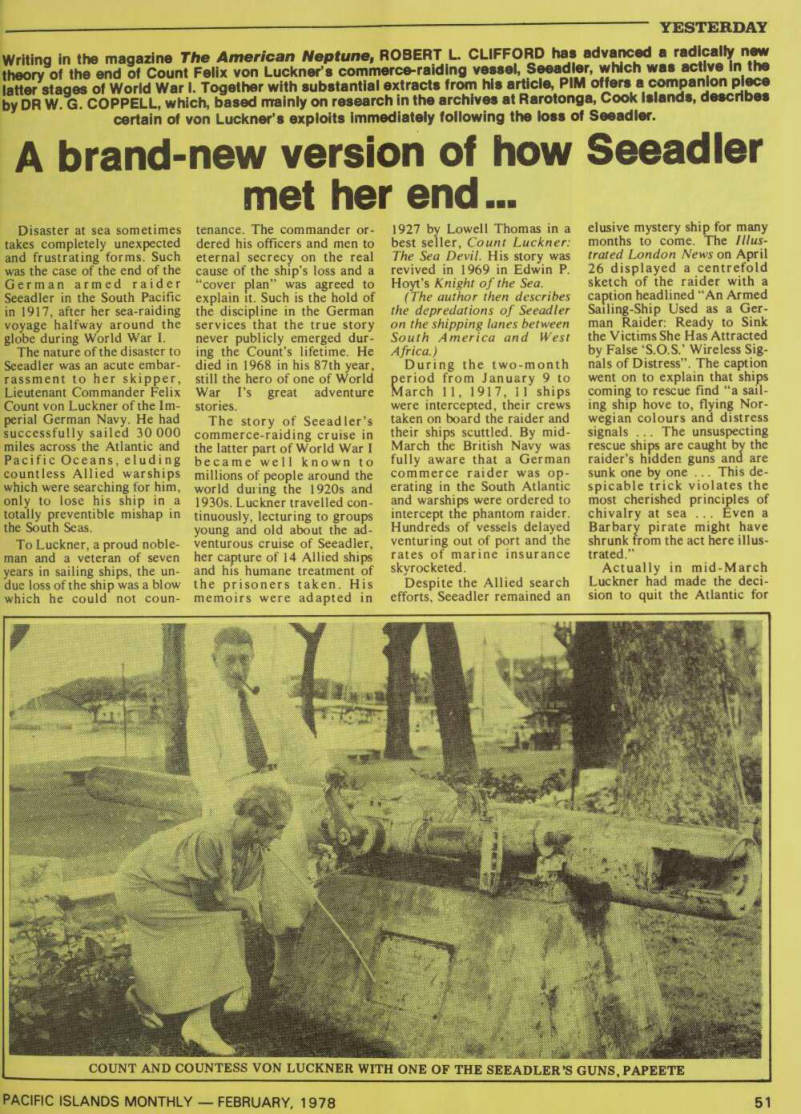
COUNT AND COUNTESS VON LUCKNER WITH ONE OF THE SEEADLER’S GUNS, PAPEETE
the Pacific. On March 21 he loaded his 264 prisoners aboard the captured French bark Cambronne and ordered her to sail for Rio de Janeiro and land the Allied prisoners there. The prisoners re portedly had appreciated their good care aboard Seeadler but enjoyed their release even more.
On April 18, Luckner rounded Cape Horn. He sighted the British auxiliary cruiser Otranto waiting for him but eluded her by turning into a storm. As there were three other British cruisers hunting for him in the East Pacific, he sailed northwest for the mid-Pacific. He also avoided the West Coast of the Americas because he had heard on his wireless about the entry of the United States into the war on April 6.
Seeadler reached the waters near Christmas Island along the Equator early in June and made them her next cruising ground.
Seeadler encountered three American schooners in the course of the next month: A.
B. Johnson, R. C. Slade and Manila. The accounts of the American crew members from these ships will provide the major portion of the story that follows.
Captain Andrew B.
Petersen of Johnson described Seeadler’s interception of his schooner, which was carrying a cargo of lumber from Ray mond, Washington, to Newcastle, Australia. “On June 14 about 4 pm a vessel was first sighted steering a southeast course. The rapidity of the stranger’s approach clearly indicated that it did not depend entirely on its sails as motive power but that it must have an auxiliary engine.
At about 5 pm the first shell was fired and exploded about 12 feet from the side of the Johnson, wetting the man at the wheel.
“As the attacking vessel came closer the flag it was fly ing was made out to be the German war flag. Someone on her deck sang out ‘Lower sails and boats ready to leave.’ This order was obeyed, the Johnson making no attempt to escape. An officer and 10 men armed with rifles and revolvers came alongside in an unarmed launch and boarded the schooner. All the ship’s papers were em meaiately asked for and con-
fiscated. The crew were given a half hour to gather up their personal effects before pro ceeding to the raider. Here they were quartered in the be tween deck forward, each man being given a hammock and two blankets. The German party remained on board the Johnson and removed all the provisions and stores to their own ship.”
The following day the Ger mans attempted to scuttle the 529-ton schooner by blowing up her masts but failed as the deck cargo interfered. They then fired 38 shells with little effect, succeeding only in waterlogging the schooner, after which they set fire to her.
Then they sailed away leaving the deck cargo of lumber burning.
On June 17 the schooner R.
C. Slade was sighted and overtaken. She was flying the American flag and the raider was flying the German flag at the time. Slade made no re sistance but nine shots were fired at her before she could be hove to. Seaman Robert Batty of Johnson, then a firisoner on board Seeadler, ater stated that the Germans had decided to sink the vessel when first sighted even before her nationality could be ascertained. In any event, the Germans put the American crew aboard the raider, removed the schooner’s stores and sank the 673-ton vessel by burning.
Captain Fred E. Southard of Manila reported that on July 8 “a full rigged ship ap proached on the horizon off nis port quarter and quickly came up on his vessel. The first warning of anything unusual about the stranger was the firing of a shell followed by four others in quick succession. The at tacking vessel was a three masted, square-rigged ship
with double top gallant yards and royals and a black hull, flying the German naval flag, and showing no guns until the ports in the railings were opened. The Manila hoisted the American flag when the first shell was fired and made no attempt to escape.”
As usual a German party came aboard, ordered the crew to pack their effects and go on board Seeadler. “They removed everything movable and capable of being carried away.” The 731-ton ship was
sunk by exploding bombs
placed fore and aft.
There were now 29 mem bers of crews of the American vessels prisoners on the raider. The captives reported that the food was at all times sufficient and of fair quality.
The Americans were permit ted to move freely about the ship and at all hours had ac cess to the open deck. At no time on board ship did the Germans treat the prisoners with harshness.
On July 31, Mopelia Island in the French Society Islands was reached, about 300 miles northwest of Tahiti. Seeadler anchored off the atoll’s entrance. The Germans went ashore to relax and to collect water and food. They soon found abundant supplies of turtle, lobster, fish, pigs and coconuts on which they feasted as a welcome change in their diet.
While preoccupied with their shore activies, the Ger mans ran a line from the anchored Seeadler to the reef and swung the vessel parallel to the reef, leaving only an anchor to seaward to keep her off. Luckner had asked the American captains if it were safe to anchor close to the reef and had been assured that sailing vessels frequently did it. Captain Southard knew from past experience in the South Seas how changeable the winds and currents are around these islands, but the Americans did not feel it their duty to so advise their Ger man enemies.
On the morning of August 2, disaster struck. The easterly trade wind quietly died. Most of the Germans with the three American cap tains, were on their way ashore for a picnic, leaving one officer on board. The American sailors had been kept aboard to perform main tenance duties. The events
that followed were described 55 years later by Adolph G.
Miller, the Second Mate of Johnson: “The vessel was anchored in the lee of the island and von Luckner figured the prevail ing winds would hold the ship off the reef. It was flat calm. I was working on a stage over the side of the Seeadler with my feet in the water.
“As I was sitting there on the stage, I could see the bot tom and I realised we were moving, drifting. I told the fellow with me, That means they don’t take us back to Germany on the ship,’ and I said over and over ‘Go, Go, Go’ until we hit.
“They made the mistake of hauling up sail, which in creased the forward motion.
The anchor chain wrapped around some coral. The Ger mans did everything wrong.
When we finally hit, the keel was cut through in five places.
That was the end of the Seeadler.’’
Charles Julius, able-bodied seaman from Johnson, re counted that “the Commander and the German crew on their way ashore were recalled by Lieutenant Preiss who or dered the firing of the guns.
But the raider was doomed and all efforts to haul her off the reef proved ineffectual.
All hands were set to work removing her stores and pro visions. The Germans first salved the wines and beer, then the ammunition, rifles and machine guns. The salvage work continued for 10 days during which the captive crews were kept on board un til the water had risen so high in her hold that living aboard was no longer possible. All hands were taken ashore then and a camp laid out and tents set up.”
Understandably Luckner was dismayed by this sudden reversal of the luck which had been with him for nearly eight months. Being unwilling to be censured for his negligence in handling the ship, he called his officers into a conference at which it was decided that Seeadler’s stranding on the reef was due to a spring tide and nothing else! While the Germans clung to this story forever after, an American cabin boy had overheard the conversation. The cabin boy had never let on to his knowledge of German.
In the postwar years,
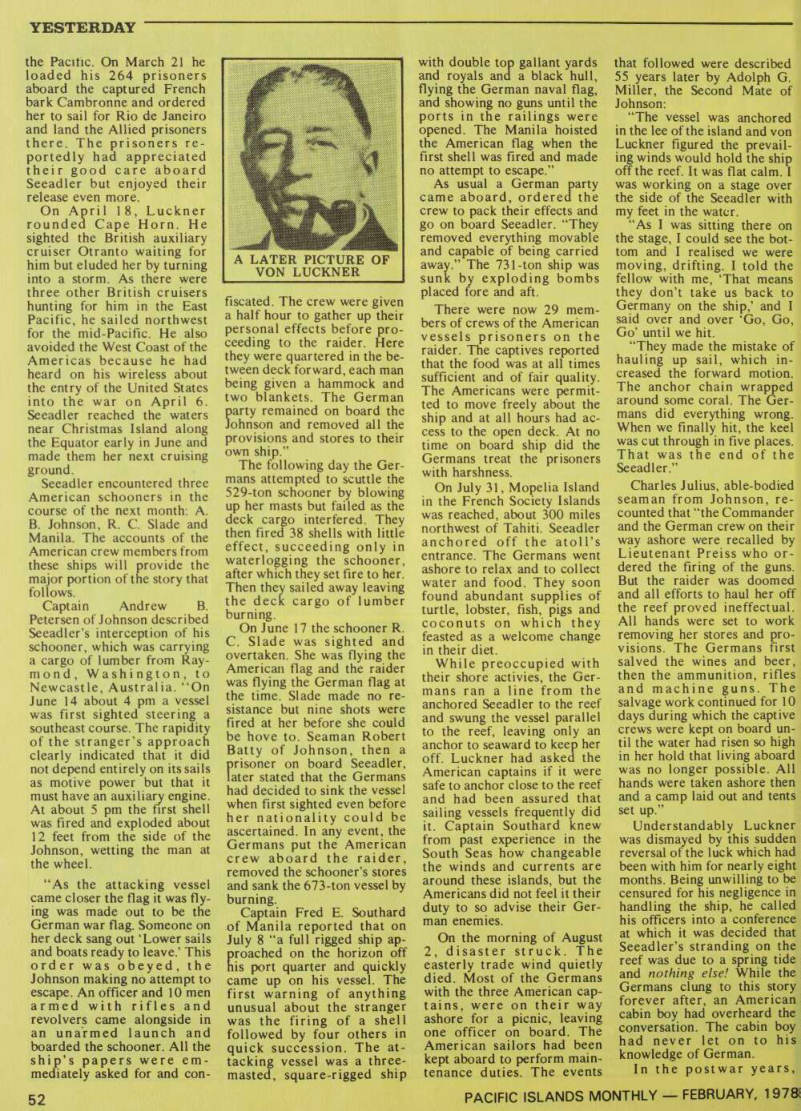
A Later Picture Of
Von Luckner
Luckner described in awesome tones the tidal wave which upended Seeadler: “At 9.30 o’clock I noticed a strange bulge to the east. Soon we recognised it as a tidal wave rushing toward us as we lay between the island and the sea. I ordered the cable cut and the motor started. But the motor did not stir despite frantic efforts to turn her over. Quickly the tidal wave was upon us, 30 to 40 feet high. The wave swung the ship on high and threw her for ward, crashing us on the coral •eef ... Our masts and rigging went over, broken like natchsticks.
“The shattering impact of he ship smashed the coral eef and pieces flew in all lirections. The Seeadler heel id over until her deck was ilmost perpendicular. Water wept over the deck swirling
pieces of coral. I clung to an iron rail and that saved me from the tons of coral being hurled around. In a moment, the wave had ebbed away, leaving us high and dry.”
Commented Captain Adolph Muller years later: “Tidal wave? That story is for the birds!” Subsequent official depositions by the other American crew members con firm Miller’s view.
The weather records for August 1917 make no mention of such a tidal wave in the So ciety group. Had there been such it would have overrun Mopelia and damaged Bora Bora, Maupiti, and Raiatea is lands as well. There is no such incident found in the official records kept in Papeete, the capital of this French colony.
On shore the Germans and the Americans had camps side by side. The wireless set was
erected so that the German could continue to listen in to news from around the Pacific.
A hospital tent Was set up but never used as the doctor was in a perpetual state of intox ication. The Americans were put to work collecting turtles and fish on what Luckner jokingly called “Germany’s last colony”.
The German treatment of the Americans and the food given to them were not as good as they had been on the raider. When Second Mate Fred J, Williams and Charles Brown of Manila slipped off in search of food on the island and found shellfish, Luckner ordered them to make daily expeditions around the coral to collect shellfish for the en tire group. When the Americans complained that the coral cut their feet very badly, the Commander
pointed to the earth saying “There is your grave.’’ The Americans continued their
daily quests.
“On August 23, Luckner, with three officers and two men, sailed off in one of Seeadler’s 32-foot launches to go in search of a vessel to take the Germans away from the is land. They sailed west with the trade winds and never returned ...” (The Americans left on Mopelia were eventually re scued as a result of an epic I 770 km voyage to American Samoa under the command of Fred Williams. Williams and his crew sailed in a 5.5 m dingly left in a damaged state by the Germans and then re paired by the Americans. Ar riving in American Samoa they quickly organised relief for the captives on Mopelia.)
R.L.Clifford
The most dramatic sejuence of events involving the ieeadler began at Mopelia Isand in French Polynesia.
Fhere the Seeadler, the brmer American, Glasgowmilt Pass of Balmaha, was vrecked on the reef on August '>1917, Von Luckner decided that le must capture another vessel so as to continue his narauding activities and the ifeboat was converted for a ong open-ocean voyage. \fter it had been loaded with mrdtack, machine guns, riles, hand grenades and )istols, and boarded by von mckner and five of his crew, here was a 14-inch freeboard.
Von Luckner planned to iverage 95 km a day, to visit he Cook Islands and Fiji and, f he was successful in capturng a ship, to be back at Vlopeha within three months.
Phe voyage took him through he Cooks to Niue, where the jerman flag was hoisted on he lifeboat, now named Cronprinzessin Cecilie. The jermans did not land there Hit were welcomed by the Niueans and given supplies of resh water and bananas, \tter landing at Katafaga Isand in the Fiji group, von
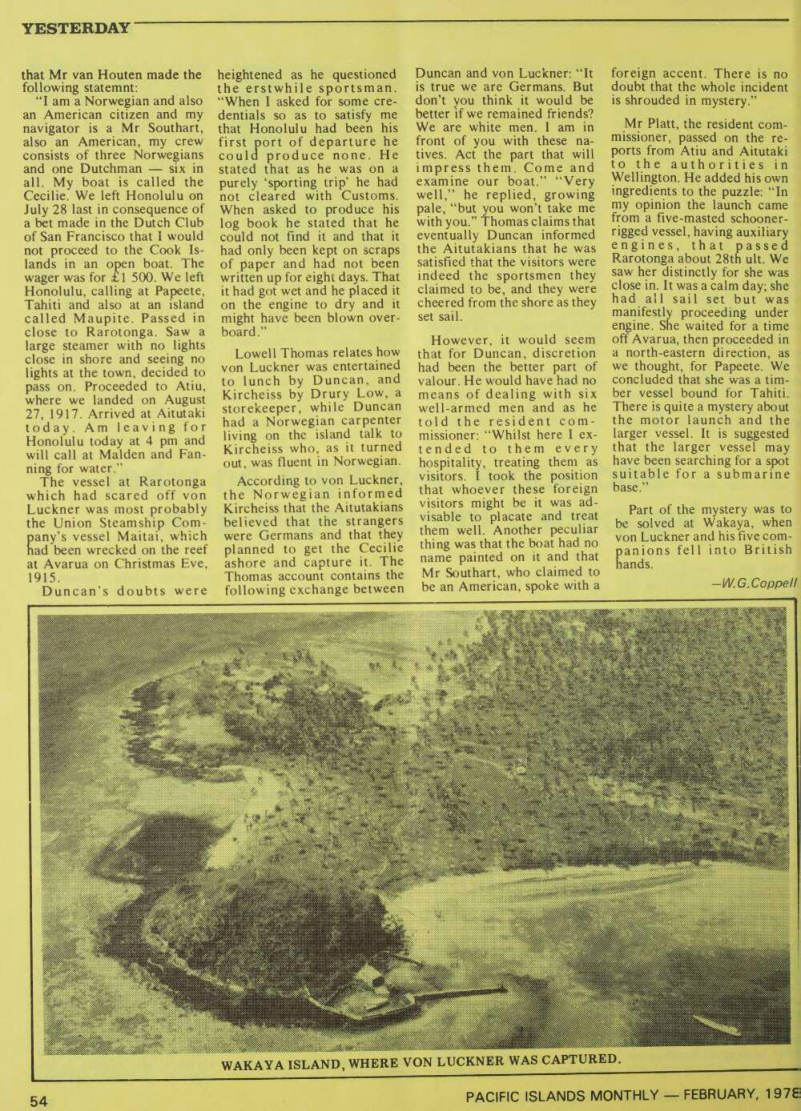
Luckner and his men were captured by the British at Wakaya.
The saga of the Count did not end there as he was later to escape from captivity on Motiuhi Island in Auckland Harbour, capture the scow Moa and reach the Kermadec Islands before being ap prehended once more, Among the files in the archives building at Rarotonga are reports on von Luckner’sjourney through the Cook Islands, which throw fresh light on that part of his escapades. The best known ac count is Lowell Thomas’, in his book Count Luckner: The Sea Devil.
Thomas tells how von Luckner called at Atiu Island and, with Lieutenant Kircheiss, “went ashore and straight to the house of the British Resident. He lay stretched out in his shirt and trousers on a Borneo long chair on his porch and didn’t even get up when we ap preached. He was a good looking fellow but lazy as the devil. The lassitude of the South Seas had certainly got him.” Kircheiss, who was more fluent in English than his captain, told the resident
agent that they were Americans of Dutch birth and that they were on a voyage from Honolulu to Tahiti by way of the Cook Islands and back to Honolulu for a wager of $25 000.
According to the German account, the resident agent gave them a certificate stating that they had called on him in the course of a sporting cruise, They were also entertained on Atiu by the French missionary priest who wined and dined them and had the Germans sing in unison to a record of “La Marseillaise”. Von Luckner and his men found that “everywhere on the island were trees and fruits, coconuts, bananas, mangoes and oranges.” They took the supplies they needed and departed for Aitutaki.
And what did the resident agent think about this bizarre visit to his isolated island? His report to the resident commissioner on Rarotonga says: “On the morning of the 27th inst., a boat put into Tarapuka harbour and picked up a native to pilot them to Taunganiu. Upon arrival here it proved to be a motor boat Cecilie, bound from Australia to Honolulu. The crew con-
sisted of six men, Captain van Houten in command. They asked for food and water, canoes were launched, captain and chief officer came ashore, after receiving provisions and water, together with a little rest, they proceeded on their
journey/’
At Aitutaki, the Germans decided to pass themselves off as Norwegians as the French man on Atiu had told them that he had a Dutch friend liv ing there. The Cecilie steered through the reef passage to the landing place at Aitutaki and its crew were relieved to see that there was no other vessel in sight. Von Luckner found that the resident agent at Aitutaki was a harder person to manage than his Atiu coun terpart had been. “He was a tall, lank fellow, who wore glasses and looked a perfect picture of President Wilson, We found this resident to be full of the same British suspi cion. Unlike his colleague at Atiu he was in no wise lost in tropical indolence, but was active and shrewd.” Thomas Duncan was filled with doubts about the credentials and in tentions of his unexpected visitors. His report to his superior in Rarotonga says
that Mr van Houten made the following statemnt: “I am a Norwegian and also an American citizen and my navigator is a Mr Southart, also an American, my crew consists of three Norwegians and one Dutchman six in all. My boat is called the Cecilie. We left Honolulu on July 28 last in consequence of a bet made in the Dutch Club of San Francisco that I would not proceed to the Cook Islands in an open boat. The wager was for £l 500. We left Honolulu, calling at Papeete, Tahiti and also at an island called Maupite. Passed in close to Rarotonga. Saw a large steamer with no lights close in shore and seeing no lights at the town, decided to pass on. Proceeded to Atiu, where we landed on August 27, 1917. Arrived at Aitutaki t o d a y. A m I e a v i n g f o r Honolulu today at 4 pm and will call at Malden and Fanning for water.”
The vessel at Rarotonga which had scared off von Luckner was most probably the Union Steamship Company’s vessel Maitai, which nad been wrecked on the reef at Avarua on Christmas Eve, 1915.
Duncan’s doubts were
heightened as he questioned the erstwhile sportsman.
“When I asked for some cre dentials so as to satisfy me that Honolulu had been his first port of departure he could produce none. He stated that as he was on a purely ‘sporting trip' he had not cleared with Customs.
When asked to produce his log book he stated that he could not find it and that it had only been kept on scraps of paper and had not been written up for eight days. That it had got wet and he placed it on the engine to dry and it might have been blown over board.” „ Lowell Thomas von Luckner was entertained J 9. '“ n 9h Jy Du .
Kircheiss by Dru y > storekeeper, * had a Norwegian carpenter hv.ng on the island talk to K.rche.ss whl ;“J' i " e n d °ut, was fluent in Norwegian.
According to von Luckner, the Norwegian informed Kircheiss that the Aitutakians believed that the strangers were Germans and that they planned to get the Cecilie ashore and capture it. The Thomas account contains the following exchange between
Duncan and von Luckner; “It is true we are Germans. But don’t you think it would be better if we remained friends?
We are white men. I am in front of you with these nalives. Act the part that will impress them. Come and examine our boat.” “Very well,” he replied, growing pale, “but you won’t take me with you.” Thomas claims that eventually Duncan informed the Aitutakians that he was satisfied that the visitors were indeed the sportsmen they claimed to be, and they were cheered from the shore as they set sa ji However, it would seem that for Duncan, discretion had been the better part of valour. He would have had no means of dealing with six well-armed men and as he told the resident commissioner; “Whilst here I extended to them every hospitality, treating them as visitors. I took the position that whoever these foreign visitors might be it was advisable to placate and treat them , Another peculiar thing was thauhe boat had no name painted on it and that Mr Southart, who claimed to be an American, spoke with a
foreign accent. There is no doubt that the whole incident is shrouded in mystery.” ,M. r Platt, the resident con rmssioner, passed on the re ports from Atiu and Aitutaki ... e authorities in Wellington. He added his own ingredients to the puzzle: “In JPV opinion the launch came from a five-masted schooner nBBe? vessel, having auxiliary engines, that passed Rarotonga about 28th ult. We saw her distinctly for she was close in It was a calm day; she had ail sail set but was manifestly proceeding under engine. She waited for a time off Avarua, then proceeded in a north-eastern direction, as we thought, for Papeete. We concluded that she was a tim ber vessel bound for Tahiti, There is quite a mystery about the motor launch and the larger vessel. It is suggested that the larger vessel may have been searching for a spot suitable for a submarine base.” f , was , . solved at Wakava when von L „ ck d ner j fell into Br i t i s h fj anc s
W.G.Coppell
WAKAYA ISLAND, WHERE VON LUCKNER WAS CAPTURED.