New Testament For A New Nation
p. 29 · Read in the full issue
TUVALU More than a century ago, Samoan missionaries from the London Missionary Society established the Ellice Islands Church in the country now known as Tuvalu. But it has taken until now to produce a New Testament in the Tuvaluan language. Around 97% of the people belong to the Church of Tuvalu. How they welcomed their new New Testament is told by a special correspondent.
For two days in December, Tuvaluans celebrated what was described as the biggest event in the history of the Church of Tuvalu “since the departure of the mission aries.” The occasion was the introduction of the Tuvalu language version of the com plete New Testament Ko te Feagaiga Fou i te ’gana Tuvalu and was marked by special church services, hymn-singing, feasting and dancing on all the islands of the group and among Tuvaluans in Fiji, Samoa, the Gilberts, Ocean Island and Nauru.
The Church of Tuvalu probably one of the most united and effective in the Pacific is virtually the es tablished church for the coun try, although there are active groups of Bahais, Jehovah’s Witnesses and Seventh-day Adventists. There is a large, stone-built church on every is land except Funafuti, where the church, destroyed by hurricane Bebe in 1972, is being rebuilt at a cost of more than $BO 000 and church activity dominates village life, with family prayers at dawn and dusk, strict observance of the Sabbath, high standards of sexual morality and bible sto ries as the basis of traditional
dancing.
Protestant by tradition, and modelled on the old Con gregational Church of Eng land, the Church of Tuvalu, formerly the Ellice Islands Church, was established by Samoan pastors of the London
Missionary Society. The of
ficial date is 1865, but the first preacher, Elikana, actually landed on Nukulaelae, quite by chance, in 1861, having drifted 2 110 km from Manahiki in the Cooks. The last missionary pastor left in 1968 and the church became independent of London, run ning its own affairs through its pastors, deacons, women’s committees and boys’ and girls’ brigades.
With such close religious ties to Samoa, and with a simi lar language and culture, it was natural that the version of the Bible generally used should be O le Tusi Paia, the well-loved Samoan version.
Indeed, for some decades there was a feeling in Tuvalu that Samoan was the only proper language for religious expression. However, once the church became autonomous, and with the aid of the Bible Society in the South Pacific, translation work on the New Testament began.
The Gospel of Mark was published in 1969, followed by Luke in 1972 and the Epis tle to the Romans in 1973, all undertaken by the Rev Alovaka Maui with a team of consultants. After separation from the Gilberts in 1975, there was a growing desire to have a Tuvaluan version of the whole Bible and the work was stepped up, with the Rev Laumua Kore joining the team, and the Tuvalu Language Board advising on the written language.
The New Testament was completed by the end of 1976, when the Bible Society in the South Pacific took on the task of actual publication of what would be the first complete book published in the Tuvalu language. John Chalkley, a teacher at Motofoua School the secondary school on Vaitupu jointly maintained by church and government
was asked to design a cover; it is a picture of Christ walking on the water and surrounded by eight stars, for the eight is lands of Tuvalu. The cover proclaims Ko te Tala Nei mo Aso Nei (Good news for to day.) By Sunday, December 18, all was ready for the transla tion to be launched and it was done in true Tuvaluan style, beginning with morning wor ship which on Funafuti was conducted by the Rev Founuku Tipelu, vice-chair man of the church. After hymns, bible readings and a dedication prayer by Afaese Manoa, pastor of the SDA Church, a copy of the book was presented to Com missioner Tom Layng, as patron of the Tuvalu branch of the Bible Society. Maika R.
Bovoro, executive secretary of the Bible Society of the South Pacific, spoke and was followed by Chief Minister Toalipi Lauti, and Latasi Kamuta, chairman of the Tuvalu branch of the Bible Society.
The ceremonial feast that followed the first of several during the two days— showed Tuvaluan hospitality at its most impressive, with teams of young men and women first
presenting water for hand washing, then bringing the food (which included 3 000 fish caught by the men of Funafuti the day before,) then sitting with fans while guests ate cross-legged on the mat covered floor of the maneapa (meeting house.) But the guests, including delegates from all the islands, were nearly all Tuvaluans; these feasts were not put on for the tourists or for the palangi (Europeans) but were spon taneous examples of the best Tuvaluan tradition. So it was with the usu pese (hymn-sing ing) and faatele (dance con test) which followed. They were performed by Tuvaluans for Tuvaluans as a natural ex pression of joy on this great occasion for their church and country. The next big occa sion for celebration will no doubt be Independence, plan ed for next October, but as the Chief Minister said in his ad dress, it is most appropriate for a country like Tuvalu, that it should have attained its own New Testament before it ob tains its Independence Con stitution Ko te Tala Nei a te tou Aliki ko lesu Keliso mo aso nei (The Good News about Our Lord Jesus Christ for today.)
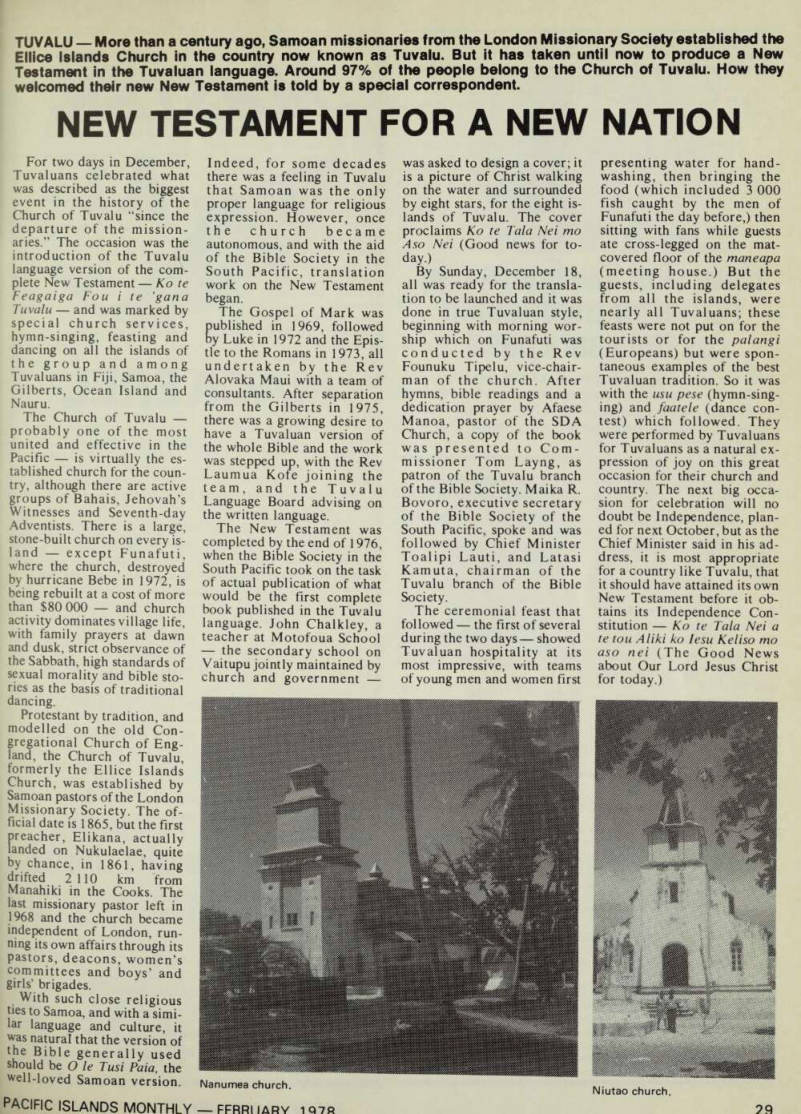
Nanumea church.
Niutao church.