Straight talk by Tongan
pp. 73-75 · Read in the full issue

trade mission to NZ
Tonga wants to reduce its trade deficit with New Zea land, mainly through better access to the NZ markets for Tongan products. This was the message passed on by Tongan Minister of Labour, Industries and Commerce, Baron Vaea, when he arrived at Auckland as the head of Tonga’s first trade mission to NZ Baron Vaea said Tonga was New Zealand’s closest neighbour. The two countries had a long and historic rela tionship. Many good New Zealanders had gone to Tonga to help the country. Many Tongans had visited New Zea land. Many had been edu cated there. There was now a substantial Tongan com munity in New Zealand.
Baron Vaea said Tonga’s trade imbalance with NZ was about five to one. Her unemployment rate was 17 times higher than New Zea land’s while per capita income was about one-seventh of that of her neighbour.
“New Zealand should help us correct such an imbalance in an economic relationship with a near and friendly neighbour”, he said.
During his visit, Baron Vaea announced that Tonga had approved an industrial development incentives poli cy, aimed 'at higher living standards and improved social welfare for the people of Tonga. The policy was de signed to attract more inves tors.
The incentives were; • Fiscal tax holidays and incentives, certain deprecia tion and accounting conces sions, customs duty exemp tions on raw materials or semi-finished products, port and service tax concessions and repatriation of funds. • Non-fiscal immigra tion assistance through an in dustrial entrepreneur visa subject to approval by the Minister of Police, promo tional assistance through the Ministry of Labour, Com merce and Industries, development finance through the new Development Bank, and land availability.
The incentives will be available to both local and foreign enterprises setting up manufacturing processing and assembly industries, or tour ism-related industries.
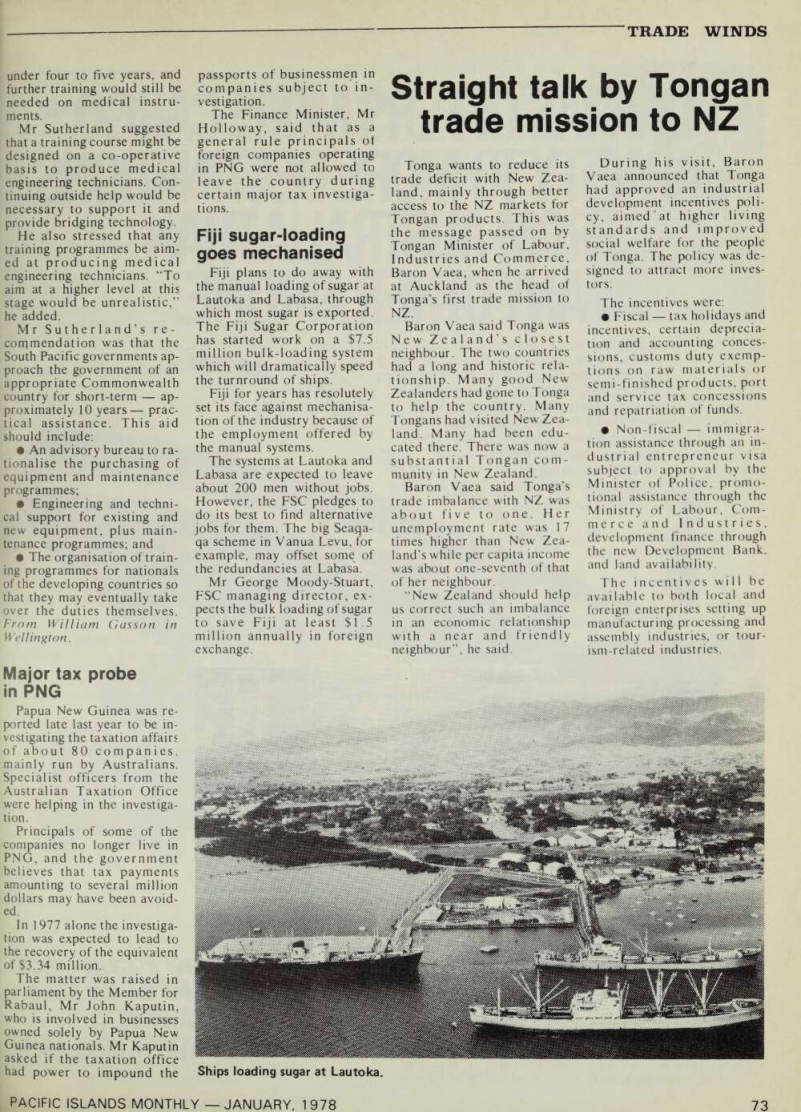
Ships loading sugar at Lautoka.
Briefly
• A new, high-value crop, cardamom, could be in troduced into the Solomons, Used as a spice, the plant re sembles wild ginger, but grows to 3 to 4 metres high. It thrives only at altitudes above 600 m and needs relatively heavy rainfall. It could prove particularly beneficial to peo ple in Solomons mountain areas who find it hard to grow cash crops. • The Asian Development Bank will finance a study by overseas consultants on the future development of all ports in Fiji, particularly Suva wharf. Aim is to help Fiji to meet increased shipping and cargo operations in the next 20 to 30 years. • The Ports Authority of Fiji earned $3 887 566 in its first full year of operation and made a profit of $1 529 477.
The Fiji Government got $750 000 of the profit, with a like amount going into general and development re serves. • The Carpenter South Seas subsidiary, W. R. Carpenter (South Pacific) Ltd, which trades in Fiji, Tonga and Samoa, recorded a net profit of $3.8 million in the last financial year. This was 9.4% down on the year before. Fiji
was the main problem area, feeling the impact of the 1974-76 economic recession. • Mr B. D. Lakshman, one time “stirrer” in Fiji trade unions, later a politician and now a businessman, is to launch a pilot project to make industrial alcohol from sugar cane juice. Power alcohol from sugar has been a subject dear to his heart for many years. He often raised the sub ject in Fiji’s old Legislative Council, but never attracted great support for his views. • Of 25 000 trainees spon sored by the Australian Government under overseas aid programmes since 1951, approximately 4 000 came from the Pacific Islands, in cluding Papua New Guinea (3 000), Fiji (450), and Western Samoa (280). • For around $2 000 million, Papua New Guinea could have a major hydro-electric scheme on the Purari River which flows into the Gulf of Papua. Consultants from Papua New Guinea, Australia and Japan have come up with this figure which would cover the cost of an initial scheme, with options for steady ex pansion. The initial phase would generate 1 800 megawatts at Wabo near the Purari headwaters in the Highlands. This would power an industrial port complex on the gulf, but the earliest com pletion date is eight to nine years away. The government
has still to study it from several angles, not the least important being the need to attract barge power-consum ing industries to the area and commit them to firm develop ment agreements, and the question whether the develop ment would be in the overall interests of the PNG people. • Mr S. K. Petelo Pua, 46, is the first Tongan appointed to a senior administrative position with Morris Hedstrom Ltd. He is now as sistant accountant of the firm’s Tongan branch, a post previously always held by a man from overseas. • The Fiji Government backed fishing enterprise, Ika Corporation, is increasing its fishing fleet to six, and ex pects to double its catch of skipjack tuna which is sup plied to Pacific Fishing Co Ltd, at Levuka. Pacific Fish ing cans the tuna for export.
Mr Robert Stone, manager of Ika Corporation and the Fiji Government's chief fish eries officer, said the fleet should supply about 3 500 tonnes of skipjack in 1978. • The Emperor Gold Min ing Co Ltd at Vatukoula, Fiji, will be on its own when it uses up a loan of $2 million from the Fiji Government about a year from now. The loan was originally intended to cover company losses for a 28month period from October, but as gold output was much lower than expected, loan support will cut out earlier.
Fiji’s Finance Minister, Mr Charles Stinson, told parlia ment that the government moved to help Emperor when the mine closed for a short period in 1977. Now, the mine’s future, and the future of Vatukoula itself, were en tirely in the hands of the Vatukoula people. • The Tobalar copra pro cessing plant in Majuro, Marshall Islands, has started crushing copra. In its first week the plant produced more than 100 tonnes of coconut oil, exceeding expectations.
The plant is capable of pro ducing $1 million worth of oil a month. But because not enough copra is available it will work for six months of the year only. The by-product, copra cake, is pelletised and exported as animal feed.